ABC’s one-sided bushfire analysis


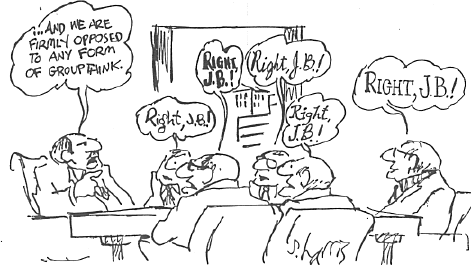
Groupthink at your ABC

Groupthink at your ABC

ABC’s 7.30 Report tonight focussed on the effect of “climate change” on bush fires.

So they invite John Connor, alarmist from the Climate Institute, who essentially agreed with Adam Bandt, alarmist from the Greens, who essentially agreed with Don Henry, alarmist from the Australian Conservation Foundation, who essentially agreed with Andy Pitman, alarmist from UNSW, who essentially agreed with Don Henry (again), who essentially agreed with John Connor (again).

The sole dissenting voice, allowed just 45 words out of the entire segment, was Climate Change Minister Greg Hunt, who managed to sneak in this:

“No-one, no-one should be politicising these bushfires and I would say that respectfully to the gentleman in question.”

Quickly rebutted of course. No sign of anybody to question the four alarmists, whose assertions were unchallenged.

And who says the ABC is infected with groupthink?
Source.

Moronic: Greens MP links NSW bush fires to climate policy


Greens see an opportunity to make cheap political points

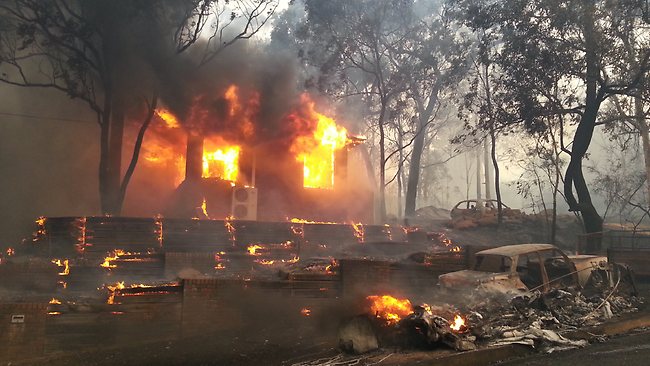
Greens see images like this as an opportunity to make cheap political points

Adam Bandt is a typical Greenie, and because he, like all the rest of them, is on an ideological crusade and possesses no brains, he is unable to understand even the basic facts about Australia’s contribution to “global warming”, which is why Bandt has claimed on social media that the Coalition’s climate policy will cause more bush fires, like those suffered by many areas yesterday.

Never mind the fact that over 100 homes may have been destroyed and many others damaged by the fires (which were intense due to a strong wind, but not at all unusual or unprecedented), Bandt was more interested in scoring cheap political points:

And being the brainless greenie he is, he continued to defend the indefensible today:

Mr Bandt said the link between extreme weather events and global warming needs to be recognised.

“Global warming is the biggest threat to Australian life,” he said.

“I don’t want every summer, let alone every spring, for us to be worrying about whether we are going to see these kind of bush fires again, to have to worry about threats to people’s property and threats to people’s safety.”

Not quite sure why Bandt finds this so difficult to comprehend, but Australia’s emissions are 1.5% of the global total. If we reduced that to zero overnight, it would make no difference at all to the climate. As it is, we are only planning to reduce by 5% by 2020, or in other words, 0.075% of global emissions, when the major emitters are doing close to nothing by comparison.

And Bandt thinks that will make a difference to bush fire frequency or intensity?

Idiotic statements like this will ensure the Greens are consigned to the sewer of Australian political history, where they rightly belong, from whence they shall be flushed out into the sea with all the other turds.

FAIL: 34 years and billions of dollars… for what?


Texas TI99 from 1979

Texas TI99 from 1979

UPDATE: Stewart, in the comments, makes an excellent point:

“There is a great analogy with the development of hydrological models in the 1960′s (because we could automate computation) – in 2013, we are still unable to simulate process accurately – it doesn’t stop us from building the models with increasing complexity which many then blindly believe however the programmer has decided to represent individual processes…

In 1979, personal computers looked like this.

In 2013, you carry around a supercomputer in your pocket (a smartphone), with the processing power of a warehouse full of TI 99s, and millions of times the 16k storage capacity.

Such is the speed of progress in computer technology. How has climate science fared by comparison?

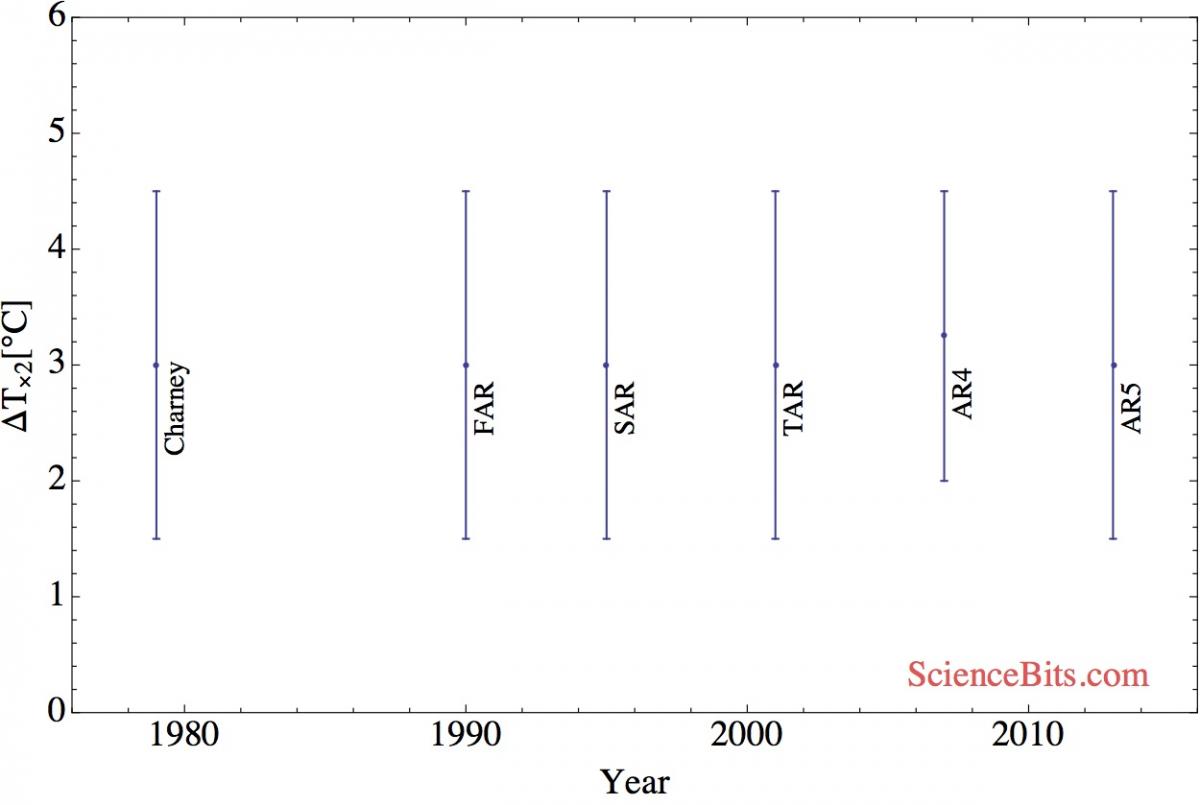
In climate, the only number that really matters is the sensitivity of the climate to a doubling of CO2. Normally, over a period of years, greater understanding, better modelling and greater computing power will reduce the margins of error as the theories become more finely tuned.

So how has the IPCC done, after 34 years and billions of taxpayer dollars? The following plot shows the range of climate sensitivity since the Charney Report of 1979, and then through the IPCC’s FAR, SAR, TAR, AR4 and AR5:

Fail.

Epic fail

As as you can see, despite a slight narrowing of the range in AR4, the precision of the sensitivity value hasn’t improved at all from 1979 to today. Not one bit. Nada. Zip. Zilch. Zero. Despite billions of dollars of taxpayers’ hard earned cash, thousands of scientists and years of research, the entire climate science community has failed to improve on the original estimate for climate sensitivity made 34 years ago.

Prof Nir Shaviv writes:

if the basic premises of a theory are wrong, then there is no improved agreement as more data is collected. In fact, it is usually the opposite that takes place, the disagreement increases. In other words, the above behavior reflects the fact that the IPCC and alike are captives of a wrong conception.

Full story here.

(h/t Lubos)

Dr Karl’s klimate krap


Krap

Drowning in krap

UPDATE: In the comments, Baldrick provides a timely reminder of Dr Karl’s activist past, in that he was a Senate candidate in 2007 for the Climate Change Coalition, which was “formed in 2007 with a view to accelerate action by politicians from all parties on global warming and climate change.” He lost, as did all the other CCC candidates…

As any fule kno, every science presenter on the ABC is a fully paid-up climate alarmist. Robyn Williams, Bernie Hobbs, the Catalyst team, Adam Spencer and of course, Dr Karl Kruszelnicki himself, all plug the same consensus line, without any proper scientific scepticism.

But because of the 16-year temperature stasis that nobody wants to acknowledge, Dr (for a doctor he is*) Karl resorts to spouting krap:

Even before this report was released, some of the news media (such as the Daily Mail in the United Kingdom) recklessly claimed that this latest IPCC report revealed that global warming was over — and that in fact, the world was now cooling. This was very wrong.

Krap. The four major temperature series, GISS, HadCRUT, UAH and RSS (take note, Dr Suzuki) all show either stasis, imperceptible warming or cooling (see image below). And whether global warming is “over” or not is irrelevant – that’s just a tabloid newpaper making a story.

The real issue is why there has been such a divergence between models and real-world temperature. Despite fudging the graph in the IPCC Summary for Policymakers to give the impression that the models are still on track, the truth is that the models have spectacularly failed to predict the current stasis in global temperatures. Climate sensitivity to CO2 has been overestimated and natural forces ignored.

For one thing, nine of the 10 hottest years on record have happened in the last decade.

True, but irrelevant. Yes, the planet is warming, and has been for a couple of centuries, so it’s no great surprise that each decade is, generally, warmer than the last. The old “on record” chestnut is wheeled out, despite the fact that records barely cover 150 years. Dispassionate? Krap!

The trouble is, the surface of our planet has many many square metres. So that extra heat reflected back down to the ground is roughly equivalent to exploding a few hundred thousand Hiroshima-sized nuclear weapons in our atmosphere — every day.

This is recycled krap. Recycled by Dr Karl, from John Cook of Un-Skeptical Pseudo-Science, who in turn recycled it from James Hansen. Despite sounding terrifying, because the Sun is so powerful and the Earth so huge, this amount of energy approximates to half a watt per square metre (your average light globe is 60 watts), which would be lost in the downwelling radiation of approximately half a kilowatt. Cheap alarmist krap.

The overwhelming majority of the heat trapped by the extra carbon dioxide in our atmosphere enters the oceans.

Since 2007, we have been monitoring the oceans with small drifting oceanic probes — ARGO probes. Today, there are some 3,600 of these robotic probes in the oceans of the world. They continuously float up and down, rising to the surface and then diving down to a depth of 2 kilometres on a roughly 10-day cycle.

These ARGO probes have measured the heating of the oceans caused by that 93.5 per cent of the heat energy reflected back down by the carbon dioxide in the atmosphere. It turns out that about two thirds remains in the upper ocean between the surface and a depth of 700 metres, while the remaining one third of that heat energy goes deeper into the ocean — between 700 and 2000 metres.

Dr Karl trots out the buzzword du jour (see yesterday), ocean heat. The dog ate my warming. They seek it here, they seek it here, they seek it everywhere. Everywhere it can’t be measured, that is.

The ARGO probes have been around less than a decade, and the changes in temperature are of the order of a few hundredths of a degree. But here’s a thought – perhaps the warming over the last twenty years was caused by the oceans releasing heat (that couldn’t be measured) into the atmosphere, and was nothing to do with CO2?

Verdict: a kolourful kornukopia of klimate krap from Dr Karl (enough with the K’s – Ed)

Read it here.

trends_2001_2014

GISS, HadCRUT4, UAH, RSS trends, 2001-2014

* Borrowed from Media Watch Dog

Rapid increase in ocean heat…?


Ocean heat?

Ocean heat?

What does this graph show? A catastrophically rapid increase in ocean heat content?

When global surface temperatures started levelling off, and then continued to plateau, it was a real blow to the alarmist cause. How could they claim that global warming was an urgent problem that needed trillions of taxpayer dollars to fix when the temperatures showed otherwise?

How could they retain their cushy roles on UN- and government-funded climate organisations, jetting round the world staying in five-star hotels at the taxpayers’ expense, whilst all the while imploring the rest of us to scale back our unsustainable and polluting lifestyles?

Here’s the alarmists’ thought process: Where’s the missing heat? Our models must be right (no doubt there), so it must be hiding somewhere. Somewhere we can’t measure it. Deep in the oceans!

And because of the much larger heat capacity of water compared to air, the differences in temperature would be of the order of hundredths of a degree.  Which is conveniently impossible to measure accurately.

Which is why ocean heat content is the buzzword du jour.

The graph above actually shows the number of times “ocean heat” appears in a Google search of Skeptical Science for each year since 2006. From six mentions in 2007, we have reached a projected 166 for the whole of 2013 (125 as of today).

That’s why virtually every new post at SkS references this graph from Nuccitelli et al 2012:

Misdirection that would make a magician proud

Misdirection that would make a magician proud

The intent is clear: Don’t believe your lying eyes – global warming continues unabated. Ocean heat content gives us the scare we need. We don’t need no stinking surface temperatures.

Maybe if surface temperatures do rise again in the future, which they well may, the warmists will use this classic misdirection again, and ocean heat content will be relegated to obscurity once more, where it will remain until it is convenient for The Cause to drag it out and place it front and centre again.

P.S. By the way, just for the record, a ∆E of 20 x 10E22 J equates to approximately two hundredths of one percent of estimated total ocean heat.

“Stop indulging warmists’ poisonous fantasy”


Delingpole:

“We have to take a stand on this issue. One side is right; one side is quite simply wrong and deserves to be humiliated and crushingly defeated. And the sooner – for all those of us who believe in truth, decency and liberty – the better.”

Read the whole thing.

ABC: time to shoot a furry animal


Fluffy story

Fluffy story

The ABC, Anything but Climate (sceptics), has successfully avoided mentioning any of the numerous problems with the IPCC’s recent report, like changing a graph to make it look like climate models hadn’t wildly overestimated warming in the last decade.

In order to distract attention even further, this morning it wheeled out one if its “choose an Aussie icon and put a gun to its head” stories, accompanied by a cute picture to tug at the heart strings:

Rising temperatures pose risk for koalas

A new study on vulnerable koala populations has found the Australian icon could struggle to survive rising temperatures.

Dr Crowther says the results of the research call for a change in the management and conservation of koalas.

“One quarter of the koalas we studied perished in a heatwave in 2009 and Australia has just experienced the hottest year since climate records began,” he said.

With temperatures increasing, without more help koalas could really start to feel the heat.

“The lack of understanding of the importance of shelter trees for koalas is particularly concerning given the increasing frequency of extreme weather events,” Dr Crowther said.

“Exposure to prolonged high temperatures can result in heat stress, dehydration and eventually death.” (source)

Gimme all your fossil fuels, or the koala gets it!

Bookmark recommendation: Bogpaper.com


Add it to your "bog" roll

Add it to your “bog” roll

I recently came across this site, which is an excellent libertarian blog sporting James Delingpole as one of its writers. There are some very entertaining posts appearing on climate, and I would highly recommend paying them a visit.

A couple of recent examples to whet the appetite. Firstly, on conspiracies – highly relevant given Lewandowsky and Cook’s recent papers:

One of the more recent examples of this delusion [that they are “impeccably reasonable folk”] is the Left’s reaction to global warming ‘deniers’, who are accused of facilitating a corporate plot to destroy the planet. Bogpaper’s own James Delingpole is continually described as a shill for Big Oil by hysterical greens; but you don’t have to be a high-profile critic of the environmental movement to provoke its wrath. Anyone who dares to question the end-is-nigh ‘consensus’ is liable to be branded an unwitting collaborator in the capitalist conspiracy.

In the words of Mad Men’s Don Draper, “There is no big lie. There is no system. The universe is indifferent.” Business isn’t out to get you, because it’s easier and more profitable just to give you what you want. Besides, conspiracies require the ability to work beyond the reach of public accountability – a luxury that is hard to come by in the marketplace, where customers are free to walk away at any time. It’s true that corporations are dangerous when they cosy up to the state, but that’s not capitalism, it’s cronyism; and it’s the state that poses the threat in that relationship, not the business that curries favour with it. Government agencies and other unaccountable institutions provide the perfect hiding place for those with dark ambitions. They’re the ones we should be afraid of.

And the regular satirical column, Marx on Mondays, this week on the subject of the IPCC:

Last week when parts of the IPCC’s much heralded “Climate Change Report” were leaked to the press I, as much as any liberal, found myself despairing at some of its findings. No global warming for 16 years; record levels of sea ice; so many polar bears that the UN was proposing a humane cull to limit their numbers; no extreme weather conditions like hurricanes and typhoons – and – worst of all – the computer forecasts were wrong and there was no global warming! I felt like I did when as a child I found out that there was no Santa Claus!

Thank goodness, therefore, for the IPCC – the Intergovernmental Panel on Climate Change. When I was a young boy I remember going to the theatre to see Peter Pan. I, along with the rest of the children, became very upset when Tinkerbell was dying, but Peter Pan saved her life by encouraging the audience to chant along with him, “I do – I do – I do believe in fairies.”

And in like fashion the scientists of the IPCC, when faced with the evidence of their own scientific research that Global Warming was the stuff of fairy tales, simply stood in a circle, held hands and chanted, “we do – we do – we do believe in Global Warming.” And miraculously, just like Tinkerbell, Global Warming was brought back to life.

Much more at bogpaper.com.

Even if the IPCC predictions were 100% correct…


Mutual distrust

Adversarial process required?

… why should anyone trust them?

The AGW advocates delight in making shrill claims about sceptics being funded by “Big Oil”, which the advocates believe is a perfectly good reason to dismiss much, if not all, of what they say as compromised. But what’s the difference with the IPCC? It is an organisation that is funded by “Big Green”, comprised of governments desperate to appear politically correct, vested interests from academia and business, and environmental activist groups. What goes for one, goes for the other. By analogy, anything the IPCC says must be regarded as equally compromised.

The only differences, as far as I can see, are that:

  • Big Green funds the AGW advocates a thousand dollars for every one dollar funding sceptics;
  • the IPCC shies away from transparency and open debate, whereas sceptics encourage it.

So even if all the dire predictions of the IPCC were correct, why should anyone believe them? And how is such a problem resolved?

The success of the adversarial process in a court of law relies on cross-examination and forensic analysis by those on the other side of an argument. By forcing a witness to answer difficult questions, and putting to him an alternative set of circumstances, a skilled counsel can drill down to reveal the uncomfortable truth that the witness may be reluctant to reveal. At the moment, the IPCC is a courtroom with a defendant (human emissions of CO2), but no defence lawyers present. All we get is the prosecution case. And the defendant is, unsurprisingly, quickly found guilty.

The alarmist industry, including the IPCC, must engage with those on the other side of the debate, and willingly bring them into the process, instead of excluding, and then demonising them. The IPCC should actively want its reports fact-checked and picked over by those who disagree. It must embrace the cross-examination of sceptics, as such a forensic examination would lend huge credibility to its findings.

But that change is not going to happen in a hurry, and until it does, the IPCC’s predictions are as worthless and compromised as the alarmists claim those of the sceptics to be.

IPCC’s political exercise in consensus building


Climate politics

Climate politics

The IPCC has never been about science. It has always been about building a gargantuan “consensus” by which to fashion the alarmist narrative and steamroller any attempt at genuine debate.

The organisation is stacked with scientists who are already convinced that global warming is man-made and dangerous and that something must be done. It is riddled with environmental activists from Friends of the Earth, WWF and other extreme-green organisations who are on a crusade to save the planet. Despite claims that the IPCC only considers “peer-reviewed” literature, previous reports have relied heavily on grey literature which, oddly enough, always supports the consensus. Funny that.

So it is of very little consequence that the latest Summary for Policymakers for Working Group 1 (Physical Science Basis) of the 5th Assessment Report, continues in the same way, building on the alarmism created in reports 1 – 4. As we have learned, this document is pored over by scientists and policy wonks for days, with every paragraph, sentence and word subjected to tough negotiation in order to ensure the message remains focussed, and isn’t diluted by, oh, I don’t know, er… facts?

It helpfully advances the narrative created over the past thirty years, so that compliant journalists can continue to print the same old rubbish (more ABC: same old rubbish) they’ve been printing for years. At the press conference, virtually every journalist was a subscriber to the cause, with only David Rose of the UK Daily Mail daring to ask something “off script”.

You only have to look at environmental journalists in Australia to realise that they are almost invariably eco-warriors. Why would anyone who isn’t want to be an environmental journalist in the first place?

It’s bizarre, but since temperatures have actually fallen slightly since the last report in 2007, the IPCC is now more certain that humans have been the dominant cause of observed warming since the 1950s. The IPCC claims that climate models have improved since AR4, but cannot give a best estimate for climate sensitivity, the only number that really matters in the end, because of, quote:

“a lack of agreement on values across assessed lines of evidence and studies.”

Feeling confident so far? The pause in warming is brushed aside as due to:

“reduced trend in radiative forcing and a cooling contribution from internal variability, which includes a possible redistribution of heat within the ocean (medium confidence). The reduced trend in radiative forcing is primarily due to volcanic eruptions and the timing of the downward phase of the 11-year solar cycle.”

In other words, the dog ate it. Where’s my heat, dude? It’s in the ocean, where we can’t measure it.

Whether the IPCC’s dire warnings will be proved correct is yet to be seen. But as an exercise in political spin, it will no doubt succeed. All we can remember is the old adage, if it’s about consensus, it isn’t science.

Note: For the inside peek at the highly suspect IPCC process, head to Donna Laframboise’s excellent Delinquent Teenager.