IPCC glacier claim was "speculation", not based on formal research


More dodgy science

The house of cards continues to topple as yet more “settled science” is revealed as being nothing of the sort:

THE peak UN body on climate change has been dealt another humiliating blow to its credibility after it was revealed a central claim of one of its benchmark reports – that most of the Himalayan glaciers would melt by 2035 because of global warming – was based on a “speculative” claim by an obscure Indian scientist.

The 2007 report by the Intergovernmental Panel on Climate Change, which claimed to incorporate the latest and most detailed research into the impact of global warming, appears to have simply adopted the untested opinions of the Indian glaciologist from a magazine article published in 1999.

The IPCC report claimed that the world’s glaciers were melting so fast that those in the Himalayas could vanish inside 30 years.

But the scientists behind the warning have now admitted it was based on a news story in the New Scientist, a popular science journal, published eight years before the IPCC’s report.

It has also emerged that the New Scientist report was based on a short telephone interview with Syed Hasnain, a little-known Indian scientist then based at Jawaharlal Nehru University in Delhi.

Mr Hasnain, who was then the chairman of the International Commission on Snow and Ice’s working group on Himalayan glaciology, has since admitted that the claim was “speculation” and was not supported by any formal research.

The revelation represents another embarrassing blow to the credibility of the IPCC, less than two months after the emergence of leaked emails from the University of East Anglia’s Climatic Research Unit, which raised questions about the legitimacy of data published by the IPCC about global warming.

Read it here.

Bird shredders to blight "one in six beauty spots" in UK


Bird shredders at work

Gotta love them wind turbines. The moonbat Labour government of Gordon “On the Way Out” Brown is planning to spend GBP 10 billion on wind farms in order to “tackle global warming,” despoiling the British countryside in the process:

One in six of the UK’s officially-designated beauty spots could soon be blighted by wind farms, an investigation has found.

Out of 89 sites given special protection due to the quality of their landscape, planning permission for turbines has been approved or sought at 14.

Affected areas range from Cornwall and the Isle of Wight to the Lake District, the Outer Hebrides and the Shetland Islands. Campaigners claimed that the projects would spoil much-loved views and called for clearer rules on where wind farms can and cannot be built.

In England, out of 35 Areas of Outstanding Natural Beauty (AONBs), four are the subject of a planning application for turbines. In one case the development would be within the AONB boundaries, in the other three it would be just outside but close enough to have a dramatic impact on the view enjoyed by visitors.

Among Scotland’s 40 designated National Scenic Areas (NSAs), six have already had turbines approved, one inside its boundaries and five just outside. One more is the subject of a planning application for a development inside its boundaries.

Out of nine AONBs in Northern Ireland, three are the subject of planning applications to build turbines within their boundaries.

Another kind of “dark satanic mills” on England’s green and pleasant land.

Read it here.

UK: Taxpayers' millions "paid to Pachauri's institute"


Pachauri - conflicts?

More on IPCC chief Rajendra Pachauri’s conflicts of interest, as reported previously in The Telegraph (see here and here). Despite Pachauri’s protestations of innocence, this story just won’t go away, and the Telegraph is starting to get its teeth into it:

Millions of pounds of British taxpayers’ money is being paid to an organisation in India run by Dr Rajendra Pachauri, the controversial chairman of the UN climate change panel, despite growing concern over its accounts.

A research institute headed by Dr Pachauri will receive up to £10 million funding over the next five years from the Department for International Development (DfID).

The grant comes amid question marks over the finances of The Energy and Resources Institute’s (TERI) London operation. Last week its UK head called in independent accountants after admitting ‘anomalies’ – described as ‘unintentional’ – in its accounts that have prompted demands for the Charity Commission to investigate.

The decision to resubmit accounts follows a Sunday Telegraph investigation into the finances of TERI Europe, which has benefited from funding from other branches of the British Government including the Foreign Office and the Department for Environment, Food and Rural Affairs.

Dr Pachauri, TERI’s director-general, has built up a worldwide network of business interests since his appointment as chairman of the Intergovernmental Panel on Climate Change (IPCC) in 2002. The post, argue critics, has given him huge prestige and influence as the world’s most powerful climate official.

The decision by DfID to fund Dr Pachauri’s institute, based in Delhi, will add to growing concern over allegations of conflict of interest with critics accusing Dr Pachauri and TERI of gaining financially from policies which are formulated as a result of the work he carries out as IPCC chairman – a suggestion he strongly denies.

But Lord Lawson, the former Chancellor who now chairs the Global Warming Policy Foundation, a think tank which challenges the prevailing scientific view on climate change, said: “It is now a wholly legitimate concern to ask questions about possible conflicts of interests. The IPCC is a very influential body and he is obviously very involved in its leadership.”

The plot thickens.

Read it here.

Climategate in the US


More on the fudging of data at NOAA and NASA by James Delingpole in the UK Telegraph:

For those who haven’t seen it, here’s a link to US weatherman John Coleman’s magisterial demolition of the Great AGW Scam. I particularly recommend part 4 because that’s the one with all the meat. It shows how temperature readings have been manipulated at the two key climate data centres in the United States – the NASA Goddard Science and Space Institute at Columbia University in New York and the NOAA National Climate Data Center in Ashville, North Carolina. (Hat tip: Platosays)

Here is the video of Part 4 that James refers to:

[hana-flv-player video=”http://stream.tribeca.vidavee.com:80/vidad/tribeca.vidavee.com/bim/kusi/A129EA4D049A41CC260C3AAC814349E7.mp4″
width=”400″
height=”330″
description=”John Coleman – Part 4″
player=”4″
autoload=”false” autoplay=”false”
loop=”false” autorewind=”true”
/]

And he continues:

This is a scandal to rank with Climategate.

What it shows is that, just like in Britain at the Climatic Research Unit (CRU) temperature data records have been grotesquely distorted by activist scientists in order to exaggerate the appearance of late 20th century global warming. They achieved this – with an insouciant disregard for scientific integrity which quite beggars belief – through the simple expedient of ignoring most of those weather station sited in higher, colder places and using mainly ones in warmer spots. Then, they averaged out the temperature readings given by the warmer stations to give a global average. Et voila: exactly the scary “climate change” they needed to persuade bodies like the IPCC that AGW was a clear and present danger requiring urgent pan-governmental action.

The man who spotted all this is a computer programmer called EM Smith – aka the Chiefio. You can read the full report at his excellent blog. In the 70s, the Chiefio discovered, GISS and NOAA took their temperature data from 6,000 weather stations around the world. By 1990, though, this figure had mysteriously dropped to 1500. Even more mysteriously this 75 per cent reduction in the number of stations used had a clear bias against those at higher latitudes and elevations.

Read it here.

Arctic greenhouse gas emissions "jump 30%"


A scary headline for a Saturday morning, and the rest of the story isn’t much better:

ARCTIC emissions of a powerful greenhouse gas jumped 30 per cent in recent years in a worrying hint that global warming might unlock vast stores frozen in permafrost, scientists say.

“It’s too early to call it a trend but if it continues this way there will be serious implications,” said Paul Palmer, a scientist at Edinburgh University in Scotland who was among authors of the study of methane emissions from wetlands.

The 30.6 per cent rise in emissions from the Arctic from 2003-2007, to about 4.2 million tonnes, was the biggest percentage gain for any region of the world’s wetlands in the study in the journal Science with colleagues in Scotland and the Netherlands.

Arctic wetlands account for only two per cent of global emissions from wetlands, most of which are in the tropics. But many experts have pointed to risks that climate change could melt permafrost stores of billions of tonnes of methane, a more potent greenhouse gas than carbon dioxide.

“It’s a warning the scientists have been giving for a while now – what we are seeing are signs of global warming,” Mr Palmer said. (source)

Mr Palmer’s pretty certain – this is “global warming” at work. But even the news story has to concede that only 2% of methane emissions actually originate in Arctic regions, but in any case I thought I’d pay the $15 and download the full paper from Science: Large-Scale Controls of Methanogenesis Inferred from Methane and Gravity Spaceborne Data, and see if the headline and the alarmism was really justified. So I started off with the abstract:

Wetlands are the largest individual source of methane (CH4), but the magnitude and distribution of this source are poorly understood on continental scales. We isolated the wetland and rice paddy contributions to spaceborne CH4 measurements over 2003–2005 using satellite observations of gravity anomalies, a proxy for water-table depth {Gamma}, and surface temperature analyses Ts. We find that tropical and higher-latitude CH4 variations are largely described by {Gamma} and Ts variations, respectively. Our work suggests that tropical wetlands contribute 52 to 58% of global emissions, with the remainder coming from the extra-tropics, 2% of which is from Arctic latitudes. We estimate a 7% rise in wetland CH4 emissions over 2003–2007, due to warming of mid-latitude and Arctic wetland regions, which we find is consistent with recent changes in atmospheric CH4.
The paper uses a model to estimate the global distribution of methane emissions according to changes in temperature and water-table depth. The temperature data originates from the NCEP/NCAR database. The total emissions of methane from global wetlands is claimed as 227 Tg/year (1 Tg = 1 million metric tonnes), from the IPCC AR4 report.

By analysing the temperature and water table distribution, the paper claims that arctic emissions have increased by 30.6% from 2003 – 2007. Since total emissions from the Arctic is only about 4.2 Tg/year in 2007 (about 2%), this means that in the period covered by the paper, those emissions have risen by about 1 Tg/year, which is less than 0.5% of total methane emissions. So whilst it is correct that the increase is 30%, this arises from the fact that it is calculated by reference to a tiny number as a percentage of a slightly tinier number.

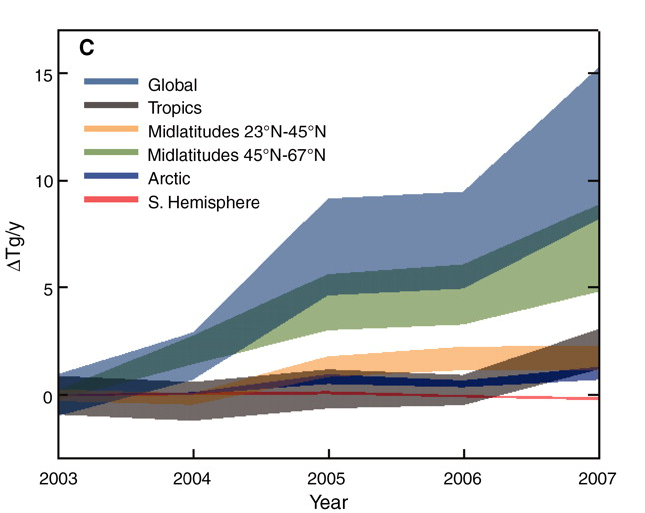
To put this into perspective, here is the graphic from the paper showing the changes in emissions of methane from different sources between 2003 and 2007:

Changes in methane emissions plotted against year

It is obvious that the areas where methane emissions are rising most rapidly are the tropics and the midlatitudes. And although the percentage change in the Arctic is large, the absolute change is very small. I haven’t even bothered to go into the temperature sources – but considering global temperatures as measured by satellite have been pretty steady since about 2001, there would have to be arguments that the contribution arising from the melting of permafrost should be negligible in this period. But I would assume that the NCEP/NCAR figures, since they are based on NOAA data, would show an increase.

The only mention of climate change in the paper is in the very last paragraph:

There is substantial potential for wetland emissions to feed back positively to changes in climate and therefore it is critical that we understand the extent of overlap between wetlands and regions that are most sensitive to projected future warming. We anticipate that the new constraints developed here will ultimately improve model predictions of this feedback.

“Substantial potential” – no evidence, just a hunch. Yet out of that one paragraph, a string of scary news stories has been generated, thanks to an author who has the preset “global warming” bias. The media spin cycle on full blast.

Monckton & Plimer vs. Readfearn & Brook


Carbon Sense

This will be a battle worth watching. Only wish I could be there:

The Brisbane Institute is holding a climate change debate with a panel consisting of Lord Christopher Monckton, Professor Ian Plimer, Graham Readfearn and Professor Barry Brook on January 29th at the Hilton Hotel, Brisbane, 12 – 2pm. Please see the attached brochure for full details and booking information: http://carbon-sense.com/wp-content/uploads/2010/01/climate-debate-brisbane.pdf

Tom Switzer: The Climate is Changing


WSJ Online

Another excellent article from Tom on the changing attitudes to cap-and-trade:

Nowhere is the changing climate more evident than in Australia. Last month, the Senate voted down the Labor Government’s legislation to implement an emissions-trading scheme. Polls show most Aussies oppose the complicated cap-and-trade system if China and India continue to chug along the smoky path to prosperity. The center-right Liberal-led opposition, moreover, is now led by Tony Abbott, a culture warrior who has described man-made global warming in language unfit to print in a family newspaper and cap-and-trade as “a great big tax to create a great big slush fund to provide politicized handouts, run by a giant bureaucracy.”

Until Mr. Abbott’s election as opposition leader last month, the climate debate in Australia had been conducted in a heretic-hunting, anti-intellectual atmosphere. Prime Minister Kevin Rudd claimed that climate change is the “greatest moral, economic and social challenge of our time.” In clear breach of the great liberal anti-communist Sidney Hook’s rule of controversy—”Before impugning an opponent’s motives, answer his arguments”—Mr. Rudd linked “world government conspiracy theorists” and “climate-change deniers” to “vested interests.” Much of the media, business and scientific establishment deemed it blasphemy that anyone dare question his Labor Party’s grand ambitions.

Australians had heard a lot of science, much of it poorly explained. But the “dismal science” had been conspicuously absent from the climate debate. There was very little serious analysis of the economic consequences of climate change: What choices did we have to mitigate its effects, and how much would these choices cost us? Labor ministers had emitted a lot of hot air about global warming and the urgency with which resource-rich Australia (which accounts for only 1.4% of global emissions) must act.

All of this has now utterly changed: Australia’s debate has entered a new phase, one that goes beyond the religious fervor and feel-good gestures that had held sway all too often. Suddenly, political strategists are thinking the unthinkable: far from presaging an electoral debacle that was inevitable under Mr. Abbott’s green predecessor Malcolm Turnbull, the issue could be a godsend for conservatives Down Under.

Read it here.

Dodgy data at NASA and NOAA as well?


Yet more fudge?

If you thought the CRU-files were an isolated incident, and that apart from that blip, the world of climate science is whiter than white, think again. It appears that much the same has been going on at other leading climate centres, as Watts Up With That reports:

Climate researchers have discovered that NASA researchers improperly manipulated data in order to claim 2005 as “The Warmest Year on Record.” KUSI-TV meteorologist, Weather Channel founder, and iconic weatherman John Coleman will present these findings in a one-hour special airing on KUSI-TV on Jan.14 at 9 p.m. A related report will be made available on the Internet at 6 p.m. EST on January 14th at www.kusi.com.

In a new report, computer expert E. Michael Smith and Certified Consulting Meteorologist Joseph D’Aleo discovered extensive manipulation of the temperature data by the U.S. Government’s two primary climate centers: the National Climate Data Center (NCDC) in Ashville, North Carolina and the NASA Goddard Institute for Space Studies (GISS) at Columbia University in New York City. Smith and D’Aleo accuse these centers of manipulating temperature data to give the appearance of warmer temperatures than actually occurred by trimming the number and location of weather observation stations. The report is available online here.

The report reveals that there were no actual temperatures left in the computer database when NASA/NCDC proclaimed 2005 as “THE WARMEST YEAR ON RECORD.” The NCDC deleted actual temperatures at thousands of locations throughout the world as it changed to a system of global grid points, each of which is determined by averaging the temperatures of two or more adjacent weather observation stations. So the NCDC grid map contains only averaged, not real temperatures, giving rise to significant doubt that the result is a valid representation of Earth temperatures.

The number of actual weather observation points used as a starting point for world average temperatures was reduced from about 6,000 in the 1970s to about 1,000 now. “That leaves much of the world unaccounted for,” says D’Aleo.

Read it here.

Tony Abbott at the Sydney Institute


Tony Abbott delivers an earlier Sydney Institute address

I was fortunate enough to attend Tony Abbott’s policy speech at the Sydney Institute last night and had the pleasure of meeting him afterwards. It was a very interesting speech, with one of the key messages being that environmental matters are being sidelined thanks to the obsessions with climate change. I understand he will announce a climate change policy in a couple of weeks, but the focus of last night’s speech was the Murray-Darling, and the creation of a 15,000 strong land army to tackle environmental problems.

Mr Abbott did touch on climate issues, however:

Of course, Australia has a role in reducing global emissions but we can’t save the world from climate change on our own. To act alone would simply export emissions (and jobs) to other countries. Not only has the Rudd Government’s grandstanding on climate change failed. It’s masked the near total neglect of those environmental problems that Australians alone can fix. In the past two years, there has been almost no progress on improving water use in the Murray-Darling basin, only modest additional use of renewable energy, and no further support for more effective land care. In fact, funding for solar panels, water recycling and land care programmes has been cut. Instead, there’s been a great deal of political barracking plus obsessive support for an emissions trading scheme: a great big new tax on everything that merely masquerades as a programme to improve the environment.

A unilateral emissions tax here in Australia would do next to nothing for the environment but would seriously damage the competitive position of our export industries. In the long run, it would damage our ability to fund the environmental improvements here in Australia that only Australians can bring about.

It’s stunning to hear the Greens to give even limited support to ideas on the environment from the Liberals, as the ABC reports:

Greens Senator Sarah Hanson Young agrees with the Opposition Leader’s critique of the Government.

“They have done little on tackling the Murray Darling Basin – a lot of talk and no action,” she said.

Senator Hanson Young says both ideas have merit, but the Liberal’s track record on environmental issues undermines Mr Abbott’s message. (source)

That’s why they’re changing the track. But we can always count on a knee-jerk reaction from Penny Wong, and we weren’t disappointed:

“It appears Mr Abbott is again making things up as he goes along, stealing from failed Howard government policies when he can’t come up with his own ideas,” Senator Wong said.

“Mr Abbott now has 19 days to release his detailed and fully costed policy on climate change.” (source)

Tick tock tick tock. Penny clearly doesn’t read the papers, or else she would have seen The Australian’s ridiculing of her constant, robotic “countdown mode” just two days ago (see here).

Read the full text of the speech here.

Dr Roy Spencer: GW predictions based on faith, not science


Dr Roy spencer explains why climate modellers can tune their models to achieve just about any rate of warming they like:

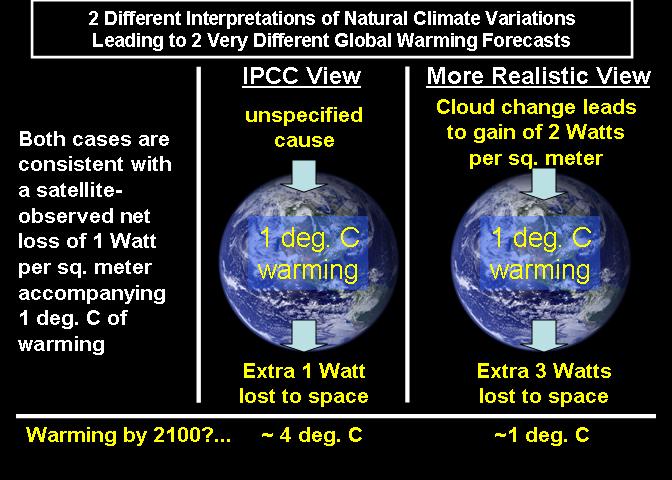
The ‘consensus’ IPCC view, on the left, would be that the 1 deg. C increase in temperature was the cause of the 1 Watt increase in the Earth’s cooling rate. If true, that would mean that a doubling of atmospheric carbon dioxide by late in this century (a 4 Watt decrease in the Earth’s ability to cool) would eventually lead to 4 deg. C of global warming. Not good news.

But those who interpret satellite data in this way are being sloppy. For instance, they never bother to investigate exactly WHY the warming occurred in the first place. As shown on the right, natural cloud variations can do the job quite nicely. To get a net 1 Watt of extra loss you can (for instance) have a gain of 2 Watts of forcing from the cloud change causing the 1 deg. C of warming, and then a resulting feedback response to that warming of an extra 3 Watts.

The net result still ends up being a loss of 1 extra Watt, but in this scenario, a doubling of CO2 would cause little more than 1 deg. C of warming since the Earth is so much more efficient at cooling itself in response to a temperature increase.

As a result of this inherent uncertainty regarding causation, climate modelers are free to tune their models to produce just about any amount of global warming they want to. It will be difficult to prove them wrong, since there is as yet no unambiguous interpretation of the satellite data in this regard. They can simply assert that there are no natural causes of climate change, and as a result they will conclude that our climate system is precariously balanced on a knife edge. The two go hand-in-hand.

Their science thus enters the realm of faith. Of course, there is always an element of faith in scientific inquiry. Unfortunately, in the arena of climate research the level of faith is unusually high, and I get the impression most researchers are not even aware of its existence.

Read it here.