Bad for Gillard
Andrew Bolt’s column on the carbon tax announcement sums up the frustration and disenfranchisement many of us are feeling this morning:
JULIA Gillard’s carbon tax is the most brazen fraud perpetrated by an Australian government.
Warming believers should be outraged that the tax is so useless. Sceptics should be outraged it’s so pointless.
It offends the intelligence of everyone and threatens the jobs of thousands.
For nothing.
The Prime Minister yesterday claimed “the science is in” and man’s gasses were heating the planet dangerously.
But not even Gillard dares to claim that the tax she’s finally unveiled will stop any of that warming, or change the climate in any way – because it won’t. It can’t. (source)
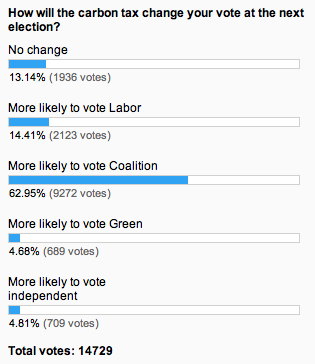
News.com.au runs a poll on the carbon tax, and the results aren’t pretty. However, GetUp has obviously been mobilised to vote on this, as the results are far less dramatic than they were yesterday evening, but they are still damning (see graphic):
ANGRY Australians have vowed to vote Julia Gillard from office at the next election after today’s controversial carbon tax announcement.
Scores of voters rejected the plan soon after details of the $24.5 billion package to tackle climate change were revealed, with more than 80 per cent who voted in a national online poll saying Australia shouldn’t have a carbon tax.
Almost 100,000 votes were cast by more than 25,000 people across four polls in News Limited’s “Carbon Tax Plebiscite”, with 87.1 per cent saying they planned to change their vote at the next election in light of the tax.
More than 70 per cent of voters, or 15,866 people, said they now planned to vote for the Coalition at the next election while just 8.51 per cent said they would support a Labor government.
Just 13 per cent of voters said they wouldn’t change their vote at the next election. (source – vote at the link)
Industry is unimpressed:
CANBERRA’S grand carbon tax reform package will only raise the growing alarm in the business community that the Gillard government just doesn’t understand the meaning of the bottom line or the pressures facing industry and the economy.
It will be hard enough to convince highly sceptical voters that the carbon tax is an important economic and environmental reform that won’t leave most of their budgets worse off.
But most of the business community, already coping with massive structural changes, will be even less persuaded that this scheme has merit, let alone that it deserves the title of major reform. The $23 a tonne tax is high enough to increase costs on business but not sufficiently high to do what the government promises it will — drive substantial change in energy use, provide investment certainty or reduce global warming.
What it does produce is the churning of billions of dollars in and out of Canberra, intrusive and inefficient regulation and a (hopefully) modest drag on economic growth just when the non-mining sector feels so weighed down. (source)
Tim Blair takes Gillard’s address to pieces:
“Most Australians now agree our climate is changing, this is caused by carbon pollution, this has harmful effects on our environment and on the economy and the government should act.”
Most Australians don’t want a carbon tax.
“The first Australian government to announce a plan for a carbon price was John Howard’s back in 2007.”
And look where it got him. And Kevin Rudd. And Malcolm Turnbull. Gillard is shooting for a climate change four-peat.
“A lot has happened since then; the debate has been difficult and divisive. But we have now had the debate – 2011 is the year we decide that as a nation we want a clean energy future.”
Whoa! The debate is over now? The Prime Minister’s powers evidently now extend to public opinion.
Frankly, she could do with a little more practice on her own cabinet first.
“Now is the time to move from words to deeds.”
Several words from which the Prime Minister dearly wishes we could move: “There will be no carbon tax under the government I lead.”
That sentence didn’t survive as fact for even one year. (source)
Jo Nova:
“Great nations rise and fall. The people go from bondage to spiritual truth, to great courage, from courage to liberty, from liberty to abundance, from abundance to selfishness, from selfishness to complacency, from complacency to apathy, from apathy to dependence, from dependence back again to bondage.” Henning Webb Prentis, Jr., President of the Armstrong Cork Company 1943
The quoted passage from Prentis is known as “the fatal sequence”, and the only good news is that we don’t have to stay on the road to bondage. The message about the real science and economics is spreading from BBQ to BBQ, dinner to dinner, through letters to the editors, and through phone calls to radio stations. Information is our friend, and when it comes down to it, we can do it without the lamestream media, and the ABC. They can rubber-stamp the government PR, and union sponsored activists can try to cancel speeches that might reveal the truth, but these distant messengers don’t come between family and friends.
Word-of-mouth spreads the story with an exponential growth curve. There’s a one way stream of people leaving the “carbon faith” and shifting to skepticism, there’s virtually no flow the other way.
Sooner or later the hard rock meets the immovable force and when 70% of the country know that the tax is a lie, based on deceit, wallowing in corruption and plastered with vested interests it will be all over — all over for the tax, all over for Labor Party credibility, all over for the witchdoctors who think they can change the weather. (source)
Letter from Viv Forbes:
Carbon Tax Mark 4 is flimsy but dangerous.
Because of public opposition to a new tax on everything, the tax has been gutted. The PM hopes to buy public support by giving exemptions to almost everyone and offering widespread bribes to voters. It is now feeble and ineffective.
But the Green-Gillard coalition is desperate and such people cannot be trusted. They will say or promise anything in order to get this new tax introduced.
Once on the law books, the exemptions will be whittled away, the tax rate will increase and the tax bribes will disappear. It is a stealthy cancer in the gut of the Australian economy.
The cost of electricity, food, fuel and travel will increase, but few people will recognise the root cause. Politicians will blame “Woolworths, power suppliers and Big Oil” for the pain.
This new stealth tax is the thin edge of the wedge.
It will have no effect on the climate, but is a fiscal weapon too dangerous to be left in the hands of green extremists.
Leaving Bob Brown loose with the vast powers of a carbon tax is like leaving the grandkids alone in the hayshed with a box of matches.
“Abolish the Stealth Tax” will be the next election slogan. (source)
As everyone now knows, the tax will do nothing for the climate, and even warmist Adam Morton from the Sydney Morning Herald acknowledges that fact. And points out what many commentators miss, namely that Australia will have to buy permits to reach even the modest target set for 2020:
ONCE you can get past the extraordinary compensation packages – some justifiable, others less so – the real test of the carbon price package is pretty basic: will it cut Australia’s carbon dioxide emissions?
Beyond that, will it set up the economy for potentially even deeper cuts down the track?
The answer to the first question is probably yes, though it depends on how you define a cut in emissions.
…
What does all this mean for emissions? It depends on your perspective. Treasury modelling suggests Australia’s emissions will rise slightly in the years ahead before starting to fall in a couple of decades.
They will quickly be significantly lower than they would be without a carbon price, or under most analyses of the Coalition’s ”direct action” policy. But it also means Australia will only reach its targets by buying international carbon permits – 101 million tonnes worth in 2020, and many more by 2050. (source)
With such lukewarm support from one of Gillard’s cheerleaders, it looks as though the tax will annoy everyone. Not enough to please the Greens, and too much for everyone else. And we hope voters have long, long memories.





 Australian Climate Madness
Recent Comments