The debate is over… on the carbon tax


Contempt for Parliament

With the carbon tax bills being introduced to Parliament, the government is doing its best to ensure that there is as little debate as possible. Greg Combet, difficult to like at the best of times, is at his most arrogant, contemptuous worst:

“Tony Abbott’s misinformed people, deceived people, told lies about things,” he said. [Better not mention the lies in the government’s ad campaign then – Ed]

“I don’t expect the Coalition to make much in the form of a constructive debate.”

The Coalition claim that there is no where near enough time to debate the complex bills, with each member only having a minute to debate the 18 bills. Combet explains helpfully:

“That’s all rubbish,” Mr Combet said, adding the bills would be debated as one piece of legislation. [That still is only 18 minutes per member for one of the most complex changes to our economy in Australia’s history – Ed]

Mr Combet said there had been 35 inquiries into climate change [all of them fudged or fixed – Ed].

“It really is time we got on with it.”

“Time we got on with it.” I love the smell of hypocrisy in the morning. Just imagine Labor’s outrage at a minority Coalition government with no mandate, which broke an express pre-election promise to force through a hotly contested piece of legislation and then stifled proper democratic processes in Parliament by cutting short the debates. We’d have Combet, Gillard, Albanese and all the other Labor attack dogs shrieking from the rooftops. Tony Abbott responds:

Mr Abbott said it would be a “travesty of democracy” for the Government to rush its legislation through Parliament, especially as it had no mandate for a carbon tax.

He vowed to repeal the laws once a Coalition government was elected, despite concerns it might cause disruption to business.

“It’s never disruptive to get rid of a bad tax,” he told ABC Radio.

“It’s always advantageous to reduce business costs and they don’t want this tax and if they get it, they will want to be rid of it as quickly as they possibly can.”

Read it here.

Roger Pielke Sr on Skeptical Science


Roger Pielke Sr

Roger Pielke Sr responds to the trashy attacks on the UAH dataset and Roy Spencer personally from the likes of our own “Eureka Prize winning” John Cook at the web site (Un-) Skeptical Science.

A few quotes:

As a result of the persistent, but incorrect (often derogatory) blog posts and media reports on the robustness of the University of Alabama MSU temperature data, I want to summarize the history of this data analysis below. John Christy and Roy Spencer lead this climate research program.

The ad hominem presentations on this subject include those from the weblog Skeptical Science who have sections titled:

“Christy Crocks” and “Spencer Slip Ups”

If this weblog intends, as they write, to contribute to

“Explaining climate change science & rebutting global warming misinformation”

they certainly have failed in this effort, with respect to the outstanding research that Christy and Spencer have accomplished.

Pielke also cautions:

Weblogs such as Skeptical Science, if they want to move the debate on the climate issues forward, need to move towards a more constructive approach.

All I can say in response to that is “don’t wait up”. Skeptical Science isn’t interested in a constructive approach to this issue, because it is an agenda-driven propaganda site. It has nothing to do with seeking scientific truth, and everything to do with advancing a pre-determined position by rubbishing and dismissing anything (and anybody) that challenges it. The last thing Skeptical Science wants to do is move the debate forward – the debate’s over.

And if you want to understand your “denialist” psychological condition, all you have to do is read one of Cook’s books on the subject. See, no agenda there, clearly!

Read it here. (h/t WUWT)

Another paper suggests cosmic ray influence on clouds


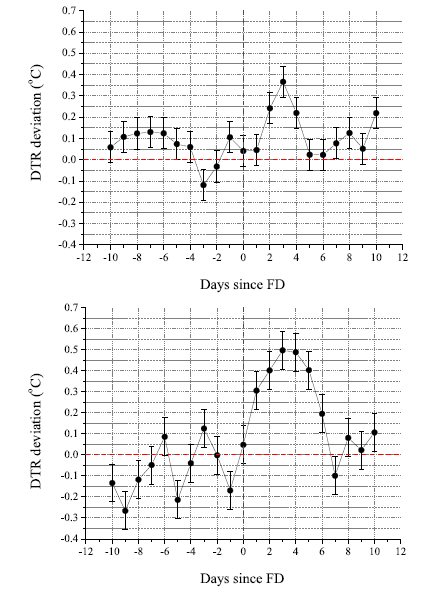
Figure 5 - click to enlarge

This time based on real-world experimentation, rather than laboratory test results as with CERN/CLOUD. In this case, the paper looks at the link between Forbush decreases, which are a decrease in the galactic cosmic ray flux in response to a burst of gas ejected from the Sun towards the Earth, and the change in diurnal temperature variation (i.e. the difference between night and day). Fewer cosmic rays mean fewer clouds, which means colder nights and warmer days, in theory…

From Nigel Calder:

More than a year ago I began a succession of posts on whether or not observations in the real world support or falsify the Svensmark hypothesis. The most explanatory was the first – see link

The focus was on the “natural experiments” in which big puffs of gas from the Sun block some of the cosmic rays coming from the Galaxy towards the Earth. The resulting falls in cosmic ray influx, called Forbush decreases, last for a few days. The game is to look for observable reductions in cloudiness in the aftermath of these events. The results are most clearly favourable to the Svensmark hypothesis for the Forbush decreases with the largest percentage reductions in cosmic rays. Scientists keen to falsify the hypothesis have only to mix in some of the weaker events for the untidiness of the world’s weather to “hide the decline”. 

The Serbs avoid that blunder by picking out the strongest Forbush decreases. And by using the simple, reliable and long-provided weather-station measurements of temperature by night and day, they avoid technical, interpretive and data-availability problems that surround more direct observations of clouds and their detailed properties. The temperatures come from 184 stations scattered all across Europe (actually, so I notice, from Greenland to Siberia). A compilation by the Mount Washington Observatory that spans half a century, from 1954 to 1995, supplies the catalogue of Forbush decreases.

The prime results are seen here in Dragić et al.‘s Figure 5 [image top right]. The graphs show the increase in the diurnal temperature range averaged across the continent in the days following the onset of cosmic ray decreases (day 0 on the horizontal scales). The upper panel is the result for 22 Forbush events in the range 7−10%, with a peak at roughly +0.35 oC in the diurnal temperature range. The lower panel is for 13 events greater than 10%. The peak goes to +0.6 oC and the influence lasts longer. It’s very satisfactory for the Svensmark hypothesis that the effect increases like this, with greater reductions in the cosmic rays. The results become hard (impossible?) to explain by any mechanism except an influence of cosmic rays on cloud formation.

The case for the Sun influencing climate by modulating cloud cover becomes stronger, little by little. By the way, just for the benefit of the Consensus Boys, this is how science works.

Read it here.

Remembering 9/11


We are putting aside the petty whirlwind of climate change politics to remember something far more important: the events of 9/11 and the families of the thousands that died ten years ago today. Our thoughts at this time are with our US friends and others who suffered in that terrible tragedy.

Bob Carter comments on Sunday Age article


Climate sense

Prof Bob Carter has commented on the Sunday Age’s article on ACM’s question. It will be preserved here in case it gets inadvertently posted down the memory hole:

Editorial presumption of the danger of human-caused global warming (which is a speculative hypothesis) as opposed to natural climate change (which is a certainty, and dangerous) rests upon a number of myths. Prime amongst these is that the IPCC is a scientific advisory body. Wrong. As a branch of the UN, the IPCC renders political advice, albeit dressed up with plausible sounding but mostly alarmist-slanted science.

A second myth is that the majority of scientists assert that dangerous human warming will occur (it hasn’t yet). Wrong again. For since 1995 tens of thousands of qualified scientists have signed statements similar to the following, current on the website of the International Climate Science Coalition:

“We, the undersigned, having assessed the relevant scientific evidence, do not find convincing support for the hypothesis that human emissions of carbon dioxide are causing, or will in the foreseeable future cause, dangerous global warming”.

Myth number three is that present day temperature is unusually warm compared with past climate. Wrong again, as demonstrated by both historic and deep time records.

And myth number four is that dangerous global warming will be caused by human emissions. In actuality, global temperature has cooled slightly over the last 10 years in the face of a 5 per cent increase in atmospheric carbon dioxide. Need I go on?

Yes, but only to say that the needed and cost-effective policy to deal with climate change hazard, of whatever origin, is to prepare for and adapt to dangerous events as and when they happen.

 Bob Carter | Townsville – September 11, 2011, 11:17AM

Thanks for your contribution, Bob.

P.S. I note that comments were closed for this article sometime around 3pm AEST (barely 24 hours after the piece was published). Seems a tad premature… read the comments to see if you can spot a possible reason…

Sunday Age Climate Agenda: ACM's question reported


Fairfax parodies itself - gold!

The Sunday Age today publishes a lengthy article (and deserves a lengthy response) regarding my question on the OurSay website, which was, by way of reminder:

It is accepted that man’s carbon dioxide emissions are causing an amount of warming of the climate. However, the magnitude of any future warming is highly uncertain. The Inter-governmental Panel on Climate Change acknowledges that its understanding of a number of key natural climate drivers and feedbacks is ”low” or ”very low”. Why is it, therefore, that the Fairfax press is reluctant to engage with and investigate this uncertainty with an open-minded impartiality, and instead continues to publish articles based on a rigid editorial agenda that ‘the science is settled’?

Michael Bachelard, the writer, discovered that the question was from this site – I had used a nom de plume to avoid the question being tainted in any way by being from a “sceptic” blog as I wanted the question to be judged on its merits not its provenance – but given that they had established it had come from this site, I have to admit to being a little disappointed at not being contacted by him to expand a little on the premise of my question before the article was written, which I would have liked the opportunity to do. Never mind.

The article is entitled:

“Majority Report: why consensus is all the rage”

And this is the first trap: consensus is a word of politics, not science. I will return to this later.

The article firstly describes briefly the history of the IPCC, but fails to mention that the purpose of the IPCC, as set out in its Principles (terms of reference) was to investigate, specifically, “human-induced” climate change. This, I submit, is a significant reason why the reports of the IPCC will inevitably have an intrinsic (even if inadvertent) bias towards findings that support the AGW theory.

The article then discusses some of the issues raised by my question:

But despite the endeavours of its 1250 scientific authors and 2500 peer reviewers over four reports – from 1990 to 2007 – the panel still has ”low” or ”very low” certainty about a number of the drivers of climate change. When it measures uncertainty, the panel looks at both the scientific evidence, and also the consensus among scientists about the evidence. If either of these measures is low, then the IPCC flags an uncertainty.

In its most recent report, in 2007, the impact on climate change of clouds, snow, aircraft vapour trails, the ash, soot and chemicals from volcanoes, water vapour, cosmic rays and the ”surface effects” of vegetation, buildings and other things occupying land space, were all considered uncertain. There were further doubts about the history of the changing climate and the growth and shrinkage of ice sheets in the past.

All agreed so far. However, the justification given by Sydney Morning Herald editor, Peter Fray, for running alarmist stories is less convincing. He claims:

”The IPCC … may still be investigating the natural drivers of climate change but that is not the same as saying climate change does not exist or the science is in doubt,” he said.

On the first part of this claim, I would suggest that is not very likely, and on the second, it is a misrepresentation of my position, and the position of sceptics. At no point did I say climate change does not exist – in fact I expressly acknowledged the effect of anthropogenic emissions on the climate. [This is a long post so click through to continue reading – thanks]

[Read more…]

New look for ACM


ACM is trialling a new look – more modern, cleaner, less cluttered, and most importantly, easier to read. Features will be tweaked over the coming weeks.

Leave your feedback in the comments and let us know what you think.

Thanks!

Ban Ki-moon: clueless on climate


Moon(-bat)

Ban ki-Moon has been in Sydney – lucky old us. He gave a speech at Sydney University and was interviewed (worshipped) from various different positions by the ABC, naturally.

One of the key subjects was climate change, and as usual, there was spin and emotional blackmail from the UN chief, claiming on the one hand that “Australia could lead the way” in the fight against climate change [er, if reducing global emissions by 0.075% in a decade is “leading the way”, I’d hate to see the slackers at the back… – Ed] and on the other imploring us to “look into the eyes” of Pacific islanders forced out of their homes by climate change.

Of course, there is no evidence that sea levels are accelerating due to anthropogenic emissions (in fact they have plateaued and recently dropped), but that doesn’t stop the UN chief using it to push his organisation’s political agenda for a global governmental role.

You can’t blame him really, after all, he’s got the IPCC advising him, poor bloke. He had words of advice for “sceptics” (thanks in advance):

“I know, once again, there are the sceptics. Those who say climate change is not real,” he said. 

Wrong. We do not say climate change is not real, we say that climate change happens (duh) but man’s effect on it is small and taxing our economies out of existence won’t make any difference whatsoever. In fact, strong economies are needed to fund the costs of adaptation to climate change whether anthropogenic or natural, rather than pissing trillions of dollars up the wall trying, and failing, to mitigate.

“But the facts are clear: global greenhouse gas emissions continue to rise, millions of people are suffering today from climate impacts. Climate change is very real.”

It’s that correlation and causation thing again.

He suggested the doubters take a trip to Kiribati.

“Look into the eyes of the young boy who told me: ‘I am afraid to sleep at night’ because of the rising water,” he said.

“Talk with the parents who told me how they stood guard fearing that their children might drown in their own homes when the tide came in.” (source)

Nothing but mawkish emotional blackmail. Sea levels have not accelerated due to industrialisation. They have risen at virtually the same rate for thousands of years. And anyway, Kiribati is growing – the BBC told us so it must be true.

Then there was the usual bull on China, an example to us all whilst at the same time building a new coal fired power station every couple of weeks:

To those who said there was no point in taking action, because other nations were not, Mr Ban pointed to big polluters including China and India.

China had pledged to reduce its carbon pollution by up to 45 per cent in the next decade, he said. (source)

Well, my friends, that is an outright lie. Because they have pledged to do nothing of the kind. I think the Sydney Morning Herald in its agenda-driven editorial haze forgot the most important phrase “carbon intensity”. Which means China’s emissions will continue to rise, but at a slower rate than before. Big deal – their increases will still outstrip Australia’s reductions many, many times over – that is, if they actually manage to achieve that target, which is far from certain.

Smoke and mirrors once again from the UN’s chief alarmist. The airport’s that way…

Roy Spencer responds to Dessler


The saga continues

Roy Spencer has indicated he will be preparing a paper in response to Dessler’s response to Spencer and Braswell’s original paper in Remote Sensing – although he jokes it will take longer than six weeks to get peer-reviewed (because sceptical papers are by definition heresy and must not be given any credibility, © K Trenberth).

However, his initial comments on Dessler are here. The following extract is interesting from the point of view of integrity:

Quoting Dessler’s paper, from the Introduction:

“Introduction
The usual way to think about clouds in the climate system is that they are a feedback… …In recent papers, Lindzen and Choi [2011] and Spencer and Braswell [2011] have argued that reality is reversed: clouds are the cause of, and not a feedback on, changes in surface temperature. If this claim is correct, then significant revisions to climate science may be required.”

But we have never claimed anything like “clouds are the cause of, and not a feedback on, changes in surface temperature”! We claim causation works in BOTH directions, not just one direction (feedback) as he claims. Dr. Dessler knows this very well, and I would like to know:

1) what he was trying to accomplish by such a blatant misrepresentation of our position, and

2) how did all of the peer reviewers of the paper, who (if they are competent) should be familiar with our work, allow such a statement to stand?

I can guess it’s because Dessler’s peer-reviewers are probably all on “the Team”, and they can’t be bothered to actually read the heretical paper Dessler is referring to (or if they did it was treated with contempt), and anyway, who cares if we misrepresent what he wrote? It’s only Spencer, after all.

Double standards at work, as usual.

"And the Eureka Prize for climate propaganda goes to…"


Propaganda

… John Cook, who has been awarded the gong for “Advancement of Scientific Knowledge” in the 2011 Eureka Prize. Cook publishes the website Skeptical Science, which allegedly “rebuts” all the filthy lies peddled by evil deniers (© any alarmist you care to mention).

The Sydney Morning Herald crows:

John Cook, a physics graduate who created the Skeptical Science website to debunk lies and misinformation about climate change science, won the prize for advancement of climate change knowledge, sponsored by the NSW government.

Mr Cook, co-author of Climate Change Denial, started the website in 2007 and has published scientific rebuttals to more than 150 climate change myths. (source)

Impartial presentation of scientific knowledge, however, it ain’t. It is an ideologically driven propaganda site, the sole aim of which is to rubbish, ridicule and dismiss anything which challenges the precious consensus. If you need further evidence of this, simply look at Cook’s publications, which are more concerned with attacking “deniers” than seeking scientific truth. Also check out Lubos Motl’s response to Cook’s “rebuttals” here.

More than anything, however, the award reflects extremely poorly on the Australian Museum, which awards the prizes, and, like so many formerly respectably scientific institutions, has been wholly compromised by a blind acceptance of climate hysteria.

We sure are having a bad week for the integrity of science…