Aussie carbon tax "a trip to the moral high ground" – Guardian


Totally screwed. Thanks, Labor.

When even the Guardian thinks that you’ve screwed up, you know you’ve REALLY screwed up. Julia, Greg, Kevin, Penny and all you other Labor no-hopers and no-brainers, read this editorial, bemoaning the fact that Durban achieved essentially nothing:

Bold unilateral moves like the Australian carbon tax, due to take effect from July next year, now look like a trip to the moral high ground at the expense of international competitiveness. 

Gee, who’d a thunk it? Answer: anyone on planet Earth with a couple of functioning brain cells (which excludes most of the ALP). Even bivalve molluscs washing up on Bondi beach have more intelligence than the average Labor MP and could have worked this out.

Let us all take a moment to despair at the depths to which our great country has sunk. Time to get angry.

Read it here (and weep).

Canada abandons Kyoto


Climate heroes

But, but, but… Kyoto was so successful at reducing emissions! Not.

Canada has become the first country to announce it will officially pull out of the Kyoto accord on reducing greenhouse gases.

Canadian environment minister Peter Kent said it was not economically feasible for Canada to continue under the rules of the Kyoto agreement in 2012.

He made the announcement two hours after returning to Ottawa from the climate talks in Durban, where countries agreed to extend Kyoto for five years and hammer out a new deal forcing all big polluters for the first time to limit greenhouse gas emissions.

Canada, a major energy producer which critics complain is becoming a climate renegade, has long complained Kyoto is unworkable precisely because it excludes so many significant emitters.

“As we’ve said, Kyoto for Canada is in the past … We are invoking our legal right to formally withdraw from Kyoto,” Mr Kent told reporters.

He said the decision would save the government $14 billion a year in penalties and blamed what he called an incompetent Liberal government that signed the accord but then took little action to make the necessary emissions cuts.

“To meet the targets under Kyoto for 2012 would be the equivalent of either removing every car, truck, all-terrain vehicle, tractor, ambulance, police car and vehicle off every kind of Canadian road,” Mr Kent said.

He said the Kyoto accord was “an impediment” to finding a real solution to climate change because it does not include the world’s largest emitters, China and the United States. (source)

Climate sense from the Canadians. We envy you here in the country of climate madness.

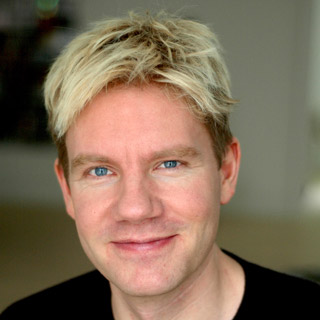
Lomborg: emissions cuts are futile


© Scientific American

Climate sense

I agree with much of what Bjørn Lomborg writes, even though we might disagree on the magnitude of the problem we face. I also agree that investment in research into alternative energy sources, so that they might become genuinely competitive in the market, is far preferable to punishing energy use through carbon dioxide taxes – the carrot as opposed to the stick approach.

In the Wall Street Journal, he states the painfully obvious fact that, like Kyoto before it, any global deal to cut carbon dioxide emissions will have an almost imperceptible effect on the climate, and that a simple cost/benefit analysis would always favour adaptation over mitigation.

The Durban pit-stop in the endless array of climate summits has just ended, and predictably it reaffirmed the United Nations’ strong belief that the most important response to global warming is to secure a strong deal to cut carbon emissions.

What is almost universally ignored, however, is that if we want to help real people overcome real problems we need to focus first on adaptation.

The Durban agreement is being hailed as a diplomatic victory. Yet it essentially concedes defeat, leaving any hard decisions to the far end of the decade when other politicians will have to deal with it. For nearly 20 years, the international community has tried to negotiate commitments to carbon cuts, with almost nothing to show for it.

Even most rich countries don’t want to cut fossil fuels, because the alternatives are considerably more expensive. China, India and other emerging economies certainly do not want to, because putting the brakes on growth means consigning millions to poverty.

But even if such intractable issues could be magically resolved, any deal would have a negligible impact on climate. Even if we were to cut emissions by 50% below 1990-levels by 2050—an extremely unrealistic scenario— the difference in temperature would be less than 0.2 degrees Fahrenheit in 2050.(source)

(h/t Hockey Schtick)

Durban: Phew, planet saved. What's next?


Durban nightmare

Only in the fantasy world of UN climate negotiations could anyone seriously believe that agreeing a piece of paper that shifts money around will “save the planet”. OK, perhaps in the fantasy world of journalism as well.

At 3 in the morning, a few exhausted and desperate delegates hammer out a “deal” which, when examined carefully, appears to be little more than an agreement to agree in the future (which is legally unenforceable), containing more loopholes than a battered old cardigan

As predicted yesterday, the moonbat media (Sydney Morning Herald, UK Telegraph etc) are crowing about this “historic” deal:

The world is on track for a comprehensive global treaty on climate change for the first time after agreement was reached at talks in Durban in the early hours of Sunday morning.

Negotiators agreed to start work on a new climate deal that would have legal force and, crucially, require both developed and developing countries to cut their carbon emissions. The terms now need to be agreed by 2015 and come into effect from 2020. (Guardian)

A new deal to “save the planet” will force the world’s three biggest emitters the US, China and India to cut carbon emissions for the first time, although scientists fear it will come too late to stop global warming. (Telegraph)

THE world’s heaviest greenhouse gas emitters, including China and the US, have forged a plan to unite all major nations under a legally binding pact to slow climate change.

The last-ditch deal, reached yesterday at the end of the United Nations climate conference in South Africa, is the first time developing nations such as China and India have agreed to work towards emissions reduction targets that have ”legal force”.

Australia’s Climate Change Minister, Greg Combet, called the agreement ”a significant breakthrough in tackling global warming”. (Sydney Morning Herald)

The excitement is clearly too much, as, in a throwback to an earlier era, both the Telegraph and Greg Combet oddly refer to the issue as “global warming” again – a full two revisions back from the phrase du jour, “climate disruption”. How last decade.

Notice how nothing is binding, just that the world is “on track”, or “forging a plan”, or “working towards” something which we will put off until later because it’s too hard right now. I wonder what will change to make it so much easier in 2015? A few years of global cooling or another few thousand Climategate emails would make it interesting…

Naturally this is the kind of vague wording that keeps everyone happy. The developing countries and the rent seekers (stand up, Maldives: “Our islands are sinking!! But we’re building multiple new airports for all the tourists anyway…”) believe they have a deal, and China, India and the US know full well it’s worth less than the paper it’s written on. An awful lot can change in the world before 2015, and even more before 2020.

Once again, and as always with the UN, it’s more about the appearance of progress than something tangible – and an excuse for more taxpayer funded jollies to luxury resort destinations in future years. Which is clearly good for those of us that believe that any global treaty on climate change will do precisely nothing, exactly like Kyoto has done precisely nothing.

Chris Horner, writing at Watts Up With That, summarises:

The annual “historic agreement” to meet again later — wait, sorry, that’s “to save the planet” — has been agreed, to the also-annual teary-eyed hugging and standing ovations by EU delegates, at “COP-17”, the negotiations to replace the expiring (after 2012) Kyoto Protocol.

On its face, the summary is that the rest of the world agreed to let Europe continue binding itself until some later date. Yesterday, ClimateWire reported that a fund was established to administer the fund agreed in Copenhagen two years ago. Oh.

AP tells us that “a separate document obliges major developing nations like China and India, excluded under Kyoto, to accept legally binding emissions targets in the future”, meaning in a separate document China et al bound themselves to bind themselves later. [So….uh, they bound themselves for later? No. They bound themselves to bind themselves later. THIRD BASE!]

Oddly, no one seems too proud of this latest “breakthrough”, described as countries binding themselves to bind themselves later. The UN isn’t providing what the Telegraph tells us is a whopping two-page text. Takes awhile, you see.

The State Department doesn’t seem too keen on trumpeting their latest “historic agreement”, either, but the home page’s Daily Press Briefing does offer “New Photovoltaic Project Inaugurated At U.S. Embassy in Athens” and “Global Alliance for Clean Cookstoves Receives South-South Cooperation Award for Partnership”.

So whatever it was it was less historic than these advances. Or no one wants to draw too much attention.

As Chris mentions, the document isn’t available on the UN website yet, so we don’t know exactly what it says, but (again thanks to WUWT), it looks even less of a breakthrough than we thought, as Kumi Naidoo, Greenpeace International Executive Director, explains:

“The grim news is that the blockers lead by the US have succeeded in inserting a vital get-out clause that could easily prevent the next big climate deal being legally binding. If that loophole is exploited it could be a disaster. And the deal is due to be implemented ‘from 2020′ leaving almost no room for increasing the depth of carbon cuts in this decade when scientists say we need emissions to peak.”

Phew, planet saved, then. From climate lunacy, that is.

Durban Tweet of the Day


Twitter was brilliant for watching the chaos unfold live, I have to say. Tweetdeck with live updating was actually quite riveting. Almost like watching a soccer match: “Noooo – UN have scored with agreement between EU and India, Yesss – failure back on the cards as Russia pulls the plug…” All it needed was the live commentary from John Motson, yes indeed.

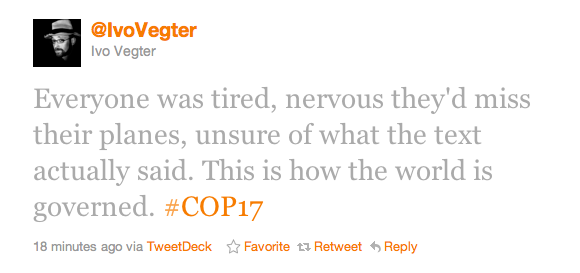
Anyway, you can bet that tomorrow the moonbat media will be hailing the wonderful new UN agreement that will “save the planet” (translation: syphon trillions of dollars from developed to developing countries and do nothing for the climate) or perhaps not, but at least one Twitterer captured the reality:

The reality of the Durban agreement

So when everyone wakes up tomorrow morning with hangovers and bad breath, they will for the first time face the grim realisation of what exactly they have agreed to… How long do you reckon it will last?

Durban descends to a playground huddle


Rather like school children exchanging trinkets, the talks at Durban descend into a huddle of negotiators, desperate to reach some agreement:

Swapping sweeties in the playground

Except it isn’t sweeties, it’s billions of dollars which will be flushed down the proverbial in a futile attempt to control the climate. Ludicrous.

Shambolic Durban limps into extra day


Durban nightmare

As usual, the delegates at the latest pointless climate gab-fest in Durban are desperate to confect a silk purse out of a tugboat-load of sow’s ears. Drama ensued when a new set of documents had to be drawn up at the 11th hour as a rebellion of developing states threatened the entire proceedings.

So, as seems to be the normal routine, the talks will limp feebly on into the weekend in a frantic push to deliver a meaningless piece of paper which will claim to be able to control the climate by taxing everyone more.

The Guardian (UK) is running live updates here (if you can stand it).

UPDATE: Here’s the opening of the new “document” (which barely struggles onto a second page):

“Recognizing that climate change represents an urgent and potentially irreversible threat to human societies and the planet and thus requires to be urgently addressed by all parties…”

Yawn.

"Rights of Mother Earth": barking madness from Durban


Durban nightmare

This is what you get if you fill a room full of extreme greens – total nonsense. It would be funny if it weren’t so dangerous. Here are some of the key points from a draft (or should that be plain “daft”) document from Durban, and a glimpse at the kind of world we may inhabit if the lunatics ever get to run the asylum:

  • A new International Climate Court will have the power to compel Western nations to pay ever-larger sums to third-world countries in the name of making reparation for supposed “climate debt”. The Court will have no power over third-world countries. Here and throughout the draft, the West is the sole target. “The process” is now irredeemably anti-Western.
  • “Rights of Mother Earth”: The draft, which seems to have been written by feeble-minded green activists and environmental extremists, talks of “The recognition and defence of the rights of Mother Earth to ensure harmony between humanity and nature”. Also, “there will be no commodification [whatever that may be: it is not in the dictionary and does not deserve to be] of the functions of nature, therefore no carbon market will be developed with that purpose”.
  • “Right to survive”: The draft childishly asserts that “The rights of some Parties to survive are threatened by the adverse impacts of climate change, including sea level rise.” At 2 inches per century, according to eight years’ data from the Envisat satellite? Oh, come off it! The Jason 2 satellite, the new kid on the block, shows that sea-level has actually dropped over the past three years.
  • War and the maintenance of defence forces and equipment are to cease – just like that – because they contribute to climate change. There are other reasons why war ought to cease, but the draft does not mention them.
  • A new global temperature target will aim, Canute-like, to limit “global warming” to as little as 1 C° above pre-industrial levels. Since temperature is already 3 C° above those levels, what is in effect being proposed is a 2 C° cut in today’s temperatures. This would take us halfway back towards the last Ice Age, and would kill hundreds of millions. Colder is far more dangerous than warmer.
  • The new CO2 emissions target, for Western countries only, will be a reduction of up to 50% in emissions over the next eight years and of “more than 100%” [these words actually appear in the text] by 2050. So, no motor cars, no coal-fired or gas-fired power stations, no aircraft, no trains. Back to the Stone Age, but without even the right to light a carbon-emitting fire in your caves. Windmills, solar panels and other “renewables” are the only alternatives suggested in the draft. There is no mention of the immediate and rapid expansion of nuclear power worldwide to prevent near-total economic destruction.
  • The new CO2 concentration target could be as low as 300 ppmv CO2 equivalent (i.e., including all other greenhouse gases as well as CO2 itself). That is a cut of almost half compared with the 560 ppmv CO2 equivalent today. It implies just 210 ppmv of CO2 itself, with 90 ppmv CO2 equivalent from other greenhouse gases. But at 210 ppmv, plants and trees begin to die. CO2 is plant food. They need a lot more of it than 210 ppmv.
  • The peak-greenhouse-gas target year – for the West only – will be this year. We will be obliged to cut our emissions from now on, regardless of the effect on our economies (and the lack of effect on the climate).
  • The West will pay for everything, because of its “historical responsibility” for causing “global warming”. Third-world countries will not be obliged to pay anything. But it is the UN, not the third-world countries, that will get the money from the West, taking nearly all of it for itself as usual. There is no provision anywhere in the draft for the UN to publish accounts of how it has spent the $100 billion a year the draft demands that the West should stump up from now on.

You just can’t make this stuff up, unless you’re in a hermetically sealed eco-bubble disconnected from reality, just like Durban in fact.

Read it all.

And whilst you’re over at Climate Depot, read the “A-Z Climate Reality Check” (65 page PDF).

Paul Sheehan unloads on the Green government


Running Australia

The fact that our present government is run by the Greens hasn’t escaped even the Sydney Morning Herald, as Paul Sheehan documents the Green takeover of the legislative agenda. The article will have the latte-sipping urban-green elite spraying their organic muesli over the breakfast table:

When the Australian people voted in last year’s federal election, most of them did not vote for the Greens nor did they endorse a Coalition government involving the Greens. But that’s what they got.

In the vote for the House of Representatives, where government is decided, 94 per cent of the adult population voted and 88 per cent of their collective primary vote went to parties other than the Greens. Yet in the ensuing 15 months all the big policy shifts by the Gillard government – none of which was put to the electorate – have been towards core policies of the Greens.

The Prime Minister said no to a carbon tax. We have a carbon tax. She said no to open borders. We have de facto open borders. She said no to gay marriage. Support for gay marriage is now Labor Party policy. She put off indefinitely any substance of an emissions trading scheme. The machinery for such a scheme has been legislated. She said little about giving trade unions sweeping new rights. The unions are now acting on sweeping new rights.

Yet another brick in the Green wall was put in place this week when Gillard and her cabinet made a mockery of the tender process, reversed itself again, and wasted millions of dollars again, giving the running of the Australia Network to the ABC, indefinitely.

The Greens, utterly wedded to big government, wanted this tax-funded Australian overseas TV network to be part of the ABC. The Greens will propose legislation seeking to make this happen next year.

It already has, effectively. The network will operate as part of the ABC despite losing the tender process to Sky News and despite the ABC’s dreadful 24-hour news network being grossly inferior to Sky News.

Read it all.

The Cry grows quite stale and threadbare


Croxall's Fables

The Boy who cried Wolf. Or in this case, “the Boys” – the climate alarmists, the IPCC, the mainstream media (particularly Fairfax and the ABC), the university climate change departments, Flannery, Gillard, Combet, Rudd, Wong, and all the others who are guilty of barefaced and brazen exaggeration and scaremongering in respect of the dangers posed by man-made climate change.

So many times have we heard that it is the last chance to save the planet, it has lost any impact it may have once had. Year after year, the climate fails to follow the dire predictions, the rains still fall, the sun still shines, the planet is indeed still here, and so are we, healthier and, for the most part (EU excepted perhaps), wealthier.

What follows is a wonderful extract from a book of Aesop’s Fables by S Croxall, dated 1722:

“He that is detected for being a notorious Liar, besides the Ignominy and Reproach of the Thing, incurs this Mischief, that he will scarce be able to get any one to believe him again as long as he lives. However true our Complaint may be, or how much soever it may be for our Interest to have it believed, yet if we have been frequently caught tripping before, we should hardly be able to gain Credit to what we relate afterwards.

Though Mankind are generally stupid enough to be often imposed upon, yet few are so senseless as to believe a notorious Liar, or to trust a Cheat upon Record. These little Shams, when found out, are sufficiently prejudicial to the Interest of every private Person who practices them. But, when we are alarmed with imaginary Dangers in Respect of the Public, till the Cry grows quite stale and threadbare, how can it be expected we should know when to guard ourselves against real ones?”

What a glorious phrase: the Cry grows quite stale and threadbare, and how appropriate the extract above relates to the current debate on climate change.

Indeed, the climate alarmists have been “frequently caught tripping before”. We only have to take the briefest glance at the Climategate emails to see uncertainties downplayed, an agenda (or “The Cause” as it should now be referred to) bolstered and protected, and extreme measures taken to ensure The Message is consistent – or in other words, there is consensus. Mankind is certainly still stupid enough to be imposed upon frequently, but the point is near where the public will in future “resolve to take no notice of their alarm.”

And this is a huge problem. As has been discussed many times on this blog, the credibility of the climate science community, in particular the IPCC, is destroyed. No-one who has read even a small proportion of the Climategate emails can possibly take the word of the IPCC (or any of their associated alarmists) when the latest scare story is regurgitated by the mainstream media.

However, this situation will inevitably stifle proper scientific advancement. If a significant section (the majority?) of the climate science community is so tainted by the Ignominy and Reproach of so many failed predictions and hysterical warnings, on whom can policymakers rely to base their decisions? Politicians require such experts to guide their thinking, but so many organisations around the world have abandoned their impartial scientific principles to climb aboard the bandwagon of environmentalism that there are very few of them that remain unscathed.

And the bigger question is this: if at some point in the future, a particular branch of science was genuinely predicting impending catastrophe for the planet and its inhabitants – perhaps from a possible asteroid impact, a deadly virus, or a range of other threats – would we believe it? Would we, given the experience we have so far endured with climate science, be prepared to put our trust in the hands of those who tell us, We know best and we must act now? Would the public consent to such a course, “However true our Complaint may be”? Or would the wolf devour the sheep?

The Cry has indeed grown stale and threadbare. Trust once lost is never regained. The IPCC and the climate science community have lost that trust, squandering it and abandoning their scientific integrity in pursuit of politically correct environmental agenda supported by misrepresentation, bullying and spin. It will take an extraordinary effort to rebuild it again from scratch, and that’s no exaggeration.