German article: sceptics are "like viruses"


Fritz Vahrenholt

UPDATE: Un-Skeptical Pseudo-Science smears Vahrenholt with one of its usual smug cut-and-paste jobs from IPCC AR4,  dismissing any possible solar influence on climate other than TSI. See? The science is settled when you cover your eyes and shut your ears! Yawn. How they loathe it when one of their own turns on them. Link – Webcite only, not giving them any of my traffic.

Once again, I suppose we should be pleased that those who attack sceptics have no arguments whatsoever, and resort to name calling and bizarre explanations as to why anyone could possibly be a climate heretic. These poor souls are so brainwashed that they have lost the ability to reason logically, so instead they flail wildly around, searching for any possible excuse. So much less effort than responding to the sceptics’ points.

We have seen this before. Here, from 2009, is a response to the claim that sceptics were mentally ill:

The idea that ‘climate change denial’ is a psychological disorder – the product of a spiteful, wilful or simply in-built neural inability to face up to the catastrophe of global warming – is becoming more and more popular amongst green-leaning activists and academics. And nothing better sums up the elitism and authoritarianism of the environmentalist lobby than its psychologisation of dissent.

The labelling of any criticism of the politics of global warming, first as ‘denial’, and now as evidence of mass psychological instability, is an attempt to write off all critics and sceptics as deranged, and to lay the ground for inevitable authoritarian solutions to the problem of climate change.

Historically, only the most illiberal and misanthropic regimes have treated disagreement and debate as signs of mental ill-health.

And again from 2009, here:

CSIRO’s former climate director, Dr Graeme Pearman, suffered a personal crisis after confronting this question before deciding to study psychology, which he describes as the new frontier in climate change:

“Behavioural issues are likely to be much more important than the development of improved descriptions of exactly what happens or might happen to the climate. These are the main barriers to the actions that are needed.”

So we shouldn’t be surprised when a recent article in Germany likens sceptics, including Fritz Vahrenholt, author of The Cold Sun, to “viruses”. Petra Döll, lead author for IPCC AR5 WG2, Part A, Chapter 3, freshwater resources (see here – PDF), claims climate sceptics “should no longer be heard”. Vahrenholt responds:

The attitude of refusal by the IPCC with respect to open scientific discussion and debate is now conspicuous. This is demomstrated by IPCC lead author Dr. Petra Döll in the German online taz in claiming that “climate skeptics” no longer need to be heard. Indeed it is questionable just how long this weird scientific approach can be maintained. Should we not expect a professional demeanor from scientists who are paid and supported by German tax revenue? Döll’s dubious reasoning: The climate skeptics ”just keep repeating the same arguments”.  

Could it be that the so-called climate skeptics are forced to keep repeating because the current climate science establishment has yet to provide a satisfactory answer? There’s a lot that indicates this is the case. An assessment of the media one week after the launch of the book “Die kalte Sonne” has clearly shown: The media are relying on a hand-full of prominent experts whose arguments are showing to be everything but scientifically convincing. The statements of many experts and activist editors are characterized by misrepresentations, intentional omissions and errors.

There’s much more at No Tricks Zone.

Frozen Europe


Heidelberg frozen solid

The Big Freeze in Europe continues. This clearly has nothing to do with climate change, it’s just weather. However, it does demonstrate the damaging power of extreme cold. Now imagine what it would be like surviving in these extreme weather conditions with astronomical energy prices as a results of pointless “climate change mitigation policies”:

You would be forgiven for thinking these stunning vistas lay deep in the heart of Antarctica.

But they are, in fact, what has become of the European landscape as temperatures plummet to nearly -40C – the coldest snap in decades.

Rivers, lakes, beaches and even seas have been iced over by a Siberian freeze, creating some incredible sights, but also more tales of tragedy.

Thousands enjoyed a day out on the frozen Lake Pfaeffikersee, near Zurich, Switzerland, today, while ice anglers looked more like Eskimos as they braved the conditions on a Polish reservoir.

But in southern Kosovo, nine people were killed when an avalanche hit the village of Restelica, officials said on Sunday, adding to more than 500 killed in snow and bitter cold across the Continent in the past two weeks.          

In Poland, the interior ministry said 20 people had died in the past 24 hours because of the freezing weather, bringing the toll there so far this year to at least 100.

A spokeswoman said the latest victims froze to death or were suffocated or killed by fires due to defective or improvised heaters. 

The Kosovo avalanche enveloped about 15 houses on Saturday, but only two were occupied at the time.   

One person was missing and a girl aged about six was found alive late on Saturday after residents and emergency services helped dig out the houses. She was taken to hospital.   

‘The number of dead people now is nine and we believe there is still one missing person,’ said Ibrahim Shala, a spokesperson from the Kosovo Security Force (KSF).           

Temperatures have plummeted in parts of Europe close to minus 40 degrees Celsius (minus 40 Fahrenheit) in the coldest February snap the region has seen in decades. Meteorologists say it could last till the end of the month.           

In Kosovo, three people died and two children were injured on Thursday when a gas can that a family was using for heating exploded.

Kosovo’s government ordered schools to remain closed for another week with more snow expected. Police said many inhabited areas were completely cut off.

In neighbouring Montenegro the government imposed a state of emergency late on Saturday after snow blocked roads and railways across most of the country. Three people have died so far.

More than 50 people have been stranded on a train in Montenegro’s north for more than two days as emergency crews struggle to rescue them.
In the mountain town of Zabljak in Montenegro’s north, snow was 2.3 metres deep, while authorities have banned all private traffic in the capital Podgorica, where snow is almost a metre (three feet) deep and more is forecast on Sunday.

In Serbia, which declared a state of emergency last week, 19 people have died in the cold snap so far.

Economists said damage from the cold weather may cost the country more than 500 million euros ($660 million).

More than 2,000 industrial businesses have been idled to limit the strain on coal-fired power plants and hydropower plants, which were struggling because of the buildup of ice.

The government also ordered the closure of all schools and non-essential businesses until February 20.

Port authorities for Serbian sections of the Danube, Sava and Tisa rivers halted navigation due to a heavy buildup of ice.

For the first time in decades, parts of the Black Sea has frozen near its shores, while the Kerch Strait that links the Azov Sea and the Black Sea has been closed to navigation.

Some great photos at the link.

Adelaide cold snap "not seen before since at least 1977"


City of churches (and brass monkeys)

From the Weather Isn’t Climate department:

Adelaide has remained at least seven degrees cooler than average for the past six days, which is a February feat not seen before since at least 1977.

From Sunday 5th February to Friday 10th, Adelaide failed to climb above 22.5 degrees, well below the long term February average of 29.4.

The unusually cool conditions are the result of a persistent flow of southerly air over the city during the past week and lingering cloud cover, which has restricted solar heating from the sun.

The city only managed to reach 20 degrees on Friday, nine degrees cooler than usual and the coldest February day in seven years.

Adelaide’s run of cool days is expected to end next week, when temperatures return to more familiar territory. The city can expect to reach the high 20’s by the end of the weekend and from Tuesday the mercury is set to climb into the 30s for the first time in 11 days.

Looking ahead, a weak change will affect Adelaide in the middle of next week, although temperatures are unlikely to stay as low as they have over the past six days.

(Weatherzone)

IPCC "ignores an entire field of science"


Rotten to the core

Why should that surprise anyone? The IPCC isn’t a scientific organisation, impartially sifting through and collating the current state of climate research to seek the truth, it is a political one, established for the sole purpose of finding evidence to support a pre-determined conclusion reached back in the 1980s, namely that man-made CO2 was causing dangerous climate change.

Why else would the IPCC include acres of grey literature, the majority of it from environmental advocacy groups, and the majority of it tending to make the case against CO2 stronger, yet exclude much peer-reviewed (for what that’s worth) research which questions the influence of CO2 relative to other factors? Why else would virtually every error discovered in the IPCC reports tend to exaggerate the seriousness of the crisis? Why else would many lead authors be permitted to be closely involved with environmental organisations like WWF and Friends of the Earth whilst carrying out their duties for the IPCC? Why else would Rajendra Pachauri, the head of the IPCC, be seen regularly advocating particular policy outcomes, such as reduction of emissions, which assume a particular scientific conclusion?

When one stops deluding oneself that the IPCC is a scientific organisation and appreciates that it is a political organisation, rotten to the core, all the above make perfect sense.

In Germany, where the sceptic movement has received considerable publicity over the past week or so, thanks to Fritz Vahrenholt’s new book, The Cold Sun, newspaper Die Welt publishes a damning indictment of the IPCC, in an editorial entitled Climate science is the new replacement religion:

Very few people have recognised that in the research that Vahrenholt und Lüning are referring to has nothing to do with the irradiative heating of the sun, which indeed does not fluctuate much, but with the solar winds which are increasingly shown to have an indirect impact on cloud formation, and thus influence the climate.

The IPCC has looked at this on the fringes and have determined that this research – which the renwoned CERN institute and others are carrying out -– is not far enough to allow conclusions to be drawn.

That may or may not be the case. But the fact remains that the IPCC, which is responsible for bringing the scientists together, still has not gotten the idea to invite these scientists for its large climate reports. Why not? After all it’s the Intergovernmental Panel on Climate Change, and not the Intergovernmental Panel on CO2.”

As No Tricks Zone goes on to say:

The positive feedbacks ASSUMED for CO2 with respect to water vapour are also very poorly understood. Yet the IPCC has no problems inflating those and including them in their climate reports.

Source link from No Tricks Zone.

Google Translate version of Die Welt editorial is here.

Australian auto manufacturers should be "retooled to produce wind turbines"


We don't need cars. Build more of these!

The Socialist Alliance is an extreme anti-capitalist rag-tag bunch that strives for a “socialist Australia”. Fortunately for the rest of us, they will never see it. But they do provide plenty of Looney Left amusement. Their latest press release will cheer up the struggling motor vehicle manufacturers in Australia no end:

Workers in the car industry have the skills and expertise in logistics, production, engineering, designing for production and quality control that could be applied to help us break from a fossil fuel dependent economy. This is urgently needed to address the climate change crisis.

The industry can be retooled to produce wind turbines and other equipment for renewable energy production, as well as trams, trains and other vehicles and infrastructure for a sustainable transport system.

You have to laugh!

Read it here (Webcite archive – not giving them any of my traffic…)

Ice core data shows Greenland warmer in the past


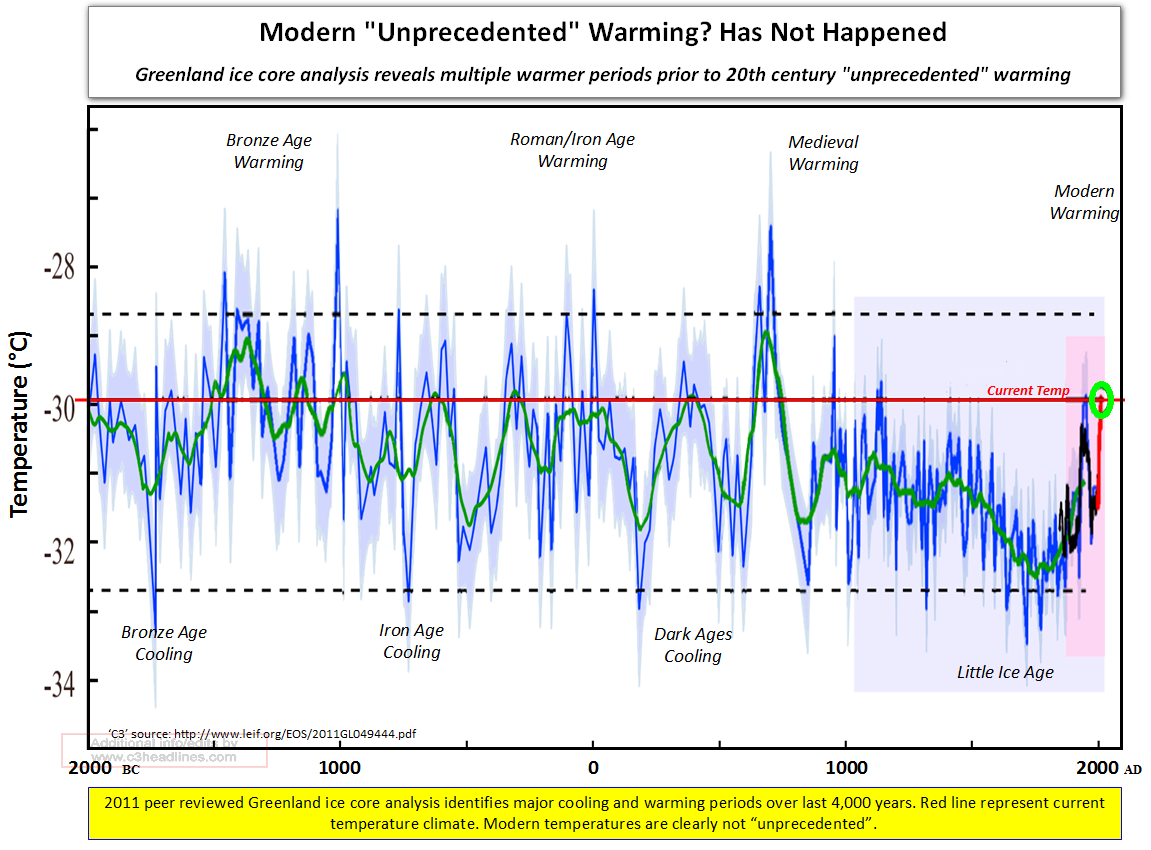
Greenland temperatures (click to enlarge)

It appears that in Greenland at least, the current warming cannot be said to be “unprecedented”, since similar magnitudes and rates of warming are present in several previous eras. Man certainly didn’t cause those warming periods, so natural climate change obviously had a significant effect on Greenland temperatures over the past 4000 years.

In a paper entitled “High variability of Greenland surface temperature over the past 4000 years estimated from trapped air in an ice core” the authors state:

… we reconstruct Greenland surface snow temperature variability over the past 4000 years at the GISP2 site (near the Summit of the Greenland ice sheet; hereafter referred to as Greenland temperature) with a new method that utilises argon and nitrogen isotopic ratios from occluded air bubbles. The estimated average Greenland snow temperature over the past 4000 years was −30.7°C with a standard deviation of 1.0°C and exhibited a long-term decrease of roughly 1.5°C, which is consistent with earlier studies. The current decadal average surface temperature (2001–2010) at the GISP2 site is −29.9°C. The record indicates that warmer temperatures were the norm in the earlier part of the past 4000 years, including century-long intervals nearly 1°C warmer than the present decade (2001–2010). Therefore, we conclude that the current decadal mean temperature in Greenland has not exceeded the envelope of natural variability over the past 4000 years, a period that seems to include part of the Holocene Thermal Maximum. 

However, in order to get it past the pal-review system, the following caveat was inserted to appease the headbangers:

Notwithstanding this conclusion, climate models project that if anthropogenic greenhouse gas emissions continue, the Greenland temperature would exceed the natural variability of the past 4000 years sometime before the year 2100.

Unfortunately, it does little to dampen the effect of the preceding paragraph. Namely even with the additional CO2 presently in the atmosphere and its accepted small warming effect, Greenland was still warmer in the past.

Abstract is here.

(h/t Climate Depot and C3 Headlines)

Man-made climate change "began 3,500 years ago"


The Congo

From The Science is Settled Department comes news that man may have been affecting the climate for far longer than the last 40 years or so. From Scientific American, so you’ll have to wade through the alarmist phraseology:

Humans may have been causing climate change for much longer than we’ve been burning fossil fuels. In fact, the agrarian revolution may have started human-induced climate changes long before the industrial revolution began to sully the skies. How? Through the clearing of forests, which still remains the second-largest source of greenhouse gas emissions from human activity.

Sediment cores from the mouth of the Congo River—the deepest river in the world—suggest that humans may have played a significant role in changing the landscapes of Central Africa. That river curves through the world’s second-biggest lingering tropical forest, but it and its tributaries also flow through the savannas so prized by modern-day safaris.

Scientists had previously thought that a climate shift from warm and humid to seasonally cooler and drier had helped create those savannas, which covered even more of Central Africa in the past. But the 40,000-year-old record preserved in the sediment cores tells a different story. Roughly 3,500 years ago the Congo River suddenly began dumping a lot more muck without any appreciable increase in rainfall to explain such weathering. One plausible explanation is the simultaneous arrival of the so-called Bantu people, who brought farming into the region.

They cultivated oil palm, pearl millet and yams, crops that need plenty of sunlight, which, of course, necessitated clearing forests. They also cut down trees for charcoal and as fuel for the fires of iron-smelting, which enabled them to make tools and weapons. Coupled with climate change, the result was savannas—and mutually reinforcing climate change.

At the same time, the presence of crops such as millet and yams suggests that climate had already changed given that they require alternating seasons of wet and dry. So it remains unclear whether changing climate conditions created the savannas that made Bantu-style farming possible or if Bantu-style farming created the conditions for savannas and changed the climate. What is clear is that “the environmental impact of human population in the central African rainforest was already significant about 2,500 years ago,” as the researchers write in the paper presenting their findings published online in Science on February 9. (source)

Ockham’s Razor would suggest the much simpler explanation: the climate changes by itself, without the need for any man-made intervention. But that would be slightly too inconvenient to contemplate.

Rio Earth Summit "doomed to fail"


Non-event

New Scientist analyses 20 years of climate inaction since the original Earth Summit in Rio in 1992, blaming “government systems” for the failure. Just the incentive we need to “suspend the democratic process” in order to save the planet, perhaps, as extremist Clive Hamilton has suggested.

Climate change has already been airbrushed out of the Rio 2012 summit, and adding this to the embarrassing failures in Copenhagen, Cancun and Durban, it’s pretty clear that the appetite for tackling climate change has all but disappeared. Not surprising really when the economies of Europe and the US are on shaky ground.

And people are slowly waking up to the political machinations and interference which have corrupted the supposedly impartial and unbiased investigation and reporting of climate science. Combine all these factors and further failure is a foregone conclusion:

We can forget about fixing the planet’s ecosystems and climate until we have fixed government systems, a panel of leading international environmental scientists declared in London on Friday. The solution, they said, may not lie with governments at all.

“We are disillusioned. The current political system is broken,” said Bob Watson, the UK government’s chief environmental science advisor, who chaired the meeting.

The panel, all winners of the prestigious Blue Planet prize, often seen as the Nobel prize for environmental science, were meeting to prepare a statement for the Earth Summit 2012, to be held in Rio de Janeiro in June – 20 years after the original Earth Summit in that city.

The world has wasted the intervening years, the group said. Ecosystems are disappearing ever faster, the world is still warming, and two 1992 treaties, on climate change and species loss, have failed to achieve their aims. Governments, the group said, were largely to blame.

“Last time in Rio we had an unreasonable faith in governments. Since then we’ve lost our innocence in believing government was wise and benevolent and far-sighted. That’s been blown completely out of the water,” said Camilla Toulmin, director of the International Institute for Environment and Development, a non-profit organisation based in London.

“Essentially nothing has changed in 20 years. We are not remotely on a course to be sustainable,” Watson said.

“What’s most discouraging is a loss of feeling that government would help us,” said Harold Mooney, a veteran biologist from Stanford University.

No one held out much hope that the forthcoming summit would usher in a new era. Politicians do not seem interested. The 1992 summit lasted two weeks, attracted most of the world’s leaders and garnered huge headlines. But this year’s event will last just three days, and so far China’s president Hu Jintao is the only head of state scheduled to attend. 

Never mind. I’m sure the delegates will have a wonderful time at someone else’s expense. And hints at “changing the system” sneak in:

We do believe that the political system can be reformed, and that there will be technical solutions. But time is not on our side,” Watson said. (source)

Wonder what that means…

US approves first new nuclear power plant in 34 years


Constructing the containment vessel

Why? Because nuclear power is safe, clean, reliable and efficient – and produces zero CO2 emissions. Contrast with “renewables” which are horrifically expensive, unreliable and inefficient, and require CO2-belching fossil fuel backup. And wind turbines shred rare birds.

And with the hysteria surrounding Fukushima, which resulted in the most astonishing fear-through-ignorance anti-nuclear knee-jerk reaction from many countries, it demonstrates that at least the US is taking its energy security seriously, and is not prepared to rely on hopeless renewables to keep the lights on.

The United States’ first new nuclear power plant in a generation has won approval after federal regulators voted on Thursday to grant a licence for two new reactors at a site in eastern Georgia.

Atlanta’s Southern Co hopes to begin operating the $14 billion reactors at its Vogtle site, south of Augusta, as soon as 2016. The Nuclear Regulatory Commission (NRC) approved the company’s plans on a 4-1 vote.

The NRC last approved construction of a nuclear plant in 1978, a year before a partial meltdown of the Three Mile Island nuclear plant in Pennsylvania. That accident raised fears of a radiation release and brought new reactor orders to a near halt.

The planned reactors, along with two others in South Carolina expected to win approval in coming months, are the remnants of a once-anticipated building boom that the power industry dubbed the “nuclear renaissance”. The head of an industry lobbying group said the Vogtle project could be the start of a smaller renaissance that expands nuclear power in the United States.

“This is a historic day,” said Marvin Fertel, president and CEO of the Nuclear Energy Institute. He said the NRC vote “sounds a clarion call to the world that the United States recognises the importance of expanding nuclear energy as a key component of a low-carbon energy future that is central to job creation, diversity of electricity supply and energy security”.

President Barack Obama and other proponents say greater use of nuclear power could cut the nation’s reliance on fossil fuels and create energy without producing emissions blamed for global warming. The Obama administration has offered the Vogtle project $8.3 billion in federal loan guarantees as part of its pledge to expand nuclear power. (source)

If the climate catastrophe is half as serious as claimed, nuclear is the ONLY option for energy security.

Quotes of the Day: Michael Mann


Quote of the Day

Michael “Hockey Stick” Mann has a new book out, the title of which, The Hockey Stick and the Climate Wars: Dispatches from the Front Lines“, hints at the valiant warrior for truth, battling against the evil enemy (sceptics). As we know, this is standard fare for alarmists, donning the mantle of victimhood at the drop of an FOI request.

But this quote takes the biscuit:

“Perhaps “climategate” was the moment when the climate change denial movement conceded the legitimate debate, choosing instead to double down on smear and disinformation, a tacit acceptance that an honest, science-based case for denying the reality of human-caused climate change and the threat it presents could no longer be made.”

Wow, this guy’s been hanging around with trees for too long. And this as well:

“In any case, there is no evidence that Jones actually deleted any e-mails. Nor is there any evidence of any impropriety in his e-mails.”

And they accuse the sceptics of being delusional… Thanks to Tom Nelson for the quotes.