
Australian graphic (Click to enlarge)
Chris Merritt, Legal Editor, writes today in the Weekend Australian of the ABC’s failure to correct their report of 4 June 2011, which claimed that ANU scientists had received “death threats” in the six months prior to the report:
THE accuracy of the ABC’s reporting on climate change has been called into question by an activist who uncovered documentary evidence that undermines one of the national broadcaster’s most sensational reports on the subject.
Climate change blogger Simon Turnill told The Weekend Australian the contents of 11 emails he uncovered using the Freedom of Information Act were at odds with last year’s ABC report that death threats had been made against climate scientists at the Australian National University.
Then, when the ABC reported on the contents of those emails after they were uncovered, it did so in a manner that he regarded as being incomplete. The ABC neglected to include the key fact that there was no evidence in those emails of death threats at ANU, contrary to previous ABC reports. Mr Turnill said he was disappointed but not surprised because he believed the ABC’s approach to climate change “toes the consensus line” and anyone who challenged the orthodoxy received short shrift.
The original ABC article read:
Several of Australia’s top climate change scientists at the Australian National University have been subjected to a campaign of death threats, forcing the university to tighten security.
Several of the scientists in Canberra have been moved to a more secure location after receiving the threats over their research.
Vice-chancellor Professor Ian Young says the scientists have received large numbers of emails, including death threats and abusive phone calls, threatening to attack the academics in the street if they continue their research.
He says it has been happening for the past six months and the situation has worsened significantly in recent weeks. (source)
But instead of conceding that there were no death threats to ANU scientists in the period referred to in the original story, the ABC merely repeated the claim that the emails contained abuse, conveniently forgetting that the original article referred specifically to “death threats”:
The Australian National University has released a series of abusive and threatening emails which were sent to its climate change scientists.
The 11 emails to members of the university’s Climate Change Institute have been made public after a Freedom of Information request. (source)
In reality, only 2 of the 11 emails were seriously abusive (of the crank “f*ck you” variety), with the majority containing language that could simply be viewed as passionate disagreement. Not one single email contained a “death threat”. The ABC has not clarified or corrected the following claim either, which appears in the same article:
One email, dated June 2, 2010, describes a threat to use a gun against an academic because a conference participant reportedly disagreed with the climate change research.
It has subsequently been revealed that the discussion in question related to kangaroo culling in the ACT, and the claim that it was a “threat to use a gun against an academic” is fiction. [Also, why was this email even included in the ANU’s FoI release? It occurred well before the six month period in question – Ed]
The Weekend Australian also reports that ABC’s Media Watch intends to report on the matter on Monday:
While accepting Mr Pilgrim’s findings that the 11 emails did not contain any death threats, Media Watch supervising producer Amy Donaldson asks how this newspaper could conclude that other alleged threats outlined in The Canberra Times had also been debunked.
While The Australian’s reporting had focused on Mr Turnill’s FOI investigation, Ms Donaldson asked why this newspaper had not approached other climate scientists. The parameters of Mr Turnill’s FOI request had been heavily influenced by the six-month timeframe used in the original ABC report asserting that there had been death threats at ANU.
Late yesterday, this newspaper sent questions of its own to Media Watch seeking a response from presenter Jonathan Holmes on whether he saw his role as defending climate change orthodoxy? Holmes replied: “No. The program’s role is to apply accepted journalistic standards to the output of the Australian mainstream media.”
Sounds all very reasonable. But, unfortunately, we know for a fact that Holmes is a believer in catastrophic man-made climate change, and has written about News Limited’s coverage of the issue in the past:
The evidence for climate change, since then [2007], has only got stronger. The reasons for taking precautionary action have only become more compelling. Of course News Ltd can’t, on its own, affect the global climate by reducing its carbon footprint, and nor can Australia. But if every company, and every nation, acted – or refrained from acting – on the basis of that logic, the chances of eventually stabilising global temperatures at less than catastrophic levels would be reduced to zero.
You have to be an alert and habitual reader to notice that week after week, year after year, The Australian and The Weekend Australian massage their news coverage and grossly unbalance their opinion pages so as to send the message that the existence of human-induced climate change is highly debatable, and that any action by Australia to reduce its emissions would be economically ruinous and politically foolish. (source)
And thankfully, Weekend editor Nick Cater spells it out:
“Media Watch’s flaw is that it is vulnerable to capture by its presenters’ pet obsession. Jonathan Holmes has taken a neutral stance on most issues, but on climate change he has clearly fallen victim to ABC group think.”
One has to ask, who benefits from this “death threat” story anyway? And who suffers? Clearly, the climate scientists who are portrayed as the victims of this campaign will be viewed sympathetically, whilst the story also helpfully demonises anyone who questions the consensus view on climate as a crackpot who would go to the extreme measures of sending death threats to silence debate.
Last week’s Media Watch headline reads “Sensational stories invite serious scrutiny”. I wonder if the ABC’s sensational (and inaccurate) story of death threats at ANU will receive the same treatment?
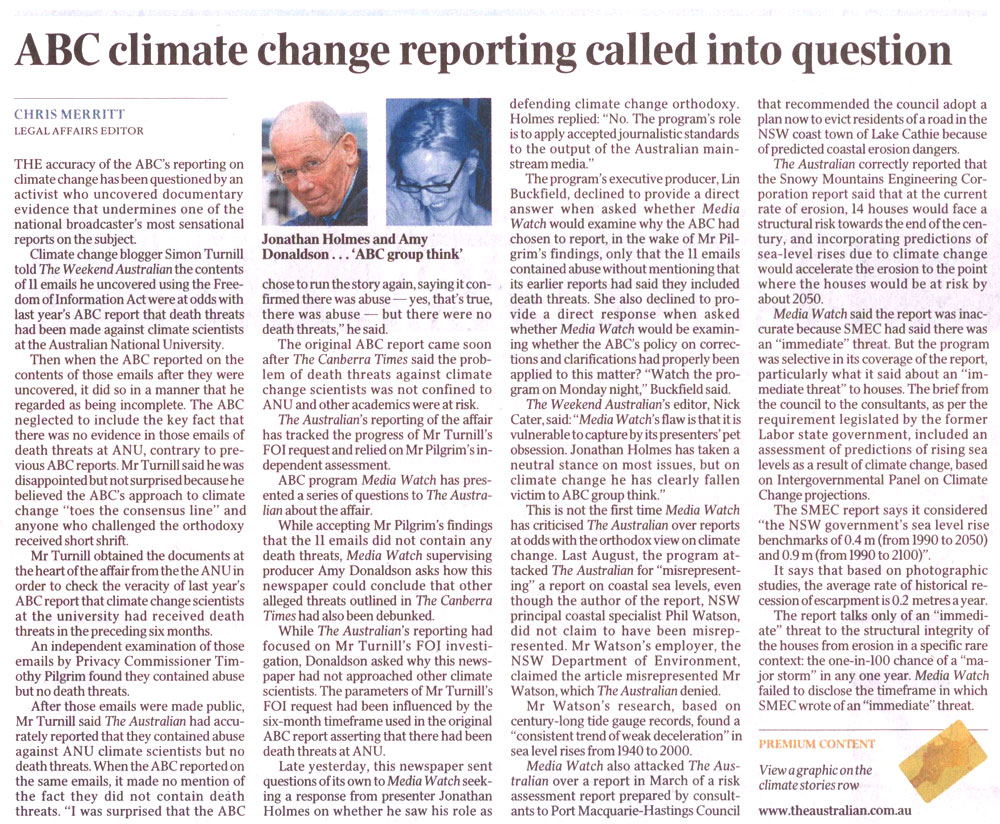
Weekend Australian, p3, 19 May 2012








 Australian Climate Madness
Recent Comments