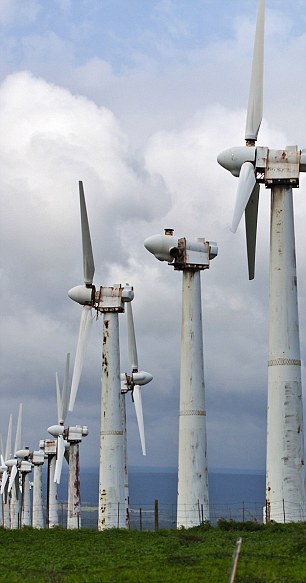
Fitting end?
Wind power sums up green stupidity: it’s expensive, inefficient and ugly. And those are just the good points. It’s also utterly useless.
As such it is a perfect monument to the Greens – in a few years time the turbines will be silent, rusting away, unloved, past their sell-by date, and abandoned.
Yesterday, Bjørn Lomborg wrote in The Australian:
The use of wind turbines has increased tenfold during the past decade, with wind power often touted as the most cost-effective green opportunity. According to Connie Hedegaard, the European Union’s Commissioner for Climate Action, “People should believe that (wind power) is very, very cheap.”
In fact, this is a highly problematic claim. While wind energy is cheaper than other, more ineffective renewables, such as solar, tidal, and ethanol, it is nowhere near competitive. If it were, we wouldn’t have to keep spending significant sums to subsidise it. (source)
And earlier this month, the Global Warming Policy Foundation released a scathing report on the state of wind energy in the UK:
One of the UK’s leading energy and environment economists warns that wind power is an extraordinarily expensive and inefficient way of reducing CO2 emissions. In fact, there is a significant risk that annual CO2 emissions could be greater as a result of Britain’s flawed wind policies when compared with the option of investing in efficient and flexible gas combined cycle plants.
…
“The key problems with current policies for wind power are simple. They require a huge commitment of investment resources to a technology that is not very green, in the sense of saving a lot of CO2, but which is certainly very expensive and inflexible. Unless the current Government scales back its commitment to wind power very substantially, its policy will be worse than a mistake, it will be a blunder.” (source)
And the UK Daily Mail reports on the rusting wind farms on Hawaii (pictured):
If any spot was tailor-made for a wind farm it would surely be here. The gales are so strong and relentless on the tip of South Point that trees grow almost horizontally.
Yet the 27-year-old Kamaoa Wind Farm remains a relic of the boom and inglorious bust of America’s so-called ‘wind rush’, the world’s first major experiment in wind energy.
At a time when the EU and the British Government are fully paid-up evangelists for wind power, the lesson from America — and the ghostly hulks on this far-flung coast — should be a warning of their folly. (source)
But no one’s listening. The mad dash to cover the landscape with wind turbines is a result not of careful consideration, but naive environmental ideology. And now Australian industry is suffering as a result:
STALLED investment in renewable energy has forced the country’s largest wind farm tower manufacturer to seek voluntary redundancies from up to 100 of its 450 staff.
Keppel Prince, based in Portland, in southwest Victoria, has experienced a drop in demand for wind farms while the other core part of its business, maintenance of Alcoa’s local aluminium smelter, is also suffering.
General manager Steve Garner said the wind farm work would dry up in the next two months as production finished for the 140-turbine Macarthur wind farm and a smaller 13-turbine project.
“The wind energy industry’s promise of ‘project, project, project’ just hasn’t materialised,” he said. “There are just so many projects that are still in a state of limbo waiting to try and secure funding.”
The optimism of green energy companies has dimmed since the carbon tax legislation was passed last year, amid political uncertainty and growing concern over the forthcoming review of the 20 per cent by 2020 renewable energy target. The oversupply of renewable energy certificates has also held electricity retailers back from new investment. (source)
The unpalatable reality is that all renewable energy sources available at the moment are hideously uncompetitive and require massive government subsidies. If just a few percent of the billions (trillions?) wasted on climate mitigation globally were directed towards intensive research for genuinely effective and inexpensive renewable energy, we might make some progress (hint: it isn’t wind, solar, geothermal…)








 Australian Climate Madness
Recent Comments