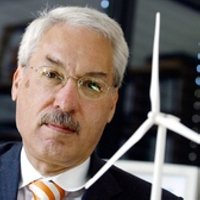
US approves first new nuclear power plant in 34 years


Constructing the containment vessel

Why? Because nuclear power is safe, clean, reliable and efficient – and produces zero CO2 emissions. Contrast with “renewables” which are horrifically expensive, unreliable and inefficient, and require CO2-belching fossil fuel backup. And wind turbines shred rare birds.

And with the hysteria surrounding Fukushima, which resulted in the most astonishing fear-through-ignorance anti-nuclear knee-jerk reaction from many countries, it demonstrates that at least the US is taking its energy security seriously, and is not prepared to rely on hopeless renewables to keep the lights on.

The United States’ first new nuclear power plant in a generation has won approval after federal regulators voted on Thursday to grant a licence for two new reactors at a site in eastern Georgia.

Atlanta’s Southern Co hopes to begin operating the $14 billion reactors at its Vogtle site, south of Augusta, as soon as 2016. The Nuclear Regulatory Commission (NRC) approved the company’s plans on a 4-1 vote.

The NRC last approved construction of a nuclear plant in 1978, a year before a partial meltdown of the Three Mile Island nuclear plant in Pennsylvania. That accident raised fears of a radiation release and brought new reactor orders to a near halt.

The planned reactors, along with two others in South Carolina expected to win approval in coming months, are the remnants of a once-anticipated building boom that the power industry dubbed the “nuclear renaissance”. The head of an industry lobbying group said the Vogtle project could be the start of a smaller renaissance that expands nuclear power in the United States.

“This is a historic day,” said Marvin Fertel, president and CEO of the Nuclear Energy Institute. He said the NRC vote “sounds a clarion call to the world that the United States recognises the importance of expanding nuclear energy as a key component of a low-carbon energy future that is central to job creation, diversity of electricity supply and energy security”.

President Barack Obama and other proponents say greater use of nuclear power could cut the nation’s reliance on fossil fuels and create energy without producing emissions blamed for global warming. The Obama administration has offered the Vogtle project $8.3 billion in federal loan guarantees as part of its pledge to expand nuclear power. (source)

If the climate catastrophe is half as serious as claimed, nuclear is the ONLY option for energy security.

Quotes of the Day: Michael Mann


Quote of the Day

Michael “Hockey Stick” Mann has a new book out, the title of which, The Hockey Stick and the Climate Wars: Dispatches from the Front Lines“, hints at the valiant warrior for truth, battling against the evil enemy (sceptics). As we know, this is standard fare for alarmists, donning the mantle of victimhood at the drop of an FOI request.

But this quote takes the biscuit:

“Perhaps “climategate” was the moment when the climate change denial movement conceded the legitimate debate, choosing instead to double down on smear and disinformation, a tacit acceptance that an honest, science-based case for denying the reality of human-caused climate change and the threat it presents could no longer be made.”

Wow, this guy’s been hanging around with trees for too long. And this as well:

“In any case, there is no evidence that Jones actually deleted any e-mails. Nor is there any evidence of any impropriety in his e-mails.”

And they accuse the sceptics of being delusional… Thanks to Tom Nelson for the quotes.

Himalayan glaciers "melting ten times more slowly than feared"


Embarrassing

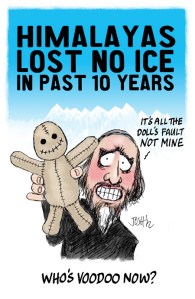
UDPATE: Cartoon by Josh, right.

Remember the IPCC melting glacier scare? Gone by 2035? Glaciergate? It made great publicity for the alarmists. Sadly it was total rubbish. And now further studies reveal that the melting is fully ten times slower than previously thought.

But it’s still bad news, naturally. They’re still melting. Just an order of magnitude more slowly than we had previously been led to believe, as the ABC reports:

Himalayan glaciers and ice caps that supply water to more than a billion people in Asia are losing mass up to 10 times less quickly than once feared, according to a new study.

Based on an improved analysis of satellite data from 2003 to 2010, the findings offer a reprieve for a region already feeling the impacts of global warming.

But they do not mean that the threat of disruptive change has disappeared, the researchers warn. [Of course, any good news has to be tempered with a reminder that the planet is going to hell in a handcart – Ed]

“The good news is that the glaciers are not losing mass as fast as we thought,” says Professor Tad Pfeffer of theUniversity of Colorado‘s Institute of Arctic and Alpine Research and a co-author of the study.

“The bad news is that they are still losing a lot of water. There is still definitely a serious problem for the Himalayas.”

Much of that loss, it turns out, is taking place in the huge plains immediately south of the towering mountain range, where pumping from wells is draining ancient aquifers far faster than precipitation can replenish them.

Earlier estimates, also based on satellite data, mistakenly attributed much of the draining of these water tables to glacier melt-off, says Pfeffer.

So the attribution of the cause was wrong too.

Other calculations now thought to be off the mark were based on scaled-up extrapolations from lower-elevation glaciers that were more accessible to observation, but also more subject to warming trends.

“Many of the high glaciers would still be too cold to lose mass even in the presence of atmospheric warming,” says co-author John Wahr, a physicist at the University of Colorado. (source)

And of course, none of this says anything about the cause of the warming. Amazing that the ABC reported this, but at least the spin cycle made sure that any good news was diluted by more hectoring warnings of disaster.

Even more dire warnings at the press release here.

More at the UK Guardian here, where it is claimed that “the worlds greatest snow-capped peaks have lost no ice in the last ten years”.

Challenge to UK's Royal Society


Sold out?

The Royal Society is (was?) one of the most respected scientific institutions. However, in recent years, and like many other similar organisations around the world, it has sold out to climate alarmism and has abandoned its guiding principles of championing impartial scientific enquiry. Even its motto, Nullius in verba, meaning “take no one’s word for it”, looks forlorn and lost surrounded as it is by a fog of political posturing and environmental advocacy.

Andrew Montford, the author behind the Bishop Hill blog and The Hockey Stick Illusion has prepared a report for the Global Warming Policy Foundation:

The Global Warming Policy Foundation (GWPF) is calling on the Royal Society to restore a culture of open-mindedness and balanced assessment of climate science and climate policy.

In a new GWPF report, written by science author Andrew Montford, the Royal Society is urged to ensure that genuine controversies are reflected in its public debates and reports and that the full range of reputable scientific views are being considered.

“As the Society’s independence has disappeared, so has its former adherence to hard-nosed empirical science and a sober detachment from the political process. Gone are the doubts and uncertainties that afflict any real scientist, to be replaced with the dull certainties of the politician and the public relations man,” said Andrew Montford, author of the new report.

In his report, Andrew Montford describes the development of the Royal Society’s role in the climate debates since the 1980s. He shows the Society’s gradual closing of critical scrutiny and scientific impartiality and the emergence of an almost dogmatic confidence that climate science is all but settled.

In recent years, the Society has issued a series of highly political statements demanding drastic action on energy and climate policies from policy makers and governments. On the issue of climate change, it has adopted an increasingly political rather than scientific tone. Instead of being an open forum for informed scientific debate, the Society is at risk of turning into a quasi-political campaign group.

The GWPF report criticises the Society for being too narrow minded in its assessment of climate change and for failing to take into account views of eminent scientists and policy experts that do not accord with its own position.

In his foreword to the report, Professor Richard Lindzen (MIT), one of the world’s most eminent atmospheric scientists, warns that “the legitimate role of science as a powerful mode of inquiry has been replaced by the pretence of science to a position of political authority.”

The report can be downloaded here (PDF).

Media ownership: lefties good, conservatives bad


Global wail

The hypocrisy of the media knows no bounds. Whilst the liberal elite have been hyperventilating over Gina Rinehart’s purchase of a share in Fairfax, with Left-wing media outlets such as the Silly Moaning Herald and Crikey publishing acres of copy criticising and smearing as only the Left can, there is a deafening silence when Graeme Wood, founder of travel website wotif.com and bankroller of the Greens, rounds up a bunch of ex-Fairfax and ex-ABC journos to launch, er, a media organisation.

The excellent blog Bunyipitude has exposed this hypocrisy beautifully:

The incantation worked, Monica Attard’s portal finally opened and allowed The Professor to slip in and find …. why leftists love Malcolm Turnbull, the scourge of air conditioning, why Occupisants need to make more noise, and how Bob’s little boy, Eric Ellis, is eating Europe. (Ellis deserves a nice jaunt, by the way. He must be exhausted after churning out the sophistries needed to elevate Wayne Swan’s reputation with a 32-quid tin plate and the title of the World’s Hottest Treasurer.)

This is revolutionary stuff. Brave, courageous, daring to go where only the Phage [The Age], Silly [SMH], The Conversation, SBS, The Drum, Q&A, Lateline, New Matilda, Lavatorius Pronto [Larvatus Prodeo], Crikey and poor Margo have gone before. (source)

Wonderful. And there’s plenty more:

THE Globular Mail isn’t impressing the pros. No comments, no links to source material, and its crab-like sideways crawl is rated a huge annoyance. Here is one observation from the Technology Spectator’s critique:

If Global Mail readers wish to provide feedback or comment or add to a story they must email the publisher. “Please note that while we appreciate all feedback, we do not guarantee all letters will appear on the website,” proclaims the site – as if it’s readers had dipped nib into ink and crafted their comment on parchment. The Global Mail’s stated desire to step back from the “breathless 24/7 news cycle” is admirable and should help ensure a high standard of quality. But applying old media models that drive one-way conversation to a new media platform won’t help the Global Mail build a loyal following.

Also interesting is author Chris Palmer’s news that patron Graeme Wood owns most of Hunted Media, the outfit responsible for the Global Mail’s, er, innovative horizontal design. So, not only does Wood list the “impartial” Global Mail as his email address on forms declaring seven-figure donations to the Greens, he also is supporting the site out of one pocket and slipping the development cash into another.

If Gina Rinehart begins to make her presence felt at Fairfax, we can expect to hear lots of luvvie suggestions that the company be wrested from her control and run as an employee co-operative. Few luvvies have to balance books, pay taxes or meet a weekly payroll, but they always imagine their unique brand of competence would see things done better. This may be because luvvies enjoy nothing so much as a good meeting, but their compulsion to rabbit on in the company of the like-minded is a topic for another day.

They should keep an eye on the developing, gold-plated debacle that is the Global Crab and think again — if they have ever thought before, that is. (source)

I highly recommend a bookmark.

UPDATE: And of course the Leftard lemmings at GetUp! are in on the action as well… see here.

Varhrenholt: "I feel duped on climate change"


Fritz Vahrenholt

More spectacular publicity from Germany for a high profile convert to scepticism. We posted on Fritz Vahrenholt, and his book, “The Cold Sun”, at the end of last month. Now Spiegel Online carries an interview with the renewable energy executive and former global warming disciple:

SPIEGEL: Do you seriously believe that all 2,000 scientists involved in the IPCC are deluded or staying true to the official line?

Vahrenholt: It’s not like that. However, I am critical of the role played by the handful of lead authors who take on the final editing of the report. They claim that they are using 18,000 publications evaluated by their peers. But 5,000 of them are so-called gray literature, which are not peer-reviewed sources. These mistakes come out in the end, just like the absurd claim that there will no longer be any glaciers in the Himalayas in 30 years. Such exaggerations don’t surprise me. Of the 34 supposedly independent members who write the synthesis report for politicians, almost a third are associated with environmental organizations like Greenpeace or the WWF. Strange, isn’t it?

SPIEGEL: Why are you taking on the role of the climate rebel with such passion? Where does this rage come from?

Vahrenholt: For years, I disseminated the hypotheses of the IPCC, and I feel duped. Renewable energy is near and dear to me, and I’ve been fighting for its expansion for more than 30 years. My concern is that if citizens discover that the people who warn of a climate disaster are only telling half the truth, they will no longer be prepared to pay higher electricity costs for wind and solar (energy). Then the conversion of our energy supply will lack the necessary acceptance.

SPIEGEL: If we take your book to its logical conclusion, it will be unnecessary to reduce CO2 emissions at all.

Vahrenholt: No. Even a temperature increase of only one degree would be a noticeable change. But I am indeed saying that climate change is manageable because the cooling effects of the sun and the ocean currents give us enough time to prepare. In any case, it will be easy for us in Germany to adjust.

SPIEGEL: So, is it a mistake to concentrate exclusively on the reduction of carbon dioxide?

Vahrenholt: Yes. In addition to carbon dioxide, we also have black soot, for example. It creates 55 percent of the warming effect of CO2, but it could be filtered out with little effort within a few years, especially in emerging and developing countries. And, in doing so, we would achieve huge benefits for human health.

Read it all here.

WSJ: "When you're a hammer, everything looks like a nail"


WSJ Online

Some wonderful letters in the Wall Street Journal in response to Trenberth et al‘s response to that letter:

As for Mr. Trenberth’s heart-surgeon analogy: You might be better off consulting an intelligent generalist, probably not a dentist, but a primary-care physician who could recommend exercise and diet change before undergoing unnecessary and potentially dangerous surgery. Heart surgeons tend to recommend surgery more often than nonsurgeons because specialists are easily biased by their specialization. When you’re a hammer, everything looks like a nail.

The letter from Kevin Trenberth and his colleagues is straight out of the Saul Alinsky playbook: Marginalize your opponents by demeaning them (“dentists practicing cardiology”); state your position without definitive support (“observations show unequivocally” and computer models show); explain away statements that compromise your position by claiming they were taken out of context; restate your position in such a manner that it looks as if the issue is settled, even when it isn’t (“the science is clear: The world is heating up and humans are primarily responsible”) and then restate it again because if you say it often enough, people just might believe it (“climate change is real and human caused”); and, finally; call for federal funding to remedy the apparent impending crisis (“investing in the transition to a low-carbon economy . . . [is] just what the doctor ordered”). No thanks. I’m glad we got a second opinion, even if it was from a dentist.

The Trenberth letter is little more than an appeal to authority masquerading as a scientific argument. It casts no light, therefore, on the actual substance of the issues, particularly given the corruption of the peer-review process made clear by the East Anglia University emails. The most revealing sentence in the Trenberth letter is the statement that computer models show that smaller increases in surface temperatures are accompanied by warming “elsewhere in the climate system.” Sorry, computer models do not “show” anything. They make predictions that must be tested against the evidence, which in the global-warming context is deeply problematic. Mr. Trenberth’s models may be a magnet for government grants, but their usefulness for policy is far from clear.

Great stuff. Read them all here.

Island states want "climate justice"


Sinking?

Island states that claim they are being threatened by “climate change” are considering taking the matter to the International Court of Justice:

The International Court of Justice should take action against states unwilling to combat the causes of climate change, according to the President of the Pacific island of Palau.

President Johnson Toribiong was speaking [link to UN document] at the United Nations Headquarters in New York, after meeting the Prime Minister of Grenada to discuss his proposals.

The Palau President wants the International Court of Justice to force states to take action to cut their carbon emissions – a plan he first announced to the General Assembly in September 2011.

“While we continue to negotiate, we should renew our faith in a system of law that has guided States’ actions in the past and gives them legitimacy today,” he said.

“The rule of law must reflect the interests of the entire international community – for us, it’s about survival.”

The proposal would see the International Court of Justice provide an advisory opinion on damages from climate change, a move the President insists would complement the UNFCCC’s efforts to build a binding treaty through negotiation.

Palau’s Permanent Representative to the UN Stuart Beck says roads are unusable and staple crops have been threatened in Palau and other Pacific nations because of the rising sea waters. (source)

An opportunity to get the climate alarmists’ case before a court to be cross-examined in a judicial environment sounds too good to miss. The claimants will have to prove an extremely long chain of causation, namely that the rising sea levels are a result of rising temperatures, which are themselves a result of increased CO2 emissions, which are a result of man’s burning of fossil fuels.

They will also hope they can explain away all the confounding factors – natural climate change, solar variation, sinking landmasses – that might break that chain.

Some states, like the Maldives, will need to explain why they are building new airports whilst at the same time claiming compensation for sinking islands…

Good luck with that. Although with the UN on their side, justice will no doubt disappear out of the window…

Cambridge Engineering professor on climate


Mike Kelly

Richard Black has a piece up at the BBC about consensus in which his shaky point (I think) is that sceptics are just as bad as alarmists because they keep saying that the “consensus” is broken – or something – thereby acknowledging that consensus is important – or something.

Black is an eco-headbanger, so despite relying on the existence of the “consensus” for the last billion articles or so to justify his AGW alarmism, suddenly he’s happy to throw it under a bus if it gives him the opportunity to diss a few crazy deniers. Weird.

Anyway, what was of more interest to me (having read Engineering at Cambridge a fairly long time ago) was the views of one of its current professors, Michael Kelly, one of the signatories of that WSJ letter, whom Black interviewed for the article:

His basic position is that the kind of energy transformation through which the UK, for example, is planning to go is really tough to achieve in engineering terms, and would be financially ruinous.

To meet the goals of the Climate Change Act (notably an emissions cut of 80% from 1990 levels by 2050) he argues that “we’d really need a command economy of the kind we had in World War 2 if we were really serious about meeting the targets in full.

“What we need to do will bankrupt us if we really go for it and ignore the rest of the world.”

He would, he says, still endorse the rapid transformation if he thought the scientific evidence for needing it was compelling.

“Are you convinced that the world’s going to hell in a handbasket on the basis of the predictions and what’s been happening for the last 10 or 12 years?

“The answer is simply ‘no’.

“I look back 300 years and I find that the temperature went up by more than it’s gone up recently – in Central England from about 1699 to 1729 it went up by nearly 2C – and nobody said that was carbon dioxide.”

(UPDATE by Black: The full CET time series is graphed here, while one of the original science papers on analysis of its early years is here)

Other components of his argument are that money is better spent on aid to Africa than on a dash to renewables, that higher CO2 levels will boost plant growth, that current climate models are not trustworthy – in particular, because they project an acceleration of warming whereas over the last 17 years we have seen a deceleration – and that wind turbines may be left derelict in future when the cost of replacing the nascelles proves uneconomic.

He also cites a recent study on ocean acidification showing that natural short-term variability in ocean pH is greater than the change in the average projected to occur over the next century or so.

And he has a bet with other Fellows of the Royal Society that temperatures during the current decade will be lower, on average, than during the preceding one, the stake being a case of wine.

All of the points above are challengeable, and – playing Devil’s advocate – I did challenge him on some.

What we agreed on is that formulating climate change polity is first and foremost a question of risk judgement.

In Prof Kelly’s view, the risks of rushing into a low-carbon future, as opposed to taking the transition more slowly, outweigh the risks of not doing so; hence the WSJ article’s title, “No need to panic”.

I’m sure his arguments will find favour with many regular readers, and equally infuriate many others who contend that political leaders aren’t panicking enough.

But it is surely the arguments themselves that ought to be the focus for discussion – not what they purport to say about a cracking consensus. (source)

Suddenly it’s all about the arguments and not about consensus. How amusing, especially coming from Black.

Bob Carter's Climate Review Part 2


Climate sense

Part 2 of Bob Carter’s Climate Review in Quadrant Online is now available:

January to June, 2011

Stimulated by research spending of billions of dollars, inexorably, and month by month. torrents of new scientific information appear that are relevant to the twin issues of global warming and climate change.

No one scientist, or group, can possibly absorb and précis accurately the full range of this literature, though valiant efforts are made both by the IPCC and by its essential counterpart, the Non-governmental International Panel on Climate Change(NIPCC).

To date, research findings are consistent with a largely natural, though still incompletely understood, origin for modern climate change. Discounting virtual reality computer model studies, no recent paper has provided empirical evidence that dangerous human-caused global warming is occurring; and neither the atmosphere nor the ocean are currently warming despite the continuing increases in atmospheric carbon dioxide.

With no pretence of being comprehensive, Parts II and III of this Review provide summaries of a representative selection of events, enquiries and new scientific publications that occurred in 2011 and were germane to the topic of global warming.

33 of these events are analysed, presented in the monthly order in which they occurred. A hot-linked index of selected topics, also arranged in date order to match the text, is here.

Provided in parallel, too, are monthly examples of some of the often painfully conflicting, and at times exquisitely ironic, political statements that accompanied the bulldozing of carbon dioxide policy through the Australian parliament, and finally into law on November 8th.

Read it here.

Part 1 is here.