US: Democrats' threat to cap and trade bill


On the way out?

Democrats in the US are “lining up” to argue against Obama’s Cap ‘n’ Trade bill in the wake of the non-existent outcome at Copenhagen. If the US bill is sunk, or watered down significantly, the whole face of global climate action will change radically.

Less than ten days after claiming a breakthrough on climate change in Copenhagen President Obama is facing a mutiny from senior Democrats who are imploring him to postpone or even abandon his cap-and-trade Bill.

Democratic Senators, fearful of a drubbing in the mid-term elections next year, are lining up to argue for alternatives to the scheme that is the centrepiece of the carbon reduction proposals that Mr Obama hopes to sign into law. With the Congressional battles over Mr Obama’s healthcare reforms fresh in their memory senior Democrats are asking the Administration to postpone the next big climate change push until at least 2011.

Senators from Louisiana, Indiana, Nebraska and North Dakota, some with powerful energy companies among their constituents, are falling out of love with the idea of a large-scale cap-and-trade scheme — which seeks to allocate tradeable permits to major polluters — in favour of less ambitious proposals that put jobs and the economy first.

Each of their Senate votes is vital for any climate change Bill to have a chance of being passed, and a firm American commitment to cap and trade is essential for similar carbon reduction mechanisms to be effective on a global scale.

Interesting times.

Read it here.
Carbon Sense: Climate crusaders conned in Copenhagen


Carbon Sense Coalition

From Viv Forbes at the Carbon Sense Coalition:

The Carbon Sense Coalition today called on the Australian Parliament to repudiate the Copenhagen giveaways promised by PM Rudd to the failed states of Africa and the welfare beggars of the islands.

The Chairman of “Carbon Sense”, Mr Viv Forbes, said that the three Climate Crusaders, Obama, Brown and Rudd, had been comprehensively conned in Copenhagen by African mendicants and fakers from the islands.

“They have agreed to hand over mega-bucks of our money (anywhere from $5 billion to $100 billion) as compensation for alleged damage caused by our production of carbon dioxide – the Africans citing climate damage and the islanders claiming rising sea levels.

“Even a cursory examination of the facts would prove that both of these claims are fraudulent.

“There is no evidence that carbon dioxide has caused global warming, or causes damage to any aspect of life on earth. The vast majority of earth’s warming originates from the sun, and fluctuations there are the major cause of climate changes.

“In addition, careful recent surveys show no unusual rising of sea levels.

“Moreover, all plant and animal life on earth benefit from industry’s production of carbon dioxide. Crops, grasses, forests and fruit trees are growing more profusely, the planet is becoming greener, and the oceans can produce more algae, more plankton and more life – all because of this free bounty of aerial plant food released whenever carbon fuels are burnt.

“Carbon dioxide is not a pollutant – it is a boon to all mankind. Africa and the islanders should pay us to release more valuable carbon dioxide, not the reverse.

“This giveaway is just a back door extension of the foreign aid program which has done so much harm to both donors and recipients.

“The vast majority of mendicant African nations have sterilised vast agricultural and mineral resources by their failed political systems. The foreign aid has mainly assisted their dictatorial governments to stay in power, harm their people and amass ill-gotten wealth.

“To increase the resources controlled by these dictators does nothing to improve the lot of their ordinary citizens.

“What they need is not welfare or climate compensation, but investment funds, low cost reliable energy, efficient infrastructure, sound currency, fair taxation and secure property rights.”

Source (PDF).

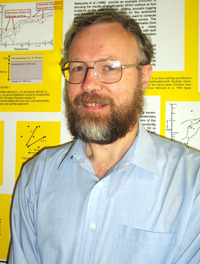
Michael Asten: cautious on CO2 causation


Climate sense

Writing in The Australian, Michael Asten again questions the climate science orthodoxy in an excellent article (his earlier article was posted here). Here he addresses the Palaeocene-Eocene thermal maximum, a time when CO2 levels rose sharply and temperatures also rose, often cited by the warmists as “proof” that CO2 causes rapid and dangerous warming:

I argue there are at least two possible hypotheses to explain the data in this study: either the link between atmospheric CO2 content and global temperature increase is significantly greater (that is, more dangerous) than the existing models show or some mechanism other than atmospheric CO2 is a significant or the main factor influencing global temperature.

The first hypothesis is consistent with climate change orthodoxy. Recent writings on climate sensitivity by James Hansen are consistent with it, as was the Intergovernmental Panel on Climate Change in its pre-Copenhagen update, The Copenhagen Diagnosis.

Indeed, the 26 authors of the IPCC update went a step further, and encouraged the 46,000 Copenhagen participants with the warning: “A rapid carbon release, not unlike what humans are causing today, has also occurred at least once in climate history, as sediment data from 55 million years ago show. This ‘Palaeocene-Eocene thermal maximum’ brought a major global warming of 5C, a detrimental ocean acidification and a mass extinction event. It serves as a stark warning to us today.”

We have to treat such a warning cautiously because, as Pearson and his colleagues pointed out in their letter two weeks ago, “We caution against any attempt to derive a simple narrative linking CO2 and climate on these large time scales. This is because many other factors come into play, including other greenhouse gases, moving continents, shifting ocean currents, dramatic changes in ocean chemistry, vegetation, ice cover, sea level and variations in the Earth’s orbit around the sun.”

Sound science also requires us to consider the second of the above two hypotheses. Otherwise, if we attempt to reconcile Zeebe’s observation by inferring climate sensitivity to CO2 is greater than that used for current models, how do we explain Pearson’s observation of huge swings in atmospheric CO2, both up and down, which appear poorly correlated with temperatures cooling from greenhouse Earth to moderate Earth.

The two geological results discussed both show some discrepancies between observation and model predictions. Such discrepancies do not in any sense reduce the merit of the respective authors’ work; rather they illustrate a healthy and continuing process of scientific discovery.

Read it here.

Grocery industry "backs Coalition on ETS"


5% increase at least

The grocery industry has rubbished the government’s forecasts on price increases, claiming that they will rise far more than predicted:

THE grocery industry has sided with the Coalition’s claim the Rudd government’s emissions trading scheme will be a big tax.

Environment Minister Peter Garrett said yesterday that claims by the Australian Food and Grocery Council that food prices would be pushed up by 5 per cent overstated the reality by seven times.

“The Treasury modelling found that in 2013, the average price impact of the Carbon Pollution Reduction Scheme on food bills will be around $68 a year — less than 1 per cent of household food bills,” Mr Garrett said.

However, the council chief executive Kate Carnell said this was not realistic, given the role of electricity in the processed food supply chain. “The average shopping basket is about $200 a week, so the government’s modelling suggests a barely 0.5 per cent increase off the back of increases in electricity prices of 20 to 40 per cent. That is not even vaguely credible in a manufacturing industry,” she said.

Read it here.

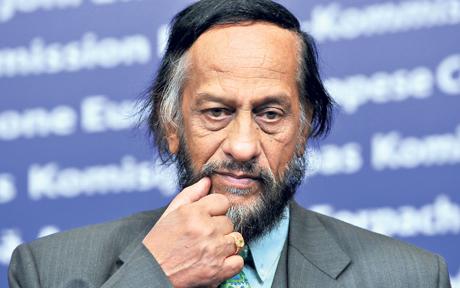
Questions Pachauri still has to answer…


Way more questions than answers…

You will recall that Christopher Booker in the UK Telegraph wrote about IPCC head Rajendra Pachauri’s financial interests in the global warming scare (see here). Pachauri responded almost immediately, but now Booker has written a follow up, which is well worth a read:

A first point to emerge from these responses is how much of what we wrote they do not contradict. Dr Pachauri does not deny that he holds all the positions referred to in our article, such as giving advice on climate change to bodies ranging from major banks such as Credit Suisse and Deutsche Bank to the Chicago Climate Change, the worlds’s largest dealer in buying and selling the right to emit CO2.

He and Teri insist, however, that all the money he receives for his services, such as 100,000 euros from Deutsche Bank and $80,000 from Toyota Motors are paid not to him personally but to his institute (and that he receives no fee from the Chicago Climate Exchange). Teri denies that it does not publish its accounts simply by stating that its accounts are supplied to the relevant tax authorities.

Dr Pachauri repeatedly denied that Teri still has any links with the Tata Group, India’s largest privately-owned business empire, with interests ranging from coal and steel to renewable energy, and which set up Teri as the Tata Energy Research Institute in 1974. He now claims that Teri has had no “direct links” with Tata since 1999 (or, in another interview, 2001). But it was not until 2003 that the name changed to The Energy and Resources Institute, and then a Teri spokesman explained that “we have not severed our links with the Tatas” and that the change of name was “only for convenience”.

Indeed one of the Tata group of companies is still listed among Teri’s corporate sponsors, several directors of Tata serve on Teri’s Business Council for Sustainable Development, and one senior director serves on Teri’s Advisory Board. Other links include the fact that Dr Pachauri and Ratan Tata, the head of the group, both serve on the Indian Prime Minister’s Council on Climate Change, advising on all aspects of national climate policy.

In short, these initial responses to our article leave many questions unanswered. At the least it seems that Dr Pachauri’s position as the world’s “top climate official” has been earning a very substantial income for the institute of which he is director-general; and the only way to avoid further questioning must now be for both Dr Pachauri and Teri to come out into the open over all those issues that remain obscure.

Read it here.

Terry McCrann – Let's face it: the ETS is dead


Dead as a…

The only people who don’t know this already appear to be Kevin Rudd and Penny Wong, getting ready to re-introduce it to Parliament in February, despite the world having moved on. Copenhagen has shown that the desire to cripple economies with “carbon reduction” plans is virtually non-existent, and with Tony Abbott at the helm of the Coalition, there isn’t the slightest possibility of it getting through:

While an argument could have been mounted before Copenhagen for moving towards an ETS, that is not possible after the chaos in doleful Hamlet’s hometown that produced the “China solution”.

There will be no global agreement to cut emissions of carbon dioxide.

Formally, it was “Chindia” — China and India. But China is the elephant in that pairing. And in any event, nothing that President Barack Obama might have promised in Copenhagen was ever going to be endorsed by the US Senate, as it has to be.

While we wouldn’t have quite seen a replay of the 95-0 vote that rejected the Kyoto Treaty in 1997, there is zero prospect of the US adopting either binding CO2 emission targets or a cap-and-trade policy, their name for an ETS.

So we have a situation post-Copenhagen, where the two countries that between them are responsible for nearly half of all global emissions of CO2 are not committed to cutting emissions, far less binding targets. And more pointedly, they won’t have an ETS.

Read it here.

Merry Christmas, Happy Holidays from ACM


Thanks for all your support this year, I very much hope you have enjoyed reading. Have a great holiday, and we will be posting again straight after Christmas (no rest for the wicked sceptics!) to provide you with your daily dose of climate sanity.

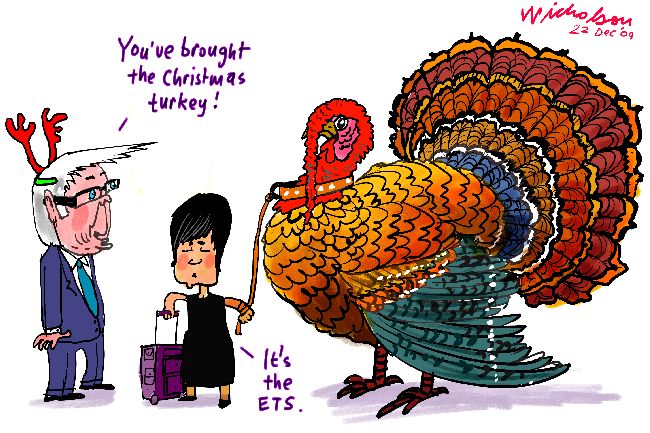
I will leave you with a festive cartoon, courtesy of Nicholson in The Australian:

Wikipedia: MWP page "locked" due to "vandalism"


Censorship at work

And by “vandalism” it means honest attempts to remove the fraudulent and discredited hockey stick graph. William Connolley, climate editor in chief at the ‘pedia (and coincidentally Green party activist), still up to his old tricks, and since Lawrence Solomon’s article earlier in the week (see here), the plot has thickened further, as Solomon reports again:

With the hockey stick graphs so thoroughly discredited, you’d think they would become a footnote to a discussion of the Medieval Warm Period, or an object of amusement and curiosity. But no, on the Wikipedia page for the Medieval Warm Period, the hockey stick graph appears prominently at the top, as if it is settled science.

Because the hockey stick graph has become an icon of deceit and in no way an authority worthy of being cited, fair-minded Wikipedians tried to remove the graph from the page, as can be seen here. Exactly two minutes later, one of Connelley’s associates replaced the graph, restoring the page to Connelley’s original version, as seen here.

Battles like this occurred on numerous fronts, until just after midnight on Dec 22, when Connolley reimposed his version of events and, for good measure, froze the page to prevent others from making changes — and to prevent the public, even in two-minute windows, from realizing that today’s temperatures look modest in comparison to those in the past. In the World of Wikipedia, seen as here, the hockey stick graph, and Connolley’s version of history, still rules. (source)

Let’s look at Wikipedia’s own definition of “vandalism” in respect of content:

Vandalism is any addition, removal, or change of content made in a deliberate attempt to compromise the integrity of Wikipedia. Vandalism cannot and will not be tolerated. Common types of vandalism are the addition of obscenities or crude humor, page blanking, and the insertion of nonsense into articles.

Any good-faith effort to improve the encyclopedia, even if misguided or ill-considered, is not vandalism. Even harmful edits that are not explicitly made in bad faith are not vandalism. For example, adding a controversial personal opinion to an article once is not vandalism; reinserting it despite multiple warnings is (however, edits/reverts over a content dispute are never vandalism, see WP:EW). (source)

And the following is listed as an example of what is not vandalism:

Repeated deletion or addition of material may violate the three-revert rule, but this is not “vandalism” and should not be dealt with as such.

So by labelling such attempts at editing “vandalism,” Connolley isn’t even complying with Wikipedia’s own editorial guidelines. But Connolley has the final say anyway, and has the power to disable editing of pages where such edits don’t fit with his personal views.

So the moral is: you still can’t trust Wikipedia on climate.

Animals "on the run" from climate change


At least he'll be OK…

The UK Telegraph used to be a serious newspaper, but, as I have mentioned before, it’s now more like a broadsheet version of Hello. In fact, Private Eye always refers to it as the Daily Hellograph. Despite Climategate, they still parrot any old press release that lands on the “climate change desk” and this story is no exception. From our old friend, Chris Field (see here, and here), we have a lovely alarmist Christmas present:

Plants and animals will need to move at an average rate of a quarter of a mile a year to escape climate change over the course of this century, according to scientists.

For species in flatter, low-lying regions such as deserts, grasslands, and coastal areas, the pace of the retreat could exceed more than half a mile a year, it is claimed.

Creatures and plants only able to tolerate a narrow range of temperatures will be most vulnerable, said the researchers.

Those unable to match the migration speeds needed to escape the effects of global warming could vanish into extinction.

Plants in almost a third of the habitats studied were thought to fall into this category, the scientists reported in the journal Nature.

Author Dr Chris Field, director of the Carnegie Institution’s Department of Global Ecology in Stanford, California, said animals will be forced to migrate while many plants will die out.

“Expressed as velocities, climate-change projections connect directly to survival prospects for plants and animals. These are the conditions that will set the stage, whether species move or cope in place,” he said. (source)

Yawn. We’ve had enough of alarmism. We’re not listening any more. Climate change scientists need to rebuild their shattered credibility before we will take anything they say seriously again.

Copenhagen: UN appeals for calm after "bust-up"


De Boer: clearly wishing he was somewhere else

With the air thick with blame and recrimination, and with any hope of a global deal disappearing faster than a Himalayan glacier, UN climate chief Yvo de Boer has appealed to the various factions to stop bickering:

We need to work together constructively, whereas countries are in the media blaming each other for what happened, the same countries that are going to have to be back at the negotiating table next year with an open willingness to work together,” he told AFP in a phone interview from London.

“It’s bad for the atmosphere, it’s bad for the relationship among people that ultimately have a common goal to move this forward.”

De Boer did not name names but chose to give the interview after Britain and China swapped verbal blows as to who was to blame for the Copenhagen outcome, while Brazil took aim at the United States.

De Boer urged all parties not to inflate or pull down the importance of the Copenhagen Accord.

“We shouldn’t pretend it is anything more or anything less than what it is — an agreement, a sense of direction that can help us in further negotiations.”

He acknowledged, though, that what happened in Copenhagen “was a very extraordinary event.”

“The fact of the matter is a small group of countries put this accord together, there wasn’t enough time to get buy-in from the larger meeting and have it adopted in any kind of formal sense, and that’s the reality.” (source)

All a bit childish and unseemly, really.