Tim Blair links to a wonderful collection of tweets about the Carbon Tax rally, like this one:
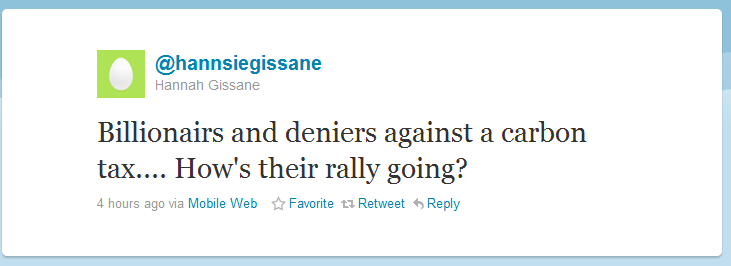
Billion airs?
Just don't tell me the debate's over…
Tim Blair links to a wonderful collection of tweets about the Carbon Tax rally, like this one:
Billion airs?

Hey Bob, where's your apology for this? (photo via Bolt)
A favourite trick of the Left – brand your opponents as “extremists” and then you can avoid actually engaging with their arguments. Thousands of ordinary Australians protested in Canberra yesterday, angry at being lied to by Julia Gillard before the election about her policy for a carbon tax. But the Left’s smear machine is in full swing this morning, rubbishing the genuine concerns of ordinary people:
Labor backbencher Nick Champion says the protesters are extremists.
NICK CHAMPION: A rally that has all the credibility of a Dungeons and Dragons convention – full of fantasists, full of people who think we can just avoid this problem – and we can’t.
It’s a serious problem. The world has to deal with it and Australia has to do our part.
REPORTER: Does that mean you think that they’re extremists, the people at this rally?
NICK CHAMPION: Yes.
SABRA LANE: Labor MP, Michelle Rowland:
MICHELLE ROWLAND: Some of these people, you objectively analyse their positions and they are extreme. They are extreme. (source)
She said it twice just in case you didn’t get it the first time. Greg Combet also used the word “extremists”:
Climate Change Minister Greg Combet said some people in the rally crowd were extremists.
“We had the Lavoisier group – a group which, as one commentator points out, warned the Kyoto protocol was part of a new imperial structure that would relocate Australian sovereignty to Germany,” he said. (source)
WTF? And one Labor MP has gone even further:
FEDERAL MP for Bendigo Steve Gibbons has been caught on social media website twitter comparing anti-carbon tax protesters to the notorious Ku Klux Klan.
But Mr Gibbons has defended the tweet, saying one of three anti-carbon tax rallies yesterday had been infiltrated by right-wing groups with a racist agenda.
Bendigo man Tony Hooper, a key organiser in Victoria of the No Carbon Tax Protest Group, says he is absolutely disgusted at the comments and will demand an apology.
In his tweet on the pro-carbon tax “noCTrally” Twitter feed, Mr Gibbons said: “Looks like all the extremists were having a day out. Was the Ku Klux Klan represented?”. (source)
Bob Brown even went as far as to write to Julia Gillard, apologising to her for some of the signs, which admittedly went too far: the words “bitch” and “witch” were undignified. However, when did Brown ever write to Howard about some of the disgusting treatment he received from the thugs on the Left? Never, because it’s OK when the target is from the Right of politics.
An ACM first, a caption competition. Laughed out loud when I saw this image and thought I would give readers the chance to submit their suggestions for a caption:

A useless monument to political stupidity… and a wind farm.
No prizes, just the honour of being the first ACM Caption Competition winner!

The way ahead for Australia
Sorry if this has turned into a nuclear power blog, but this is too good. Yes, you read that correctly. The events at Fukushima have convinced George Monbiot of the benefits of nuclear power, and its safety:
You will not be surprised to hear that the events in Japan have changed my view of nuclear power. You will be surprised to hear how they have changed it. As a result of the disaster at Fukushima, I am no longer nuclear-neutral. I now support the technology.
A crappy old plant with inadequate safety features was hit by a monster earthquake and a vast tsunami. The electricity supply failed, knocking out the cooling system. The reactors began to explode and melt down. The disaster exposed a familiar legacy of poor design and corner-cutting. Yet, as far as we know, no one has yet received a lethal dose of radiation.
Some greens have wildly exaggerated the dangers of radioactive pollution. For a clearer view, look at the graphic published by xkcd.com. It shows that the average total dose from the Three Mile Island disaster for someone living within 10 miles of the plant was one 625th of the maximum yearly amount permitted for US radiation workers. This, in turn, is half of the lowest one-year dose clearly linked to an increased cancer risk, which, in its turn, is one 80th of an invariably fatal exposure. I’m not proposing complacency here. I am proposing perspective.
If other forms of energy production caused no damage, these impacts would weigh more heavily. But energy is like medicine: if there are no side-effects, the chances are that it doesn’t work. (source)
Well said. George, for once, we salute you. (h/t Konrad in comments, and Delingpole)
The way ahead for Australia
Once again, although we disagree on many issues of climate, Barry Brook is right on the money on nuclear power:
Nuclear power will be needed to supply up to 75 per cent of Australia’s baseload electricity by 2060, a climate change expert says.
Barry Brook, chair of climate change at Adelaide University, said the scenario would be the same for other modern and emerging economies if the current demand for low-carbon energy continued.
He said such a change in supply dynamics would require a large-scale but prudent expansion of nuclear energy infrastructure, including incorporating lessons learnt from the nuclear crisis in Japan.
‘Globally, to service such power demands will need current levels of nuclear energy supply to increase 21-fold around the world,’ Professor Brook told the Paydirt 2011 Uranium Conference in Adelaide on Tuesday.
‘For the protagonists of alternative energy sources, such as solar and wind, those contributors would have to increase their infrastructure more than 40-fold to take even a 15 per cent slice of the future energy mix.’
Prof Brook said the problems with the earthquake and tsunami-damaged Japanese nuclear reactors would, in time, be seen in their proper context.
‘They will lead to improved measures at protecting against extreme natural events,’ he said.
‘They also provide greater encouragement for governments and energy utilities to move even more rapidly now to the very latest nuclear power technologies.
Prof Brook said it should be kept in mind that the explosions at the Japanese reactors were chemical, not nuclear.
‘The radiation dose threat to the public has been small, not one member of the public has died as a direct consequence of the reactor challenges, there has not been a failure of the primary containment vessels nor any large-scale release of radiation,’ he said.
But Prof Brook said the Japanese crisis was a salient lesson for what the nuclear power had to do in the future.
‘As long as any industry learns from the lessons of the past and continues to maintain a high culture of safety, I see a very bright future ahead for nuclear power,‘ he said. (source)
If CO2-related climate change is the apocalypse in waiting the climate change alarmists say it is, then nuclear electricity generation is the only option. Barry Brook correctly acknowledges this fact, and ACM applauds him for that.

Climate sense
Climate sense from Richard Blandy from the University of South Australia, writing in The Australian today. Even though I do not agree with the necessity to “save the planet” as he puts it, the logic of the government’s climate policy is deeply flawed:
Unilateral action to decarbonise our own economy harms us for no gain in terms of solving the global problem. Enthusiasm for doing our bit to save the planet will surely wane as it becomes clear this is all pain for no gain. Only a watertight international treaty will save the planet. After the fiasco of Copenhagen, such a treaty looks unlikely for a long time. This means the global target of limiting the rise in global temperatures to 2C above pre-industrial levels will not be achieved.
The most sensible climate change policy for Australia in this situation (and for everywhere else, for that matter) is not only to try to put together an international treaty with enough teeth to stop climate change but also to prepare to adapt to a world that will be warmer (wetter? drier? stormier? with higher sea levels?) than at present.
We can do something about adapting to climate change all by ourselves without needing to join in any international treaties.
Whatever happens, we will need to learn how to live with climate change anyway, assuming the projections of the climate change models are correct. This knowledge and the products and services built on it will be much sought after not only by us but by other countries facing the same necessity.
This is what a climate change economy should be built on. (source)
Adaptation not mitigation. It’s obvious. And adaptation needs a strong economy, not one burdened with pointless carbon taxes. Why can the government not grasp this most basic point?
Seems to be summed up thus:

Confusion reigns
UPDATE: The Sydney Morning Herald beat me to the link between these events:
“Sixty years ago, my father was in the Royal Australian Navy. The ships he sailed on took him to the Korean War and to Japan, when Australia was part of the occupation force after the bombs ended the war in the Pacific.
He saw what was left of Hiroshima after nuclear power was rained upon it. My father remembers the flattened countryside. When he reads some commentators say that the nuclear threat to Japan and beyond from the stricken reactors is a media beat-up, he gets annoyed. He has seen nuclear power in its destructive guise. To downgrade its threat – even in peacetime – is to him idiocy.” (source)
The way ahead for Australia
“Never let a good crisis go to waste.” The Japanese earthquake, one of the worst in recorded history, and the subsequent tsunami, caused extensive damage to the Fukushima nuclear plant, but its resilience is testament to the design of the reactors and the safety of their design. That, however, doesn’t stop hysterical eco-moonbats from jumping on the bandwagon and using Fukushima as an excuse to abandon nuclear power, despite the fact it is cheap, clean and safe, and the only realistic alternative to coal.
Ian Lowe is just such a person, with frequent appearances on these pages (see here and here). Lowe is the head of the Australian Conservation Foundation (which promotes Al Gore’s Climate Project, the aim of which is to disseminate misinformation on climate to the public) and writes in the Fairfax press under the headline “No nukes now, or ever”:
There are five good [?] reasons for Australia to heed the lesson of Fukushima. [The “lesson” of Fukushima is precisely the opposite of the one you’re about to give – Ed]
THE damage to the Fukushima reactors may have ended the risk of Australia going down the nuclear path. [Translation: “ended the dream of cheap, low emissions electricity” – Ed]
In fact, despite some uninformed commentary, there has been no renaissance of nuclear energy, only a resurgence of pro-nuclear talk.
In 2008 and 2009, the world retired 3000 megawatts of old nuclear capacity and only 1000 megawatts was brought on line. In the same two years, about 60,000 megawatts of new wind power was commissioned. [60,000 megawatts of unreliable wind generators probably generates less than the 1000 megawatts of reliable nuclear, and at many times the price – Ed]
While some enthusiasts claim new nuclear reactors would not have the technical limitations of Chernobyl or be built as dangerously as Fukushima, there will always be some risk of accidents. I was calmly sitting in a Christchurch coffee shop at lunchtime on February 22. We can be glad New Zealand does not have nuclear reactors.
We simply don’t know enough about Earth to be totally confident that any specific location is safe. An accident in a nuclear power station is a much more serious risk than a problem with any form of renewable energy supply.
Where do you start? Fukushima was built on an active fault, and was designed expressly for that purpose. When a massive magnitude 9.0 earthquake struck, there was no breach of the reactor cores, no significant radiation leaks, in fact it behaved exactly what it was supposed to. Contrast this with Australia, which has very little significant earthquake activity and massive reserves of uranium – the ideal location for nuclear generation. And to seriously compare nuclear power with expensive, hopeless, unreliable, inefficient wind is nothing more than a joke. Lowe is a climate alarmist, yet still cannot bring himself to admit that if you genuinely believe the AGW scaremongering, then nuclear is the only option for electricity generation.
The idiocy of his position is summed up in the final paragraph:
The nuclear debate should be a no-brainer for Australia. There is no case for us to commit to a dangerous, slow and expensive energy option when we have such plentiful sources of safe, clean renewable energy. (source)
Delusional doesn’t come close. He genuinely and honestly believes that solar and wind can replace baseload coal and gas! Solar, that doesn’t work at night, and wind that only works when the wind blows. Words. Fail. Me.
Christopher Booker, writing in the UK Telegraph, skewers all this hysteria:
The scaremongers were certainly out in force last week, with talk of “meltdown” and claims that the Japanese nuclear power plant emergency threatened a disaster “worse than Chernobyl”. There is, of course, no parallel with Chernobyl at all. The problem at Fukushima was not the explosion of a working nuclear reactor (all its reactors had been automatically shut down). The main problem was the lack of water to cool spent fuel rods. Even if the overheating rods caught fire, the worst-case scenario was never more than that some radioactive particles, given an unfavourable wind, might reach as far as Tokyo. There was never any chance that this could compare with Chernobyl, although even the long-term effects of that 1986 disaster, as it turned out, were very much less serious than scaremongers at the time predicted.

Obama in drag
So everyone suffers because of the carbon tax, and the poorest in society are then “compensated” by tax cuts:
LOW income earners will be the biggest winners [“biggest winners”? What is this, a TV game show? – Ed] from a Gillard government compensation scheme to offset cost of living pressures from a tax on big carbon polluters.
Generous tax breaks may be offered to low-income families and pensioners while middle-class income earners would also be compensated to soften the blow of rising household bills and living costs associated with the proposed carbon tax. [So they admit that prices of everything will go up, now? – Ed]
Labor is considering a range of options to ease the pain but is understood to be in favour of slashing tax rates, a measure encouraged by the government’s chief climate change adviser Ross Garnaut.
Professor Garnaut has urged sweeping compensation tax cuts for about half of Australia’s working population to keep household costs down and floated the idea of a one-off cut to the petrol excise to keep bowser prices manageable.
The government rebates could net low income earners about $1500 a year extra in tax breaks, with welfare increases also a likely option [must entrench that culture of dependence on the state – Ed] News Ltd reports today. The report says Prime Minister Julia Gillard is considering raising the tax free threshold to deliver a financial break to a larger number of Australians who will be hit by escalating cost of living pressures under a carbon tax. (source)
Everyone with half a brain (which obviously excludes Gillard and the Labor government) knows that the carbon tax won’t make the slightest bit of difference to “pollution” or the climate. People won’t use less energy or eat less food, they’ll just pay more for it. So it’s nothing more than a socialist experiment in spreading the wealth around, as someone famous once said…
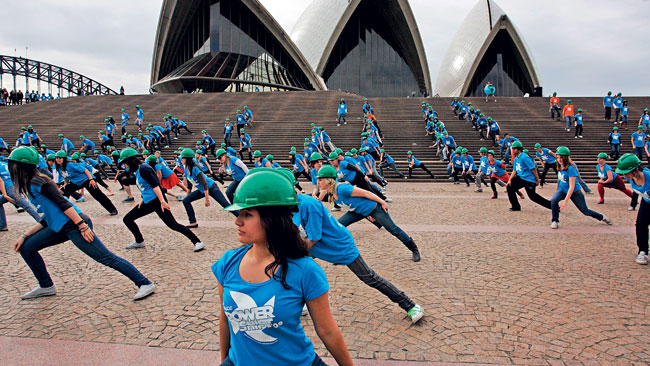
Just a bit of harmless fun, right?
It’s so easy to believe you can change the world when you’re young. The Australian runs an article about political activist groups such as GetUp! and the Australian Youth Climate Coalition, and paints a charming picture of dreamy optimism:
Driven, idealistic, passionate, the 27-year-old arts and law graduate is determined to change the world for the better. By the age of 23 she had established two not-for-profit organisations committed to addressing climate change; by 24 she had hooked up with colleague Anna Rose to create the Australian Youth Climate Coalition, which in four years has grown to 57,000 members registered on their website.
“I had read Tim Flannery’s The Weather Makers and wanted to do something,” says McKenzie. And do something she did. She led Australian youth delegations to UN climate conferences in Poland, Denmark and Bali, and persuaded Al Gore and Flannery to be keynote speakers at the Power Shift youth conference organised by the AYCC with 1500 attendees. And then there were the 1000 people dancing on the steps of the Sydney Opera House to help get their collective message out to the broader community. (source)
The fact that her inspiration was Flannery, he of the multiple failed climate predictions, shows that the AYCC has nothing to with climate, and all to do with social justice and urban environmentalist crusades. Young people are particularly susceptible to this kind of condition, since they have frequently never had to deal with the harsh realities of life, working for a living, paying taxes, making ends meet in difficult economic circumstances. Many continue to live with their parents for much of their twenties (and even thirties), and have no concept of managing a household or a budget. They believe that their aims and objectives have no costs – only what they perceive to be benefits.
The language on their site is typical, loaded with predictable ad hominems of course (“shock jocks”, “right wing deniers” etc), but nowhere to be found is any logically argued justification for the action they take. Virtually everything on the site is in the form of a video clip – is it really too hard to sit and read something these days? Nowhere do they address the key issue that unilateral climate action in Australia is pointless, even if we assume that CO2 is causing dangerous climate change (which this site disputes).
The AYCC’s source for “the science” is David Karoly – an alarmist (link), and a regular on these pages. Why not have a chat to Bob Carter? No, that won’t do, because being a heretic, he may challenge the precious belief system of the faithful.
The AYCC have no idea of the effect that a carbon tax will have on the economy, or our hard-won standards of living. Give them a few years of employment, rent, expenses, income tax, budgeting and everything else that goes on in the “real” world, and they may change their tune. I am fully in favour of young people caring for the environment and conserving scarce resources, but climate change is closer to a political ideology than environmentalism.
Ironically, it is the first paragraph of the article which is the most accurate:
Narcissistic, hedonistic, lacking in drive and discipline, today’s young adults are thought to be so plugged in to their mobile phones and iPods that they have no idea what’s going on in the world.
 Australian Climate Madness
Recent Comments