Desperation as alarmists sense the battle is lost


The fate of a sceptic in Kruddistan

The more desperate the quotes, the more tragic the arguments, the more it reveals that the alarmists realise that not only is the planet not complying with their incomplete and worthless climate models, but also that the penny [Wong? – Ed] has dropped in the public mind. The public realises now that the IPCC is a politicised advocacy group, spinning the science to fit an agenda conceived back in the 1980s to regulate CO2. Witness the outpouring of vitriol on Tony Abbott for daring to suggest that school pupils be sceptical (see here for original story). Heaven forbid. In Kruddistan we don’t want any of that, they should just uncritically believe whatever Chairman Rudd and the Wongbot say.

So it is with a wry smile that I read this piece in the Sydney Morning Herald.  It shows utter desperation in the face of a lost cause, even down to the headline, “Climate scientists cross with Abbott for taking Christ’s name in vain“, which once again tries (and fails) to portray Abbott as some religious nutcase:

TONY ABBOTT is under pressure to justify telling students it was considerably warmer when Jesus was alive after leading scientists said his claim was wrong.

He urged year 5 and 6 pupils at an Adelaide school to be sceptical about the human contribution to climate change, saying it was an open question.

In a question-and-answer session on Friday, the Opposition Leader said it was warmer “at the time of Julius Caesar and Jesus of Nazareth” than now.

Leading scientists said there was no evidence to suggest it was hotter 2000 years ago.

The president of the Australian Academy of Science, Professor Kurt Lambeck, said true scepticism was fine, but required looking at published data with an open mind. “To make these glib statements to school students, I think, is wrong. It’s not encouraging them to be sceptical, it’s encouraging them to accept unsubstantiated information.” Tas van Ommen, who as principal research scientist with the Australian Antarctic Division collects climate data from ice cores, said any definitive statement about temperatures 2000 years ago was “completely unfounded”.

He cited the 2007 report of the UN Intergovernmental Panel on Climate Change, which found the available data from climate records was too sparse to make clear statements beyond about 1000 years ago. Dr van Ommen said the confidence that global warming was linked to greenhouse gas emissions was based on multiple lines of evidence.

Yawn. We’ve heard it all before. As soon as you quote the IPCC, it’s time to switch off. And then they wheel out Fairfax’s alarmist in chief:

David Karoly, a Melbourne University federation fellow and climate panel lead author, said Mr Abbott’s statement appeared to be based on Heaven + Earth, a 2009 book by the geologist and climate change contrarian Ian Plimer. It has been embraced by sceptics, but criticised by scientists working in the fields it covers. [Ah yes, of course, Plimer isn’t “working in the fields it covers”, right? – Ed]

Professor Karoly said: “It seems strange to me that the leader of a political party would be seeking to disagree with Australia’s chief scientist, the Bureau of Meteorology, CSIRO, the overwhelming majority of climate scientists and Australia’s support of the work of the IPCC. He obviously knows better.” (source)

Probably right. The public have an innate common sense which Sackett (raving alarmist), the Bureau, CSIRO (all on the climate gravy train) and the IPCC (ditto) all lack. They can smell a rat – and it’s a dead, rotting, carcass of a rat with a stench that could strip paint. One letter writer in The Australian gets it right:

CLIMATE Change Minister Penny Wong says she was disappointed in Opposition Leader Tony Abbott for encouraging climate change scepticism in the classroom, which she claimed was “irresponsible”, (“Climate change natural”, 8-9/5).

Since when was scepticism in science a bad thing? Mr Abbott was quite right to point out it is an open question as to why the climate changes, and what role man plays in that change.

Surely we want our children to grow up with open and questioning minds and not to accept unthinkingly any proposition put to them in the classroom.

The irony in all this is that Mr Abbott is presented as something of a hardliner, as being inflexible. But it now appears the boot is on the other foot. It is Senator Wong who is the dour, inflexible one as she constantly refuses to accept there is a valid scientific position on climate change apart from her own doomsday alarmist scenario.

It is irresponsible not to present the full range of scientific views on climate change to young, inquiring minds — indeed the general public, and individuals should be allowed to make up their own minds, without fear of being labelled or ostracised.

Alan Barron, Grovedale, Vic (source)

Keep it coming, SMH. Just more evidence that climate hysteria, like Rudd, is on the skids.

Yet another whinging letter from climate scientists


Still an embarrassment

Climate scientists can sense they’re being found out. You can always tell, because they start writing bleating letters to journals banging their fists and saying “It’s not fair” like toddlers who don’t get their own way. And yes, another one appears today in the pages of Science. You can read the full text at the Guardian (of course) here. The opening paragraph sets the tone:

We are deeply disturbed by the recent escalation of political assaults on scientists in general and on climate scientists in particular. All citizens should understand some basic scientific facts. There is always some uncertainty associated with scientific conclusions; science never absolutely proves anything. When someone says that society should wait until scientists are absolutely certain before taking any action, it is the same as saying society should never take action. For a problem as potentially catastrophic as climate change, taking no action poses a dangerous risk for our planet. [and our wallets – Ed]

And our own chief scientist Penny Sackett can’t support it quickly enough. Sackett is a regular on these pages (see here and here) for her extreme views on climate change, and she still hasn’t learnt that being a scientist is all about free-thinking and impartial enquiry, not eco-Marxist environmental advocacy:

AUSTRALIA’S chief scientists Professor Penny Sackett has backed a group of eminent international scientists calling for urgent action on climate change.

Professor Sackett said governments everywhere needed to show more leadership on climate change action.

“Even if each one of us on the face of the earth stopped emitting greenhouse gases tomorrow, not another ounce into the atmosphere, the temperature would still rise,” she told ABC radio today.

“I would say that every delay makes it harder for ourselves in the future. I’d like us to also think about how much more difficult it makes it for the next generation.”

In their open letter published in the journal Science, the group of 250 scientists called for rationale [sic] debate and not to have discussion deflected by extreme views. (source)

Rational debate? Don’t make me laugh. And “extreme views” in this context means anything that challenges the pseudoscience of An Inconvenient Truth, I guess. And then there is the inevitable victim status plea for the sympathy vote. The letter reads:

“We also call for an end to McCarthy-like threats of criminal prosecution against our colleagues based on innuendo and guilt by association, the harassment of scientists by politicians seeking distractions to avoid taking action, and the outright lies being spread about them.”

You have to laugh, don’t you. So let’s get this straight: destroying emails is innuendo perhaps? Fudging data is innuendo maybe? If these guys were accountants or lawyers they would understand this concept better – because they would be in prison.

Just more evidence that the consensus scientists can see their cash cow being sent to market, and they are doing everything to keep their precious funds flowing in. Sorry guys, the public (who are far more intelligent than you have ever given them credit for) are not falling for it any more.

UPDATE: And a timely Galaxy opinion poll demonstrates that exact point:

Two out of three Australians are not convinced climate change is man-made, and even those who do believe it is aren’t prepared to pay much to fix it, a new poll shows.

A Galaxy Poll, commissioned by the conservative Institute of Public Affairs, found 35 per cent of respondents blamed humans for global warming.

Fully 26 per cent believed it was just part of a natural cycle, while 38 per cent remained uncertain. [Total 64% – Ed]

Thirty-five per cent said they would not be prepared to pay anything to generate cleaner energy and fight global warming.

Of those who believed climate change to be man-made, 27 per cent said they would be prepared to pay only $100 or less a year in increased tax and utility costs. (source)

ABC's Catalyst: increased CO2 is bad for plants


Cassava, soon to be cyanide if we keep driving SUVs

Another week, another “climate” scare story from Catalyst. The ETS is dead and nobody’s interested in reducing CO2 to “tackle climate change” any more, so the ABC goes looking for another reason to cripple Western economies and send our standards of living back to the Dark Ages.

And they find a corker. You thought increasing CO2 in the atmosphere would be good for plants? Wrong. It’s bad, and the ABC’s “science” programme jumps on this research without pausing for breath. Brilliant. Forget global warming, forget how the majority of plants would benefit from increased CO2, forget how we are actually living in a CO2 starved atmosphere. Now it’s “food security” that everyone’s worrying about, thanks to reduced nutrition and increased toxins:

Dr Graham Phillips
The next big food issue could be how rising levels of carbon dioxide are affecting our fruit and vegies. Now we know that plants love CO2 so rising levels of it will affect their metabolisms and it seems almost certain that for many foods the levels of nutrition will go down and for some toxin levels will go up. Both serious issues when you are trying to feed a world with an increasing population.

Dr Ros Gleadow
We’re tracking worst case scenario with carbon dioxide at the moment [what? – Ed] and we need to predict what sort of things are going to happen in the future.

Maybe they could predict the future with some dodgy second-hand climate models bought off the back of a truck from Michael Mann. That should do the trick. Or Madame Za Za’s crystal ball, perhaps? Just like last week: more scary music, more alarmism. And they’ve found a plant, cassava, that links rising CO2 levels with increased levels of cyanide. Almost a Holy Grail for the ABC’s alarmism department – cut CO2 or you’ll die of cyanide poisoning:

NARRATION
Back in the lab Ros’s group have been looking at how rising CO2 will affect the cyanide levels of cassava.

Dr Ros Gleadow
We grew cassava at three different concentrations of carbon dioxide. Today’s air, one and a half times the amount of carbon dioxide and twice the carbon dioxide of today. And we found that cyanogen concentration in the leaves increased.

Dr Graham Phillips
So as we get more Carbon Dioxide in the atmosphere these will contain more cyanide?

Emeritus Prof. Howard Bradbury
More cyanide yes. The yield from the roots which is the main thing, will go down. So that is the most worrying aspect.

And the last word to Dr Gleadow:

Dr Ros Gleadow
I don’t want to be a gloom and doom person. I want to think okay clover’s going to become more toxic, let’s develop other cultivars. If cassava’s going to become more toxic, let’s look at some other cultivars. Let’s look at other ways we can deal with this problem.

Don’t say that! It’ll spoil the story!

Read/watch it here.

ABC: quotes "residents" in climate change article


Victim of climate change?

The ABC just can’t stop, can they? Any authority, no matter how worthless, will do in advancing their pre-conceived agenda of climate alarmism. In another bleeding heart article on the same government report discussed here, the ABC quotes the opinion of local residents as somehow worthy of reporting. Not only that but throwing in “Kakadu” is a cheap shot to grab the punters’ attention, with the breathless headline “Climate change could hit Kakadu food sources”:

[The report] says a projected sea level rise of 20 centimetres would irreversibly change the shape of rivers like the South Alligator and alter tidal flows and vegetation cover.

Rising sea levels would also reduce the availability of traditional food sources for Indigenous communities, like magpie geese, barramundi and freshwater turtles.

The report did not discuss the impact of climate change on mining projects, but residents raised concerns about how the Ranger uranium mine, near Jabiru, would cope with more intense cyclones and heavier rainfall.

So the report didn’t even mention mining, but the residents have raised concerns, and those concerns conveniently happen to fit the alarmist agenda of the ABC, so they get published uncritically! Forget the fact that more intense cyclones and heavier rainfall are chestnuts that has been debunked over and over again. And anyway, I thought climate change caused drought? Who cares. It’s just whatever fits the requirement at the time.

And what about the concerns of other residents that climate change is a crock and a complete waste of taxpayers money? No, they won’t get published, because according to the biased ABC, people who hold those views are just dumb bogans.

Read it here.

ABC: yet more scaremongering


More like science fiction

Another day, another hysterical climate piece from your publicly funded national broadcaster. This time, researchers claim that when wet bulb temperatures (dew point, in other words) reach 35 degrees, it will become “uncomfortable” for humans. They have used climate models to predict when this will occur, and we all know how reliable and accurate they are. The ABC uncritically publishes it all in its science pages, under the headline “Warmer planet to stress humans: study”:

Professor Steven Sherwood of University of New South Wales and Associate Professor Matthew Huber of Purdue University in Illinois, used climate models to predict where and when temperatures will increase to uncomfortable levels.

They found a global temperature increase of 7°C above pre-industrial levels would push temperatures in some regions above 35°C for extended periods, resulting in heat stress across the whole population.

Sherwood says while heat-related deaths among the elderly and young already occur, global warming will result in more of the population suffering.

“What we’re talking about here is something a bit different – these limits apply to a healthy person,” he says.

But the final paragraphs tell the real story:

Sherwood says a 7°C increase isn’t likely to happen until next century, but he says it’s important to understand the impact should it occur.

“When you’re planning sensibly for anything you plan for the worst case scenario,” he says. [In other words, take the precautionary principle to its logical conclusion – Ed]

“We’re saying this is the worst scenario, we’re not saying it’s going to happen soon, but to ignore it seems foolhardy.”

The researchers conclude further warming would have a more drastic impact.

“If warmings of 10°C were really to occur in [the] next three centuries, the area of land likely rendered uninhabitable by heat stress would dwarf that affects by rising sea level,” they write.

The average global temperature has increased by 0.8°C since pre-industrial times. Some scientists and environmental groups are pushing for limits on human-produced greenhouse gas emissions to limit the increase to no more than 2°C.

In other words, this is a worst-case, precautionary-principle-gone-mad study, which somehow makes it onto the ABC as mainstream science.

Read it here.

ABC: alarmist business as usual


Not science, but alarmism

I suppose we should have expected the green-left brigade at the ABC to go into alarmist overdrive in response to the government’s dropping of the ETS, but I didn’t expect it to be so soon. The flagship TV science programme, Catalyst, opened last night with a hysterical piece on the melting Antarctic. Yes, the Antarctic. Note how, without dropping a beat, the ABC switches its attention to the South pole, since as we all know, ice levels in the Arctic are the highest they have been for years.

The segment played out like a disaster movie: scary voiceovers, scary music, dramatic footage of, er, melting ice, scary “what ifs”, and, to suck away any last vestige of credibility, quotes from James Hansen. Here are a few choice extracts, starting with the creepy opening:

NARRATION: The seas are rising [Yes, at the same rate they have been for thousands of years – Ed]. How fast and how high they will go is the big unknown. But one thing is certain. What happens in Antarctica will be critical. Around 90 percent of the planet’s snow and ice is found here. Is the sleeping giant stirring?

NARRATION: The Wilkins Ice shelf is the latest of seven ice shelves on the Peninsula to start collapsing, and it’s the furthest south. Ice shelves are already floating, so they can’t contribute to sea level rise. It’s what’s behind them that’s the big concern. But now it is all too familiar. Seven shelves on the Antarctic peninsula have collapsed in the past two decades. This is a region of the huge Wilkins ice shelf which collapsed in 2008.

Dr Ian Allison: If you take that barrier away, the big glaciers behind it will flow more quickly.

NARRATION: Glaciers that drained into the Larsen B ice shelf have sped up by a factor of seven.

Neal Young: That does contribute to sea level rise. The quantity of ice in the Antarctic Peninsula region though is small. The key message is what would happen in the east and to the major glaciers in the West Antarctic if such changes were to occur there? That would be a consistent, persistent and very ominous I think change in the scenario.

NARRATION: And there’s strong evidence that change is already occurring. In the Amundsen Sea region, glaciologists have found the major glaciers are speeding up and losing mass, thinning by up to nine metres a year. What’s remarkable is the thinning extends hundreds of kilometres into the grounded ice sheet.

Mark Horstman: It’s the middle of summer here in East Antarctica, and right now the air temperature is minus four degrees and dropping. There’s no way that air temperatures like this are going to melt any ice. And In fact, until just recently, it was thought that the ice sheet on this side of the continent was actually growing in size.

NARRATION: But alarming new evidence indicates this trend has reversed.

Mark Horstman: What we’ve revealed here is a complex story about Antarctica under changing climates. And the take home message, like the continent itself, comes in two parts. Here in the East, it appears that it’s a warming ocean that;s driving the changes in the ice sheet.

Dr Paul Willis: Whereas here in the West the ice is melting from above and below. When it comes to sea level rise, Antarctica the sleeping giant is waking up.

Business as usual at Their Alarmist Broadcasting Corporation.

Read it (and watch it) here.

ABC: presumption of bias


Biased unless proven otherwise

It has now reached the stage with the ABC that there must be a presumption of bias, towards Labor and climate alarmism. And, as in its legal analogue, where there is a presumption, that presumption must be rebutted on each and every occasion. That is the position from we have to view the ABC today. So when we read an alarmist article on climate change, we presume bias unless it can be rebutted. When we read an article critical of the Opposition, we must again presume bias, unless it can be rebutted. Unfortunately, since that rebuttal is almost never there, this means that our nationally funded broadcaster has ceased to be a serious media organisation, and is now nothing but a cheap shill for Labor and environmental pressure groups.

So it is no surprise that the ABC is still quite happy to use the derogative term “denier” in an article on climate sceptics published this morning (five times, no less). The story relates to a paper by John McLean, Chris DeFreitas and Bob Carter, originally published in July 2009 in Journal of Geophysical Research (JGR), challenging the theory of human-induced global warming. This is a peer reviewed journal, and the article was accepted for publication at that time, following the peer review process. In January 2010, a critical response was prepared by a team of consensus scientists, which was also published in JGR. The original authors put together a response to those criticisms, which … JGR refused to publish. Understandably, the original authors were furious not to have the right to respond to criticisms of a previously published paper. They have subsequently published on SPPI a paper claiming censorship:

“The practice of editorial rejection of the authors’ response to criticism is unprecedented in our experience. It is surprising because it amounts to the editorial usurping of the right of authors to defend their paper and deprives readers from hearing all sides of a scientific discussion before they make up their own minds on an issue. It is declaring that the journal editor – or the reviewers to whom he defers – will decide if authors can defend papers that have already been positively reviewed and been published by that same journal. Such an attitude is the antithesis of productive scientific discussion.”

You can read the full SPPI paper here. This is how ABC’s reporting of this story begins:

The latest debate on climate science to emerge centres on a paper that suggests humans played no role in the recent warming trend and that El Nino activity is mostly to blame.

But a group of climate scientists say that is false, misleading and that the data has been manipulated by climate deniers. [Well, they should know. Alarmist climate scientists are experts in manipulation of data – Ed]

Central to the paper, published in the Journal of Geophysical Research last July, was that the southern oscillation index, which is a measure of El Nino activity, was the most likely influence on global temperatures changing.

The senior author of the report, IT analyst [just thrown in to remind you he’s not a climate scientist – Ed] John Mclean, says man has had little impact on global warming.

The major force seems to be probably the southern oscillation, though you’ve also got to think that maybe that is just an indicator of something else. Whatever’s driving the southern oscillation therefore drives temperature,” he said. (source)

They give McLean a quote of just 83 words to explain the paper’s position. They then proceed to give Kevin Trenberth (of Climategate fame), a quote of 237 words, nearly three times as much, criticising it (did I mention anything about bias earlier?), and in total there are 369 words critical of the paper compared to just 164 words explaining it. You can read all that in the source article if you wish.

The ABC article then deals with the censorship claim, but fails to identify the key point, that this was a response to a criticism of an originally peer-reviewed, and published, article in JGR. To not give authors the opportunity to respond to criticism sure sounds like censorship to me.

Presumption of bias? Tick. Rebuttal? None.

"Disappearing island" in Bengal nothing to do with "climate change"


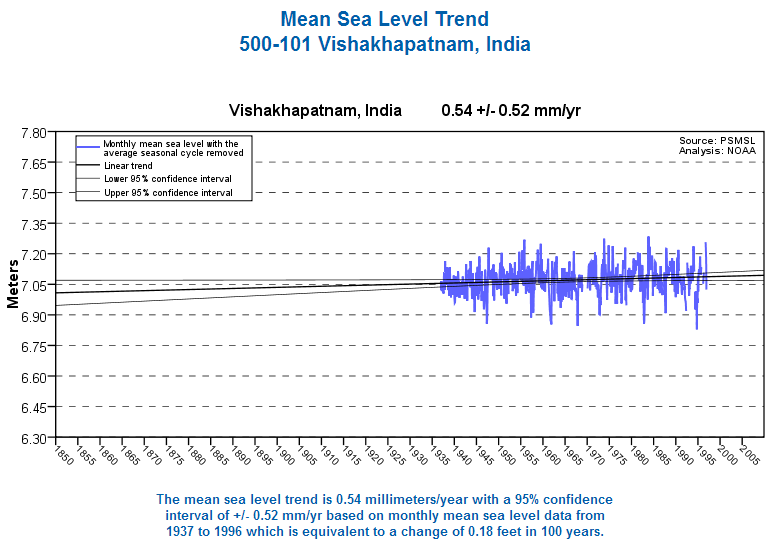
Nearest tide gauge - less than 1 mm per year…

Although you surely wouldn’t believe it by reading the mainstream media, trumpeting as they are the fact that an “island” has disappeared because of rising sea levels “caused by climate change”. The Sydney Morning Herald does a brilliant job of getting it all wrong:

In an unusual example of the effects of global climate change, rising sea levels in the Bay of Bengal have helped resolve a troublesome territorial dispute between two of the world’s most populated countries, a leading Indian oceanographer says.

Sugata Hazra, the head of oceanography at Kolkata’s Jadavpur University, says a flat muddy patch of land known as South Talpatti in Bangladesh and New Moore Island in India has disappeared under the Bay of Bengal. The landmass had been claimed by both countries but Professor Hazra says satellite images prove it has gone.

”It is now a submerged landmass, not an island,” Professor Hazra told the Herald.

”Only small parts can be seen in very, very low tide conditions.”

Sea-level rise caused by climate change was ”surely” a factor in the island’s inundation, Professor Hazra said.

”The rate of sea-level rise in this part of the northern Bay of Bengal is definitely attributable to climate change,” he said.

”There is a close correlation between the rate of sea-level rise and the sea surface temperature.”

The island was once about 3.5 kilometres long and three kilometres wide and situated four kilometres from the mouth of the Hariabhanga River, the waterway that marks a stretch of the border between south-western Bangladesh and India.

Scientists believe the disputed island was formed following a cyclone in the Bay of Bengal in 1970 and both countries laid claim to the land. (source)

Right, so what’s the reality? It’s not an island, as in a rocky outcrop, it’s a sand bar. As the article says, it was created following a cyclone just 40 years ago. It is in an estuary, an area of rapid erosion and deposition. “Islands” such as this are being created and destroyed on a regular basis all the time. Look at the sea level rise from the nearest official gauge – just 0.54mm per year.  Whatever caused this sandbar to disappear, it sure as hell wasn’t “climate change.”

Thanks to Anthony Watts.

Butterfly study hijacked by AGW


Ever felt used?

Here’s an innocent little story about butterflies [which is now plastered all over the ABC and will no doubt be on the 7 o’clock News and 7.30 Report and Lateline and every ABC web site under the sun – Ed]. Apparently they are getting impatient and are now emerging from their cocoons ten days earlier than 65 years ago. But who does the ABC choose to interview on The World Today? Firstly Michael Kearney, biologist from Melbourne University, but then, oddly, David “Asteroid” Karoly, who is a fully paid up climate alarmist (link to audio and transcript here):

Professor David Karoly of the University of Melbourne, says the study breaks new ground on the impact climate change has on the natural environment.

“Butterflies and many other natural systems are responding to warming both in Australia and around the world,” he said.

“This is the first time we’ve been able to link the change in a natural system, like a butterfly, to regional warming and then link that regional warming to increase in green house gases as a result of human activity.”

Why would they interview Karoly? So I did a bit of research, and tracked down the original home page at Monash for the study here. Firstly, it should be noted that this is a research project within the school of Biosciences (not Earth Sciences or Climate Change) and there is no mention of Karoly as part of the project. Here is the project summary from a project update dated August 2008 :

Climate change and habitat fragmentation are together a major threat to the continued survival of a vast number of species. Correlative bioclimatic models are often used for predicting future suitable habitats, but currently do not take into account whether species are able to colonise new regions, nor the mechanisms by which they interact with and adapt to their environment. We will use a butterfly model species to investigate the relationship between genetic polymorphisms, physiological capacity for dispersal, and environmental constraints at the landscape scale. This will allow truly mechanistic and more accurate predictions of how novel climatic environments will affect species distributions. (source – PDF)

Again, no mention of anthropogenic climate change or greenhouse gases or carbon dioxide (or Karoly). They are simply looking at how butterflies react to increasing temperatures – you only need to read the PDF to see that. But wait, look what’s happened. Suddenly there is a “final step”, oddly not mentioned in any of the project’s earlier documentation, where Karoly steps in and neatly links the whole thing to human caused climate change:

The final step taken by the researchers was to link the regional temperature changes with human-induced global warming.

Team member [since when? – Ed] climatologist, Professor David Karoly applied global circulation models to the Melbourne region, taking into account local factors that influence climate.

This suggested that the regional temperature changes observed over the decade were unlikely to be observed without the influence of human greenhouse emissions, says Kearney. (source)

And hey presto, an avowed climate alarmist manages to show that Melbourne’s temperature rise can only be cause by human factors [because we don’t know what else could have caused it – brilliant – Ed]. What a surprise. So somebody, at present unknown, had the brilliant idea “if we can tie this butterfly study into AGW, we might get some air time from the ABC,” and that somebody was dead right, because it fits the ABC’s unashamedly alarmist agenda.

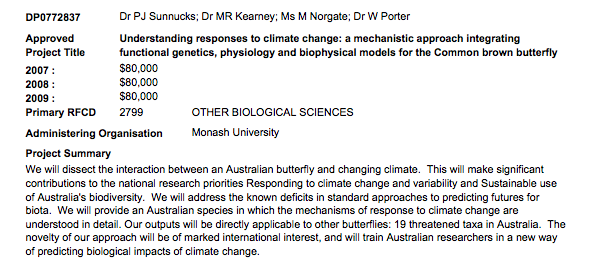
UPDATE: The Australian Research Council lists the grants made for this study (a total of $240,000 over three years), and it too mentions nothing about Karoly or the anthropogenic nature of the climate change in question. Here is the extract from the ARC’s PDF for funding grants made to Monash (not Melbourne) in 2006 for research commencing in 2007:

Extract from ARC's funding

So Karoly has simply been wheeled in to add the alarmist perspective. The difficult questions to ask would be:

  • When did Karoly become part of the project?
  • On whose instigation?
  • Were all the funding bodies notified of the change in emphasis of the study towards human-induced climate change?

UK government ads "exaggerated global warming"


Giving kids nightmares

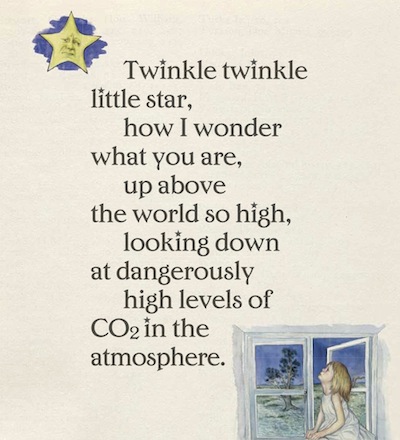
Really? Why would they do that? Maybe because as the generally intelligent British public becomes more fed up with having the wool pulled over its eyes, that the government has to spin and mislead even more to keep the message going:

Two nursery rhyme adverts commissioned by the Government to raise awareness of climate change have been banned for overstating the risks.

The Advertising Standards Authority (ASA) ruled that the adverts – which were based on the children’s poems Jack and Jill and Rub-A-Dub-Dub – made exaggerated claims about the threat to Britain from global warming.

In definitely asserting that climate change would cause flooding and drought the adverts went beyond mainstream scientific consensus, the watchdog said.

It noted that predictions about the potential global impact of global warming made by the Intergovernmental Panel on Climate Change (IPCC) “involved uncertainties” that the adverts failed to reflect.

The two posters created on behalf of the Department of Energy and Climate Change juxtaposed adapted extracts from the nursery rhymes with prose warnings about the dangers of global warning.

One began: “Jack and Jill went up the hill to fetch a pail of water. There was none as extreme weather due to climate change had caused a drought.” Beneath was written: “Extreme weather conditions such as flooding, heat waves and storms will become more frequent and intense.”

The second advert read: “Rub a dub dub, three men in a tub — a necessary course of action due to flash flooding caused by climate change.” It was captioned: “Climate change is happening. Temperature and sea levels are rising. Extreme weather events such as storms, floods and heat waves will become more frequent and intense. If we carry on at this rate, life in 25 years could be very different.”

Upholding complaints from members of the public, the ASA said that in both instances the text accompanying the rhymes should have been couched in softer language.

After the UK government’s despicable “bedtime story” advert, now they are defiling nursery rhymes in order to advance their extreme green agenda. Nothing is sacred to these people.

And this week’s best “yeah, right” moment:

Ed Miliband promised to better reflect scientific uncertainty about global warming in future campaigns.

My aching sides, I think not.

Read it here.