Dr Roy Spencer: "The Great Global Warming Blunder"


Must read

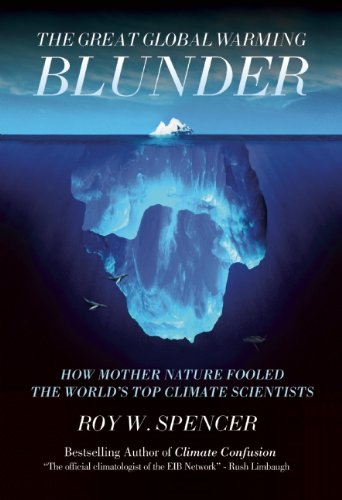
Dr Roy Spencer has written a book summarising the findings of his soon to be published (and peer-reviewed) work on probably the most important aspect of climate science: climate sensitivity:

The most obvious way for warming to be caused naturally is for small, natural fluctuations in the circulation patterns of the atmosphere and ocean to result in a 1% or 2% decrease in global cloud cover. Clouds are the Earth’s sunshade, and if cloud cover changes for any reason, you have global warming — or global cooling.

How could the experts have missed such a simple explanation? Because they have convinced themselves that only a temperature change can cause a cloud cover change, and not the other way around. The issue is one of causation. They have not accounted for cloud changes causing temperature changes.

The experts have simply mixed up cause and effect when observing how clouds and temperature vary. The book reveals a simple way to determine the direction of causation from satellite observations of global average temperature and cloud variations. And that new tool should fundamentally change how we view the climate system.

Blunder also addresses a second major mistake that results from ignoring the effect of natural cloud variations on temperature: it results in the illusion that the climate system is very sensitive. The experts claim that, since our climate system is very sensitive, then our carbon dioxide emissions are all that is needed to explain global warming. There is no need to look for alternative explanations.

But I show that the experts have merely reasoned themselves in a circle on this subject. When properly interpreted, our satellite observations actually reveal that the system is quite IN-sensitive. And an insensitive climate system means that nature does not really care whether you travel by jet, or how many hamburgers or steaks you eat.

Read Dr Spencer’s post here. A copy of the book is on its way to me right now, and a more detailed review will follow.

Climate change: global socialism and global governance


Climate change science

Thanks to Peter “Batts” Garrett and his insulation fiasco, climate change has taken a back seat in the media (despite the fact that “tackling climate change” is the reason behind the incompetent insulation programme in the first place). But a piece by James Delingpole in the UK Telegraph pointed me to a devastating article, on the blog Buy the Truth, about “Post-normal Science” which I find chimes exactly with my feelings on the climate change debate. Climate science is the perfect example of this new theory of Post-normal Science. But first, a few definitions:

Normal science

[Normal] Science is a logic inductive process leading to theory formulation, while all the way put through critical tests that have been deductively derived from the theory; Popper’s critical rationalist concept of science is an objective progression toward the truth…The term normal science refers to the routine work of scientists within a paradigm; slowly accumulating knowledge in accord with established theoretical assumptions…The paradigm is enlarged and frontiers of knowledge and techniques pushed forward.

The exercise of scholarly activities is defined by the dominance of the Mertonian CUDOS norms of science. They include:

(C)ommunalism – the common ownership of scientific discoveries, according to which scientists give up intellectual property rights in exchange for recognition and esteem;

(U)niversalism – according to which claims to truth are evaluated in terms of universal or value-free criteria;

(D)isinterestedness – according to which scientists are rewarded for acting in ways that appear to be selfless;

(O)rganized (S)kepticism – all ideas must be tested and are subject to structured community scrutiny.

Post-normal science

A new concept of science was introduced by Funtowicz and Ravetz during the 1990s…The concept of post-normal science goes beyond the traditional assumptions that science is both certain and value-free…The exercise of scholarly activities is defined by the dominance of goal orientation where scientific goals are controlled by political or societal actors…Scientists’ integrity lies not in disinterestedness but in their behaviour as stakeholders. Normal science made the world believe that scientists should and could provide certain, objective factual information…The guiding principle of normal science – the goal of achievement of factual knowledge – must be modified to fit the post-normal principle…For this purpose, post-normal scientists should be capable of establishing extended peer communities and allow for ‘extended facts’ from non-scientific experts…In post-normal science, the maintenance and enhancement of quality, rather than the establishment of factual knowledge, is the key task of scientists… Involved social actors must agree on the definition of perceptions, narratives, interpretation of models, data and indicators…scientists have to contribute to society by learning as quickly as possible about different perceptions…instead of seeking deep ultimate knowledge. (source: Eva Kunseler, Towards a new paradigm of Science in scientific policy advising)

So in essence, post-normal science is just another term for post-modern science: there are no absolute truths, value systems are always imposed on results, in other words a relativistic system of scientific investigation. Now any proper scientist would be horrified at this concept (as any proper science teacher would be horrified at the proposed new Australian National Curriculum in science, steeped as it is in marxist theory, cultural relativism and outcomes – where aboriginal dreamtime stories are as “relevant” as Newton or Einstein and the periodic table isn’t taught until Year 10, but don’t get me started on that…). Read what Mike Hulme, climate scientist at the University of East Anglia (of Climategate fame) has to say:

Philosophers and practitioners of science have identified this particular mode of scientific activity as one that occurs…where values are embedded in the way science is done and spoken.

It has been labelled “post-normal” science. Climate change seems to fall in this category. Disputes in post-normal science focus…on the process of science – who gets funded, who evaluates quality, who has the ear of policy…The IPCC is a classic example of a post-normal scientific activity.

Within a capitalist world order, climate change is actually a convenient phenomenon to come along.

The largest academic conference that has yet been devoted to the subject of climate change finished yesterday [March 12, 2009] in Copenhagen…I attended the Conference, chaired a session…[The] statement drafted by the conference’s Scientific Writing Team…contained…a set of messages drafted largely before the conference started by the organizing committee…interpreting it for a political audience…And the conference chair herself, Professor Katherine Richardson, has described the messages as politically-motivated. All well and good.

The danger of a “normal” reading of science is that it assumes science can first find truth, then speak truth to power, and that truth-based policy will then follow…exchanges often reduce to ones about scientific truth rather than about values, perspectives and political preferences.

…‘self-evidently’ dangerous climate change will not emerge from a normal scientific process of truth-seeking…scientists – and politicians – must trade truth for influence. What matters about climate change is not whether we can predict the future with some desired level of certainty and accuracy.

Climate change is telling the story of an idea and how that idea is changing the way in which our societies think, feel, interpret and act. And therefore climate change is extending itself well beyond simply the description of change in physical properties in our world…

The function of climate change I suggest, is not as a lower-case environmental phenomenon to be solved…It really is not about stopping climate chaos. Instead, we need to see how we can use the idea of climate change – the matrix of ecological functions, power relationships, cultural discourses and materials flows that climate change reveals – to rethink how we take forward our political, social, economic and personal projects over the decades to come.

There is something about this idea that makes it very powerful for lots of different interest groups to latch on to, whether for political reasons, for commercial interests, social interests in the case of NGOs, and a whole lot of new social movements looking for counter culture trends.

Climate change has moved from being a predominantly physical phenomenon to being a social one…It is circulating anxiously in the worlds of domestic politics and international diplomacy, and with mobilising force in business, law, academia, development, welfare, religion, ethics, art and celebrity.

Climate change also teaches us to rethink what we really want for ourselves…mythical ways of thinking about climate change reflect back to us truths about the human condition…

The idea of climate change should be seen as an intellectual resource around which our collective and personal identifies and projects can form and take shape. We need to ask not what we can do for climate change, but to ask what climate change can do for us…Because the idea of climate change is so plastic, it can be deployed across many of our human projects and can serve many of our psychological, ethical, and spiritual needs.

…climate change has become an idea that now travels well beyond its origins in the natural sciences…climate change takes on new meanings and serves new purposes…climate change has become “the mother of all issues”, the key narrative within which all environmental politics – from global to local – is now framed…Rather than asking “how do we solve climate change?” we need to turn the question around and ask: “how does the idea of climate change alter the way we arrive at and achieve our personal aspirations…?”

We need to reveal the creative psychological, spiritual and ethical work that climate change can do and is doing for us…we open up a way of resituating culture and the human spirit…As a resource of the imagination, the idea of climate change can be deployed around our geographical, social and virtual worlds in creative ways…it can inspire new artistic creations in visual, written and dramatised media. The idea of climate change can provoke new ethical and theological thinking about our relationship with the future….We will continue to create and tell new stories about climate change and mobilise these stories in support of our projects. Whereas a modernist reading of climate may once have regarded it as merely a physical condition for human action, we must now come to terms with climate change operating simultaneously as an overlying, but more fluid, imaginative condition of human existence. (various sources – see original article, including a Guardian article here)

The American Thinker’s review of Mike Hulme’s book, Why We Disagree About Climate Change, from where many of the quotes above are taken, sums it up nicely:

More than a few people will be tempted to buy this book based on the promise, implicit in its title, that it offers an examination of the ideas and motives of both sides in the global warming debate. But that is not what this book is about. Rather, it is the musings of a British socialist about how to use the global warming issue as a means of persuading “the masses” to give up their economic liberties. The fact that the author, Mike Hulme, is a scientist who helped write the influential reports of the Intergovernmental Panel on Climate Change (IPCC) and many other influential government agencies makes this book more disturbing than informative.

…socialists like Hulme can frame the global warming issue in such as way as to achieve seemingly unrelated goals such as sustainable development, income redistribution, population control, social justice, and many other items on the liberal/socialist wish-list.

It is troubling to read a prominent scientist who has so clearly lost sight of his cardinal duty — to be skeptical of all theories and always open to new data. It is particularly troubling when this same scientist endorses lying by others to advance his personal political agenda.

Read this book if you want insight into the mind of a scientist who has surrendered all moral authority to speak truthfully about global warming. Avoid it if you are looking for a book that explains why we disagree about climate change.

And as the article concludes:

From what Hulme has admitted, the climate change debate is not about truth and physical reality, but a way of making it the “mother of all issues” in order to achieve socialist and Marxist aims, including de-capitalizing the West, and bringing about global governance by an elite. Hulme is delighted to be in the vanguard, and it is paying him handsomely. Critical to this is capture of the scientific institutions. Hulme says, we are all actors “in the unfolding story…alongside the personal gods of the heavens”. Climate change is a new lying narrative serving an agenda as old as the hills.

You will recall Lord Monckton speaking about how climate change is a tool to achieve global governance and socialist/marxist aims, and how the warm-bloggers scoffed and ridiculed such a suggestion? Well, there you have it – Hulme has let the cat out of the bag.

Read the article in its entirety here.

John Christy: Is the world even warming?


So, are you saying the jet blast from two or possibly four turbofan aircraft engines might somehow affect the readings on our temperature sensor a few yards away? Is that important? Rome Airport (from WUWT)

It’s like a house of cards in a (global warming intensified) hurricane. Bits flying everywhere – the fragile structure reduced to its constituent molecules. That’s what the global warming movement looks like right now. All four wheels have parted company from the bandwagon, it’s out of gas, driverless, out of control, sliding towards the edge of a thousand metre drop, and all we can do is look on and watch the ghastly spectacle unfold before our eyes.

THE UN climate panel faces a new challenge, with scientists casting doubt on its claim that global temperatures are rising inexorably because of human pollution.

In its last assessment, the Intergovernmental Panel on Climate Change warned that greenhouse gases had already heated the world by 0.7C and there could be 5-6C more warming by 2100.

New research has cast doubt on such claims.

“The temperature records cannot be relied on as indicators of global change,” said John Christy, professor of atmospheric science at the University of Alabama, in Huntsville, and a former lead author on the IPCC.

The doubts of Professor Christy and several other researchers focus on the thousands of weather stations around the world, which have been used to collect temperature data over the past 150 years.

They believe these stations have been seriously compromised by factors such as urbanisation, changes in land use and, frequently, being moved from site to site.

Professor Christy has published research papers looking at these effects in three different regions: east Africa and the US states of California and Alabama.

“The story is the same for each one,” he said. “The popular data sets show a lot of warming but the apparent temperature rise was actually caused by local factors affecting the weather stations, such as land development.”

Read it here. Original Times article here. UK Telegraph article here.

NASA: Global warming continues unabated


Hansen (L), Homer (R)

So screams the headline on News.com.au, which then breathlessly reports:

THE past decade was the warmest ever on Earth, according to a new analysis of global surface temperatures released by NASA. The US space agency also found that 2009 was the second-warmest year on record since modern temperature measurements began in 1880. Last year was only a small fraction of a degree cooler than 2005, the warmest yet, putting 2009 in a virtual tie with the other hottest years, which have all occurred since 1998. According to James Hansen, who heads NASA’s Goddard Institute for Space Studies, global temperatures change due to variations in ocean heating and cooling. “When we average temperature over five or 10 years to minimise that variability, we find global warming is continuing unabated,” Mr Hansen said. (source)

Warmest ever? On earth??! Was someone around 8000 years ago with a thermometer at the peak of the Holocene climate optimum? Hysterical nonsense. The Medieval Warm Period (just 1000 years ago) and the Roman Warm Period were almost certainly warmer, and it says nothing of previous warming events. Only later do they concede that modern records began just 130 years ago (a blink of an eye in geological terms). Let’s remember who we’re dealing with here. NASA’s GISS is headed up by James Hansen, an über-alarmist who would do anything to keep the global warming bandwagon rolling. GISS is based on surface temperature records which are “homogenised” (i.e. adjusted) to take account of various factors, but guess what, the adjustments are almost always upwards! Gee, that’s a surprise! And recently it has been revealed that many surface stations are simply left out of the surface temperature record – especially the cooler ones… For example, Bolivia has no stations whatsoever contributing to the GISS temperature record. So the temperature for Bolivia, which includes snow capped peaks and high cold deserts, is just “made up” from readings 1200 km away i.e the beaches of Chile, Peru and of course the Amazon jungle (see here)! The only reliable temperature indication today is the satellite record, which shows no significant warming since 2001:

No statistically significant warming since 2001

And in any event, what’s the big deal about this decade being warmer than the last? It’s hardly surprising considering we’re coming out of a mini Ice Age just a few hundred years ago. But that would spoil a good story, wouldn’t it? And in a great twist, James Delingpole reports that Hansen has put his stamp of approval on an enviro-loony tome:

Reader Michael Potts has drawn my attention to yet further evidence of Dr Hansen’s radical, virulently anti-democratic instincts. He has lent his support to an eco-fascist book advising on ways to destroy western industrialisation through propaganda, guile and outright sabotage. In a scary new book called Time’s Up – whose free online version titled A Matter Of Scale you can read here – author Keith Farnish claims:

The only way to prevent global ecological collapse and thus ensure the survival of humanity is to rid the world of Industrial Civilization.

Like so many deep greens, Farnish looks forward to the End Times with pornographic relish (masquerading as mild reasonableness):

I’m rarely afraid of stating the truth, but some truths are far harder to give than others; one of them is that people will die in huge numbers when civilization collapses. Step outside of civilization and you stand a pretty good chance of surviving the inevitable; stay inside and when the crash happens there may be nothing at all you can do to save yourself. The speed and intensity of the crash will depend an awful lot on the number of people who are caught up in it: greater numbers of people have more structural needs – such as food production, power generation and healthcare – which need to be provided by the collapsing civilization; greater numbers of people create more social tension and more opportunity for extremism and violence; greater numbers of people create more sewage, more waste, more bodies – all of which cause further illness and death.

He believes – as the Hon Sir Jonathon Porritt does – that mankind is a blot on the landscape and that breeding (or for that matter, existence) should be discouraged:

In short, the greatest immediate risk to the population living in the conditions created by Industrial Civilization is the population itself. Civilization has created the perfect conditions for a terrible tragedy on the kind of scale never seen before in the history of humanity. That is one reason for there to be fewer people, providing you are planning on staying within civilization – I really wouldn’t recommend it, though.

Among his proposed solutions to this problem are wanton destruction:

Unloading essentially means the removal of an existing burden: for instance, removing grazing domesticated animals, razing cities to the ground, blowing up dams and switching off the greenhouse gas emissions machine. The process of ecological unloading is an accumulation of many of the things I have already explained in this chapter, along with an (almost certainly necessary) element of sabotage.

Needless to say, our friend Dr James Hansen thinks this book is the bees knees. Here is his puff on the Amazon website:

Keith Farnish has it right: time has practically run out, and the ’system’ is the problem. Governments are under the thumb of fossil fuel special interests – they will not look after our and the planet’s well-being until we force them to do so, and that is going to require enormous effort.

Nice. Read it all here.

Arctic greenhouse gas emissions "jump 30%"


A scary headline for a Saturday morning, and the rest of the story isn’t much better:

ARCTIC emissions of a powerful greenhouse gas jumped 30 per cent in recent years in a worrying hint that global warming might unlock vast stores frozen in permafrost, scientists say.

“It’s too early to call it a trend but if it continues this way there will be serious implications,” said Paul Palmer, a scientist at Edinburgh University in Scotland who was among authors of the study of methane emissions from wetlands.

The 30.6 per cent rise in emissions from the Arctic from 2003-2007, to about 4.2 million tonnes, was the biggest percentage gain for any region of the world’s wetlands in the study in the journal Science with colleagues in Scotland and the Netherlands.

Arctic wetlands account for only two per cent of global emissions from wetlands, most of which are in the tropics. But many experts have pointed to risks that climate change could melt permafrost stores of billions of tonnes of methane, a more potent greenhouse gas than carbon dioxide.

“It’s a warning the scientists have been giving for a while now – what we are seeing are signs of global warming,” Mr Palmer said. (source)

Mr Palmer’s pretty certain – this is “global warming” at work. But even the news story has to concede that only 2% of methane emissions actually originate in Arctic regions, but in any case I thought I’d pay the $15 and download the full paper from Science: Large-Scale Controls of Methanogenesis Inferred from Methane and Gravity Spaceborne Data, and see if the headline and the alarmism was really justified. So I started off with the abstract:

Wetlands are the largest individual source of methane (CH4), but the magnitude and distribution of this source are poorly understood on continental scales. We isolated the wetland and rice paddy contributions to spaceborne CH4 measurements over 2003–2005 using satellite observations of gravity anomalies, a proxy for water-table depth {Gamma}, and surface temperature analyses Ts. We find that tropical and higher-latitude CH4 variations are largely described by {Gamma} and Ts variations, respectively. Our work suggests that tropical wetlands contribute 52 to 58% of global emissions, with the remainder coming from the extra-tropics, 2% of which is from Arctic latitudes. We estimate a 7% rise in wetland CH4 emissions over 2003–2007, due to warming of mid-latitude and Arctic wetland regions, which we find is consistent with recent changes in atmospheric CH4.
The paper uses a model to estimate the global distribution of methane emissions according to changes in temperature and water-table depth. The temperature data originates from the NCEP/NCAR database. The total emissions of methane from global wetlands is claimed as 227 Tg/year (1 Tg = 1 million metric tonnes), from the IPCC AR4 report.

By analysing the temperature and water table distribution, the paper claims that arctic emissions have increased by 30.6% from 2003 – 2007. Since total emissions from the Arctic is only about 4.2 Tg/year in 2007 (about 2%), this means that in the period covered by the paper, those emissions have risen by about 1 Tg/year, which is less than 0.5% of total methane emissions. So whilst it is correct that the increase is 30%, this arises from the fact that it is calculated by reference to a tiny number as a percentage of a slightly tinier number.

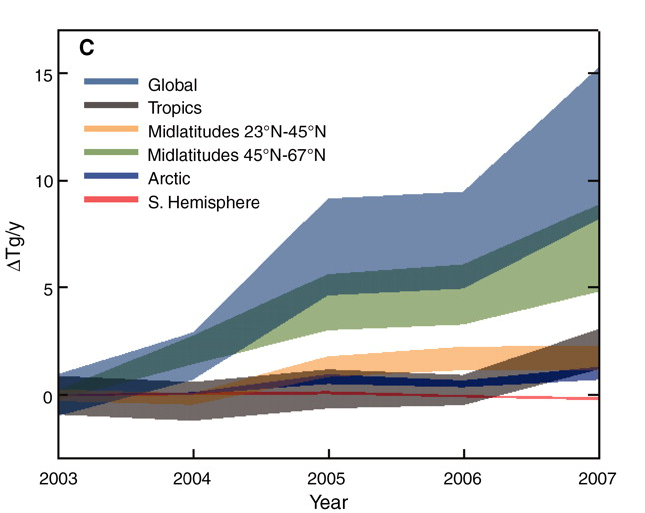
To put this into perspective, here is the graphic from the paper showing the changes in emissions of methane from different sources between 2003 and 2007:

Changes in methane emissions plotted against year

It is obvious that the areas where methane emissions are rising most rapidly are the tropics and the midlatitudes. And although the percentage change in the Arctic is large, the absolute change is very small. I haven’t even bothered to go into the temperature sources – but considering global temperatures as measured by satellite have been pretty steady since about 2001, there would have to be arguments that the contribution arising from the melting of permafrost should be negligible in this period. But I would assume that the NCEP/NCAR figures, since they are based on NOAA data, would show an increase.

The only mention of climate change in the paper is in the very last paragraph:

There is substantial potential for wetland emissions to feed back positively to changes in climate and therefore it is critical that we understand the extent of overlap between wetlands and regions that are most sensitive to projected future warming. We anticipate that the new constraints developed here will ultimately improve model predictions of this feedback.

“Substantial potential” – no evidence, just a hunch. Yet out of that one paragraph, a string of scary news stories has been generated, thanks to an author who has the preset “global warming” bias. The media spin cycle on full blast.

Tom Switzer: The Climate is Changing


WSJ Online

Another excellent article from Tom on the changing attitudes to cap-and-trade:

Nowhere is the changing climate more evident than in Australia. Last month, the Senate voted down the Labor Government’s legislation to implement an emissions-trading scheme. Polls show most Aussies oppose the complicated cap-and-trade system if China and India continue to chug along the smoky path to prosperity. The center-right Liberal-led opposition, moreover, is now led by Tony Abbott, a culture warrior who has described man-made global warming in language unfit to print in a family newspaper and cap-and-trade as “a great big tax to create a great big slush fund to provide politicized handouts, run by a giant bureaucracy.”

Until Mr. Abbott’s election as opposition leader last month, the climate debate in Australia had been conducted in a heretic-hunting, anti-intellectual atmosphere. Prime Minister Kevin Rudd claimed that climate change is the “greatest moral, economic and social challenge of our time.” In clear breach of the great liberal anti-communist Sidney Hook’s rule of controversy—”Before impugning an opponent’s motives, answer his arguments”—Mr. Rudd linked “world government conspiracy theorists” and “climate-change deniers” to “vested interests.” Much of the media, business and scientific establishment deemed it blasphemy that anyone dare question his Labor Party’s grand ambitions.

Australians had heard a lot of science, much of it poorly explained. But the “dismal science” had been conspicuously absent from the climate debate. There was very little serious analysis of the economic consequences of climate change: What choices did we have to mitigate its effects, and how much would these choices cost us? Labor ministers had emitted a lot of hot air about global warming and the urgency with which resource-rich Australia (which accounts for only 1.4% of global emissions) must act.

All of this has now utterly changed: Australia’s debate has entered a new phase, one that goes beyond the religious fervor and feel-good gestures that had held sway all too often. Suddenly, political strategists are thinking the unthinkable: far from presaging an electoral debacle that was inevitable under Mr. Abbott’s green predecessor Malcolm Turnbull, the issue could be a godsend for conservatives Down Under.

Read it here.

Dodgy data at NASA and NOAA as well?


Yet more fudge?

If you thought the CRU-files were an isolated incident, and that apart from that blip, the world of climate science is whiter than white, think again. It appears that much the same has been going on at other leading climate centres, as Watts Up With That reports:

Climate researchers have discovered that NASA researchers improperly manipulated data in order to claim 2005 as “The Warmest Year on Record.” KUSI-TV meteorologist, Weather Channel founder, and iconic weatherman John Coleman will present these findings in a one-hour special airing on KUSI-TV on Jan.14 at 9 p.m. A related report will be made available on the Internet at 6 p.m. EST on January 14th at www.kusi.com.

In a new report, computer expert E. Michael Smith and Certified Consulting Meteorologist Joseph D’Aleo discovered extensive manipulation of the temperature data by the U.S. Government’s two primary climate centers: the National Climate Data Center (NCDC) in Ashville, North Carolina and the NASA Goddard Institute for Space Studies (GISS) at Columbia University in New York City. Smith and D’Aleo accuse these centers of manipulating temperature data to give the appearance of warmer temperatures than actually occurred by trimming the number and location of weather observation stations. The report is available online here.

The report reveals that there were no actual temperatures left in the computer database when NASA/NCDC proclaimed 2005 as “THE WARMEST YEAR ON RECORD.” The NCDC deleted actual temperatures at thousands of locations throughout the world as it changed to a system of global grid points, each of which is determined by averaging the temperatures of two or more adjacent weather observation stations. So the NCDC grid map contains only averaged, not real temperatures, giving rise to significant doubt that the result is a valid representation of Earth temperatures.

The number of actual weather observation points used as a starting point for world average temperatures was reduced from about 6,000 in the 1970s to about 1,000 now. “That leaves much of the world unaccounted for,” says D’Aleo.

Read it here.

Dr Roy Spencer: GW predictions based on faith, not science


Dr Roy spencer explains why climate modellers can tune their models to achieve just about any rate of warming they like:

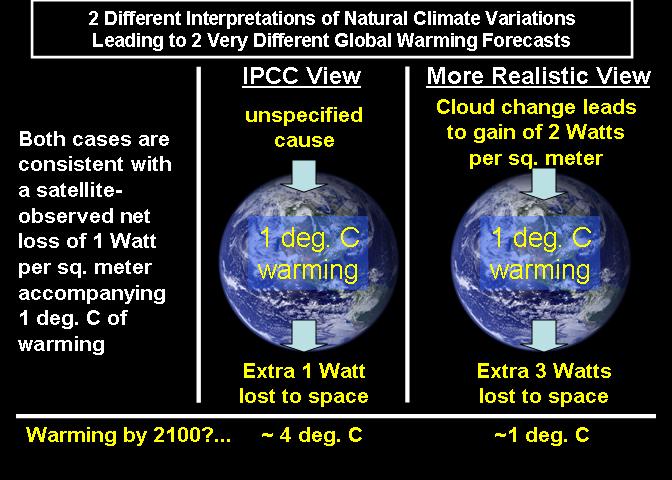
The ‘consensus’ IPCC view, on the left, would be that the 1 deg. C increase in temperature was the cause of the 1 Watt increase in the Earth’s cooling rate. If true, that would mean that a doubling of atmospheric carbon dioxide by late in this century (a 4 Watt decrease in the Earth’s ability to cool) would eventually lead to 4 deg. C of global warming. Not good news.

But those who interpret satellite data in this way are being sloppy. For instance, they never bother to investigate exactly WHY the warming occurred in the first place. As shown on the right, natural cloud variations can do the job quite nicely. To get a net 1 Watt of extra loss you can (for instance) have a gain of 2 Watts of forcing from the cloud change causing the 1 deg. C of warming, and then a resulting feedback response to that warming of an extra 3 Watts.

The net result still ends up being a loss of 1 extra Watt, but in this scenario, a doubling of CO2 would cause little more than 1 deg. C of warming since the Earth is so much more efficient at cooling itself in response to a temperature increase.

As a result of this inherent uncertainty regarding causation, climate modelers are free to tune their models to produce just about any amount of global warming they want to. It will be difficult to prove them wrong, since there is as yet no unambiguous interpretation of the satellite data in this regard. They can simply assert that there are no natural causes of climate change, and as a result they will conclude that our climate system is precariously balanced on a knife edge. The two go hand-in-hand.

Their science thus enters the realm of faith. Of course, there is always an element of faith in scientific inquiry. Unfortunately, in the arena of climate research the level of faith is unusually high, and I get the impression most researchers are not even aware of its existence.

Read it here.

Antarctic sea water shows "no sign" of warming


More "no warming"

From The Science is Settled Department. But, but, but, everyone knows the sea is warming – it must be, our models say so:

SEA water under an East Antarctic ice shelf showed no sign of higher temperatures despite fears of a thaw linked to global warming that could bring higher world ocean levels, first tests showed yesterday.

Sensors lowered through three holes drilled in the Fimbul Ice Shelf showed the sea water is still around freezing and not at higher temperatures widely blamed for the break-up of 10 shelves on the Antarctic Peninsula, the most northerly part of the frozen continent in West Antarctica. [Gee, maybe the break up of the ice shelves was caused by something else, perhaps? Surely the scientists didn’t rush to blame global warming, did they? – Ed]

The water under the ice shelf is very close to the freezing point,” Ole Anders Noest of the Norwegian Polar Institute wrote after drilling through the Fimbul, which is between 250m and 400m thick.

This situation seems to be stable, suggesting that the melting under the ice shelf does not increase,” he wrote of the first drilling cores.

The findings, a rare bit of good news after worrying signs in recent years of polar warming, adds a small bit to a puzzle about how Antarctica is responding to climate change, blamed largely on human use of fossil fuels [by the media and alarmist scientists, that is – Ed].

Read it here.

30 years of global cooling?


Natural cycles

The UK Daily Mail reports that Mojib Latif, an IPCC scientist, has again predicted a long period of cooling, in defiance of the climate models which indicate steady warming with increasing CO2:

According to the U.S. National Snow and Ice Data Centre in Colorado, the warming of the Earth since 1900 is due to natural oceanic cycles, and not man-made greenhouse gases.

It occurred because the world was in a ‘warm mode’, and would have happened regardless of mankind’s rising carbon dioxide production.

And now oceanic cycles have switched to a ‘cold mode’, where data shows that the amount of Arctic summer sea ice has increased by more than a quarter since 2007.

The research has been carried out by eminent climate scientists, including Professor Mojib Latif. He is a leading member of the UN’s Intergovernmental Panel on Climate Change.

He and his colleagues predicted the cooling trend in a 2008 paper, and warned of it again at an IPCC conference in Geneva in September.

Working at the prestigious Leibniz Institute in Kiel University in Germany, he has developed methods for measuring ocean temperatures 3,000ft under the surface, where the cooling and warming cycles start.

For Europe, the crucial factor is the temperature in the middle of the North Atlantic Ocean. He said such ocean cycles – known as multi-decadal oscillations or MDOs – could account for up to half of the rise in global warming in recent years.

Professor Latif said: ‘A significant share of the warming we saw from 1980 to 2000 and at earlier periods in the 20th century was due to these cycles – as much as 50 per cent.

‘They have now gone into reverse, so winters like this one will become much more likely. All this may well last two decades or longer.

The extreme retreats that we have seen in glaciers and sea ice will come to a halt. For the time being, global warming has paused, and there may well be some cooling.’

As WUWT says, “Now watch the warmists throw Latif under the bus.”

Read it here (h/t WUWT)