Bob Carter – Futility of Climate Control


Being a “sceptic” can be hard work sometimes – reporting scaremongering article after scaremongering article, discussing bad science after more bad science, suffering the rantings of hysterical greens after the rantings of more hysterical greens, considering the acts of incompetent governments after the acts of more incompetent governments.

So it’s a bit of a relief to be able to point you to an article by Bob Carter in Quadrant Magazine that restores one’s sanity a bit.
Enjoy.

International Energy Authority goes a-scaremongering


It seems that many sensible organisations have been infected with the scaremonger virus. The latest is the IEA, which is forecasting 6 degree temperature rises by 2100, reports The Australian, doubtless without a shred of credible evidence to support it (other than some “garbage in, garbage out” model, of course).

In its 2008 World Energy Outlook, the IEA said that if present trends continued, greenhouse gas emissions from the burning of coal, oil and gas “would be driven up inexorably”, putting the world on track for a doubling in atmospheric carbon dioxide levels by the end of the century.

And any story like this gives the enviro-hippies the opportunity to bang on about the new utopian economy:

Environmental campaigners, such as Robin Webster, of Friends of the Earth, welcomed the IEA’s call for an “energy revolution” to address climate change, claiming that it could provide economic benefits through the creation of new “green-collar” jobs.

Read it here.

Ian Plimer does battle with ABC journo …


… who starts the interview by calling Plimer a “heretic” – an open goal on her part, as it allows Plimer to brand climate change a religion in the first sentence! One-nil.

Read the transcript here (where you can also watch the video).

(via Jennifer Marohasy)

The Maldives – saved from the evil clutches of the IPCC


In a rare glimmer of climate sense, The Australian reports that the imminent flooding of the Maldives, predicted by (who else?) the IPCC, is far from certain and has nothing to do with “climate change” (via Tom Nelson).

It quotes the ABC (Alarmist Broadcasting Corporation), which dutifully parrots the usual IPCC line:

MOHAMED Nasheed (the new Maldives President) has named battling the effects of rising sea levels as a key priority. He’s hatched an audacious plan to buy his people a new homeland and one of the destinations he’s considering is Australia.

But a welcome dose of reality comes in the form of Nils-Axel Morner, former head of the department of paleogeophysics and geodynamics at Stockholm University:

THE Maldives have a unique position in sea-level research. In the past decade they have attracted special attention because, in the Intergovernmental Panel on Climate Change scenario, the Maldives would be condemned to become flooded in the next 50 to 100 years.

Our research data does not lend support to any such flooding scenario, however. On the contrary, we find no signs of any ongoing sea-level rise. Our results comes from visits to numerous islands … and includes coring, levelling, sampling and carbon dating.

Present sea level was reached about 4500BC. In the past 4000 years, sea level oscillated around the present. In the past decade, there are no signs of any rise in sea level. Hence, we are able to free the islands from the condemnation to become flooded in the 21st century.

Also, the UN Food and Agriculture Organisation suggest that coral mining removes physical barriers to flooding and leaves the islands prone to increased wave action, swells, storm surges and erosion. And this is from the UN!

Sadly, the ABC, along with all the major mainstream media, can’t be bothered to report the mundane reality (i.e. “climate change” not to blame), and have to peddle alarmist propaganda instead.

Read it here.

CSIRO is away with the fairies


No-one will take the CSIRO seriously as long as they continue to spout alarmist claptrap like this, reported in the Herald Sun.

THE world may be on track to face economic and ecological collapses by the middle of the century, according to CSIRO research.

The 1972 bestselling scientific report The Limits to Growth warned of possible doomsday scenarios created by unchecked use of resources.

A study by CSIRO physicist Dr Graham Turner found data projections made in The Limits to Growth were correct.

There is still time to avert things, but we may have to consider some environmental degradation and impacts on the economy might still occur,” he said.

It is deeply embarrassing that our national scientific research organisation, which should represent the pinnacle of Australian scientific thinking, chooses to act like a bunch of unwashed enviro-hippies. Read it here.

The Age quotes Einstein in two greenie articles


“The devil can cite scripture for his purpose” – Shakespeare, Merchant of Venice.

The Age, in a typically nauseating green diatribe, ends its article with:

As Albert Einstein said: “No problem can be solved from the same consciousness that created it. We must learn to see the world anew.”

As if that justifies the rubbish that has gone before. And it isn’t the first time either. In a similar climate alarmist article only last week entitled “We’re never going to survive unless we get a little bit crazy” (see here), Catherine Deveny again quotes Einstein:

According to Albert Einstein, imagination is more important than knowledge.

The fact is that Einstein, if he were alive today, would be horrified by the politicisation of science that has taken place in the field of climate research. He knew well that if the experimental evidence did not fit with the predictions of a theory, then the theory was flawed. This does not seem to apply to climate research, where no matter what contradictory evidence is put forward against the theory of anthropogenic global warming, the alarmists manage to somehow keep it afloat, by hook or by crook.

Climate alarmists should not even be mentioned in the same breath as a truly great scientist such as Einstein, let alone use his quotes to support their tawdry agenda.

Read it here.

Last word on GISS


The most alarming thing about today’s GISS debacle is not that the data was wrong, but that no one at GISS thought to question what was clearly a duff anomaly (0.78). I can only imagine the glee with which Hansen greeted the draft figures when they came across his desk, rubbing his hands together and thinking to himself, “This’ll shut the flat-earthers up for a while.”

But the likely truth is that because the anomaly fitted GISS’s pre-conceived ideas of runaway global warming so well, nobody thought to double-check the source data. The fact that this data was published with such an obvious error does little for the reputation of GISS (and NASA) – either way, they lose: if there was no quality control on on the published data, then that’s unacceptable, and alternatively, if there was quality control which failed to spot an obvious flaw, then that’s unacceptable too.

I await with interest the press release that re-issues the corrected data.

See my full post on the sorry tale here.

October anomalies – GISS goes off piste


…but UAH is steady (thanks to Climate Skeptic). GISS is surface stations, UAH is satellite-based. The media will pick up on GISS (which is run by the second High Priest of the Church of Global Warming, James Hansen) and we will be overrun with stories about the hottest October on record, (despite the fact that they will be fighting for space with stories about records for cold being broken all over the globe…).

Let’s see how long it takes for the first “hottest October” story to hit the Aussie press!

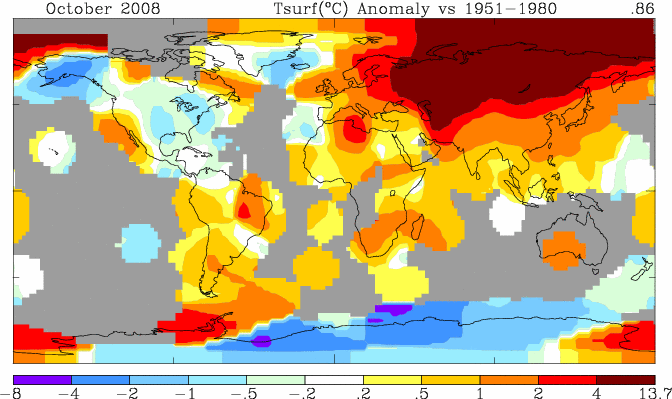
UPDATE: Comments on Anthony Watts’ article indicate that certain temperatures in Russia that contribute to the GISS anomaly figure have been copied over from September! There’s quality control for you! Firstly, here is the GISS temperature anomaly map, showing the extraordinary hotspot over central and north eastern Russia:

And here’s the comment, from Patrick Kiser:

Quite simply, there is an input error.

In completing random check of the cities in warm area, every city with October 2008 data has identical data for both October and September:

Moskva 10.9 both months
Kraznojarsk 8.6 both months
Turuhansk 8.1 both months
Tarko-Sale 6.9 both months
Bor 8.1 both months

These were just the first five I’ve checked. I did also look at data in the US (St. Louis) and France (Dijon), and these appear to be actual temperatures.

Given that they are using September temperature readings for October, it is no surprise that they are getting such a large positive anomaly. I would be interested in finding out if there is an efficient way to notify NASA of these errors, so that they can correct their number.

I have personally just checked a few more of the GISS text files, and as well as those listed above, I found within a few minutes the following stations:

  • Enisejsk
  • Kolpasevo
  • Suntar
  • Viljujsk
  • Minusinsk
  • Tura
  • Verhojansk
  • Aldan
  • Olenek
  • Vitim
  • Bomnak
  • Njaksimvol
  • Salehard
  • Nar’jan-mar
  • Hanty-Mansijs
  • Tobol’sk, and
  • Arhangel’sk

all with October temperature data identical to the September data. This will clearly have a significant impact on the anomalies, since in previous years temperatures from these stations have varied by many degrees between these months (e.g. a 9.3°C difference from September to October at Enisejsk in 2007). If you want to see the data first hand, go here, and look up any of the stations listed above.

In short, GISS has become a joke…

My last word on GISS (for the time being) here.

The Age – the future's green


A typical Age story – throw in some cheap climate alarmism, and then follow it up with how wonderful a new green economy would be, all of it without any link to reality. So, firstly the alarmism:

The evidence is compelling. Polar ice cores show carbon [dioxide? – Ed] in the atmosphere is at an 800,000-year high. Researchers calculate that within as little as 15-20 years we may reach a crucial tipping point when carbon in the atmosphere rises above 450 parts per million.

Beyond that point, global warming may become entirely self-sustaining and increasingly rapid. Time may well be running short.

Quick – run for the hills. And then follow the misty-eyed descriptions of the new green utopia:

Many are talking about launching stimulus packages to lessen the effect of the downturn. If they do so, they should view this as an historic opportunity to climate-proof their economies by focusing spending on green infrastructure and technologies. They may, for instance, boost energy security by improving renewables and clean-coal technology. In our view, energy efficiency has clear attractions to economies heading into recession. Infrastructure spending should be directed to climate- sensitive areas such as power grids, water, buildings and transport.

Read it here.

Super storms blamed on climate change


Tenuous Link to Climate Change Alert: Despite the association between “global warming” and increased storm activity being pretty well discredited, the mainstream media still drag it up whenever required to add a bit of spice to otherwise tedious stories. The basic premise of this one is as dull as dishwater:

“Australian East Coast storms are broadly cyclical over the past 200 years, and there’s little to suggest it changing in the near future,”

which, let’s be honest, wouldn’t rate even a 2 cm column on page 94 of the local rag, just under the 5-a-side results. However, a journo at AAP has managed to spice it up by linking it to “climate change”, and getting in some besuited “expert” to make some apocalyptic predictions (which, as an added bonus, will probably deliver some Government funds into his research department):

“It’s going to cut the coast further inland and it will be more severe than past stormy periods because of the underlying climate change and subsequent sea rises.”

“Improving emergency planning is important because when the event hits, we’ll have very little warning and unless we’re set up for it, it’ll be a disaster much like Katrina was (in the US),” Dr [Peter] Helman [of the Griffith Centre for Coastal Management] said.

Parts of the Gold Coast had lost several metres, but a relative quiet on the erosion front over the past 30 years had prompted both offices [of NSW’s beach protection agencies] to be disbanded, he said.

You’d think that if they knew storm activity on the East Coast was cyclical, they may have worked out it would eventually increase again, so maybe it was a dumb idea to close the offices? Apparently not. 0/10. Must try harder.

Read it here.