
Warming exaggerated?
Surface temperature records are highly susceptible to adjustment. There are all kinds of valid reasons why the “raw” thermometer data may need adjustment, such as the relocation of a station, or urbanisation, but it’s curious, isn’t it, that in many of the data sets the corrections almost always increase any warming trend. This is highly suspect, given that urban warming, for example, is more likely to artificially increase temperatures, requiring a downward adjustment.
An article in Quadrant Online claims that whilst New Zealand’s National Institute of Water and Atmospheric Research (NIWA) has been plugging a 20th century temperature rise of 0.92˚C, the raw data shows nothing of the sort. ACM reported on this back in November of last year (see here) and here are the graphs of adjusted vs. raw data:
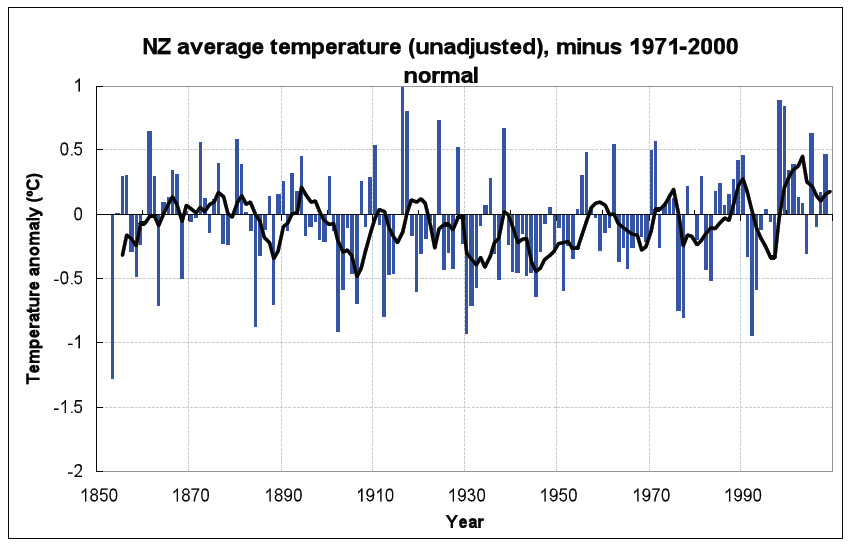
Raw temperature data

After adjustments
Barry Brill, chairman of the New Zealand Climate Science Coalition, takes up the story:
The official temperature record is wrong. The instrumental raw data correctly show that New Zealand average temperatures have remained remarkably steady at 12.6°C +/- 0.5°C for a century and a half. NIWA’s doctoring of that data is indefensible.
The NSS [NIWA Seven Station series] is the outcome of a subjective data series produced by a single Government scientist, whose work has never been peer-reviewed or subjected to proper quality checking. It was smuggled into the official archive without any formal process. It is undocumented and sans metadata, and it could not be defended in any court of law. Yet the full line-up of NIWA climate scientists has gone to extraordinary lengths to support this falsified warming and to fiercely attack its critics.
For nearly 15 years, the 20th-century warming trend of 0.92°C derived from the NSS has been at the centre of NIWA official advice to all tiers of New Zealand Government – Central, Regional and Local. It informs the NIWA climate model. It is used in sworn expert testimony in Environment Court hearings. Its dramatic graph graces the front page of NIWA’s printed brochures and its website.
Internationally, the NSS 0.92°C trend is a foundation stone for the Australia-New Zealand Chapter in the IPCC’s Third and Fourth Assessment Reports. In 1994, it was submitted to HadleyCRUT, so as to influence the vast expanses of the South Pacific in the calculation of globally-averaged temperatures.
…
Over the entire series, a total of 515 years were adjusted. Of these, no less than 467 years contributed to an upward-sloping trend line. So, by year, 90% of the NIWA corrections leaned in the same direction.The ratio of 9 out of 10 adjustments being ‘helpful to the hypothesis’ could surely not have occurred in the absence of bias.
This shouldn’t come as a surprise. NIWA has already made up its mind on climate change, and clearly, the debate is over in their view:

Already decided the answer?
The link then takes you to a page which parrots the IPCC line. But whenever this kind of news breaks, one has to wonder why, if the evidence for “global warming” is so strong, and the science so settled, why the need to exaggerate?
Read it here.
 Australian Climate Madness
Recent Comments