
Skewering the clueless
As always, a great read!
Just don't tell me the debate's over…

Time for ALT-CTRL-DELETE
Penny who? Sorry, it’s been so long since we heard anything from the Wong-bot, that I’d forgotten about her, which was actually quite nice. But now she’s back, the latest version of Windows 7 installed, spouting the same old fearmongering tactics and tired old clichés in a last, desperate effort to get the ETS passed (stifles yawn):
CLIMATE change threatens to reshape the face of Bondi Beach, Bells Beach and the Sunshine Coast unless “large and expensive nourishment programs” are implemented, Penny Wong warned today.
Shortly before the government’s ETS bills are to be considered by the upper house, Ms Wong mounted a vigorous defence of the Copenhagen Summit, the science behind climate change, the Intergovernmental Panel on Climate Change [now THAT I would love to have heard – Ed] and suggested the future of some of the nation’s most popular beaches was under threat.
The Climate Change Minister also said the government’s Carbon Pollution Reduction Scheme was the most effective way to take meaningful action, dismissing the Opposition leader’s rival plan.
In the address to the National Coastal Climate Change Forum in Adelaide this morning, Ms Wong said it was “possible that with climate change, and without large and expensive nourishment programs Bondi Beach, Sunshine Coast and Bells Beach may no longer be the beaches we know today.”
Zzzz… Oh, sorry – nodded off there. No one’s listening any more Penny. Save your batteries, spin down the hard drive, throttle back the CPU, clear the cache, and shut down – for good this time.
Read it here.
UPDATE: The whole speech is here in all its robotic tedium, and as predicted recycles all the alarmist BS that we’ve heard before, including the old canard of comparing climate realists with those who question the link between smoking and cancer, which personally I find deeply offensive.
The desperate measures some people will go to in order to keep that alarmism flowing:
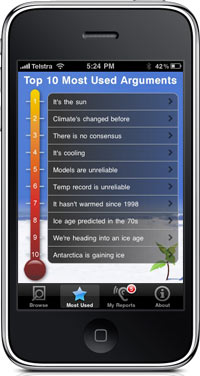
We need an iPhone app to answer the sceptics...
As I’m sure you’re all dying to download it, you can find it here.

Zero integrity
… when four are dead as a result of his bungled home insulation scheme? I am posting about this because it is basically a climate issue – encouraging householders to install insulation in order to reduce electricity and heating/cooling, and therefore reduce energy consumption and ultimately CO2 emissions.
I guess the answer is this – the Left don’t have the common decency to admit to their own failings and take the honourable course, resignation. Can you even begin to imagine the uproar in the media if this had been a minister in a Coalition government? The ABC and the left-wing press would have been a field day (although they probably wouldn’t have had the chance, since a Coalition minister would have the good sense and decency to fall on his own sword).
The only thing that matters to Rudd, Garrett and their cronies is staying in power at all costs.

Quote of the Day
Speaking of the Coalition’s climate policy:
“I did not take seriously the possibility that it would become part of the Australian policy discussion – I thought that debates over the Government taking huge decisions about the resource allocation ended with the fall of the Soviet Union.”
“To think that regulation, decisions by bureaucrats and governments to reach the right conclusions is, I think, delusional.”
Unfortunately, there is no pleasing dear old Ross, who, back in October described the government’s CPRS (ETS), you know, the one he helped construct, as:
“One of the worst examples of policy making we have seen on major issues in Australia”.
Read it here.

USCAP
They can see when the party’s over, clearly:
Three major US companies said Tuesday they were leaving a coalition pushing for action on climate change, dealing a potential fresh blow to landmark legislation to cut carbon emissions.
The companies — oil groups ConocoPhillips and BP America and equipment maker Caterpillar Inc. — said they backed efforts for a green economy but felt that proposed laws were unfair to them.
The firms said they would not renew membership in the US Climate Action Partnership (USCAP), a coalition of business leaders whom President Barack Obama’s Democratic Party often cites to bulwark its case on climate change.
ConocoPhillips and BP America, a unit of British giant BP, said the bill under consideration did not attach enough importance to natural gas — which they promote as a way to curb carbon emissions blamed for global warming.
The bills “have disadvantaged the transportation sector and its consumers, left domestic refineries unfairly penalized versus international competition, and ignored the critical role that natural gas can play in reducing greenhouse gas emissions,” said Jim Mulva, ConocoPhilips chairman and CEO.
“We believe greater attention and resources need to be dedicated to reversing these missed opportunities, and our actions today are part of that effort,” he said in a statement.
Read it here.

I hope they purchased carbon offsets for that…
I guess the church could start by not burning thousands of tons of palm fronds around the planet for Ash Wednesday services. That would remove a few tonnes of CO2 from the atmosphere (not to mention all the heretics burnt in the past – just think of the carbon footprint of that).
Several prominent Anglican British bishops are urging Christians to keep their carbon consumption in check this Lent.
The 40-day period of penitence before Easter typically sees observant Catholics, Anglicans, and Orthodox Christians give up meat, alcohol or chocolates.
But this year’s initiative aims to convince those observing Lent to try a day without an iPod or mobile phone in a bid to reduce the use of electricity – and thus trim the amount of carbon dioxide spewed [good emotive word there – Ed] into the atmosphere.
Bishop of London Rev. Richard Chartres said that the poorest people in developing countries were the hardest hit by man-made climate change.
He said Tuesday that the “Carbon Fast” was “an opportunity to demonstrate the love of God in a practical way.”
Actually, it’s the poorest people in developing countries that will be hit hardest by the global efforts to tackle climate change, denying them cheap energy to raise their standards of living… hardly a Christian good deed, is it?
Read it here.

Bjorn Lombord
Bjorn Lomborg writes in The Australian on the woes of the IPCC. Now remember, Lomborg is a believer in man-made global warming, but he has realised, unlike most of his fellow believers, that sweeping the IPCC’s errors under the carpet is precisely the wrong thing to do, if you are ever to regain public confidence:
Climate evangelism is an apt description of what the IPCC has been up to, for it has exaggerated some of the ramifications of climate change in order to make politicians take note. Murari Lal, the co-ordinating lead author of the section of the IPCC report that contained the Himalayan error, admitted he and his colleagues knew the dramatic glacier prediction was not based on any peer-reviewed science. Nonetheless, he explained, “we thought that if we can highlight it, it will [influence] policymakers and politicians and encourage them to take some concrete action.”
The concrete action they had in mind was getting governments to mandate drastic cuts in carbon dioxide emissions.
Activists have been pursuing this approach to tackling global warming without success for nearly 20 years, most recently at December’s failed climate summit in Copenhagen. The problem is that it is too expensive a solution for politicians and the public to swallow easily, which is why many well-meaning climate scientists have apparently concluded that instead of relying on reasoned discussion, they might as well try to scare us witless.
Consider what the IPCC had to say about extreme weather events such as intense hurricanes. The cost of such events in terms of destroyed property and economic disruption has been rising steadily. Every peer-reviewed study has shown this is not because of rising temperatures but because more people live in harm’s way.
Read it here.

More errors?
Another diligent blogger spots yet more “minor” errors in the Met Office data:
A science blogger has uncovered a catalogue of errors in Met Office records that form a central part of the scientific evidence for global warming.
The mistakes, which led to the data from a large number of weather stations being discarded or misused, had been overlooked by professional scientists and were only discovered when the Met Office’s Hadley Centre made data publicly available in December after the “climategate” e-mail row.
Although the errors do not alter the bigger picture on climate change, they have been seized upon as a further sign that scientific institutions have not been sufficiently transparent. “It makes you wonder how many other problems there are in the data,” said John Graham-Cumming, the programmer who spotted the mistakes. “The whole idea of doing science without releasing your data is quite worrying.
…
After trying to reproduce figures shown in scientific publications and on the Met Office website, Dr Graham-Cumming identified a number of problems with the way measurements from Australian weather stations were being averaged. He found that data from seven stations were being accidentally discarded. Data from a further 112 Australian stations, 28 per cent of the total, were not being fully included in calculations of year-on-year temperature differences.
“I’m not a climate sceptic, I think it’s pretty sure that the world is warming up, but this does show why the raw data and not just the results should be available,” said Dr Graham-Cumming.
During the checking procedure Met Office officials discovered further problems with US temperature calculations. They realised that 121 of the US stations did not have unique identifier codes, meaning that data for these stations was either being overwritten or assigned to the wrong location.
Hardly instils a feeling of confidence. Especially when we’re about to spend trillions of dollars “tackling climate change” based on this data…
Read it here.

Sorry, Al - wrong again.
Another day, another dodgy claim from AR4. We’ve already had the link between “global warming” and natural disasters debunked, and now this:
More trouble looms for the IPCC. The body may need to revise statements made in its Fourth Assessment Report on hurricanes and global warming. A statistical analysis of the raw data shows that the claims that global hurricane activity has increased cannot be supported.
Les Hatton once fixed weather models at the Met Office. Having studied Maths at Cambridge, he completed his PhD as metereologist: his PhD was the study of tornadoes and waterspouts. He’s a fellow of the Royal Meterological Society, currently teaches at the University of Kingston, and is well known in the software engineering community – his studies include critical systems analysis.
Hatton has released what he describes as an ‘A-level’ statistical analysis, which tests six IPCC statements against raw data from the National Oceanic and Atmospheric (NOAA) Administration. He’s published all the raw data and invites criticism, but warns he is neither “a warmist nor a denialist”, but a scientist.
Hatton performed a z-test statistical analysis of the period 1999-2009 against 1946-2009 to test the six conclusions. He also ran the data ending with what the IPCC had available in 2007. He found that North Atlantic hurricane activity increased significantly, but the increase was counterbalanced by diminished activity in the East Pacific, where hurricane-strength storms are 50 per cent more prevalent. The West Pacific showed no significant change. Overall, the declines balance the increases.
“When you average the number of storms and their strength, it almost exactly balances.” This isn’t indicative of an increase in atmospheric energy manifesting itself in storms.
Even the North Atlantic increase should be treated with caution, Hatton concludes, since the period contains one anomalous year of unusually high hurricane activity – 2005 – the year Al Gore used the Katrina tragedy to advance the case for the manmade global warming theory.
The IPCC does indeed conclude that “there is no clear trend in the annual numbers of tropical cyclones.” If only the IPCC had stopped there. Yet it goes on to make more claims, and draw conclusions that the data doesn’t support.
Read the rest of it here. (h/t WUWT)


Recent Comments