ABC's Catalyst: increased CO2 is bad for plants


Cassava, soon to be cyanide if we keep driving SUVs

Another week, another “climate” scare story from Catalyst. The ETS is dead and nobody’s interested in reducing CO2 to “tackle climate change” any more, so the ABC goes looking for another reason to cripple Western economies and send our standards of living back to the Dark Ages.

And they find a corker. You thought increasing CO2 in the atmosphere would be good for plants? Wrong. It’s bad, and the ABC’s “science” programme jumps on this research without pausing for breath. Brilliant. Forget global warming, forget how the majority of plants would benefit from increased CO2, forget how we are actually living in a CO2 starved atmosphere. Now it’s “food security” that everyone’s worrying about, thanks to reduced nutrition and increased toxins:

Dr Graham Phillips
The next big food issue could be how rising levels of carbon dioxide are affecting our fruit and vegies. Now we know that plants love CO2 so rising levels of it will affect their metabolisms and it seems almost certain that for many foods the levels of nutrition will go down and for some toxin levels will go up. Both serious issues when you are trying to feed a world with an increasing population.

Dr Ros Gleadow
We’re tracking worst case scenario with carbon dioxide at the moment [what? – Ed] and we need to predict what sort of things are going to happen in the future.

Maybe they could predict the future with some dodgy second-hand climate models bought off the back of a truck from Michael Mann. That should do the trick. Or Madame Za Za’s crystal ball, perhaps? Just like last week: more scary music, more alarmism. And they’ve found a plant, cassava, that links rising CO2 levels with increased levels of cyanide. Almost a Holy Grail for the ABC’s alarmism department – cut CO2 or you’ll die of cyanide poisoning:

NARRATION
Back in the lab Ros’s group have been looking at how rising CO2 will affect the cyanide levels of cassava.

Dr Ros Gleadow
We grew cassava at three different concentrations of carbon dioxide. Today’s air, one and a half times the amount of carbon dioxide and twice the carbon dioxide of today. And we found that cyanogen concentration in the leaves increased.

Dr Graham Phillips
So as we get more Carbon Dioxide in the atmosphere these will contain more cyanide?

Emeritus Prof. Howard Bradbury
More cyanide yes. The yield from the roots which is the main thing, will go down. So that is the most worrying aspect.

And the last word to Dr Gleadow:

Dr Ros Gleadow
I don’t want to be a gloom and doom person. I want to think okay clover’s going to become more toxic, let’s develop other cultivars. If cassava’s going to become more toxic, let’s look at some other cultivars. Let’s look at other ways we can deal with this problem.

Don’t say that! It’ll spoil the story!

Read/watch it here.
ABC: quotes "residents" in climate change article


Victim of climate change?

The ABC just can’t stop, can they? Any authority, no matter how worthless, will do in advancing their pre-conceived agenda of climate alarmism. In another bleeding heart article on the same government report discussed here, the ABC quotes the opinion of local residents as somehow worthy of reporting. Not only that but throwing in “Kakadu” is a cheap shot to grab the punters’ attention, with the breathless headline “Climate change could hit Kakadu food sources”:

[The report] says a projected sea level rise of 20 centimetres would irreversibly change the shape of rivers like the South Alligator and alter tidal flows and vegetation cover.

Rising sea levels would also reduce the availability of traditional food sources for Indigenous communities, like magpie geese, barramundi and freshwater turtles.

The report did not discuss the impact of climate change on mining projects, but residents raised concerns about how the Ranger uranium mine, near Jabiru, would cope with more intense cyclones and heavier rainfall.

So the report didn’t even mention mining, but the residents have raised concerns, and those concerns conveniently happen to fit the alarmist agenda of the ABC, so they get published uncritically! Forget the fact that more intense cyclones and heavier rainfall are chestnuts that has been debunked over and over again. And anyway, I thought climate change caused drought? Who cares. It’s just whatever fits the requirement at the time.

And what about the concerns of other residents that climate change is a crock and a complete waste of taxpayers money? No, they won’t get published, because according to the biased ABC, people who hold those views are just dumb bogans.

Read it here.

Rudd government still wasting money on climate change


Now wash your hands (of responsibility)

Despite the ditching of the ETS, the Rudd government is still spending truckloads of money on the empty shell of its climate change policy. As The Daily Telegraph reported last week, a bloated government department is still being run for the purpose of administering a non-existent CPRS:

TAXPAYERS will fork out $90 million a year to keep more than 400 public servants employed within the federal Climate Change Department – despite most now having nothing to do until 2013.

More than 60 of them are classified as senior executive staff on salaries between $168,000 and $298,000 a year. Their salary bill alone will cost an estimated $12 million every year.

A further $8 million will also be paid in rent for plush offices at Canberra’s Constitution Place until 2012, where it is believed 500 new computers will be delivered this week.

It can be revealed that despite Prime Minister Kevin Rudd’s decision on Tuesday to suspend the failed Carbon Pollution Reduction Scheme until at least 2013, the department has ruled out plans to cut back staff.

A formal response by department secretary Martin Parkinson to a Senate estimates hearing on Tuesday – the same day as the scheme’s suspension – claimed the department would not offer redundancies. (source)

Not only that, but thousands of (your taxpayer) dollars are still being wasted on pointless “climate change” reports, like this one reported on the ABC this morning:

A new report has found the health of Indigenous Australians living in coastal areas such as the Torres Strait could be at risk due to climate change.

The report commissioned by the Federal Government found climate change will elevate existing health risks for Indigenous people and create a whole new set of health problems.

They include respiratory illness and increasing incidence of heat stress and dehydration.

The loss of livelihoods and population displacement will also have a serious impact on the health and nutrition of those living in remote island communities.

Climate Change Minister Penny Wong [who she? – Ed] delivered the report while touring the Torres Strait. (source)

Now aren’t you glad that your hard earned money is being spent so wisely?

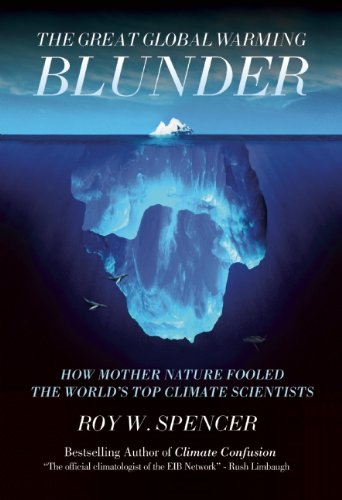
Dr Roy Spencer: "The Great Global Warming Blunder"


Must read

Dr Roy Spencer has written a book summarising the findings of his soon to be published (and peer-reviewed) work on probably the most important aspect of climate science: climate sensitivity:

The most obvious way for warming to be caused naturally is for small, natural fluctuations in the circulation patterns of the atmosphere and ocean to result in a 1% or 2% decrease in global cloud cover. Clouds are the Earth’s sunshade, and if cloud cover changes for any reason, you have global warming — or global cooling.

How could the experts have missed such a simple explanation? Because they have convinced themselves that only a temperature change can cause a cloud cover change, and not the other way around. The issue is one of causation. They have not accounted for cloud changes causing temperature changes.

The experts have simply mixed up cause and effect when observing how clouds and temperature vary. The book reveals a simple way to determine the direction of causation from satellite observations of global average temperature and cloud variations. And that new tool should fundamentally change how we view the climate system.

Blunder also addresses a second major mistake that results from ignoring the effect of natural cloud variations on temperature: it results in the illusion that the climate system is very sensitive. The experts claim that, since our climate system is very sensitive, then our carbon dioxide emissions are all that is needed to explain global warming. There is no need to look for alternative explanations.

But I show that the experts have merely reasoned themselves in a circle on this subject. When properly interpreted, our satellite observations actually reveal that the system is quite IN-sensitive. And an insensitive climate system means that nature does not really care whether you travel by jet, or how many hamburgers or steaks you eat.

Read Dr Spencer’s post here. A copy of the book is on its way to me right now, and a more detailed review will follow.

ABC: yet more scaremongering


More like science fiction

Another day, another hysterical climate piece from your publicly funded national broadcaster. This time, researchers claim that when wet bulb temperatures (dew point, in other words) reach 35 degrees, it will become “uncomfortable” for humans. They have used climate models to predict when this will occur, and we all know how reliable and accurate they are. The ABC uncritically publishes it all in its science pages, under the headline “Warmer planet to stress humans: study”:

Professor Steven Sherwood of University of New South Wales and Associate Professor Matthew Huber of Purdue University in Illinois, used climate models to predict where and when temperatures will increase to uncomfortable levels.

They found a global temperature increase of 7°C above pre-industrial levels would push temperatures in some regions above 35°C for extended periods, resulting in heat stress across the whole population.

Sherwood says while heat-related deaths among the elderly and young already occur, global warming will result in more of the population suffering.

“What we’re talking about here is something a bit different – these limits apply to a healthy person,” he says.

But the final paragraphs tell the real story:

Sherwood says a 7°C increase isn’t likely to happen until next century, but he says it’s important to understand the impact should it occur.

“When you’re planning sensibly for anything you plan for the worst case scenario,” he says. [In other words, take the precautionary principle to its logical conclusion – Ed]

“We’re saying this is the worst scenario, we’re not saying it’s going to happen soon, but to ignore it seems foolhardy.”

The researchers conclude further warming would have a more drastic impact.

“If warmings of 10°C were really to occur in [the] next three centuries, the area of land likely rendered uninhabitable by heat stress would dwarf that affects by rising sea level,” they write.

The average global temperature has increased by 0.8°C since pre-industrial times. Some scientists and environmental groups are pushing for limits on human-produced greenhouse gas emissions to limit the increase to no more than 2°C.

In other words, this is a worst-case, precautionary-principle-gone-mad study, which somehow makes it onto the ABC as mainstream science.

Read it here.

Backflip backfires


Rudd's gymnastics coach demonstrates the back flip

Kevin Rudd (he who has no political convictions whatsoever) thought that by dumping the ETS he would avoid having to be beaten repeatedly round the ears in the run up to an election by an Opposition wielding a stick bearing the words “Great big new tax”. Unfortunately, his political cowardice in not forcing a double dissolution on climate change, which is what he should have done if he truly believed it to be the greatest moral challenge of our time, is backfiring, as the public realise that he is a spineless and gutless prime minister. As The Australian reports:

THE Labor government has lost its position as the leader on climate change for the first time, following Kevin Rudd’s decision to dump plans for an emissions trading scheme.

Having always led the Coalition, at times by a margin of more than two to one on the question of which party would be best able to handle the issue of climate change, the Labor government is now equal to the Coalition opposition and, essentially, the Greens.

The Prime Minister’s sudden decision to push off any attempt to get the Carbon Pollution Reduction Scheme through this parliament and possibly not until after the election after next has led to a dramatic slump in support for Labor on climate change.

Under pressure from Tony Abbott’s political campaign against the ETS as a “great big tax” and faced with Coalition and Greens opposition in the Senate, Mr Rudd declared last week that the timetable for implementation of any CPRS would be “extended” until 2013 at least.

Read it here.

UPDATE: Of course, the warmist media is trying to spin this story as demonstrating that the Australian people really, really wanted a huge tax on everything for no environmental benefit whatsoever, and they are deserting Rudd because he isn’t giving them one… Believe that at your peril.

Fallout from ETS dumping continues


The whole landscape has shifted, and the climate debate in Australia has changed overnight. Climate change as a political issue is off the agenda, and it will sink down in public consciousness again, only emerging briefly when there is some pointless UN gabfest on (like Mexico at the end of the year). Nobody really cares, as more and more people (including politicians) realise that there are more urgent and pressing things to worry about, like huge oil spills in the Gulf of Mexico, massive eruptions of volcanoes in Iceland that cripple air transport for days, economic crises that threaten to tear apart the EU… the list goes on.

The only ones that are still bleating are the liberal left intelligentsia, spluttering “But, but, but, how can you dump climate change? We need to save the planet!” The Sydney Moonbat Herald carries a good example:

Climate change does not need faith or trust any more, just the ability to read.

Now most of us cannot really understand the economics of the Emissions Trading Scheme so that too relies on faith. Perhaps the ETS might give way to something more straightforward such as a carbon tax. Governments around the world have made a pig’s breakfast of explaining how these complicated ETS schemes work and so faith is again required. Economists and politicians must now step up, like the scientists have, to explain what ETS means to the community. Only then will the ETS stand a chance against the warriors of ignorance.

And what has this all to do with Godlessness and religion??? Well sometimes those old foes, religion and science have similar epistemological (the theory of knowledge) challenges. I once argued that climate change science is one area where I would happily proclaim – ”KEEP THE FAITH!”

I now assert that faith is not needed. The data is in. The deniers will go down, like Neville Chamberlain, as the deluded and cynical fools of history. We shall remember them. Lest we forget. (source)

Unfortunately, we will see denial all around us, not from the climate realists, but from the true believers who cannot come to terms with the fact that their precious faith has just been abandoned by KRudd & Co. Funnily enough, as one commentator noted, if Howard had been voted back at the last election in 2007, there probably would be an ETS by now! Oh, the sweet irony of it all!

The delay may of course encourage the alarmists, desperate to keep the bandwagon going, to resort to even more desperate, dangerous and undemocratic means to get their way. However, with so many broken promises from Labor, how can we even trust this last announcement? As Andrew Robb said, is this just an electioneering smoke screen? Only time will tell.

Rudd the weathervane


Twisting in the wind...

The Australian’s Cut & Paste section exposes Rudd’s blatant hypocrisy by helpfully collecting together all of Kevin Rudd’s previous spin on climate change into one handy cut-out-and-keep guide for your wallet:

As Kevin Rudd once said, there are only two stark choices: action or inaction

Monday, November 4, 2006 on The 7:30 Report:

Kerry O’Brien: Kevin Rudd , what is the one thing more, than anything else, that will define your leadership?

Rudd : We’ll have a clear alternative on climate change.

Kevin Rudd and Climate Change Minister Penny Wong at the UN, New York, September 23 last year:

EVERY time a nation delays, every time a nation puts up its hand and says, “It’s all too hard”, it’s a further excuse to put off the measures we need to take to deal with the challenges for climate change for Australia.

The PM on November 6 last year, at the Lowy Institute in Sydney:

WHEN you strip away all the political rhetoric, all the political excuses, there are two stark choices: action or inaction. We choose action, and we do so because Australia’s fundamental economic and environmental interests lie in action. Action now. Not action delayed. Now the Liberals and Nationals have said wait for Copenhagen and for President [Barack] Obama’s scheme.What absolute political cowardice. What an absolute failure of leadership. What an absolute failure of logic.

The PM in Copenhagen on December 17 last year:

THE time has come for a grand bargain between the past and the future. Each and every one of us here will be judged as individuals. For what we say. For what we do. And for what we fail to do. Words without deeds are a dead letter. There have been millions of words spoken here, but as one of our colleagues said, it is time to stop talking and start working.

Rudd yesterday:

The rest of the world has been slow to act, or slower to act on appropriate action on international climate change. The real deadline facing us is the expiration of the current Kyoto commitment period, which concludes at the end of 2012.

Rudd is just a political weathervane, blowing this way and that, following the winds of public opinion, and all the time having no genuine policy convictions whatsoever. More spin than a launderette.

Read it here.

ABC: alarmist business as usual


Not science, but alarmism

I suppose we should have expected the green-left brigade at the ABC to go into alarmist overdrive in response to the government’s dropping of the ETS, but I didn’t expect it to be so soon. The flagship TV science programme, Catalyst, opened last night with a hysterical piece on the melting Antarctic. Yes, the Antarctic. Note how, without dropping a beat, the ABC switches its attention to the South pole, since as we all know, ice levels in the Arctic are the highest they have been for years.

The segment played out like a disaster movie: scary voiceovers, scary music, dramatic footage of, er, melting ice, scary “what ifs”, and, to suck away any last vestige of credibility, quotes from James Hansen. Here are a few choice extracts, starting with the creepy opening:

NARRATION: The seas are rising [Yes, at the same rate they have been for thousands of years – Ed]. How fast and how high they will go is the big unknown. But one thing is certain. What happens in Antarctica will be critical. Around 90 percent of the planet’s snow and ice is found here. Is the sleeping giant stirring?

NARRATION: The Wilkins Ice shelf is the latest of seven ice shelves on the Peninsula to start collapsing, and it’s the furthest south. Ice shelves are already floating, so they can’t contribute to sea level rise. It’s what’s behind them that’s the big concern. But now it is all too familiar. Seven shelves on the Antarctic peninsula have collapsed in the past two decades. This is a region of the huge Wilkins ice shelf which collapsed in 2008.

Dr Ian Allison: If you take that barrier away, the big glaciers behind it will flow more quickly.

NARRATION: Glaciers that drained into the Larsen B ice shelf have sped up by a factor of seven.

Neal Young: That does contribute to sea level rise. The quantity of ice in the Antarctic Peninsula region though is small. The key message is what would happen in the east and to the major glaciers in the West Antarctic if such changes were to occur there? That would be a consistent, persistent and very ominous I think change in the scenario.

NARRATION: And there’s strong evidence that change is already occurring. In the Amundsen Sea region, glaciologists have found the major glaciers are speeding up and losing mass, thinning by up to nine metres a year. What’s remarkable is the thinning extends hundreds of kilometres into the grounded ice sheet.

Mark Horstman: It’s the middle of summer here in East Antarctica, and right now the air temperature is minus four degrees and dropping. There’s no way that air temperatures like this are going to melt any ice. And In fact, until just recently, it was thought that the ice sheet on this side of the continent was actually growing in size.

NARRATION: But alarming new evidence indicates this trend has reversed.

Mark Horstman: What we’ve revealed here is a complex story about Antarctica under changing climates. And the take home message, like the continent itself, comes in two parts. Here in the East, it appears that it’s a warming ocean that;s driving the changes in the ice sheet.

Dr Paul Willis: Whereas here in the West the ice is melting from above and below. When it comes to sea level rise, Antarctica the sleeping giant is waking up.

Business as usual at Their Alarmist Broadcasting Corporation.

Read it (and watch it) here.

ETS shelved "until at least 2013"


Interrupting work on my other current climate project to bring you the news that the Rudd government has put the “greatest moral challenge since the dawn of time” firmly on the back burner. As the ABC reports:

It was once a centrepiece of the Federal Government’s election strategy, but now the emissions trading scheme (ETS) has been relegated to the shelf until at least 2013.

Delaying the scheme means the Government could save $2.5 billion from its budget over the next three years, because it would not be paying compensation to households and industries.

Prime Minister Kevin Rudd recently said climate change remained a fundamental economic, environmental and moral challenge, whether it was popular or not.

But Government sources say it was decided last week to remove the scheme from next month’s budget, bowing to the political reality that the Senate is unlikely to pass the ETS any time soon.

The Upper House has already blocked the ETS legislation twice.

The bills are before the Parliament again but the Senate has delayed the debate while it examines the deal that Mr Rudd struck with former Opposition leader Malcolm Turnbull.

The bottom line is that neither the Opposition, now led by Tony Abbott, nor the Greens like the amended legislation, so it remains in limbo. (source)

And the Sydney Morning Herald readers will all be choking on their skinny lattes:

The decision means the government is likely to take its ETS legislation off the table until after an election, expected later this year.

It also means Labor will not use its latest legislation as a double-dissolution trigger, nor its original bills twice rejected by the upper house last year.

The Senate was expected to vote on the legislation when parliament resumes sitting in May.

“The prime minister clearly has no commitment to climate change,” Mr Hunt said, adding the ETS was a tool to get Mr Rudd through an election.

“And he’s dropped it the moment it’s become inconvenient.” (source)

Just goes to show that Rudd will do whatever it takes to get re-elected in November, even as much as scrapping his centrepiece policy.

At least the Australian taxpayers have dodged the bullet for the time being. But it also means that the Opposition will not have the ETS stick to beat the government with, which will make winning this year’s election even harder.