
No hope
What is the government’s carbon tax modelling based upon? Global trading of emissions by 2016 (see here). What is the chance of that? Zero.
Not only is Kyoto about to fall apart, but the divisions between developed and developing countries as to who should bear the greatest burden of emissions cuts are as wide and unbridgeable as ever:
U.N. climate chief Christiana Figueres lauded a climate change meeting in Panama as “good progress” this weekend, even as environmental activists warned that the world’s only structure for curbing greenhouse gas emissions appears about to crumble.
The next time diplomats meet, it will be in Durban, South Africa, in December for the year’s final climate change summit. There, countries must finally decide what they have put off for several years: the future of the Kyoto Protocol.
“South Africa is the tipping point in terms of the future of the climate regime,” said Tasneem Essop, international climate policy advocate for the World Wildlife Fund in South Africa. [Just like Copenhagen and Cancun were both the “last chance” for a deal – Ed]
The 1997 treaty requires carbon emission cuts from industrialized countries, and the first phase of the agreement ends in 2012. Developing countries are adamant that a second commitment period is non-negotiable. Moreover, they insist any follow-up should closely hew to the original agreement: Wealthy countries must agree unilaterally to cut steeper emissions, and poorer ones would cut carbon voluntarily after financial assistance from the rich. (source)
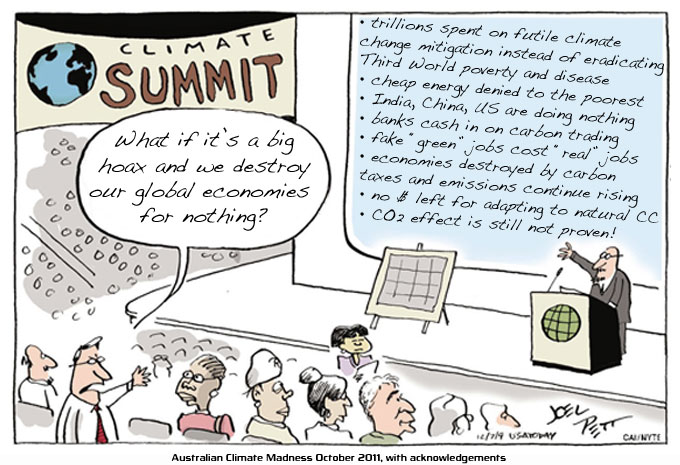
The fragility of the global negotiations on climate change only make Labor’s pointless carbon tax seem all the more ridiculous.






 Australian Climate Madness
Recent Comments