More Barrier Reef scaremongering


Dangerously rapid warming, as you can see

Dangerously rapid warming, as you can see

Whenever things are a bit slow, and the alarmists are a bit desperate, they throw in a story about some cuddly creature becoming extinct, koalas or possums or polar bears, or in default, that great Aussie icon, the Barrier Reef. So here we go again, with the same ol’ same ol’ story rehashed and spun slightly differently:

THE Great Barrier Reef has only a 50 per cent chance of survival if global CO2 emissions are not reduced at least 25 per cent by 2020, a coalition of Australia’s top reef and climate scientists said today.

The 13 scientists said even deeper cuts of up to 90 per cent by 2050 would necessary if the reef was to survive future coral bleaching and coral death caused by rising ocean temperatures.

We’ve seen the evidence with our own eyes. Climate change is already impacting the Great Barrier Reef,” Terry Hughes, director of the ARC Centre of Excellence for Coral Reef Studies at James Cook University, said in a briefing to MPs.

Australia is one of the world’s biggest CO2 emitters per capita [What relevance is that? We produce less than 1.5% of global emissions – Ed], but has only pledged to cut its emissions by five per cent from 2000 levels by 2020. The Government said it would go further with a 25 per cent cut, if a tough international climate agreement is reached at UN climate talks in Copenhagen in December, but this is looking increasingly unlikely with legally binding targets now off the agenda.

[Cue violins]This is our Great Barrier Reef. If Australia doesn’t show leadership by reducing emissions to save the reef, who will?” asked scientist Ken Baldwin.

The reality, of course, is that sea surface temperatures around the GBR have hardly risen at all, the reef has been here for hundreds of thousands of years, and has been through more warmings and coolings that Terry Hughes or Ken Baldwin between them have had hot dinners. And it’s still here. And it will still be here long after Terry Hughes and Ken Baldwin are pushing up the daisies. Why? Because reefs adapt. Unlike humans, who panic and throw trillions of dollars at a solution that won’t work.

Read it here.

Climate threat to Italian pasta


Thanks to climate change, this won't be happening again

Thanks to climate change, scenes like this will be a thing of the past

Add it to the list of things caused by “climate change” – the disappearance of Italian pasta (no joke). Embarrassingly, this is from the UK Meteorological Office, which now has a reputation for crazy predictions which always fail to eventuate:

SCIENTISTS will this week warn that Italy may be forced to import the basic ingredients for pasta, its national food, because climate change will make it impossible to grow durum wheat.

In a report to be released by Britain’s Met Office today, scientists predict that Italy’s durum yields will start to decline from 2020 and the crop will almost disappear from the country later this century.

The report will say: “Projected climate changes in this region, in particular rising temperature and decreasing rainfall, may seriously compromise wheat yields.”

It reinforces earlier research suggesting climate change may leave France unable to produce many of its leading wines, including champagne.

Oh well, we’ll all have to drink Aussie sparkling wines instead!

Read it here.

UPDATE: More on the Met Office report: “World has only ten years to control global warming, warns Met Office.”

Ten, five, twenty, a hundred – pick a number.

Penny Wong: alarmism and empty threats


The Wong-bot

The Wong-bot

Curious, isn’t it, that CSIRO choose to release dire warnings about the effects of sea level rises of 1.1m by 2100 just before the Senate is due to debate the ETS, giving the Wong-bot the perfect opportunity to threaten the Coalition with apocalyptic consequences if the ETS isn’t passed. The Wong-bot denies that it’s a scare campaign (well, she would, wouldn’t she) but I think the evidence speaks for itself:

As a result, the report says, more than $60 billion worth of residential property faces flooding.

In addition 120 ports, 1,800 bridges, power stations, water treatment plants and airports close to the coastline are also under threat.

Climate Change Minister Penny Wong says the findings can’t be ignored.

“The science tells us our climate is changing faster than first projected and the impacts are likely to be more severe,” she told reporters in Sydney.

Australia must immediately reduce its carbon emissions, she said.

“Which is why we are determined to pass the Carbon Pollution Reduction Scheme.”

OK then, Penny. Let’s work this through the twisted logic of this, shall we?

Question 1: Assuming the two-errors-in-four-words Carbon Pollution Reduction Scheme (ETS) is passed and Australia cripples its economy and reduces its emissions by, say, 20% by 2020, what effect will that have on sea level rises around Australia?

Answer: Nothing, because Australia produces less than 1.5% of global emissions.

Question 2: Assuming that at Copenhagen, the rest of the developed world is so impressed with Australia’s brand new, shiny ETS that they all fall over themselves to cripple their economies too, and sign a treaty reducing emissions significantly by 2020, what effect will that have on sea level rises around Australia?

Answer: Nothing, because increased emissions from China (who are building a new coal fired power station every week) and India (who have more important things to worry about, like tackling poverty and disease – you know, stuff that really does kill people) will more than make up for any cuts by developed countries. Plus, the developed countries will begin to realise that running a developed economy on sunbeams and fart-power ain’t as easy as they thought, so targets will simply not be met.

Question 3: Assuming that China and India miraculously reduce their emissions as well, what effect will that have on sea level rises around Australia?

Answer: Almost certainly nothing, for the same reasons as above, and also since CO2 is unlikely to be revealed as the main driver (or even one of the main drivers) of “global warming”.

Question 4: Assuming that CO2 is the main driver (or one of the main drivers) of “global warming”, what effect will the ETS and/or the Copenhagen treaty have on sea level rises around Australia?

Answer: Nothing, because just like the Kyoto Treaty, which even if fully implemented would have reduced global temperatures by about three and a half gazillionths of a degree, the Copenhagen treaty will have no discernible effect on the climate whatsoever.

Scare campaign? You decide. Why on earth the Coalition are even bothering to negotiate is quite frankly beyond my comprehension.

Read it here.

Jobs for the boys: Flannery to head climate change council


flannery

Flannelly

Who says alarmism doesn’t pay? It does when you have a government like ours in charge:

The Coast and Climate Change Council, headed by Tim Flannery, was officially announced by Climate Change Minister Penny Wong in Sydney on Saturday, coinciding with the release of a report looking at necessary preparations for coastal maintenance.

“This report marks a new phase in our work on adapting to a climate change we can’t avoid,” Senator Wong told local government mayors, councillors, community members and reporters at Sydney’s Clovelly beach on Saturday.

“And as part of this I’m announcing that we will be establishing a Coast and Climate Change Council to be chaired by Tim Flannery to engage with the community and stakeholders, local government, state government and advise the government in the lead up to the coastal forum which we propose to hold early next year.

Just when we need cool heads and impartial judgement, we get an AGW hysteric. Nice work if you can get it.

Read it here.

Sea levels "threaten 250,000 homes"


Rising faster than ever?

Rising faster than ever?

Garbage In Garbage Out Alert: This is the sort of nonsense one gets when one treats as gospel the projections of hopelessly incomplete models. Even the IPCC thinks that sea level rises will only reach 79cm, but Australia’s own alarmist CSIRO goes one better. It has chosen the figure of 1.1m (how?) as the figure to base yet further modelling on the effects to our coastal fringes, and (phew!) comes up with suitably alarmist results which will get printed in every paper in the country. Why not choose 1.5m or 2m? Surely they can find a model that predicts that?

Almost 250,000 homes, now worth up to $63 billion, will be “at risk of inundation” by the end of the century, under “worst-case but plausible” predictions of rising sea levels.

The study — released ahead of the crucial Senate vote on Labor’s emissions trading scheme — modelled the effect of a 1.1m sea-level rise on cities and towns around Australia.

This is a higher level than the 79cm end-of-century rise predicted by the last Intergovernmental Panel on Climate Change, but in the mid-range of some subsequently published research.

It found between 157,000 and 247,000 homes “at risk of inundation” — meaning they would be permanently flooded or frequently flooded by storm surges or king tides — with hospitals, water-treatment plants and other public buildings also found to be at risk.

Even Sydney airport would be at “increased risk” of inundation, according to the study, written by the Department of Climate Change with input from CSIRO, Geosciences Australia and scores of academics.

Andrew Ash, director of the CSIRO climate-change adaption flagship, said the 1.1m sea-level rise was “certainly plausible”.

“As things stand, the only variation will be exactly when we reach that level,” Dr Ash said.

So that could be in 2100, 2500, 3000, then? Climate nonsense.

Read it here.

This is what your scare tactics do


Governments across the world realise that indoctrinating children and young people with climate change alarmism is a clever tactic. They are far less experienced in the ways of the world, less sceptical and suspicious, and they will believe much more of what they are told by figures in authority (teachers in particular). They will then take these messages home to their parents and the job is done.

However, scaring our children witless about climate change isn’t without serious consequences, as demonstrated by the following case, and there will no doubt be many more:

Fears about the environment have been linked to a growing number of mental health issues in young people, writes Mary Fallon.

Last year a 17-year-old boy in Melbourne became the world’s first person to be diagnosed with “climate change delusion”.

Dr Robert Salo at the Royal Children’s Hospital reported that his patient believed his water consumption would deplete water supplies, leading to the deaths of millions of people, and that he had internet research to prove this.

He had attempted to stop drinking and checked for leaking taps to prevent the catastrophe.

The boy had a major depressive disorder with delusions specifically relating to climate change.

Salo has also seen worries about climate change in a number of young people with anxiety disorders, including obsessive compulsive and generalised anxiety disorder.

“They feel anxious about their own contributions to climate change and usually have concerns related to water usage,” he says. (source)

Jo Nova: Rudd the global bully


Rudd the bully

Rudd the bully

In response to Kevin Rudd’s extraordinary tirade at the Lowy Institute last week, Jo Nova has crafted a brilliant article:

In 6000 words Rudd uses ad hominem attacks, baseless allegations, argument from authority, mindless inflammatory rhetoric and quotes not a single piece of evidence that carbon drives our climate. He repeats quote after quote of sensible, ordinary points from his opponents as if it shows they are confused. Yet he can’t point out how any of them are wrong. It shows the depth of his own delusions—that he thinks merely questioning “the UN committee” is a flaw in itself.

It’s as if being a sceptic is a bad thing, yet the opposite of sceptical is gullible.

Rudd throws baseless innuendo when he claims vested interests are at work. The truth is the exact opposite. Exxon spent $23 million on sceptics, but the US government spent $79 billion on the climate industry. Big Government outspent big-oil 3000 to 1. Worse, carbon trading last year was $126 billion dollars. That’s for just one year. The real vested interests stand in the open like signposted black holes hidden in plain view by a legal disclaimer. The singularities at the centre of the climate change galaxy have names like Goldman Sachs, JP Morgan, ABN Amro, Deutche Bank, and HSBC.

Read it all.

Climate nonsense from Mikhail Gorbachev


Climate change is like Berlin wall?

Climate change is like Berlin wall? Really?

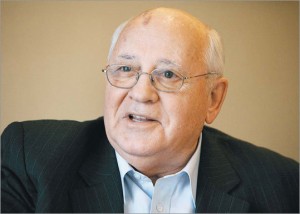
Obviously there are thousands of stories today about the momentous events in East Germany back in 1989, but it’s a bit desperate to compare the Berlin wall to climate change. However, that is what former Soviet Union president is saying in an article reprinted in The Australian this morning. Gorbachev was a great agent for change in the 80s and 90s, but on climate change, he reads like a typical alarmist.

The fall of the Berlin Wall brought hope and opportunity to people everywhere, and provided the 1980s with a truly jubilant finale. That is something to think about as the chance to take another momentous leap forward appears to be slipping away.

The road to the end of the Cold War was certainly not easy, or universally welcomed at the time, but it is for just this reason that its lessons remain relevant. In the 1980s, the world was at a historic crossroads. The East-West arms race had created an explosive situation. Nuclear deterrence could have failed at any moment. We were heading for disaster.

[Read more…]

The standard of climate debate in Australia – an example


Climate alarmism pays my mortgage

Climate alarmism pays my mortgage

Here we have a classic example of the ridiculous standard of the debate on climate change in Australia, and a perfect example of why the public do not have a clue about what’s going on. Steve Howard, CEO of the Climate Group, was interviewed by Virginia Trioli on ABC2’s Breakfast Television on Friday:

Trioli: And Steve Howard, finally, what if we’re wrong and what if those naysayers are right, if global warming is not human-induced but actually is a cyclical thing. Are you prepared to take responsibility for the economic and financial damage that might be done to some industries in the rush to try and fix it?

Howard: In the same way, yes, if we discover the world is flat then I’ll actually pay for all of the little globes to be reproduced. [You sarcastic little jerk. As if lumping climate realists with flat-earthers will end the debate – and it’s not even original, loser – Ed]

Trioli: No, the suggestion is not as outrageous as that.

Howard: It’s close to it.

Trioli: It’s just some honest dissenters and I think they have to be given their place too.

Howard: I think it is actually akin now to saying tobacco is not linked to lung cancer. It’s about that level of certainty on the science. [Yet more recycled BS – Ed] But let’s say, even then they are right, the worst we will do is create a greater energy security, a clean economy, we’ll clean up air pollution, and we’ve done a macro-economic (study) with our partner, with Tony Blair, and we found that if we have very deep emissions reduction cuts we’ll overall stimulate the global economy, we’ll create more jobs, so overall we’re better off if we do this. The worst we can do is be better off. We have the technology, we understand the policies, let’s just get on and do it.

Total, utter, unadulterated, undiluted, ill-considered, uninformed CRAP. But hey, the guy makes a living out of the climate crisis, what do you expect? At least Trioli asked the question, which given the ABC’s previous form, is a goddam miracle.

Read it here.