Yasi in context


Landfalls

I have just had the misfortune to listen to a nauseating, kid-gloves interview by Deborah Cameron on ABC Sydney of Ian Lowe, president of the environmental activist group Australian Conservation Foundation and global warming extremist (see here for previous form), in the wake of Cyclone Yasi. No transcript yet, but from the ABC blog:

This morning an interesting perspective from Professor Ian Lowe, President of the Australian Conservation Foundation. He told Deborah there is a clear relationship between increased (man-made) Greenhouse emissions and changes in the climate – and the evidence is there to suggest that weather patterns are intensifying. (source)

There were so many misrepresentations one hardly knows where to start… I telephoned the producer and asked if he was going to get Bob Carter to provide an alternative viewpoint for balance, but I won’t wait up for a reply. The ABC made up its mind on climate change years ago, and anyone who questions the consensus is just a filthy, ignorant denier.

So here are some more considered views of Yasi, firstly from Roger Pielke, Jr:

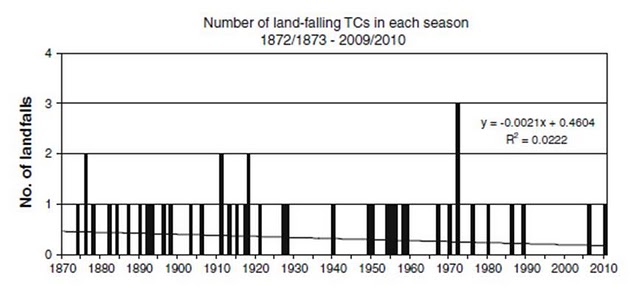
[…] a systematic evaluation of the long-term tropical cyclone landfall record in eastern Australia was published last summer in Climate Dynamics by Jeffrey Callaghan and Scott Power (2010). Callaghan and Power find a long-term trend of much fewer landfalls of intense cyclones (i.e., Category 3, 4, and 5) in the region.  They write:

The linear trend in the number of severe TCs making land-fall over eastern Australia declined from about 0.45 TCs/year in the early 1870s to about 0.17 TCs/year in recent times—a 62% decline.

The figure at the top of this post comes from their paper and comes with the following caption:

Fig. 1 The number of severe tropical cyclone (TC) land-falls in each TC season from 1872/1873 to 2009/2010 inclusive. The corresponding linear trend of -0.0021 TCs/year is also shown. This represents a decline of approximately 60% over the full period.

They find evidence for a relationship between intense cyclone landfall activity and the ENSO cycle, reflecting the natural variability of the system. (source)

And from Jo Nova:

As usual, it’s the name-callers who cling to 100 year time-frames and deny the long term evidence, while we cherry-picking denialists gravitate towards long term studies based on real observations. (The evidence lies in an obscure industry newsletter called Nature.) The way researcher, Jon Nott, describes it, things have been unusually quiet in our high CO2 world for the last few decades, but cyclones used to be a lot worse, and “worse” is coming back.

Thanks to The Australian for putting together a very timely piece about the historical pattern of cyclone activity.

[Johnathon] Nott is an expert on the incidence of super cyclones. By analysing ridges of broken coral pushed ashore by storm surges, he has catalogued the incidence of super-cyclones over the past 5000 years.

In a paper published in the scientific journal, Nature in 2001 his research shows the frequency of super-cyclones is an order of magnitude higher than previously thought.

Nott’s work puts into perspective current debate about whether climate change is responsible for the extreme weather events in Queensland.

Over recent centuries, massive cyclones have been relatively common. And after an extended period of relatively little activity their return is overdue regardless of rising global temperatures. (source)

Media bias: Monckton and Delingpole stitched up


BBC is tied up with it…

Hands up who is in the least bit surprised by this? Two shows featuring climate sceptics by the BBC, both heavily biased against any kind of scepticism whatsoever (and in favour of gullibility, therefore). Earlier this week, James Delingpole was done up like the proverbial kipper in a documentary presented by new Royal Society president, Sir Paul Nurse [that should have rung alarm bells for a start – Ed]:

Nurse came to interview me at my home last summer, ostensibly – so his producer assured me – as a disinterested seeker-after-truth on a mission to discover why the public is losing its faith in scientists. “Not scientists,” I replied. “Just ‘climate scientists.’” But as is clear from the Horizon documentary Nurse had already made up his mind. That’s why about the only section he used out of at least three hours’ worth of footage is the one where he tosses what he clearly imagines is the killer question: Suppose you were ill with cancer would you wish to be treated by “consensus” medicine or something from the quack fringe?

As you’ll see in the programme, this took me rather by surprise. Nurse had come posing as an open-minded investigator eager to hear why Climategate had raised legitimate doubts about the reliability of the “consensus” on global warming. Instead, the man I met was a parti-pris bruiser so delighted with his own authority as a proper Nobel-prizewinning scientist that he knew what the truth was already. And to prove it, here was a brilliant analogy which would rubbish the evil climate deniers’ cause once and for all!

But Nurse’s analogy is shabby, dishonest and patently false. The “consensus” on Climate Change; and the “consensus” on medical care bear no similarity whatsoever. (source)

But what does it matter? The aim is to smear the filthy deniers at any cost, right? We need to shelter the viewers from their opinions [because they are so damaging to our beloved consensus… – Ed].

The second example in a week did the dirty on Christopher Monckton. This time, “independent” filmmaker Rupert Murray ingratiates himself with the sceptics and convinces them that he’s sympathetic to their cause – but then dumps on them from a great height. As Dellers reports again:

Murray’s documentary is another hatchet job. This time the man designated for the chop is Lord Monckton. Except, knowing Monckton as I do, I don’t think he’s going to let this one lie. Sure he’ll probably be made to look a fool, but then as Richard North explains in this superb essay, this means nothing.

This is the practice of modern documentary makers, who can gather huge amounts of material and then edit and assemble the material in a way that they can present a message, the message the producer wishes to convey. This is irrespective of what is actually said, and what interviewees actually intended.

The process, North explains, works like this:

You write the script first, setting out what you want to say. Then you go out and find the talking heads that will say the words you need to fit the script. You (in this case I) interview them, collect up the words on the tape and then go back to the edit suite and pull out the words that fit.

Murray, it seems likely, had made up his mind what his angle was long, long before he inveigled his way into the sceptics’ circle and passed himself off as a decent fellow just trying to find out the truth. I’ll say one thing for him: he’s very plausible. I only twigged last week, when I rang him up to find out what his documentary would look like and how much I was in it.

“We’ve decided to concentrate on Monckton I’m afraid,” he said.

“Oh never mind,” I said. “I quite understand. Christopher is way more colourful and exciting than I am.”

We then had a chat about peer-to-peer review, in the course of which Murray quoted approvingly one “Dr Trenberth.” “Well Dr Trenberth says….” he began, in a way which suggested regular contact and great admiration.

Anyway, at least I’m not in it, I don’t think. When Calum asked me to sign the release form for my interview, I said that I would quite like to see the programme beforehand. Funny, I haven’t heard from them since. (source)

Monckton went so far as to seek an injunction preventing broadcast without a right of reply. Unfortunately, it failed.

Media bias at its absolute worst.

News Corp should "set example" by silencing sceptics


Jonathan Holmes

Jonathan Holmes is the presenter of the ABC’s Media Watch, and a well-known true believer in man-made climate change (see here, here and particularly here, where he implies that anyone who is sceptical is just plain stupid). So it’s little surprise that he has a go at News Corp on ABC’s The Drum today for their alleged hypocrisy in trying to become “carbon neutral” whilst at the same time allowing balance on the climate debate to appear in the pages of The Australian. You see, Holmes is from the brand of journalism, sorry, environmental totalitarianism, that believes that only the acceptable view on any issue should ever be published. Acceptable to whom, you may ask? Why, the liberal intellectual elite, of course – like Holmes – that’s who!

Matthew England (another well known climate alarmist, see here, here, here and here) had made some dubious points about 2010’s record temperatures in a telephone interview with Debbie Guest for a piece in The Australian, and in particular about the transition from El Niño to La Niña. England claimed that there was “very strong La Niña for about eight months of the year”, so therefore 2010 should have been relatively cool, when in fact it was hot, hot, hot! And of course it was all the work of the Green Climate Monster. Holmes uncritically accepts all of this. But England doesn’t qualify that statement by explaining that temperature doesn’t respond to the El Niño/La Niña phase switch immediately – there’s a time lag of a few months. The satellite record shows that global temperatures only even began to cool (after a very strong El Niño) in October (see here for a text file of global temperatures). Which means at least 10 months of the year was influenced by a very strong El Niño, and as a result, 2010 was warm.

Holmes complains that whilst England’s on-message alarmism was cut from the Australian article, it managed to find space for Christopher Monckton’s scepticism, and to the propaganda merchants and the eco-totalitarians, this is completely unacceptable:

The Oz had carried an AFP wire story about the WMO announcement [that 2010 was the “hottest year on record – see here – Ed] on the Friday, discreetly placed on an inside page. Debbie Guest’s piece for the Saturday dealt with the apparent paradox that a cool year in Australia was the hottest on record globally. But her story didn’t make it into most editions of the Weekend Oz the next morning. A severely truncated version did appear in early editions, and online, but the quotes from Professor England were conspicuously absent.

When he asked her why, Ms Guest told him that her story had had to be shortened for space reasons – though why that should have affected the online story, she didn’t explain.

Professor England says he’s satisfied Debbie Guest was genuinely trying to do a good job. The shortening was done by someone above her in the hierarchy.

So what did appear in The Weekend Australian that day? Well, nothing in the newspaper (as far as I can see) about the WMO’s announcement– although this alarming story from AFP was posted on The Australian’s website that day.

But The Weekend Oz did find room on its opinion pages for this piece by the ineffable Viscount Monckton of Brenchley. If you can’t understand its tortured mathematics, don’t worry. You’re not intended to. You are intended to think, “Well, I don’t really follow it all, but this bloke seems to be impressively learned, and he says it’s not worth doing anything about climate change”.

That, of course, is precisely the opposite message to the one Rupert Murdoch was trying to send his own troops back in 2007. The evidence for climate change, since then, has only got stronger. The reasons for taking precautionary action have only become more compelling. Of course News Ltd can’t, on its own, affect the global climate by reducing its carbon footprint, and nor can Australia. But if every company, and every nation, acted – or refrained from acting – on the basis of that logic, the chances of eventually stabilising global temperatures at less than catastrophic levels would be reduced to zero.

And here’s the money quote:

Well, you may argue, but doesn’t Christopher Monckton have a right to be heard? Don’t news stories get shortened every day? What does all this prove?

Nothing, in itself. You have to be an alert and habitual reader to notice that week after week, year after year, The Australian and The Weekend Australian massage their news coverage and grossly unbalance their opinion pages so as to send the message that the existence of human-induced climate change is highly debatable, and that any action by Australia to reduce its emissions would be economically ruinous and politically foolish.

As one of the world’s great media companies, News Corporation has the power to do far more to counter the risk of catastrophic climate change than merely to reduce its own emissions.

The unwritten conclusion being that News Corporation should silence anyone who questions the Holy consensus, and The Australian should not give space to sceptics on its op-ed pages. Holmes seems to overlook the fact that Fairfax and ABC are fully on message, rarely if ever giving space to filthy “deniers”, and The Australian is the only paper that gives even a small hearing to sceptics.

None of this should surprise us. What I always find myself asking is this: if the case for man-made global warming is so strong, why the need to silence dissent? Surely they will simply make fools of themselves? But unfortunately, the eco-totalitarians in the liberal intelligentsia want to control the media, and therefore the message, so the proletariat will be kept in the dark on the true uncertainties in the climate change consensus.

Read it here (if you must)

BBC: "propaganda machine for climate change zealots"


Blows the lid off the BBC

In another damning article in the UK’s Daily Mail, former BBC newsreader Peter Sissons blows the lid off the institutional climate change bias at the BBC. The results are truly shocking, if not entirely surprising. For “BBC” you can substitute most other news organisations, ABC, Fairfax, AFP… Bias against climate realism is endemic in the left-leaning media, it’s only a question of degree:

For me, though, the most worrying aspect of political correctness was over the story that recurred with increasing frequency during my last ten years at the BBC — global warming (or ‘climate change’, as it became known when temperatures appeared to level off or fall slightly after 1998).

From the beginning I was unhappy at how one-sided the BBC’s coverage of the issue was, and how much more complicated the climate system was than the over-simplified two-minute reports that were the stock-in-trade of the BBC’s environment correspondents.

These, without exception, accepted the UN’s assurance that ‘the science is settled’ and that human emissions of carbon dioxide threatened the world with catastrophic climate change. Environmental pressure groups could be guaranteed that their press releases, usually beginning with the words ‘scientists say . . . ’ would get on air unchallenged.

On one occasion, after the inauguration of Barack Obama as president in 2009, the science correspondent of Newsnight actually informed viewers ‘scientists calculate that he has just four years to save the world’. What she didn’t tell viewers was that only one alarmist scientist, NASA’s James Hansen, had said that.

My interest in climate change grew out of my concern for the failings of BBC journalism in reporting it. In my early and formative days at ITN, I learned that we have an obligation to report both sides of a story. It is not journalism if you don’t. It is close to propaganda.

The BBC’s editorial policy on climate change, however, was spelled out in a report by the BBC Trust — whose job is to oversee the workings of the BBC in the interests of the public — in 2007. This disclosed that the BBC had held ‘a high-level seminar with some of the best scientific experts and has come to the view that the weight of evidence no longer justifies equal space being given to the opponents of the consensus’.

The error here, of course, was that the BBC never at any stage gave equal space to the opponents of the consensus.

But the Trust continued its pretence that climate change dissenters had been, and still would be, heard on its airwaves. ‘Impartiality,’ it said, ‘always requires a breadth of view, for as long as minority opinions are coherently and honestly expressed, the BBC must give them appropriate space.’

In reality, the ‘appropriate space’ given to minority views on climate change was practically zero.
Moreover, we were allowed to know practically nothing about that top-level seminar mentioned by the BBC Trust at which such momentous conclusions were reached. Despite a Freedom of Information request, they wouldn’t even make the guest list public.

READ IT ALL.

ABC: "warm weather" caused Moscow's freezing chaos


"Unseasonably warm"

Stop laughing at the back, the ABC is being deadly serious here. The closure of Moscow’s airports is nothing to do with “extreme cold”, which itself is a sign of global warming (© ABC, CSIRO, New York Times, Sydney Morning Herald etc etc), but “unseasonably warm weather” which itself is, of course, a sign of global warming… or something. My brain hurts.

Russian prosecutors have launched a probe into how bad weather caused massive disruption at Moscow’s two largest airports as passengers staged protests against the chaos that has left thousands stranded.

Freezing weather and power outages have delayed more than 200 flights at Moscow’s Domodedovo and Sheremetyevo airports, with some passengers staging protests in security check areas.

Moscow transportation prosecutor Yevgeny Pospelov says he has launched a probe into the massive delays aimed to “protect the rights of passengers”.

Ironically, the chaos was caused not by a cold snap but by unseasonably warm weather which meant torrential freezing rain, rather than snow, fell at the weekend, leaving a treacherous layer of ice on roads and runways. (source)

Pass the vodka.

ABC's loathsome propaganda machine


Double whammy

The fact that the national broadcaster has a well-known and self-confessed climate alarmist as the presenter of its “flagship” science programme, The Science Show, is a perfect example of the ABC “groupthink” Maurice Newman exposed so clearly in March 2010. Robyn Williams is well known to the readers of ACM, having achieved a veritable litany of guest appearances (see here for a few examples) and is someone who accepts the politically motivated pronouncements of the IPCC, cobbled together as they are from environmental advocacy groups’ tatty leaflets, without a hint of scientific impartiality or healthy scepticism. So it is little wonder that whenever climate matters are discussed, it is invariably from the alarmist viewpoint, with generous helpings of “denier”, “flat earther”, “Big Oil”, “tobacco” and all the usual tedious ad hominems hurled at sceptics thrown in for good measure.

Oddly, for some strange reason, the audio and transcript from the 1 January 2011 programme, which opens with Williams wishing everyone a Happy New Year, has already been published on the ABC web site (making readers feel like they have tunnelled through some space-time wormhole), and therefore I can advise you to AVOID IT LIKE THE PLAGUE [and avoid the following week’s show even more, for reasons which I will discuss later – Ed]. For Williams’ guest on the show is none other than that other ACM favourite, Tim “Flannel” Flannery, whose name is almost invariably prefaced by “Australian Alarmist of the Year”  to add a bit of street cred. However, since the alarmists love to do this, I will just point out, purely for the record you understand, that Flannery isn’t a climate scientist, he’s a mammalogist and palaeontologist (according to Wikipedia), but despite that he is a “global warming activist” and since he’s plugging the consensus/IPCC/ABC/Labor view, that’s just fine. We only worry about qualifications when it’s a climate realist we’re talking about, right?

To an extent, the details of the interview are irrelevant (the transcript runs for a mind-numbing 20 pages), but as would be expected, Williams gives Flannery a free ride to plug his new book and spout all the usual misrepresentations about the current state of the climate. The two of them seem perfectly happy to inhabit this cosseted world, insulated from reality, where they can stew in their own alarmist juices. There’s lots of Gaia talk, a theme of the new book, which Flannery tries to argue has some scientific merit, which shouldn’t surprise anyone, since it has the same level of pseudo-scientific credibility as catastrophic AGW:

Robyn Williams: So there you’ve got an image of the earth, the planet as a god, but also a very sophisticated and credible scientific idea.

Tim Flannery: That’s right. I was tempted in the book to simply give in and call it Earth System Science, because Gaia is earth system science and in many university departments around the world, as you’ll know, Robyn, earth system science is a very respectable science. But as soon as you mention Gaia of course, the scepticism comes out. I didn’t do that though, because I think there’s a certain elegance to Gaia, to that word and the concept, and also because I think that within this century the concept of the strong Gaia will actually become physically manifest. I do think that the Gaia of the Ancient Greeks, where they believed the earth was effectively one whole and perfect living creature, that doesn’t exist yet, but it will exist in future. That’s why I wanted to keep that word.

“Physically manifest”? “It will exist in the future”? But that’s just the start – things get even more astrological, straying dangerously close to “energy crystals”, tarot cards and ouija boards, accompanied by the stench of patchouli wafting from the monitor screen. Williams actually dares ask a tricky question, but then doesn’t follow through:

Robyn Williams: How will it exist in the future? Because an organism is one thing; the earth is complicated, but it is after all a lump of rock with iron in the middle and a veneer of living things outside, and a very thin atmosphere. It’s not an organism, so how is the feedback system such that it stabilises things, temperature anyway, like an organism?

Tim Flannery: That’s the great question. I must admit that as I wrote the book I was unable to come to a clear landing on the extent of Gaian control over the system, because much of the data is equivocal. I think that there is clear evidence for something that I call in the book geo-pheromones, which are elements within the earth system, which when present in very small amounts have very large outcomes, a bit like ant pheromones. But they often do multiple jobs. Some ant pheromones do as well, but many of them are specific. One of those is course carbon dioxide, a trace amount in the atmosphere, four parts per ten thousand is enough to keep the earth habitable. Ozone is another one present in just a few parts per billion. Human-made CFCs are yet another one. Atmospheric dust may well be another one. So these elements in the earth system have a profound impact on the system, and there is some evidence that there’s some sort of homeostasis established, if you want. But you don’t have to look very far into earth history to see that homeostasis change. When I say homeostasis, that’s like my temperature is always at 98.4˚ or whatever it is.

Robyn Williams: As are your body fluids largely maintained.

Tim Flannery: Yes, all balanced and everything.

This kind of pagan Earth-worship stretches credibility as thin as it can go. And as always, Flannery goes on to presents the bog-standard alarmist climate arguments – faster, bigger, badder, worser:

Tim Flannery: … The climate science is getting more dismal at the same time this is happening. We’ve seen the IPCC projections are now ground truthed against real world change, and we see that we’re tracking the worst case scenario, which is 6˚ of warming.

Robyn Williams: Six! [Why does that surprise you, Mr “100 meters of sea level rise by 2100” Williams?]

Tim Flannery: Yes, that’s for the early part of the curve. You know what happened in 2001, the IPCC produced these projections and they indicated that if we double CO2 above pre-industrial levels there’s a 60% chance that the result will be a 2˚ or 3˚ rise in temperature, a 10% chance of a 1˚ rise and 10% rise of a 6˚ rise. Because those projections were done ten years ago, scientists are now going back and looking at the real world data and saying were the projections right or not? It turns out that they were wrong. They were too conservative, at least for the early part of the projection curve. We’re seeing the worst case scenario unfold.

Is this an outright lie? I guess not, because Flannery is relying solely on the UHI-contaminated, corrupted and fudged surface temperature record, which conveniently fits the alarmist cause (wonder why, with Jimmy Hansen in charge?). If he actually stopped to consider satellite records, which cannot be “adjusted”, global temperatures are tracking well below IPCC projections. But that’s not going to grab any headlines, and it certainly doesn’t fit the ABC’s groupthink agenda.

But as I said, all this detail is irrelevant. When you have a flagship science programme hosted by a presenter with a blatant political agenda to push, it is no longer science, but propaganda – precisely what Maurice Newman was keen to avoid at the ABC. Flannery is happy to smear a geologist, Bob Carter, for not looking at the “appropriate timescales” when considering climate – the ultimate irony, given that geologists have a far better understanding of timescale than climatologists or politicians – but why doesn’t Williams actually bite the bullet and invite Carter on his show? I mean, his arguments are paper-thin, so clearly he will simply make a fool of himself, right?

But it’s not that simple. This isn’t about being persuaded by facts or rational argument – this is all about religion and faith. Just as billions of Christians put their faith in the Christmas story and the Bible, so Williams and Flannery are devout followers of the Church of Global Warming, and anything that contradicts the holy scripture (An Inconvenient Truth) is heresy. Maurice Newman should kick Williams out of the ABC – nothing prevents him from making a career as a ecotard activist or Green politician, that’s his right as a citizen in a democracy, but there is no place for him at the national broadcaster.

You can read the transcript here.

And the reason you should avoid the following programme?

“Next week on the Science Show, the dynamic Naomi Oreskes at the University of NSW on merchants of doubt – how a handful of scientists obscured the truth on issues from tobacco smoke to global warming. I’m Robyn Williams.”

Lumping climate realists with Big Tobacco… the ABC propaganda mill grinds ever onwards, at your expense. More on this next week, no doubt.

ABC: "mistaken not malicious"


Climate sense

Marc Hendrickx, who runs the ABC News Watch blog, writes in The Australian:

ON ABC’s opinion site The Drum, “public intellectual” Clive Hamilton has claimed the public broadcaster has been infested by a nest of climate deniers. According to Hamilton, Aunty has handed its editorial control to the far Right. It’s a pity he forgot to provide any evidence to support his claims, as even the most superficial assessment reveals nothing to substantiate the right-wing conspiracy alluded to, just everyday sensationalism, along with naive and inept journalism.

Aunty’s main problem is not opinion sites such as The Drum that has given Hamilton a megaphone, and also posted a range of views from climate experts and non-experts alike, including me. The problem is the ABC’s news and science reporting that continues to let down its audience.

It does this in several ways. First, the natural inclination of the media to favour alarm over calm results in stories with headlines such as “Oceans on brink of mass extinction: study” getting prominence over less sensationalist stories such as “Is climate change new (and bad)?”

The media’s bias towards sensationalism results in the ABC and other media outlets picking science stories that can be beaten up. In this context the restraint of sceptical scientists simply does not attract as much attention.

Second, certain ABC reporters seem to be suffering from Stockholm syndrome when it comes to interviewing scientists promoting climate alarm. They are failing to properly scrutinise experts and authoritative documents such as Intergovernmental Panel on Climate Change assessments and government reports. Without bothering to properly verify the facts, they act as echo chambers, spreading misconceptions.

Third, the perception of bias in ABC climate reporting is not so much due to a conspiracy of amateurish environmental activists, though it seems many now walk the corridors of ABC’s head office, but stems from ineptitude. Aunty’s bias is most obvious in those stories that have gone unreported. In the same week the ABC failed to cover an important paper by Australian researchers that found no influence of climate change in last year’s Victorian bushfires (a disaster our non-climate expert, Hamilton, was quick to trumpet as a sign of impending climate doom), it also missed another study that smashed the notorious hockey stick graph to pieces.

Read it here.

More hysterical climate alarmism from the ABC


Banging the Green drum

The ABC is the campaign wing of the Labor/Green Alliance Party (as it should now be called) in all but name. Spruiking Jooolya’s policies whilst at the same time dissing Tony’s. Dredging up any tiny embarrassment from Tony’s past, but leaving Jooolya’s communist connections well alone. And of course, using the Drum as a platform for climate hysteria is just all part of the grand scheme. For every sceptical article that gets the nod, about 10 alarmist ones get through – there’s balance for you, ABC-style. Last week we had Kellie “Ranter” Tranter’s climate nonsense, deconstructed expertly by Jo Nova here, and now we have another climate evangelist, spouting deep Green propaganda:

The inertia of the climate system, particularly the slow warming of the oceans, means that the results of our emissions today only become evident decades hence. Thus, unless we take rapid action now, we may well be locking in irreversible climate change of catastrophic proportions for future generations [nonsense – there is no evidence whatsoever of irreversible climate change in our planet’s history – it’s been here for 4.5 billion years, for f***’s sake]; indeed we may have already done so.

There will always be scientific uncertainties on an issue this complex, with year-to-year climatic variations continuing to be used selectively by deniers [cheap ad hom] to discredit the mainstream science; but the overall trends are clear and they are all moving in the wrong direction. It is tempting to believe the deniers [and again] are right, but faced with the mounting empirical evidence, prudent risk management dictates we should not gamble on inaction.

The world is starting to understand that, if catastrophic outcomes and climatic tipping points are to be avoided [which don’t exist], the real target for a safe climate is to reduce atmospheric carbon concentrations back to the pre-industrial levels of around 300ppm CO2 from the current 392ppm CO2 [despite CO2 levels being at least 20 times greater in the past, with no significant effect on warming] This will require emission reductions in the order of 40-50 per cent by 2020, almost complete decarbonisation by 2050 [could have been written by the Greens] and continuing efforts to draw down legacy carbon from the atmosphere.

The author is a fellow of the Centre for Policy Development, which has already made its mind up on climate change, as it states here:

The short-term thinking of the election cycle is damaging Australia’s long-term interests. From the global economic crisis to the climate emergency, the costs of poor public policy are increasingly clear. (source)

So is it any wonder that one of their “fellows” writes such undiluted horseshit? And is it any wonder that the ABC publishes it so uncritically?

Read it here, if you must, but frankly, don’t bother.

UPDATE: From the author’s CPD biography:

He is Chairman of Safe Climate Australia, Deputy Convenor of the Australian Association for the Study of Peak Oil and a Member of the Club of Rome.

Let’s always remember that the Club of Rome once pronounced that “the Earth has cancer and the cancer is Man”. Says it all really.

UN climate report "one-sided"


Biased from the start

Prize to The Australian for the most blindingly obvious headline of 2010 (so far). But what did anybody expect from the IPCC? It was founded in the late 1980s solely for the purpose of finding evidence to bolster a conclusion already reached by its founders – namely that human activity was dangerously warming the planet – and everyone is shocked when that’s exactly what they find! Its terms of reference refer to “human-caused warming” – not any other cause should even be considered, according to the IPCC. So the whole process was completely biased from the start:

THE UN body that advises governments on climate change failed to make clear how its landmark report on the impact of global warming often presented a worst-case scenario, an investigation has concluded.

A summary report by the Intergovernmental Panel on Climate Change on regional impacts focused on the negative consequences of climate change and failed to make clear that there would also be some benefits of rising temperatures.

The report adopted a “one-sided” approach that risked being interpreted as an “alarmist view”.

For example, the IPCC had stated that 60 per cent of the Great Barrier Reef was projected to suffer regular bleaching by 2020 but had failed to make clear that this was the worst projected outcome and the impact might be far smaller.

The wording of a statement on between 3000 and 5000 more heat-related deaths a year in Australian cities had suggested that all of the projected increase would be the result of climate change, whereas most of it would be caused by the rising population and an increase in the number of elderly people.

The report, which underpinned the Copenhagen summit last December, wrongly suggested that climate change was the main reason communities faced severe water shortages and neglected to make clear that population growth was a much bigger factor. (source)

And with impeccable timing, and having clearly learnt nothing about the perception of climate science, The Guardian and AAP publish yet more alarmism, helpfully reprinted by the moonbat Age:

THE world is heading for an average temperature rise of nearly 4 degrees, according to a global analysis of national pledges. Such a rise would bring a high risk of major extinctions, threats to food supplies and the near-total collapse of the huge Greenland ice sheet.

More than 100 heads of state agreed in Copenhagen last December to limit the rise in global temperatures to 1.5 to 2 degrees above the long-term average before the industrial revolution, which started a huge global rise in greenhouse gases.

But after a concerted international effort to monitor the emission reduction targets of more than 60 countries, including all the major economies, the Climate Interactive Scoreboard now calculates that the world is on course for a rise of nearly double the stated goal by 2100. (source)

Where do you start? The stupidity of such comments beggars belief. Not only does it blindly assume that the planet’s climate has a single dial, marked “CO2”, which can be twiddled like a thermostat to determine the temperature in 90 years, but also it is based solely on incomplete, flaky computer models, which, even the IPCC admits, cannot predict anything. No wonder climate science has so little credibility, especially when journalists and politicians spin it so appallingly.

US National Academy of Sciences publishes sceptic "blacklist"


Better than being blackballed

Clearly the gloves are off, as the alarmists realise they are losing the battle, and all pretence of there being any hint of scientific integrity in the climate change debate vanishes, as Roger Pielke Jr notes:

Little did I know it, but I am intimately associated with the world’s most accomplished “climate skeptic.” But he is not actually a skeptic, because he believes that humans have a profound influence on the climate system and policy action is warranted. More on that in a second.

A new paper is out today in the Proceedings of the National Academy of Sciences (which I’ll call APHS10 after the author’s initials) that segregates climate scientists into the “convinced” and the “unconvinced” — two relatively ambiguous categories — and then seeks to compare the credentials of the two groups. The paper is based on the tireless efforts of a climate blogger, self-described as “not an academic,” who has been frustrated by those who don’t share his views on climate change:

I’ve also grown all too familiar with the tiny minority of ‘climate skeptics’ or ‘deniers’ who try to minimize the problem, absolve humans of any major impact, or suggest there is no need to take any action. I’ve gotten pretty fed up with the undue weight given to the skeptics in the media and online.

What qualifies one to be on the APHS10 list of skeptics, which I’ll just call the “black list”? Well, you get there for being perceived to have certain views on climate science or politics. You get on the black list if you have,

signed any of the open letters or declarations expressing skepticism of the IPCC’s findings, of climate science generally, of the “consensus” on human-induced warming, and/or arguing against any need for immediate cuts to greenhouse gas emissions.

In fact, it turns out that you don’t even have to sign an open letter or argue against immediate cuts for emissions. You can simply appear unwillingly on Senator James Inhofe’s list. A co-author of APHS10 warns on his website (but not in the paper) of the perils of relying on the Senator’s list:

I caution readers to take this with a grain of salt: a number of experts have been included despite their strong support for GHG reductions. However, the list does record a significant number of people who are outspoken critics of Kyoto or of efforts to cut GHG emissions generally.

So you can find yourself on the black list as a “climate skeptic” or “denier” simply because you express strong support for greenhouse gas reductions, but have been critical of the Kyoto approach. On the other hand, a scientist like James Hansen, who has expressed considerable disagreement with aspects of the IPCC consensus, finds himself on the list of people who are said to agree with the IPCC consensus. In fact, it appears that simply being a contributor to the IPCC qualifies one to be on the list of those who are defined to be in agreement with the IPCC consensus and/or demand immediate action on emissions reductions and support Kyoto (unless of course one doesn’t qualify, in which case you are placed on the other list — it is complicated, trust me).

Read it here.

UPDATE: The UK Telegraph reports on the new paper and quotes Judith Curry and John Christy:

Judith Curry, a climate expert at the Georgia Institute of Technology – who was not part of the analysis – called the study “completely unconvincing” while John Christy of University of Alabama claimed he and other climate sceptics included in the survey were simply “being blacklisted” by colleagues. (source)

Sounds about right.