
Andy Revkin (NYT image)
Andy Revkin, on his Dot Earth blog, attempts to draw comparisons between Climategate and the Heartland release of documents, and chastises Heartland for not reacting to the Climategate release in the same way as to that of their own documents:
[Quoting from Heartland press release] “But honest disagreement should never be used to justify the criminal acts and fraud that occurred in the past 24 hours. As a matter of common decency and journalistic ethics, we ask everyone in the climate change debate to sit back and think about what just happened.”
Wouldn’t it have been great if a similar message had some from the group and its allies after the mass release of e-mails and files from the University of East Anglia climatic research center in 2009 and last year — documents that skeptics quickly and repeatedly over-interpreted as a damning “Climategate”? That hasn’t been Heartland’s approach. (source)
Whilst there are aspects we should frown upon in both cases (release of confidential documents without authority – although I note that the Liberal media, to which the NYT makes a substantial contribution, rarely get so steamed up about Wikileaks, but that’s another issue), there are huge differences.
Let me make a few obvious points:
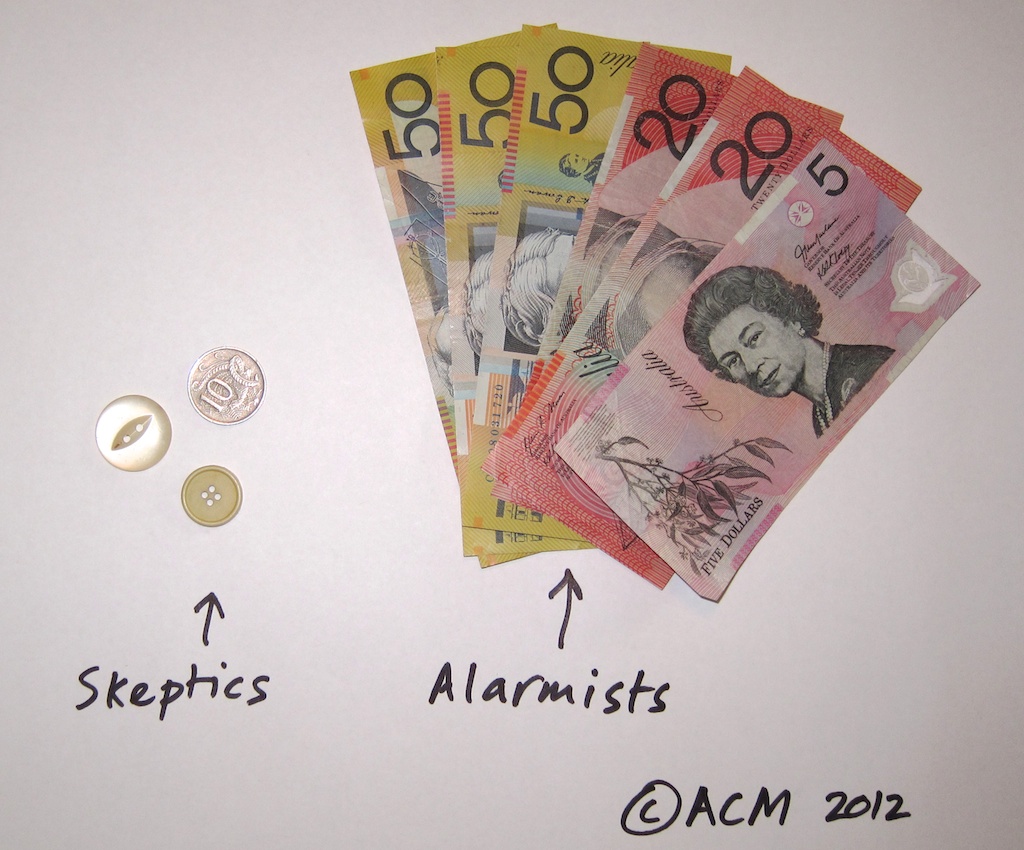
- Whereas the Heartland documents relate to a relatively small amount of funding for a handful of sceptics, the Climategate documents cast doubt on the integrity of “consensus” climate science as an entire discipline;
- Funding for sceptics is literally microscopic compared to the massive swill trough available for the consensus, but more importantly, and irrespective of that, the suggestion that any reputable scientist can be bought for a few bucks is offensive (on both sides of the debate);
- Whereas sceptics have minimal influence on policy (at present at least), the consensus influence is significant, since the majority of national governments have subscribed to the politicised, and alarmist, UN/IPCC process;
- Whereas the Heartland documents reveal little of substance regarding the discipline of climate science, the Climategate emails reveal:
- a concerted effort to manipulate and/or suppress inconvenient data;
- a desire to minimise uncertainty in order to maintain a consistent political “message”;
- attempts to subvert and corrupt the peer-review process; and,
- evidence of destruction of documents and correspondence in contravention of FOI requirements.
- UPDATE: A number of commenters have suggested (thanks!) another differentiating factor: UEA is a publicly funded institution, which, as a result, should be thoroughly transparent in its operations, whereas Heartland is a purely private organisation which does not draw upon the public purse.
Wow, they really are almost in the same league, aren’t they, Andy?
The eagerness with which these documents were seized upon by the smear blogs [by the way, from where does the funding for those come? – Ed] reveals the desperation at work behind the scenes.


 Australian Climate Madness
Recent Comments