Thousands of IPCC scientists? Try a handful…


More of the same

The so-called consensus of thousands of IPCC scientists all telling us the world is going to hell in a handcart thanks to our SUVs is phoney, according to an article in the National Post (h/t WUWT).

The UN’s Intergovernmental Panel on Climate Change misled the press and public into believing that thousands of scientists backed its claims on manmade global warming, according to Mike Hulme, a prominent climate scientist and IPCC insider.  The actual number of scientists who backed that claim was “only a few dozen experts,” he states in a paper for Progress in Physical Geography, co-authored with student Martin Mahony.

“Claims such as ‘2,500 of the world’s leading scientists have reached a consensus that human activities are having a significant influence on the climate’ are disingenuous,” the paper states unambiguously, adding that they rendered “the IPCC vulnerable to outside criticism.”

More of what we have all come to expect from the IPCC: spin, spin and yet more spin.

Read it here.

Prepare yourselves for IPCC Mark 2


Oh noes, another IPCC

ACM has reported previously that the UN is beginning to realise that climate change isn’t going to deliver the global government it so craves, so it is now casting around for another cause through which to regulate, tax and generally meddle in peoples lives. And the answer is: biodiversity! And they have taken the first step by approving the new UN body to look into it:

Representatives from close to 90 countries gathering in Busan, Korea, this week, have approved the formation of a new organization to monitor the ecological state of the planet and its natural resources. Dubbed the Intergovernmental Science-Policy Platform on Biodiversity and Ecosystem Services (IPBES) [it has its own web site already], the new entity will likely meet for the first time in 2011 and operate much like the Intergovernmental Panel on Climate Change (IPCC).

In essence, that means the IPBES will specialize in “peer review of peer review”, says Nick Nuttall, a spokesman for the United Nations Environment Programme, which has so far hosted the IPBES birth process. Its organizers hope that its reports and statements will be accepted as authoritative and unbiased summaries of the state of the science. Like the IPCC, it will not recommend particular courses of action. “We will not and must not be policy prescriptive”, emphasized Robert Watson, chief scientific advisor to the UK’s Department for Environment, Food and Rural Affairs and a vice-chair of the Busan meeting. “That is critical, or it will kill the process.”

“Authoritative and unbiased”? You mean like the IPCC’s authoritative and unbiased climate propaganda? Don’t make me laugh. And as for not being policy prescriptive, the UN is running the entire global emissions reduction programme – how is that not policy prescriptive?

It’s déjà vu, all over again.

Read it here (h/t Climate Realists).

Global warming claims fail legal scrutiny


Legal analysis

A law professor from the University of Pennsylvania has dissected the global warming consensus and found it to be an empty shell, as Lawrence Solomon reports:

The cross-examination, carried out by Jason Scott Johnston, Professor and Director of the Program on Law, Environment and Economy at the University of Pennsylvania Law School, found that “on virtually every major issue in climate change science, the [reports of the UN’s Intergovernmental Panel on Climate Change] and other summarizing work by leading climate establishment scientists have adopted various rhetorical strategies that seem to systematically conceal or minimize what appear to be fundamental scientific uncertainties or even disagreements.”

Professor Johnson, who expressed surprise that the case for global warming was so weak, systematically examined the claims made in IPCC publications and other similar work by leading climate establishment scientists and compared them with what is found in the peer-edited climate science literature. He found that the climate establishment does not follow the scientific method. Instead, it “seems overall to comprise an effort to marshal evidence in favor of a predetermined policy preference.”

The 79-page document, which effectively eviscerates the case for man-made global warming, can be found here.

Doesn’t tell me anything we haven’t suspected all along…

Read it here. (h/t WUWT)

IPCC bias exposed yet again


Anything goes if we say so

The UK Telegraph reports that Rajendra Pachauri has “defended the use of grey literature” in the IPCC’s reports. As long as it supports the IPCC’s pre-conceived conclusion of man-made warming, that is. Because whenever grey literature challenges the consensus, the knee-jerk response is “but it isn’t peer-reviewed!”. Hands up who can spot the hypocrisy there?

The head of the UN’s climate change panel has defended the use of unproven science to justify climate change by saying the “grey literature” cannot be ignored.

In a hearing at the InterAcademy Council, an organisation of the world’s science academies which is conducting an independent review of the processes and procedures of the IPCC, Dr Pachauri described the inclusion of the glacier claim as “human failure” which should not have happened. [No it wasn’t, it was deliberately put in to “pressure policymakers”, see here – Ed]

But the IPCC’s chairman said there was a need to use information which was not from peer-reviewed scientific journals, because in some places that was the only research that had been done.

He said the media and other sections of society had misunderstood the role of such information, labelling it grey literature, “as if it was some form of grey muddied water flowing down the drains”.

Dr Pachauri said academic work being done by bodies including the International Energy Agency, the World Bank, national governments and charities “cannot be ignored” [all backing the alarmist view, of course – Ed], but had to be closely examined [yeah, right – Ed] to make sure it was robust. (source)

And the IPCC was also very keen to use one particular journal that was unpublished at the time the report was finalised:

It was so impressed by one edition of the academic journal Climatic Change that it cited 16 of the 21 papers published that month. The journal editors should take a bow. When three-quarters of a single issue of your publication is relied on by a Nobel-winning report, you’re doing something right.

Except for one small problem. The issue in question – May 2007 – didn’t exist yet when the IPCC wrote its report. Moreover, none of the research papers eventually published in that issue had been finalized prior to the IPCC’s cutoff date. (source)

But hey, who cares? When an organisation and its chairman are so politically and financially motivated to come up with evidence to support a pre-conceived conclusion, anything goes. Yet it is on the advice of this organisation that governments around the world are basing their climate policies. Climate madness.

IPCC quotes WWF (again) … gets it wrong (again)


IPCC's primary source of alarmism

Peer-review, schmeer-review. Half of the IPCC’s last report was based on stuff like this, papers from deep green advocacy groups like WWF which happened to fit nicely with the IPCC’s pre-conceived agenda of climate alarmism. And they’ve been caught with their pants down yet again, this time on the sensitivity of Amazon rainforests to decreased rainfall:

A new NASA-funded study has concluded that Amazon rain forests were remarkably unaffected in the face of once-in-a-century drought in 2005, neither dying nor thriving, contrary to a previously published report and claims by the Intergovernmental Panel on Climate Change.

“We found no big differences in the greenness level of these forests between drought and non-drought years, which suggests that these forests may be more tolerant of droughts than we previously thought,” said Arindam Samanta, the study’s lead author from Boston University.

The IPCC is under scrutiny for various data inaccuracies, including its claim — based on a flawed World Wildlife Fund study — that up to 40% of the Amazonian forests could react drastically and be replaced by savannas from even a slight reduction in rainfall.

“Our results certainly do not indicate such extreme sensitivity to reductions in rainfall,” said Sangram Ganguly, an author on the new study, from the Bay Area Environmental Research Institute affiliated with NASA Ames Research Center in California.

“The way that the WWF report calculated this 40% was totally wrong, while [the new] calculations are by far more reliable and correct,” said Dr. Jose Marengo, a Brazilian National Institute for Space Research climate scientist and member of the IPCC.

Add it to the ever-lengthening list…

Read it here.

More heat than light


Climate sense

Paul Monk, writing in The Australian Literary Review, skillfully sums up the current parlous state of the climate debate, with reference to a number of recently published books from both sides of the debate. It is a long read, but very well worth it, and the conclusion is spot on:

Collectively we need to do better than this. Not only is that so because the stakes in climatic and economic terms, as everyone agrees, are about as high as they can get, whether the AGW hypothesis is correct or not; but because we need to cultivate better habits of debating matters of moment, as regards both what is so and what is to be done.

And it is for precisely this reason that the recent disclosures about the IPCC’s sloppy handling of evidence and the scandalously anti-scientific behaviour of the “hockey stick” team led by Americna climatologist Michael Mann and the East Anglia Climate Research Centre are so disturbing. These people have been supposedly conducting the AGW Solvay conference for about 20 years. What we are beginning to see is that they have not been following the Solvay rules at all. In fact, they have been seeking for some considerable time to prevent or discredit any attempt to refute their hypothesis and have manipulated evidence in an effort not merely to confirm it, as bona fide evidence might be taken to do, but to appear to confirm it, when they knew that there were all kinds of uncertainties in the data. This is, quite simply, inadmissible.

Georges Monbiot has lamented recently, in the wake of the Copenhagen conference, that “climate scepticism” is “spreading like an infectious disease”. He may or may not be right, but his attitude is dead wrong. The AGW hypothesis is, in the nature of the case contestable, a claim based on highly complex data. Where inferences from the data or the reliability of the data itself seem unclear or tendentious, scepticism is completely natural.

But more importantly, scepticism is the life blood of science and democracy. Those who sincerely believe AGW is threatening civilisation should themselves be as rigorously sceptical as possible. They should be soliciting challenges to their data and inferences. That’s what the scientific method is and it doesn’t end because someone, scientist or otherwise, feels certain of their ground. It goes on and we need it to do so.

It is the same with the proposal for an ETS as public policy. Let’s have an end of denunciation, vituperation and exasperation.

For the sake of science, civilisation and democratic governance, we need clarity in this matter. And clarity comes through making one’s arguments explicit and then trying to find where one could be in error. That’s the gold standard for all parties to all serious debates.

Read it here.

More bad science from the IPCC


@ Compweather.com

Wrong again - click for full size

Another story on the global warming/hurricane non-link:

RESEARCH by hurricane scientists may force the UN climate panel to retract its claims that greenhouse gas emissions have caused an increase in the number of tropical storms.

The benchmark 2007 report by the Intergovernmental Panel on Climate Change said an increase in cyclone-force storms since 1970 was probably caused by climate change.

It followed some of the most damaging tropical storms in history, such as Hurricane Katrina, which hit New Orleans, and Hurricane Dennis, which struck Cuba, both in 2005.

The IPCC added that the world could expect a big increase in such storms over the 21st century unless greenhouse gas emissions were controlled. The warning helped turn hurricanes — also known as cyclones or typhoons — into one of the most widely cited threats posed by global warming, with politicians including British Energy Secretary Ed Miliband and former Us vice-president Al Gore describing them as a growing threat to humanity.

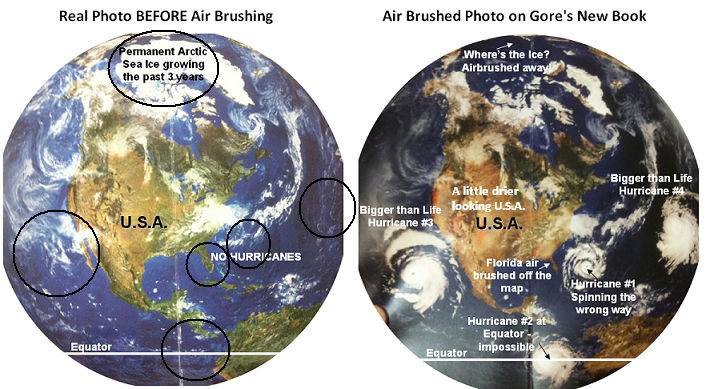
The cover of some editions of Mr Gore’s latest book, Our Choice, even depicts a world beset by super-cyclones as a warning of what might happen if carbon emissions keep rising.

However, the latest research, just published in the Nature Geoscience journal, paints a very different picture.

It suggests the rise in cyclone frequency since 1995 was part of a natural cycle and that several similar previous increases have been recorded, each followed by a decline. (source)

And don’t worry, Tim Lambert’s smug-blog Deltoid will no doubt add this article to his catalogue of  “The Australian‘s War on Science”, because in Lambert’s book, the war on science is anything which doesn’t fit with his pre-conceived agenda of alarmism.

And also in the news is a worrying sign that Rudd (who is a walking moral and principle vacuum) may do a deal with the Greens to get some kind of carbon trading scheme in place:

KEVIN Rudd has raised the prospect of a deal on climate with the Greens, who want an interim carbon price to end the Senate deadlock over an emissions trading scheme.

But he is playing down the likelihood of using the impasse as a double dissolution election trigger in October, as talks continue between Climate Change Minister Penny Wong and the Greens’ Christine Milne.

“This bill of ours for the Carbon Pollution Reduction Scheme is in the Senate now. Penny Wong and others are working with the Greens to see what can be done,” Mr Rudd told ABC TV’s Insiders program. “This is not over yet. And we will see what action emerges from the Senate.”

To secure a Senate deal, the government would, together with the five Greens, need an additional two votes, such as independent Nick Xenophon and a Coalition senator crossing the floor.

And if any Coalition senator did so, and thereby handed the government an ETS or a carbon tax, they should be strung up with piano wire. And prize for the most blindingly obvious headline goes to the Courier Mail:

Carbon Pollution Reduction Scheme could attract fraudsters

Now tell me something I didn’t know…

IPCC to be "independently reviewed"


How independent will it be?

Hmm. We’ll see. Let me guess, it will be an “independent” review stacked with climate alarmists (much like the IPCC itself, in fact) who will say the IPCC has done a fantastic job and if only filthy deniers would stop asking awkward questions and picking holes in our flawless data we could all get on with shutting down our developed economies and sending everyone back to the Dark Ages:

The world’s top climate science panel, the Intergovernmental Panel on Climate Change (IPCC), is set for review by an independent board of scientists, a UN climate spokesman said.

The IPCC has been under fire since it was discovered one of its 2007 reports incorrectly predicted Himalayan glaciers could vanish by 2035. The figure should have been 2350. [And what about the other errors? And Climategate? And Pachauri’s conflicts of interest? The ABC conveniently forgets all those, of course – Ed]

Despite a resurgence of climate change scepticism [we’ve been here all along, it’s just that the media had all made up their minds and weren’t listening – Ed] because of the mistake, the UN says the IPCC’s fundamental claim that humans are causing dangerous climate change remains.

UN Environment Program (UNEP) spokesman Nick Nuttall, attending a conference in Bali, told reporters the panel would form part of a broader review of the IPCC to be announced next week.

“It will be [made up of] senior scientific figures – I can’t name who they are right now,” he said. [Can’t wait. Let me see: Mann, Hansen, Jones, Santer, Trenberth, Karoly, Pitman, Brook, Steffen, Flannery etc etc – Ed]

“It should do a review of the IPCC and produce a report by August, and there is a plenary of the IPCC in South Korea in October.

“The report will go there for adoption.”

He says member states are insisting on a fully independent panel, appointed from scientists outside of the IPCC.

The proof of the pudding and all that. I am yet to be convinced this won’t be just another whitewash.

Read it here.

UN alarmist-in-chief Yvo De Boer resigns


"I'm not depressed, I'm just dreaming about my KPMG pay cheques"

I guess he wants to secure his future by going off to make gazillions of dollars from KPMG out of the carbon market fiasco that he himself helped create. As Biased-BBC puts it, snouts in the trough:

The UN’s top climate change official, Yvo de Boer, has resigned in the latest blow to the debate over global warming.

As Secretary General of the UN Framework Convention on Climate Change (UNFCCC), Mr de Boer was in charge of negotiating a new international deal to stop global temperature rise. [As simple as that. The UN speaks, the planet obeys – Ed]

However after four years in the post he has decided to step down to go and work for global accounting firm KPMG.

The former Dutch civil servant insisted he had been planning to stand down for some time but already there are questions over the nature of his departure and his possible replacement. [Andrew Bolt? – Ed]

Many blamed Mr de Boer for the failure of the recent UN Climate Change Conference in Copenhagen that ended in a weak accord.

His departure will also be a blow to the UN at a time when the science behind climate change is increasingly under fire after a series of scandals.

Read it here.

IPCC: Hurricane data questioned


Sorry, Al - wrong again.

Another day, another dodgy claim from AR4. We’ve already had the link between “global warming” and natural disasters debunked, and now this:

More trouble looms for the IPCC. The body may need to revise statements made in its Fourth Assessment Report on hurricanes and global warming. A statistical analysis of the raw data shows that the claims that global hurricane activity has increased cannot be supported.

Les Hatton once fixed weather models at the Met Office. Having studied Maths at Cambridge, he completed his PhD as metereologist: his PhD was the study of tornadoes and waterspouts. He’s a fellow of the Royal Meterological Society, currently teaches at the University of Kingston, and is well known in the software engineering community – his studies include critical systems analysis.

Hatton has released what he describes as an ‘A-level’ statistical analysis, which tests six IPCC statements against raw data from the National Oceanic and Atmospheric (NOAA) Administration. He’s published all the raw data and invites criticism, but warns he is neither “a warmist nor a denialist”, but a scientist.

Hatton performed a z-test statistical analysis of the period 1999-2009 against 1946-2009 to test the six conclusions. He also ran the data ending with what the IPCC had available in 2007. He found that North Atlantic hurricane activity increased significantly, but the increase was counterbalanced by diminished activity in the East Pacific, where hurricane-strength storms are 50 per cent more prevalent. The West Pacific showed no significant change. Overall, the declines balance the increases.

“When you average the number of storms and their strength, it almost exactly balances.” This isn’t indicative of an increase in atmospheric energy manifesting itself in storms.

Even the North Atlantic increase should be treated with caution, Hatton concludes, since the period contains one anomalous year of unusually high hurricane activity – 2005 – the year Al Gore used the Katrina tragedy to advance the case for the manmade global warming theory.

The IPCC does indeed conclude that “there is no clear trend in the annual numbers of tropical cyclones.” If only the IPCC had stopped there. Yet it goes on to make more claims, and draw conclusions that the data doesn’t support.

Read the rest of it here. (h/t WUWT)