Queensland Floods: Bureau of Meteorology blames climate change


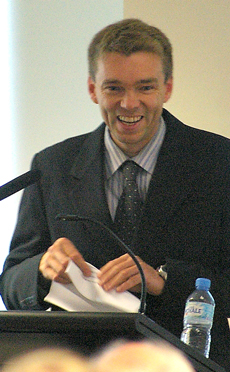
Bureau's David Jones

The floodgates are open. The unfalsifiable hypothesis of dangerous man-made global warming comes to the rescue and provides the answer to the terrible Queensland floods. We can all now self-flagellate, wailing that driving our SUVs is to blame. Over a quarter of a million Google hits for +queensland +flood +”climate change” in the last week alone. But hang on a minute, when there was a drought in Australia, climate change caused that too. Referring here to New South Wales and the Murray-Darling Basin, where there have also been recent flooding rains:

IT MAY be time to stop describing south-eastern Australia as gripped by drought and instead accept the extreme dry as permanent, one of the nation’s most senior weather experts warned yesterday.

“Perhaps we should call it our new climate,” said the Bureau of Meteorology’s head of climate analysis, David Jones.

It was the 11th year in a row NSW and the Murray-Darling Basin had experienced above normal temperatures. Sydney’s nights were its warmest since records were first kept 149 years ago.

“There is absolutely no debate that Australia is warming,” said Dr Jones. “It is very easy to see … it is happening before our eyes.” [There is debate about the cause, however – Ed]

The only uncertainty now was whether the changing pattern was “85 per cent, 95 per cent or 100 per cent the result of the enhanced greenhouse effect”. [Apparently not according to Jones – Ed]

“There is a debate in the climate community, after … close to 12 years of drought, whether this is something permanent. Certainly, in terms of temperature, that seems to be our reality, and that there is no turning back. (source)

But now that Queensland is under water, Jones has another story:

“We’ve always had El Ninos and we’ve had natural variability but the background which is now operating is different,” head of climate monitoring and prediction at the Australia Bureau of Meteorology in Melbourne David Jones said.

“The first thing we can say with La Nina and El Nino is it is now happening in a hotter world,” he told Reuters, adding that meant more evaporation from land and oceans, more moisture in the atmosphere and stronger weather patterns.

“So the El Nino droughts would be expected to be exacerbated and also La Nina floods because rainfall would be exacerbated,” he said, though adding it would be some years before any climate change impact on both phenomena might become clear.

Everyone’s a winner, ignoring the pointless weasel-word caveat at the end. Droughts: climate change. Floods: climate change. I’ve said it before, but will say it again: what evidence would show that climate change was not taking place? In other words, what conditions would falsify the hypothesis? I won’t wait for an answer, because there isn’t one. Everything strengthens the case for AGW, in the alarmists’ view.

And Keith “Travesty” Trenberth chimes in as well:

Prominent US climate scientist Kevin Trenberth said the floods and the intense La Nina were a combination of factors.

He pointed to high ocean temperatures in the Indian Ocean near Indonesia early last year as well as the rapid onset of La Nina after the last El Nino ended in May.

“The rapid onset of La Nina meant the Asian monsoon was enhanced and the over 1 degree Celsius anomalies in sea surface temperatures led to the flooding in India and China in July and Pakistan in August,” he told Reuters in an email.

He said a portion, about 0.5C, of the ocean temperatures around northern Australia, which are more than 1.5C above pre-1970 levels, could be attributed to global warming.

“The extra water vapor fuels the monsoon and thus alters the winds and the monsoon itself and so this likely increases the rainfall further,” Mr Trenberth, head of the Climate Analysis Section at the National Center for Atmospheric Research in Boulder, Colorado, said.

“So it is easy to argue that one degree Celsius sea surface temperature anomalies gives 10 to 15 per cent increase in rainfall,” he added.

Yep, dead easy if you can just pick and choose a model to fit whatever weather phenomenon is currently occurring. Even the token scientist drafted in to say that there’s no link to climate change manages to link it to climate change:

It’s a natural phenomena. We have no strong reason at the moment for saying this La Nina is any stronger than it would be even without humans,” said Neville Nicholls of Monash University in Melbourne and president of the Australian Meteorological and Oceanographic Society.

But he said global atmospheric warming of about 0.75C over the past half century had to be having some impact.

“It has to be affecting the climate, regionally and globally. It has to be affecting things like La Nina. But can you find a credible argument which says it’s made it worse? I can’t at the moment.” (source)

Well, it has to be one or the other. Either the warming is affecting La Niña or it isn’t. And of course, none of this says anything about the cause of the warming.

And we here in Australia are all deeply honoured that the Mighty Goracle has used “our” floods as “evidence of climate change.” If Big Al thinks so, it must be true. (source)

(H/t Bishop Hill)

UPDATED: Lord Monckton responds to ACM


Lord Monckton of Brenchley

UPDATE: Lord Monckton replies again, with a further clarification (see end of post)

Yesterday I wrote concerning Mike Steketee’s alarmist article in the Weekend Australian, Lord Monckton’s rebuttal, and Steketee’s response to the rebuttal. I am grateful that Lord Monckton took the trouble to write a long comment on that original post, which I have elevated to a post of its own.

The two points I made in that post were, firstly, that claiming no warming since 1998 is spurious, and secondly, that Steketee’s article was not worthy of a response. In relation to the first, Lord Monckton’s rebuttal to Steketee states:

4. THE WORLD IS NOT COOLER COMPARED TO 1998.

Actually, it is cooler. There was a remarkable spike in global temperatures in 1998, caused not by manmade “global warming” but by a Great El Niño event – an alteration in the pattern of ocean currents that begins in the equatorial eastern Pacific and spreads around the globe, lasting a few months. In the first nine months of 2010 there was another substantial El Niño, but even at its peak it did not match the Great El Niño of 1998.

The point here is that making any comparison of temperatures to a year in which there is a particularly strong El Niño is inadvisable (since it is a natural upward spike over and above the temperature had it not occurred). So whilst the 2010 El Niño spike indeed did not match that of 1998, it says nothing about the underlying trend, and more to do with the relative strengths of those El Niño events. In any case, as I said previously, who cares if the planet is warming? It’s the causation that is important.

In relation to the second, I believe that it is not worth sceptics efforts in responding to uninformed, journalistic alarmism. There are journalists all over the world who write material similar to, if not more extreme, than Mike Steketee. Responding to all of them would be impossible and pointless. Maybe Lord Monckton has a reason for choosing Steketee’s article over the thousands of climate scare stories that are published every week throughout the world – possibly that The Australian is generally regarded as more “climate realist” than any other in this country – but take a look at Adam Morton in The Age, for example. Fairfax made up its mind on climate change years ago, and regurgitates the same tired alarmist material on a daily basis. For that very reason, I have abandoned critiquing Fairfax articles. It just ain’t worth the effort (except for a bit of light entertainment now and again).

One final point I would like to make to Lord Monckton is that despite my original post, we are both on the same side here! As I said, I appreciate the work that Lord Monckton has done with the Science and Public Policy Institute, and I was first in the queue to meet him at his talk in Sydney last January.

Here is Lord Monckton’s response in full. Thoughts and comments appreciated.

Right from the get-go, Michael Steketee’s prejudice is evident in his attempted rebuttal of my article pointing out a couple of dozen questionable assertions – some of them downright false – in a scare story he had published in The Australian: Steketee says experts will continue to challenge my assertions about climate. It would have been more balanced to add that other experts will continue to support my assertions, or, better still, to leave out that redundant statement altogether.

Steketee next argues that I should not have held his remark that 2010 was the warmest year on record against him, because he was quoting the World Meteorological Organization. Yet it was his lack of balance I was criticizing: he was too prejudiced also to quote the satellite record of Remote Sensing Systems, Inc. and of the University of Alabama at Huntsville, which does not show 2010 as the warmest year on the 160-year global instrumental temperature record.

On this point, Simon-from-Sydney carelessly weighs in, accusing me of “plugging the no-warming-since-1998” line. No: in my Monthly CO2 Reports at www.scienceandpublicpolicy.org, I date the temperature graphs from both 1980, the beginning of the well-calibrated satellite record, and 2001, the beginning of the new millennium. I do not date my graphs from 1998 or draw any trend-lines starting at that date. All I did, correctly in every respect, was to point out that Steketee had said that 2010 was warmer even than the great-El-Niño year of 1998, when in fact the satellite records show it is cooler.

Steketee goes on complain that I criticized him for cherry-picking individual extreme-weather events that pointed in one direction only. True, he cited a professor as saying there had been some cold-weather events too, but not one of these was specifically mentioned in Steketee’s article, which was full of specifics about various hot-weather events.

Next Steketee tries to mislead his readers by complaining that I had criticized him for saying the 2010 hurricane season was among the worst in recent decades, when in fact, according to Dr. Ryan Maue, who keeps the Accumulated Cyclone Energy Index, it was just about the least active in half a century. The fact is that on this as on many other points Steketee simply got it wrong, and all his errors fell in the direction of making up a problem where there isn’t one and exaggerating it where there is – again, an indication of the prejudice that was (and is) my fundamental criticism of him.

Steketee goes on (and on) to accuse me of “complete misrepresentation” in saying he had asserted that “even cautious scientists tend to say we can blame [manmade] climate change for certain extreme-weather events. But that is what Steketee actually said. Steketee uses a get-out clause all too prevalent in his sort of journalism: he says he stated that a single proessor did not argue that climate change was responsible for any single event – except the bush-fires in Victoria, for which he had said there was strong evidence for an anthropogenic component. Yes, Steketee cited that one scientist: but his wider point – that “even cautious scientists” – in general – are attributing individual extreme-weather events to manmade climate change is not extinguished by his citation of a single professor who said that most extreme-weather events cannot be attributed to us.

Finally, Steketee says I was unfair to say he had asserted that manmade climate change had contributed to the 20% decline in rainfall in parts of southern Australia over recent decades. But that is exactly what he said. True, he attributed the statement to the CSIRO, but he did not offer any countervailing evidence.

But it is the omissions in Steketee’s attempted rebuttal that are so damning.
The simple fact is that many of the facts in his piece were simply wrong; I said so; and he was quite unable to say I was wrong to say so. Just a few examples:

2010 was not the most active hurricane season on record, but just about the least. the floods of last year in Pakistan were not the worst on record; only the worst since 1980 or thereby. We will not face 2 C of locked-in warming if we stop emitting any CO2 from today: it’s more like 0.4 C at most. The atmospheric concentration of CO2 has not risen by 27.5% since 1990, but by just 10.5%; and, if one takes into account all other greenhouse gases as well, the anthropogenic component has risen by just 2%.

So, Simon-from-Sydney, take some trouble to get your facts right before you accuse me of scoring an own goal. You say you don’t think I should have responded to Steketee’s nonsense at all: however, it is precisely because he and his ilk have been peddling trashy, largely truth-free extremism for years that so many feeble-minded governments have bought into the climate scare. Sometimes it is necessary to hit back with the facts, even if those who got them wrong then complain – quite inappropriately – that they were “misrepresented”. – Monckton of Brenchley

UPDATE: Lord Monckton’s response to this post [edited]:

It was Steketee, not I, who made a comparison between 1998 and the present, and he got it wrong, by saying that 2010 was warmer than 1998. No, it was cooler. I merely corrected Steketee’s error. There was and is, therefore, no basis for Simon’s allegation that I made  comparisons between 1998 (where the result was distorted by an exceptional el Nino event that caused a strong spike in warming worldwide) and 2010 (when the el Nino was less intense). No, I didn’t, and don’t.

Lord Monckton did not respond to any other points in my post. Although 2010 was technically cooler than 1998, and Lord Monckton indeed corrected Steketee’s claim (although Steketee argues he didn’t say that), it’s all meaningless. In general, alarmists love to point out that sceptics of many different varieties rely on the “no warming since 1998” line, and they rightly pull such an argument apart. In Lord Monckton’s 2008 American Physical Society paper, the first paragraph of the abstract reads (my emphasis):

The Intergovernmental Panel on Climate Change (IPCC, 2007) concluded that anthropogenic CO2 emissions probably caused more than half of the “global warming” of the past 50 years and would cause further rapid warming. However, global mean surface temperature has not risen since 1998 and may have fallen since late 2001. (source)

I merely believe 1998 should never be used as any kind of starting point for comparison of global temperatures, whether by alarmists or sceptics.

Queensland floods: Alarmist-in-Chief's weasel words


Never lets a good disaster go to waste

Linking the tragic Queensland floods to climate change in 3..2..1… Who cares about the dead, injured and missing? Never let a good disaster go to waste, right? Such is the utter, disgraceful, jawdropping callousness of the warmists, they manage to link weather events to climate change by expressly not linking weather events to climate change, but just by chance happening to talk about the subjects at the same time – brilliant! Will Steffen (link to ANU page – search here for email), Gillard’s Alarmist-in-Chief does exactly that, in a typically sickening soundbite:

Climate change committee member Professor Will Steffen, the executive director of the ANU Climate Change Institute, said there was no direct link between global warming and the tragic flash flooding in Toowoomba which has killed at least nine people in southeast Queensland.

But he told The Australian Online that climate change would lead to heavier, more frequent rain.

“As the climate warms, there is more water vapour in the atmosphere,” he told The Australian Online.

“This means that there is a probability that there will more intense rainfall events around the world.

There is some evidence that we can see them now. I think the place where the best data is the US.” (source)

We have a term at ACM for people like Steffen. It’s [censored].

UPDATE: Marc at ABC NewsWatch usefully summarises the flood history of SE Queensland here. Guess what, there have been less severe floods and more severe floods and no floods at all… and nothing has changed. Did anthropogenic CO2 cause the floods in 1893 perhaps? Hang on, let’s get the script right [clears throat]: “No direct link between global warming and the 1893 floods, but climate change would lead to heavier, more frequent rain.” Unspoken conclusion: leading to more floods like the one we just happen by chance to be talking about right now… That’s the sneaky thing about flood plains, they flood… duh.

News just in: Queensland floods blamed on George Bush, John Howard, Sarah Palin…

Monckton's own goal


UPDATE: Lord Monckton responds to ACM on this post – see here.

I avoided posting on this yesterday, because I could see that it was heading for a train wreck – I left a comment on WUWT expressing my concerns.

Mike Steketee is a columnist for the Weekend Australian, and has a history of writing articles that plug the AGW line. Last weekend he wrote a “hottest-year-since-the-dawn-of-time” scare piece, comprising many of the usual alarmist viewpoints trotted out about climate change – hurricanes, bushfires – ticks in all the boxes. He should read my post “What does ‘in history’ mean?” In response to this article, Christopher Monckton prepared a dense and detailed response in PDF form with a proper SPPI cover, a flashy graphic and all the trimmings – an error in itself, I thought, since it dignified Steketee’s piece far beyond what it deserved. The trick with his columns is simply to ignore – far safer. But in doing so, Monckton exposed himself to attack, by apparently misrepresenting what Steketee had said in several cases, and thereby letting in a simple own goal. Steketee’s response is considered, and makes Monckton look shrill.

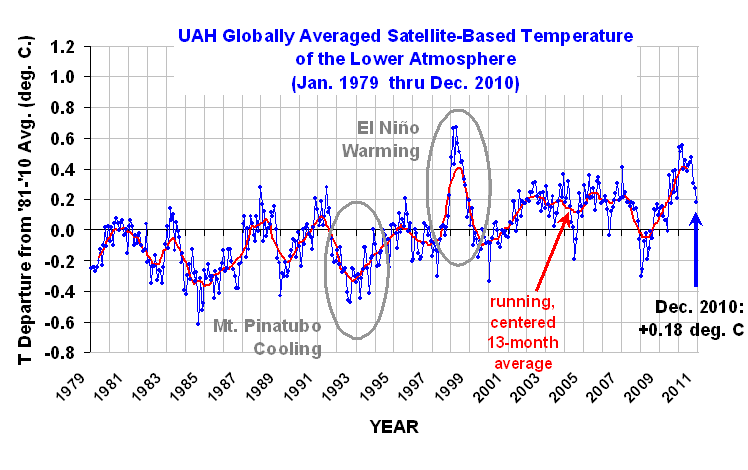
I think Christopher Monckton has done a great deal to help communicate scepticism and the debunking of AGW myths (that is if you can get past the unnecessary aristocratic coronets on every Powerpoint slide he shows) but he will insist on plugging the “no warming since 1998” line, which I’m afraid, is an open goal. 1998 was a huge El Niño year, and the spike in temperatures that year cannot be used to justify that there has been “no warming since 1998”. I ignore the surface temperature records entirely, since they have warmists’ sticky fingers all over them (eg. James Hansen and GISS – potential conflict, NASA? Apparently not…) so let’s look at the satellite record, which is less susceptible to fudging and “adjustment”:

Satellite temperatures, 1979 - 2010

We can see clearly that temperatures for much of the first decade of the 21st century were indeed higher than the last decade of the 20th. To argue otherwise is asking for trouble. And 2010 had another major El Niño, which pushed up temperatures in the first part of the year. A La Niña is now acting to reverse that increase, and it will be interesting to see how much further temperatures will drop in the next few months.

However, none of this tells us anything about the cause of that warming. So what if this decade is warmer than last? The planet has been warming slowly since the end of the Little Ice Age, well before there were any anthropogenic CO2 emissions, so is it any wonder that this decade is warmer than the last? There is a temporal relationship between increasing temperature and rising CO2 levels, but no proven causal link. That is the point that Monckton should have made.

If you really want to run the “no warming” line, you could choose 2002 if you wish, but it’s just getting a little silly then. In any case, why bother? The planet’s warming? Big deal. It warms, it cools, it does just what the hell it likes. Nobody can link the warming of the late 20th and early 21st centuries directly to anthropogenic emissions, and that is the weak link in the armour that Monckton and sceptics in general should aim for.

How to end uncertainty on carbon [dioxide] pricing


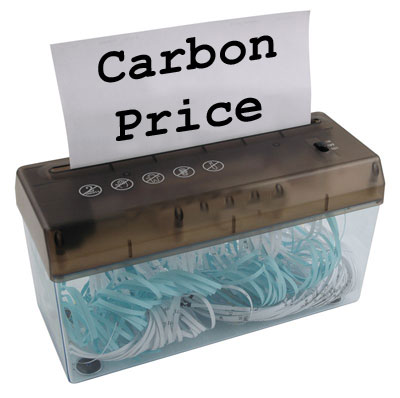
Through the shredder

Simple: abandon it.

The Australian agonises at length about “business certainty”:

IN 2007, as southern Australia ground through the hottest average temperatures on record, a national carbon price was high on the agenda.

Both John Howard and Kevin Rudd had committed themselves to an emissions trading scheme to combat global warming as they geared up for the November election, which Rudd, who was pushing the issue hardest, won.

But three years, a global financial crisis and a hung parliament later, any certainty about a carbon price, or its form, has quickly dried up.

In the electricity sector alone, the uncertainty has led to $10 billion, or 56 per cent, of power generation investment planned over the next five years being slashed. (source)

I think we all know the solution.

US: Republicans to limit EPA on emissions


House leader John Boehner

As we all know, Obama failed to get congressional approval for his plan to “tackle climate change” (code for destroying the economy – although he’s done a pretty good job of that anyway), but that wasn’t going to stop the Marxist POTUS, who thinks that the whole democracy thing is just an annoying inconvenience. He just encouraged the EPA to classify the harmless trace gas carbon dioxide as a dangerous pollutant, which they meekly did. However, the Republican majority in the House is doing its best to put an end to Obama’s undemocratic methods:

Republicans in the US Congress have wasted no time in using their new majority in the House of Representatives to try to block the authority of the Environmental Protection Agency to act on climate change.

In their first full day in the new Congress, Republicans outlined three different bills – encapsulating three different strategies – aimed at limiting the agency’s powers.

The first would declare that greenhouse gas emissions are not subject to the Clean Air Act. The second would block funding to any government agency associated with cap-and-trade. The third is seeking a two-year delay in EPA regulation of carbon dioxide and methane emissions.

The Republicans also shut down a House committee that had tackled energy and climate issues. (source)

Bravo. Climate sense from the US at last.

More money than sense


Think it through…

The wealthy founder of website wotif.com donated $1.6 million to the Greens’ 2010 election campaign:

The generous donation by Brisbane-based businessman Graeme Wood, who has an estimated wealth of $378.5m, formed the bulk of the Greens election campaign spending, according to an article in the Fairfax press.

The Greens were able to invest in a high-rotation television advertising campaign.

Independent market research found the party won more votes in the seats that were targeted by the television advertising campaign.

Mr Wood told Fairfax he made the donation because he was unhappy with Labor and the Coalition policies on climate change and the environment.

“I didn’t think either of those parties were being effective,” he said. “They were being driven by people with vested interests.” (source)

I wonder if Mr Wood realises that if the Greens were ever able to implement their backward, dangerous, Marxist policies fully (g-d help us), there wouldn’t be an economy left in which he could amass such a vast personal fortune. He should be thanking the Coalition. Twit.

UPDATE: Andrew Bolt has more.

Earth's natural negative feedbacks


Negative feedback

Feedbacks are what climate alarmism is built on. The warming effect of carbon dioxide alone is already almost at its maximum, and a doubling of the concentration would at most add less than 1 degree C to the global temperature. But the alarmist models use that modest warming to initiate positive feedbacks, increasing and accelerating it to dangerous and catastrophic levels.

Here, however, is a great example of the planet’s natural tendency for negative feedbacks:

Bacteria ate nearly all the potentially climate-warming methane that spewed from BP’s broken wellhead in the Gulf of Mexico last year, scientists reported on Thursday.

Nearly 200,000 tons of methane — more than any other single hydrocarbon emitted in the accident — were released from the wellhead, and nearly all of it went into the deep water of the Gulf, researcher David Valentine of the University of California-Santa Barbara said in a telephone interview.

Bacteria managed to take in the methane before it could rise from the sea bottom and be released into the atmosphere, but the process contributed to a loss of about 1 million tons of dissolved oxygen in areas southwest of the well.

That sounds like a lot of oxygen loss, but it was widely spread out, so that the bacterial munching did not contribute to a life-sapping low-oxygen condition known as hypoxia, said Valentine, whose study was published in the journal Science.

What happens to methane has been a key question for climate scientists, because methane is over 20 times more effective at trapping heat in the atmosphere than carbon dioxide. Like carbon dioxide, methane comes from natural and human-made sources, including the petroleum industry.

The BP spill offered an “accidental experiment” that showed particular bacteria with an all-methane diet multiplied quickly as the methane spread with the underwater plume from the broken well. Peak consumption of methane probably came in late July and early August, Valentine said.

Other organisms dealt with other hydrocarbons, including ethane and propane emitted in the worst offshore oil spill in U.S. history. The methane-eating bacteria were the last to the hydrocarbon banquet, and based on past observation, the scientists questioned whether they could do the job.

“Given observations about how slowly methane is normally consumed, we didn’t think the (bacteria) population was up to the challenge at all … we thought it would be a lot slower,” Valentine said. (source)

How wrong they were. It’s not surprising if you think about it – in a massively complex ecosystem such as our own planet, when a particular variable begins to increase (methane concentration), there will be some natural process (explosion of methane-consuming bacteria) to act as a negative feedback to restore the system to a quiescent state. Crikey, I’m beginning to sound like a Gaia-freak!

Speaking of Gaia freaks, ACM stalwart Andy Pitman (see here for one of Pitman’s previous classics) comes to a fellow warmist’s aid in today’s Australian, playing down Tim Flannery’s “earth-mother” nonsense on The Science Show (see here), and spouting all the usual alarmist nonsense we would expect from someone on the AGW funding bandwagon:

Flannery made a series of eloquent points in his interview and the transcript is worth reading in full. However, he also said: “I think that within this century the concept of strong Gaia will actually become physically manifest.” This is about as silly, in my view, as Flannery’s statement on the ABC’s Lateline program in November 2009 that global warming had not occurred over the past 10 years, that “there hasn’t been a continuation of that warming trend”. This statement was incorrect and highlights the dangers of a scientist commenting outside their area of expertise. (source)

So the one statement Flannery gets right, Pitman complains about! You get the picture…

And finally, a moral tale of junk science which cost millions of dollars (and possibly lives), which was finally exposed as fraud. Sound familiar?

RESEARCH linking childhood vaccination to autism is not only flawed but a fraud, the British Medical Journal declared yesterday.

The journal thus “closed the door” on the health scare of a decade.

It branded the bombshell study by Andrew Wakefield – published by its prestigious rival The Lancet in 1998 and retracted last year – as an “elaborate fraud”.

Mr Wakefield had been secretly working for a class-action law firm that planned to sue the manufacturers of the measles, mumps and rubella (MMR) vaccine, at the time he published his paper linking the jab to childhood autism, the BMJ claimed in an article published yesterday.

The resulting public health scare caused by the original article triggered a boycott of the vaccine in Britain, where immunisation rates crashed to 80 per cent.

The BMJ article, by investigative journalist Brian Deer, claims that Mr Wakefield was paid a total of $677,000.

“The paper was in fact an elaborate fraud,” the BMJ says in a separate editorial. “Meanwhile, the damage to public health continues.” (source)

And this is just small fry compared to the fraud being perpetrated by the GW alarmists on the global economy and standards of living.

Daily Bayonet GW Hoax Weekly Roundup


Skewering the clueless

As always a great read!

Tomorrow's Headlines Today: Decline in Vegemite sales would be "consistent with global warming"


Excellent proxy

[Satire Alert] Don’t forget, you read it here first… 😉

Decline in Vegemite sales would be “consistent with global warming”

A recent federally funded study has demonstrated that a decline in the consumption of favourite Aussie spread Vegemite, if such a decline ever occurred, would be consistent with global warming.

Climate Scientist Dr Al Armist said, “It’s been well known for many years that consumption of toast is a very good indicator of global temperature. People just don’t eat toast when it’s hot – simple as that. Here in Australia, toast is invariably accompanied by copious amounts of Vegemite, so if sales of Vegemite were ever to decline, it would indicate clearly that Australian temperatures were rising.”

When asked whether such a decline could be a result of other factors, such as people “simply going off it”, Dr Armist replied that their research showed that global warming was the only explanation. “We looked at all the other possible causes, but we discounted all of them for reasons that would be too complex to explain to the general public, or a journalist.”

The study’s results could be applied in other countries, Dr Armist said. “This isn’t just a local phenomenon, but would be repeated globally. You could look at Marmite, Bovril and other salty, yeasty spreads elsewhere in the world. They would all act as excellent proxies for global temperature, and would certainly be more reliable than GISS.”

The study, which cost the Australian taxpayer a staggering amount of money, also showed that if Vegemite sales were to increase, that too would be entirely consistent with global warming. Dr Armist concluded, “We haven’t quite worked out why yet. But it’s only a matter of time.”

© any gullible newspaper or website you care to mention.