Warmist ‘integrity’ on display


Respect and integrity

Respect and integrity

In what other area of scientific discourse would this kind of exchange take place?

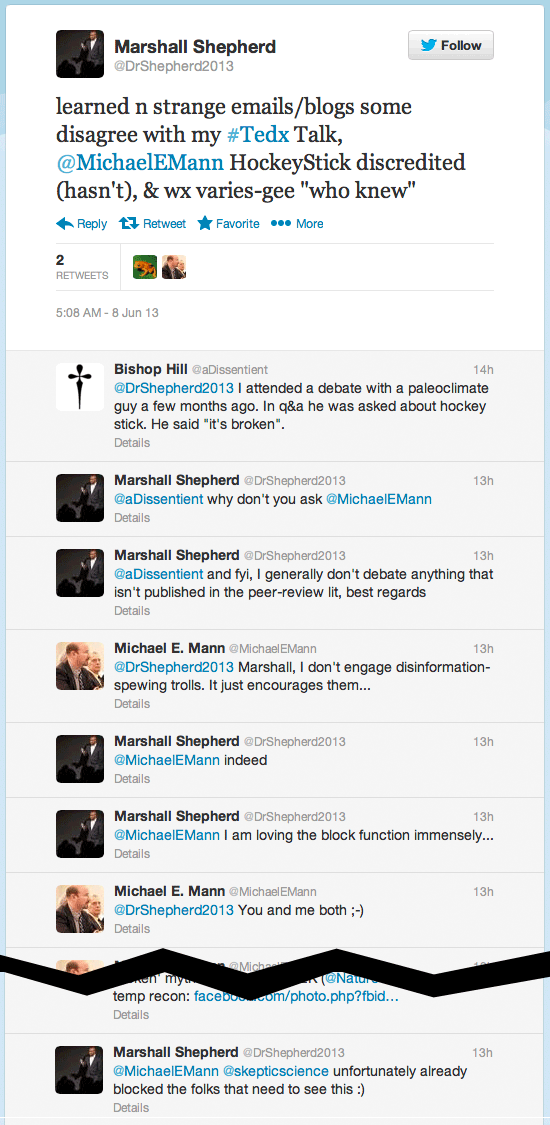
Marshall Shepherd: learned n strange emails/blogs some disagree with my #Tedx Talk, @MichaelEMann HockeyStick discredited (hasn’t), & wx varies-gee “who knew”

Bishop Hill: @DrShepherd2013 I attended a debate with a paleoclimate guy a few months ago. In q&a he was asked about the hockey stick. He said “it’s broken”.

Marshall Shepherd: @aDissentient why don’t you ask @MichaelEMann

Marshall Shepherd: @aDissentient and fyi, I generally don’t debate anything that isn’t published in the peer-reviewed lit, best regards

Then Mann shows up:

Michael Mann: @DrShepherd2013 Marshall, I don’t engage disinformation-spewing trolls. It just encourages them…

Marshall Shepherd: @MichaelEMann indeed

Marshall Shepherd: @MichaelEMann I am loving the block function immensely…

Michael Mann: @DrShepherd2013 You and me both 😉

Marshall Shepherd: @MichaelEMann @skepticscience [of course – Ed] unfortunately already blocked the folks that need to see this 🙂

No comment required. The tweets speak for themselves. By the way, Marshall Shepherd is the President of the American Meteorological Society.

P.S. Note to Michael Mann, Shepherd and all the other blockers, all you need to do is log out of Twitter and you can see everything, which is how ACM (which was blocked by Mann) can post all the tweets. 

H/T Bishop Hill

Here’s the exchange as it appeared on Twitter:
Twitter has a long memory

Twitter has a long memory…

How Cook ‘n’ Lew do science


Climate Clowns

Climate Clowns

Here’s a summary of the Scientific Method, according to John Cook & Stephan Lewandowsky:

Step 1: Develop a quasi-religious belief in a particular point of view (e.g. that human-caused emissions are causing dangerous climate change);

Step 2: Convince yourself that you are morally and intellectually superior to those who hold a different view, since your view is naturally “right” and “good”, and the other is “evil” and “bad”;

Step 3: Look for ways to caricature, demean, ostracise and ridicule your ideological opponents whilst at all times avoiding any rational discussion of the subject matter in dispute;

Step 4: Find some suitably catchy phrases, like “deniers are all conspiracy theory fruitcakes who think the Moon landing was faked” or “97% of scientific papers support the ‘consensus’ on global warming“, with which to frame the “research” and portray your opponents as fools;

Step 5: Beat, batter and torture whatever data you get until it fits said phrase;

Step 6: Use said phrase in the title of your paper so that MSM journalists, who never read anything beyond the title anyway, will do all the hard work for you (especially when one of your mates writes part of the story…!);

Step 7: Continue to pretend that the research is “impartial” and of the highest standard, despite the fact that the entire world and his dog is aware of the researchers’ firmly held beliefs and biases. How?  Mainly because they publish them every day on web sites.

Step 8: Sit back and wait for moonbat universities, governments and supposedly learned societies to award you great honours for doing such valuable “research“, and for the grants to flood in.

By the way, that whirring noise in the background is Karl Popper spinning in his grave.

Role of CO2 in climate change questioned


CFCs to blame?

CFCs to blame?

It’s all one way traffic for the carbon dioxide mongers at the moment. Not only is the climate refusing to play ball, and the pesky media is starting to ask awkward questions of the alarmists, but a new paper hints at CO2 being less of a factor in climate change than CFCs.

From The Science is Settled department:

BANNED aerosols that caused the ozone hole – not carbon dioxide – were responsible for global warming since the 1970s, according to published research from one of Canada’s leading universities.

The research predicts global temperatures will continue to fall for the next 50 to 70 years and sea levels will rise for two decades before starting to retreat.

The peer-reviewed research by Qing-Bin Lu, a professor of physics and astronomy, biology and chemistry at Waterloo University, was published in the International Journal of Modern Physics B.

The findings of Professor Lu’s paper – Cosmic-Ray-Driven Reaction and Greenhouse Effect of Halogenated Molecules: Culprits for Atmospheric Ozone Depletion and Global Climate Change – are at odds with the consensus view that climate change is driven by increasing concentrations of CO2 in the atmosphere. Waterloo University said Professor Lu’s research provided “new fundamental understanding of the ozone hole and global climate change”. Critics said it might be “nothing more than coincidental correlation”, but it warranted further study.

Chlorofluorocarbons are known to deplete ozone, but conventional thinking is the emission of human-made non-CFC gases such as carbon dioxide had mainly contributed to global warming.

“But we have observed data going back to the industrial revolution that convincingly shows that conventional understanding is wrong,” Professor Lu said. “In fact, the data shows that CFCs conspiring with cosmic rays (solar activity) caused both the polar ozone hole and global warming.”

By proving the link between CFCs, ozone depletion and temperature changes in the Antarctic, Professor Lu said he was able to draw almost perfect correlation between rising global surface temperatures and CFCs in the atmosphere. “The change in global surface temperature after the removal of the solar effect has shown zero correlation with CO2 but a nearly perfect linear correlation with CFCs,” he said.

If correct, the theory would have dramatic implications for forecasting global climate change.

“Most conventional theories expect that global temperatures will continue to increase as CO2 levels continue to rise, as they have done since 1850,” Professor Lu said. “My calculations of CFC greenhouse effect show that there was global warming by about 0.6 degrees C from 1950 to 2002, but the Earth has actually cooled since 2002. The cooling trend is set to continue for the next 50-70 years as the amount of CFCs in the atmosphere continues to decline.” (source – $)

Next step will be for the UN to tax underarm deodorants, I guess.

Rising scepticism and falling alarmism


seesaw

Swings and roundabouts

Three articles of note today. First, UK chair of climate committee says warming may be natural, second, Met Office admits that warming of last century isn’t statistically significant, and finally, Aussie scientists downgrade alarmist predictions.

To the UK first, where Tim Yeo, chairman of the parliamentary Energy and Climate Change Committee, has embraced free-thinking, rational scepticism and has abandoned dogmatic and quasi-religious alarmism, in a shift which will send shock waves through the climate community.

As the Telegraph reports, in 2009 Yeo said this:

“The dying gasps of the deniers will be put to bed. In five years time, no one will argue about a man-made contribution to climate change.”

We didn’t need to wait five years for that, since Yeo has now finally acknowledged the uncertainties himself:

Humans may not be responsible for global warming, according to Tim Yeo, the MP who oversees government policy on climate change.

The chairman of the Commons Energy and Climate Change committee said he accepts the earth’s temperature is increasing but said “natural phases” may be to blame.

Such a suggestion sits at odds with the scientific consensus. One recent survey of 12,000 academic papers on climate change found 97 per cent agree human activities are causing the planet to warm [that’s John Cook’s crock on consensus, by the way. What has consensus got to do with it anyway? If more people think the Sun goes round the Earth, does that somehow make it true? “8 out of 10 cats prefer Whiskas“… – Ed].

Mr Yeo, an environment minister under John Major, is one of the Conservative Party’s strongest advocates of radical action to cut carbon emissions. His comments are significant as he was one of the first senior figures to urge the party to take the issue of environmental change seriously.

He insisted such action is “prudent” given the threat climate change poses to living standards worldwide. But, he said, human action is merely a “possible cause”.

Asked on Tuesday night whether it was better to take action to mitigate the effects of climate change than to prevent it in the first place, he said: “The first thing to say is it does not represent any threat to the survival of the planet. None at all. The planet has survived much bigger changes than any climate change that is happening now.

He went on: “Although I think the evidence that the climate is changing is now overwhelming, the causes are not absolutely clear. There could be natural causes, natural phases that are taking place.” (source)

Still in the UK, the Met Office has been forced, by a climate system that simply wouldn’t comply with the wishes of the alarmist “consensus”, to admit that the past 140 years of modest temperature rises are statistically insignificant, after six questions were raised in the House of Lords:

The issue here is the claim that “the temperature rise since about 1880 is statistically significant”, which was made by the Met Office in response to the original Question (HL3050). The basis for that claim has now been effectively acknowledged to be untenable. Possibly there is some other basis for the claim, but that seems extremely implausible: the claim does not seem to have any valid basis.

Plainly, then, the Met Office should now publicly withdraw the claim. That is, the Met Office should admit that the warming shown by the global-temperature record since 1880 (or indeed 1850) might be reasonably attributed to natural random variation….

Lastly, it is not only the Met Office that has claimed that the increase in global temperatures is statistically significant: the IPCC has as well. Moreover, the IPCC used the same statistical model as the Met Office, in its most-recent Assessment Report (2007)…

To conclude, the primary basis for global-warming alarmism is unfounded. The Met Office has been making false claims about the significance of climatic changes to Parliament—as well as to the government, the media, and others — claims which have seriously affected both policies and opinions. When questioned about those claims in Parliament, the Met Office did everything feasible to avoid telling the truth. (h/t Bolta)

Finally, David Karoly, arch warmist of Melbourne University starts hedging bets as he has to admit that ludicrously scaremongering claims of 6 degrees of warming were “unlikely”, but given Karoly’s well-known ideological and activist stance on the subject, the press release makes sure that the bandwagon still rolls on:

Scientists from the University of Melbourne and Victoria University have generated what they say are more reliable projections of global warming estimates at 2100.

The paper, led by Dr Roger Bodman from Victoria University with Professors David Karoly and Peter Rayner from the University of Melbourne and published in Nature Climate Change today, found that [good news…] exceeding 6 degrees warming was now unlikely while [bad news…] exceeding 2 degrees is very likely for business-as-usual emissions…

This was achieved through a new method combining observations of carbon dioxide and global temperature variations with simple climate model simulations to project future global warming.

Dr Bodman said while continuing to narrow the range even further was possible, significant uncertainty in warming predictions would always remain due to the complexity of climate change drivers. “This study ultimately shows why waiting for certainty will fail as a strategy,” he said. “Some uncertainty will always remain, meaning that we need to manage the risks of warming with the knowledge we have.” (source – h/t WUWT)

Interesting times…

UPDATE: The headbangers over at Un-Skeptical Pseudo-Science (no link) respond to these developments with balanced and open-minded scientific curiosity… Nah, only joking! With yet more alarmism, this time from Kevin Trenberth, who, like most of the headbangers, must be worried he’ll be out of a job in a few years’ time, when “climate scientists” go the way of spear-makers, rag and bone men and gas lamp lighters:

Focusing on the wiggles and ignoring the bigger picture of unabated warming is foolhardy, but an approach promoted by climate change deniers. Global sea level keeps marching up at a rate of more than 30cm per century since 1992 (when global measurements via altimetry on satellites were made possible), and that is perhaps a better indicator that global warming continues unabated. Sea level rise comes from both the melting of land ice, thus adding more water to the ocean, plus the warming and thus expanding ocean itself.

Global warming is manifested in a number of ways, and there is a continuing radiative imbalance at the top of atmosphere. The current hiatus in surface warming is temporary, and global warming has not gone away.

Lewandowsky invents new pseudo-science of psycho-climatology™


Pseudo-science rules!

Pseudo-science rules!

Stephan Lewandowsky knows nothing about climatology, meteorology, geology, atmospheric physics or thermodynamics, but that trivial obstacle does not prevent him believing the alarmist consensus with such fervour that he uses his own “discipline” (if you can call it that) of psychology to label those who question said consensus as suffering from some kind of mental condition, his favourite label being “conspiracy theorist”.

If that wasn’t enough, however, Lewandowsky has also invented “recursive idiocy” by taking the above approach a step further, so that anyone who questions Lewandowsky’s psychological assessment is themselves branded a “conspiracy theorist” and the recursion goes on, presumably, ad infinitum. Seriously, I’m not making this up. And Lewandowsky is something called a “Winthop Professor” at the University of Western Australia. And a recipient of the UK Royal Society’s Wolfson Research Merit award. No, really.

By himself, Lewandowsky, with a bit of help from John Cook over at Un-Sk Ps-Sc, has invented the shiny new pseudo-science of psycho-climatology™, whereby scientific study and debate regarding the earth’s climate system is replaced by psychological demeaning of those with whom the learned professor (for a professor he is © Media Watch Dog) happens to disagree, on a subject about which he knows nothing.

Enough already. Just read Ben Pile’s majestic demolition of Lewandowsky and his pseudo-science psycho-climatology-babble here.

Climate sensitivity “lower than previously thought”


Not as bad as thought?

Not as bad as thought?

It’s only taken years of effort from “deniers” but now the mainstream media is finally catching up. Climate sensitivity is likely to be far lower than the alarmists claim, making frighteningly expensive attempts to regulate CO2 even more futile:

GLOBAL temperature increases as a result of increased carbon dioxide levels in the Earth’s atmosphere are likely to be lower than previously thought, an international research team has found.

The Oxford University-led study found that a predicted doubling of CO2 concentrations, expected to occur later this century, is likely to raise global temperatures in the short term by between 1.3C and 2C.

Previous estimates, based on climate data from the 1990s, predicted steeper rises of up to 3.1C. The new study, published today in the journal Nature Geoscience, used data gathered more recently, when the average rate of global warming was slowing down.

The latest estimate is “arguably the most reliable”, the paper says, partly because it is less affected by the 1991 eruption of Mount Pinatubo in The Philippines, but caution is still required in interpreting the available data.

The Intergovernmental Panel on Climate Change previously estimated a temperature rise of between 1C and 3C, with increases outside that range described as “very unlikely”. The new study team, which included an oceanographer from CSIRO’s marine and atmospheric research division in Hobart, estimates this rise could be as little as 0.9C.

The researchers also found that some of the modelling being used for the fifth IPCC assessment report, which is due next year, could be inconsistent with their observations.

As always, however, dogma must come first:

Ultimately, however, they found their new predictions suggested little difference to the global temperature increase in the long run. Their best estimate of the “equilibrium climate sensitivity” – the long-term temperature rise once the effects of higher CO2 concentrations had bedded down – was 2C, with an upper limit of 3.9C. This compares with other previous estimates, the study said.

Steven Phipps, a research fellow with the University of NSW, said the study provided “the most accurate estimates yet of climate sensitivity” and, in broad terms, confirmed what has long been known.

“Our planet faces a very uncomfortable future if our emissions of greenhouse gases continue unabated,” he said. (source)

If we actually spent even a tenth of the money wasted on greenhouse gas mitigation on research into alternative energy sources, we wouldn’t need unabated emissions to continue. However, it’s a step in the right direction.

UK: Energy policy dominated by “Green lobby”


Just like the 70s

Just like the 70s

In the UK, the forced transition to highly expensive “green” energy is sowing the seeds for a major crisis. I recall the power cuts of the early 1970s (just), where my family had a collection of oil lamps and candles for when the lights went out, but there’s no excuse in 2013.

However there is a glimmer of hope in the darkness:

Britain must abandon its bias towards green policies or face an energy crisis, a key parliamentary adviser has warned.

Peter Lilley, a member of the Prime Minister’s Parliamentary Advisory board, has warned that the UK’s hesitance to embrace shale gas comes at great expense to the country.

He cites decreasing gas prices in American as an example, where gas is a third of the price of what it is in Europe, and questions why Britain is “dragging its feet”.

The UK is potentially sitting on enough shale gas reserves to heat all homes in Britain for at least 100 years, experts at the British Geological Survey claimed in April this year.

However, there has been resistance to excavate the fossil fuel amid concerns about the possibility of earthquakes and water contamination if gases are leaked into the water table while the “fracking” process is carried out.

In an article for The Spectator, the Conservative MP accuses the Department for Energy and Climate Change as being “in disarray” over the issue, with some ministers now beginning to question the direction green policies have been heading.

He claims that the green lobby is in control of the Department for Energy, dominates the EU and is institutionalised in Whitehall via the Climate Change Committee. He also accuses them of deploying “scare stories with reckless disregard for the truth” on a scale comparable to the MMR scare.

“Whatever the power of Big Oil in the past, it has been eclipsed by Big Green,” he said.

(source)

Attempts to cut CO2 are futile – and expensive


Blondie Bjorn

Blondie Bjorn

Bjorn Lomborg makes a sound case for abandoning attempts to cut CO2, and instead look at investing in R & D for renewable energy sources. Even if you accept the worst predictions of the AGW alarmists, it still does not make sense to slash emissions.

All the planet’s efforts to reduce CO2 emissions have passed virtually unnoticed by the atmosphere and climate. The pointlessness of it all is summed up by Lomborg’s claim that the current EU climate policy will cost $20 trillion over the century, and will reduce global temperatures by 0.05 degrees C. How about that for a cost/benefit result?

I have always believed that strong economies lead to strong research and industry, which will lead more quickly to competitive renewable energy sources. The opposite, slashing CO2 emissions and strangling economies, means that such developments will take longer, and in the mean time, the population will suffer unnecessarily.

He writes:

Global warming is a problem for the future but a benefit now. Lots of people like to point out that global warming means more deaths from heat waves, but they forget that fewer die from cold. In Britain and almost everywhere, more people die from cold than from heat.

Likewise, higher temperatures mean higher costs for air-conditioning but lower costs for heating. Temperature rises will push some crops beyond their optimal range and reduce yields, but CO2 in the atmosphere acts as a fertiliser and has increased global yields significantly.

When economists estimate the net damage from global warming as a percentage of gross domestic product, they find it will indeed have an overall negative impact in the long run but the impact of moderate warming (1C-2C) will be beneficial. It is only towards the end of the century, when temperatures have risen much more, that global warming will turn negative. One peer-reviewed model estimates that it will turn into a net cost only by 2070.

We need to stop claiming that it will be the end of the world. Just as it is silly to deny man-made global warming, it is indefensible to describe it as the biggest calamity of the 21st century.

Here is how to quantify this. The most well-known economic model of global warming is the DICE model by William Nordhaus, of Yale University. It calculates the total costs (from heat waves, hurricanes, crop failure and so on) as well as the total benefits (from cold waves and CO2 fertilisation). If you compare these over the next 200 years, the total cost of global warming is estimated at about $33 trillion.

While this is not a trivial number, you have to put it in context. Over the next 200 years, global GDP will run to about $2200 trillion, so global warming constitutes a loss of about 1.5 per cent of this figure. This is not the end of the world but a problem that needs to be solved.

Next, consider CO2 levels. With huge, green subsidies showing up on our electricity bills, you would be excused for believing that we have managed to cut CO2 substantially. You would be wrong. Global CO2 has risen relentlessly since 1950. In 1997 the Kyoto protocol put legally binding limits on rich-country emissions. But Kyoto and all our fine policies have had no real impact. The only indication of a CO2 reduction was in 2009 when the global recession put us on track to fulfil Kyoto. Had the recession continued, we might have been able to achieve Kyoto.

Not surprisingly, such a policy has no appeal for politicians or voters in the real world.

Kyoto set a target of 36.6 per cent for the rise in global emissions since 1990. In fact they have gone up by 45.4 per cent. With no Kyoto at all, they would have increased by only about half a percentage point to 45.9 per cent. Put simply, the past two decades of climate discussions have had virtually no impact on global emissions.

The latest peer-reviewed overview of the 311 published estimates show that the entire cost of the most likely future damage is about $5 a tonne. This means that cutting CO2 for less than $5 a tonne is probably a good idea, whereas cutting for more is probably a bad deal.

Unfortunately, almost all policies for fighting global warming are bad deals by this $5 yardstick. Most large nations have managed to enact climate policies for electricity that cost a lot more than the good they do.

China has one of the most efficient climate policies on electricity. Yet it still pays about $46 to cut a tonne of CO2, which is nearly eight times more than the global, long-term benefits. Australia pays about half a billion dollars to cut less than 5 per cent of its electricity emissions, paying about $72 a tonne of CO2, or almost 15 times too much. On biofuels, the excess is even greater and emission reductions even smaller. Australia pays 73 times too much at $364 a tonne of CO2, cutting just 0.1 per cent of its total emissions at a cost of $144m. The US pays a staggering 133 times too much, at $666 a tonne of CO2, costing $17.5bn a year and cutting just 0.5 per cent of its total emissions. (source)

So Australia is paying $364 to solve every $5 worth of problems. An efficiency Gillard and Labor would be proud of.

‘Climatologists are no Einsteins’


Einstein vs Mann or Hansen? No contest.

Einstein vs Mann or Hansen? No contest.

You can say that again! Climatologists are no Einsteins [very funny – Ed]. But it wasn’t me that said it, it was a successor of Einstein himself at Princeton University, Freeman Dyson.

Even putting ‘climatologists’ in the same breath as Einstein is like putting One Direction in the same breath as J S Bach.

Unlike the majority of alarmist climate activists posing as ‘scientists’ today, Einstein was a proper scientist. Can’t remember hearing of him deleting his correspondence or not sharing his data, or worse, fudging it in order to fit a pre-conceived politically-motivated conclusion.

He also wasn’t paid more because the Aether didn’t exist, his revolutionary concept of spacetime provided the missing structure. As well as Einstein’s scientific integrity, world governments were not spending trillions of dollars to prove the existence of the Aether – and then tax it.

If the evidence did not fit the hypothesis, then the hypothesis must be wrong. No point in trying to shoehorn the data into a flawed theory.

And Dyson rightly follows that path:

“I think any good scientist ought to be a skeptic,” Dyson said.

Dyson came to this country from his native England at age 23 and immediately made major breakthroughs in quantum theory. After that he worked on a nuclear-powered rocket (see video below). Then in the late 1970s, he got involved with early research on climate change at the Institute for Energy Analysis in Oak Ridge, Tenn.

That research, which involved scientists from many disciplines, was based on experimentation. The scientists studied such questions as how atmospheric carbon dioxide interacts with plant life and the role of clouds in warming.

But that approach lost out to the computer-modeling approach favored by climate scientists. And that approach was flawed from the beginning, Dyson said.

“I just think they don’t understand the climate,” he said of climatologists. “Their computer models are full of fudge factors.”

A major fudge factor concerns the role of clouds. The greenhouse effect of carbon dioxide on its own is limited. To get to the apocalyptic projections trumpeted by Al Gore and company, the models have to include assumptions that CO-2 will cause clouds to form in a way that produces more warming.

“The models are extremely oversimplified,” he said. “They don’t represent the clouds in detail at all. They simply use a fudge factor to represent the clouds.”

Dyson said his skepticism about those computer models was borne out by recent reports of a study by Ed Hawkins of the University of Reading in Great Britain that showed global temperatures were flat between 2000 and 2010 — even though we humans poured record amounts of CO-2 into the atmosphere during that decade.

That was vindication for a man who was termed “a civil heretic” in a New York Times Magazine article on his contrarian views. Dyson embraces that label, with its implication that what he opposes is a religious movement. So does his fellow Princeton physicist and fellow skeptic, William Happer.

“There are people who just need a cause that’s bigger than themselves,” said Happer. “Then they can feel virtuous and say other people are not virtuous.”

To show how uncivil this crowd can get, Happer e-mailed me an article about an Australian professor who proposes — quite seriously — the death penalty for heretics such as Dyson. As did Galileo, they can get a reprieve if they recant.

I hope that guy never gets to hear Dyson’s most heretical assertion: Atmospheric CO-2 may actually be improving the environment.

“It’s certainly true that carbon dioxide is good for vegetation,” Dyson said. “About 15 percent of agricultural yields are due to CO-2 we put in the atmosphere. From that point of view, it’s a real plus to burn coal and oil.”

In fact, there’s more solid evidence for the beneficial effects of CO-2 than the negative effects, he said. So why does the public hear only one side of this debate? Because the media do an awful job of reporting it.

“They’re absolutely lousy,” he said of American journalists. “That’s true also in Europe. I don’t know why they’ve been brainwashed.” [And in Australia – Ed]

I know why: They’re lazy. Instead of digging into the details, most journalists are content to repeat that mantra about “consensus” among climate scientists.

The problem, said Dyson, is that the consensus is based on those computer models. Computers are great for analyzing what happened in the past, he said, but not so good at figuring out what will happen in the future. But a lot of scientists have built their careers on them. Hence the hatred for dissenters.

“It was similar in the Soviet Union,” he said. “Who could doubt Marxist economics was the future? Everything else was in the dustbin.” (source)

When you hear an eminent physicist speak such common sense, it’s like a breath of fresh air amid the fetid stench of climate science.

(h/t Lubos)

Summer not so angry after all


Who can spot the angry summer?

Who can spot the angry summer?

The emotive language and graphics of the Climate Commission are there to scare the population into thinking the worst. It’s pure alarmism.

As mentioned in the last post, the Climate Commission, Flannery, Steffen and the rest will all be gone by the end of the year – good riddance.

Murry Salby, professor of climate at Macquarie University, dismantles their latest explosion of hysteria:

CLAIMS from the latest report by the Climate Commission, titled The Angry Summer, have been widely circulated through international media. On the basis of a few sporadic episodes, which in any other era would have been regarded as marginal weather (infrequent but perennial), the Climate Commission has proclaimed that such events are now the norm – the signature of climate change come home to roost.

This report is but the latest in a series of dire proclamations from this panel. It just happens to buttress the government’s controversial carbon tax, a maladroit policy that will be pivotal in the forthcoming federal election.

The commission’s position, as proclaimed by its chief commissioner, is that “the baseline has shifted” like “an athlete (who) takes steroids”. “The same thing is happening to our climate system . . . We’re getting fewer cold days and cold events and many more record hot events” (The New York Times, March 4).

The evocative nature of these claims is matched only by the imagination behind them. On a continental scale (the scale relevant to climate), Australian temperature this summer was unremarkable – it was within the range of previous variability.

The Climate Commission was enshrined as an “independent panel of experts”. It was installed and paid for by the government. The panel is comprised of biologists and ecologists, a materials engineer and members of the business community. It has no demonstrated expertise in the physics or chemistry of climate, or even in meteorology, the scientific underpinnings of its conclusions.

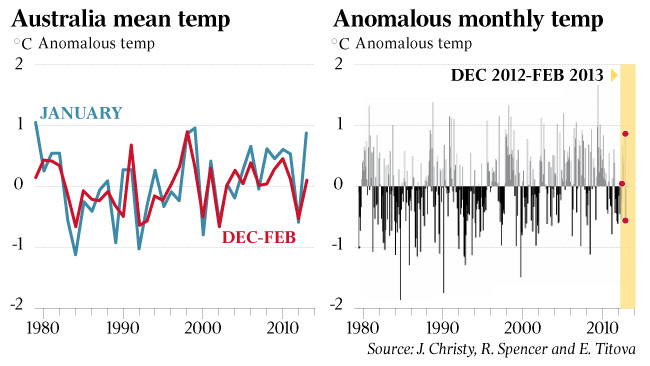
Figure 1 displays the record of Australia mean temperature during January (blue) in its anomalous value (the departure from the long-term average January temperature). Last January was warmer than recent Januaries, but hardly unprecedented. It lies about a standard deviation above the average January temperature. And even during the relatively short satellite era, two Januaries were warmer. Superimposed is anomalous summertime temperature (red). It is even less remarkable. Near the three-decade average, it is no more significant than in preceding years. Neither record evidences a sustained shift in the continental baseline.

Figure 2 displays the record of anomalous temperature for all months. It places the summer of 2012-13 into perspective. Anomalous temperature (red solid circles) lies well within the envelope of other warm anomalies during the preceding three decades. Cold anomalies are just as numerous. If anything, they are even stronger.

For many on Australia’s eastern seaboard, this summer was not anomalously hot but, rather, anomalously cool and wet. This is confirmed by the temperature record at Sydney. The central station reported only two marginal days. And during the entire summer maximum temperature reached 32C on only three days.

In the light of the satellite record, as well as the absence of any systematic change in global temperature for almost two decades, the proclaimed interpretation of this summer should be recognised for what it is: a simplistic explanation of a complex physical system. (source)

No-one’s listening any more chaps.