Climate scepticism akin to creationism?


Al Gore creating the alarmist religion

This is just the latest in the long line of attempts to demonise climate scepticism. The US National Centre for Science Education (NCSE) has announced that it will be tackling the teaching of climate scepticism in the classroom, just as it has tackled the teaching of creationism:

NCSE is proud to announce the launch of its new initiative aimed at defending the teaching of climate change. Like evolution, climate change is accepted by the scientific community but controversial among the public. As a result, educators trying to teach climate change, like their counterparts trying to teach evolution, are often likewise pressured to compromise the scientific and pedagogical integrity of their instruction. But there was no NCSE for climate — no organization, that is, specializing in providing advice and support to those facing challenges to climate change education.

With the launching of the initiative, NCSE itself becomes that organization. As NCSE’s executive director Eugenie C. Scott explained in a January 16, 2012, press release, “We consider climate change a critical issue in our own mission to protect the integrity of science education.” She added, “Climate affects everyone, and the decisions we make today will affect generations to come. We need to teach kids now about the realities of global warming and climate change, so that they’re prepared to make informed, intelligent decisions in the future.” (source)

But which side of the climate debate is really closer to creationism?

  • Which side has a pre-determined “cause” that must be defended at all costs?
  • Which side suppresses inconvenient data that doesn’t fit the cause?
  • Which side attacks heretics that dare challenge the cause?
  • Which side takes scientific findings and shoehorns them into the results it needs to support the cause?
  • Which side hides uncertainties in order to prevent the cause from being diluted?
  • Which side tries to stifle debate in order to protect the cause?
  • Which side has armies of paid organisations the spread “the word”? Think all the Green-bankrolled blogs and websites
  • Which side believes that the world will end unless the cause is blindly worshipped?

On the other hand, however:

  • Which side champions impartial, free-thinking scientific enquiry?
  • Which side isn’t beholden to any “cause”?
  • Which side welcomes all data, whether inconvenient or otherwise, to increase understanding?
  • Which side welcomes debate, since, again, it leads to greater understanding?

Check out this great essay over at Number Watch, which exposes in great detail the frightening similarities between climate alarmism and organised religion. Here is the introduction:

It was Michael Crichton who first prominently identified environmentalism as a religion. That was in a speech in 2003, but the world has moved on apace since then and adherents of the creed now have a firm grip on the world at large.

Global Warming has become the core belief in a new eco-theology. The term is used as shorthand for anthropogenic (or man made) global warming. It is closely related to other modern belief systems, such as political correctness, chemophobia and various other forms of scaremongering, but it represents the vanguard in the assault on scientific man.

The activists now prefer to call it “climate change”. This gives them two advantages:

  1. It allows them to seize as “evidence” the inevitable occurrences of unusually cold weather as well as warm ones.
  2. The climate is always changing, so they must be right.

Only the relatively elderly can remember the cynical haste with which the scaremongers dropped the “coming ice age” and embraced exactly the opposite prediction, but aimed at the same culprit – industry. This was in Britain, which was the cradle of the new belief and was a response to the derision resulting from the searing summer of 1976. The father of the new religion was Sir Crispin Tickell, and because he had the ear of Prime Minister, Margaret Thatcher, who was engaged in a battle with the coal miners and the oil sheiks, it was introduced into international politics with the authority of the only major political leader holding a qualification in science. The introduction was timely yet ironic since, in the wake of the world’s political upheavals, a powerful new grouping of left-wing interests was coalescing around environmental issues. The result was a new form of godless religion. 

I recommend you read it all. And then decide whether it’s the sceptics that should be lumped in with the creationists.


Carbon dioxide "driving fish crazy"


Pissed again…

You have to hand it to the humble CO2 molecule, it certainly is multi-talented. Not only can a few extra measly parts per million allegedly wreck the climate of a planet that has been in existence for 4.5 billion years, and turn the oceans into corrosive battery acid, but it can make fish drunk as well:

Rising human carbon dioxide emissions may be affecting the brains and central nervous system of sea fishes with serious consequences for their survival, an international scientific team has found.

Carbon dioxide concentrations predicted to occur in the ocean by the end of this century will interfere with fishes’ ability to hear, smell, turn and evade predators, says Professor Philip Munday of the ARC Centre of Excellence for Coral Reef Studies and James Cook University.

“For several years our team have been testing the performance of baby coral fishes in sea water containing higher levels of dissolved CO2 — and it is now pretty clear that they sustain significant disruption to their central nervous system, which is likely to impair their chances of survival,” Prof. Munday says. (source)

Mine’s a CO2 and tonic, please. No ice (‘cos it’s all melted).

Law firm tells government we need more laws to tackle climate change


Yet more climate regulation?

Ask a law firm to advise the government on anything, and the answer will invariably be: we need more laws, which inevitably means more lawyers.

And so it is with the latest announcement from the Department of Climate Change, which has released a report from law firm Maddocks on the “threats” to infrastructure from “climate change”, as The Australian reports:

LAWS governing key infrastructure assets such as airports, ports, roads, buildings and the electricity network should be tightened to cope with potential catastrophic events caused by climate change.

A report to be released by the federal government today warns that risks to the nation’s infrastructure “cannot be overstated” and intrusive regulations may be justified where key assets are vulnerable to catastrophic weather events.

The review was prompted by CSIRO predictions that the nation will suffer longer dry spells interspersed with increases in the intensity of wet spells.

More days of higher fire danger are predicted and forecast sea level rises will make coastal communities more vulnerable to storm surges.

The report by Maddocks Solicitors says liability laws could be used in the transport industry as “motivation” for the industry to adapt to climate change.

Rules governing airport master plans could be changed to take into account potential climate change events and the nation’s building codes altered to take into account extreme events.

The report says existing assets are more vulnerable than new infrastructure and governments may have to consider “retreat” strategies.

“This will require consideration of property rights, constitutional provisions, insurance, risk sharing, government funding and new regulatory provisions,” the report says.

The report also calls for the government to examine setting up a new national body to co-ordinate regulations aimed at climate change adaptation, with representatives from federal,state and local government. (source)

This proposal appears to have the potential to open the floodgates to yet more control and interference from government concerning areas of our lives in which government has no place, all justified by the overarching imperative to “tackle climate change”.

“Intrusive regulations may be justified”? An excuse for draconian legislation.

“Liability laws” used as “motivation”? Sounds more like a threat – in other words, widening the scope of liability to include losses suffered by third parties arising from an organisation’s failure to implement the government-decreed climate risk mitigation strategies.

“A consideration of property rights”? Using the planning regulatory regime to force property owners to take certain actions (or face the consequences).

“Retreat” strategies? Ordering people to leave property where some bureaucrat says so, for example due to projected sea level rise.

And the phrase “New regulatory provisions” to a government addicted to regulation (like Labor) is akin to giving Dracula the keys to the blood bank.

Not to mention the millions of dollars wasted annually on yet another “national body” on climate change.

So not only will our economy be slugged with a carbon tax which will achieve nothing, it will also, if the recommendations of this report are implemented, be hamstrung with miles and miles of additional climate-based red tape and bureaucracy, forcing businesses to prepare for events predicted by the cracked crystal ball of notoriously unreliable climate models.

See the Department of Climate Change page here, and the full report (170+ pages) is here (PDF).

Quote of the Day: Brian Schmidt


Quote of the Day

The Nobel laureate Professor Brian Schmidt, announced today as the Australian of the Year, on science and politics:

Science should inform policy, but must not become politicised, he says. “On issues like climate change, coal-seam gas, water management in the Murray-Darling Basin and stem cells we have seen science and public policy get mixed together,” he said. “We have seen policymakers challenging science, which they are ill-equipped to do. It is important for scientists not to get involved in the policy debate because if we do that then we are tainting the scientific argument.” (source)

Schmidt’s has previously defended the AGW consensus (see here), and his comment about policymakers not challenging science would be more credible if the scientists in question possessed proper standards of scientific integrity.

Unfortunately, in climate science consensus circles, political and financial motivations have usurped impartial free-thinking research, so that inconvenient data and results, rather than being welcomed as illuminating a path to greater understanding, are suppressed, hidden and explained away in order to avoid clouding the “message”, or should I say “The Cause” (© Climategate II).

By the way, there should be no such thing as “a cause”, in the sense of a belief or conviction, in science. Such a concept belongs firmly in the realm of propaganda and politics.

Save the planet! Burn more coal!


Avoid this - drive your SUV

Environmentalists should be very careful what they wish for. Let’s look at the choices:

  1. a modest warming over the next few decades, which will eventually level out or decline as new technologies replace fossil fuels for efficient and economical energy generation (and solar and wind are neither efficient or economical, by the way); or,
  2. a rapid plunge into the next Ice Age, rendering much of the planet uninhabitable and killing much of the global population, and which is due, er, right about now.

Which would you choose?

A new paper suggests that anthropogenic emissions of greenhouse gasses may be averting option (2):

Earth could be entering a new Ice Age within the next millennium, but it might not, the deep freeze averted by warming from increased carbon dioxide emissions. Humans could be thwarting the next glacial inception, a new study says.

Even in the comparatively long time scales of Earth history, we’re kind of overdue for another ice age — our current Holocene era has lasted about 11,600 years, roughly 600 years longer than the average interglacial (between-ice-age) periods of the past. If atmospheric CO2 levels were lower, the next ice age might have started sometime within the next 1,000 years, according to researchers from University College London and Cambridge University.

Their conclusion is based in part on abrupt temperature changes in the overall temperature contrast between Greenland and Antarctica, according to a Cambridge news release. The North Atlantic would cool rapidly while Antarctica warms, fluctuations that would only happen if expanding ice sheets were calving icebergs huge enough to impact ocean circulation. These temperature see-saws can therefore be used to pinpoint the activation of a new ice age, a “glacial inception.”

Chronis Tzedakis from UC London and colleagues examined our present conditions, including temperature averages and solar radiation strength, and found a close analogue to the present, an era called Marine Isotope Stage 19, or about 780,000 years ago. The eras have a similar astronomical configuration and climate, although their CO2 trajectories are pretty different (ours is on the rise).

A phenomenon called insolation was a key factor here. Insolation is the seasonal and latitudinal distribution of solar radiation, which changes a tiny bit over tens of thousands of years due to tiny variations in Earth’s orbit around the sun. These little differences are one of the factors that can help trigger a cooling event, cascading toward an ice age. The insolation minimum in the MIS19 era was similar to our own, so it’s a valid analogy, the researchers say.

The team applied their glacial inception fingerprinting method to MIS19, looking at ice core samples, plankton remains and debris that would have floated on the encroaching ice, and determined at what point the glacial inception would have started. Then they compared that time frame to the Holocene time frame.

“Taking the [current era] to MIS19c analogy to its logical conclusion implies that the current interglacial would be nearing its end,” the researchers write. If, that is, atmospheric CO2 levels were comparable to the MIS19 era. Which they aren’t. This shows that while insolation is an important ingredient, apparently it’s not as potent an ice age determinant as CO2.

“The current insolation forcing and lack of new ice growth mean that orbital-scale variability will not be moderating the effects of anthropogenically induced global warming,” the authors conclude. (source)

The GWPF links to Australian Popular Science as the source, however the article has vanished from their site (cached version still exists here). Not sure if Popsci broke the embargo (it doesn’t appear on Nature Geoscience yet), or whether the Warm-mongers have got to it…

Overfishing and pollution are main threats to ocean, not "acidification"


© Wall Street Journal

Greatest threat to marine ecosystem is…

UPDATE: Jo Nova links to a study which contains similar conclusions:

“Here, we present a compilation of continuous, high-resolution time series of upper ocean pH, collected using autonomous sensors, over a variety of ecosystems ranging from polar to tropical, open-ocean to coastal, kelp forest to coral reef. These observations reveal a continuum of month-long pH variability with standard deviations from 0.004 to 0.277 and ranges spanning 0.024 to 1.430 pH units. The nature of the observed variability was also highly site-dependent, with characteristic diel, semi-diurnal, and stochastic patterns of varying amplitudes. These biome-specific pH signatures disclose current levels of exposure to both high and low dissolved CO2, often demonstrating that resident organisms are already experiencing pH regimes that are not predicted until 2100.

——–

“Ocean acidification.” How many times do we see that phrase in the mainstream media? The phrase intentionally creates the impression that the oceans are slowly turning into battery acid, eating away at shellfish and coral just as the phosphoric acid in fizzy drinks dissolves teeth. Just today in the Silly Moaning Herald publishes another alarming piece on the subject:

The uptake of carbon dioxide into the oceans drives a change in ocean chemistry, changing hydrogen levels and the concentration of carbonate ions that pteropods and other organisms use to build their calcium carbonate shells.

The higher acidity also eats away at the organisms’ shells.

“Southern Ocean waters are absorbing more carbon dioxide than anywhere else on the planet so if we are going to see an effect on the biology were going to see it first in the Southern Ocean,” Dr Roberts said.

Acidification is expected to increase significantly over the next century.

“We often call it the evil twin of climate change,” Dr Roberts said.

“The little critters that have got shells that are going to be eaten away by the acid, they’re in trouble.

“We’re really worried about whether they are going to be here in the future and how that will change the Southern Ocean food chain because it’s the biggest ocean in the world. (source)

Firstly, “acidification” is the term used because it sounds scarier than the more accurate alternatives “becoming less alkaline”, or “becoming more neutral” since as discussed here, the pH of the oceans has dropped slightly from 8.2 to about 8.1, still well short of neutral (7), let alone turning acidic.

Matt Ridley injects some sense into the debate in an article in the Wall Street Journal, in which he argues that natural variation in pH exceeds such tiny anthropogenic changes by at least an order of magnitude, that many studies show that shell formation can actually increase in less alkaline conditions, and that in any case overfishing and pollution are far more damaging to the marine ecosystems than “acidification”:

“On both a monthly and annual scale, even the most stable open ocean sites see pH changes many times larger than the annual rate of acidification,” say the authors of the study, adding that because good instruments to measure ocean pH have only recently been deployed, “this variation has been under-appreciated.” Over coral reefs, the pH decline between dusk and dawn is almost half as much as the decrease in average pH expected over the next 100 years. The noise is greater than the signal.

Another recent study, by scientists from the U.K., Hawaii and Massachusetts, concluded that “marine and freshwater assemblages have always experienced variable pH conditions,” and that “in many freshwater lakes, pH changes that are orders of magnitude greater than those projected for the 22nd-century oceans can occur over periods of hours.”

This adds to other hints that the ocean-acidification problem may have been exaggerated. For a start, the ocean is alkaline and in no danger of becoming acid (despite headlines like that from Reuters in 2009: “Climate Change Turning Seas Acid”). If the average pH of the ocean drops to 7.8 from 8.1 by 2100 as predicted, it will still be well above seven, the neutral point where alkalinity becomes acidity.

The central concern is that lower pH will make it harder for corals, clams and other “calcifier” creatures to make calcium carbonate skeletons and shells. Yet this concern also may be overstated. Off Papua New Guinea and the Italian island of Ischia, where natural carbon-dioxide bubbles from volcanic vents make the sea less alkaline, and off the Yucatan, where underwater springs make seawater actually acidic, studies have shown that at least some kinds of calcifiers still thrive—at least as far down as pH 7.8.

In a recent experiment in the Mediterranean, reported in Nature Climate Change, corals and mollusks were transplanted to lower pH sites, where they proved “able to calcify and grow at even faster than normal rates when exposed to the high [carbon-dioxide] levels projected for the next 300 years.” In any case, freshwater mussels thrive in Scottish rivers, where the pH is as low as five.

Laboratory experiments find that more marine creatures thrive than suffer when carbon dioxide lowers the pH level to 7.8. This is because the carbon dioxide dissolves mainly as bicarbonate, which many calcifiers use as raw material for carbonate.

Human beings have indeed placed marine ecosystems under terrible pressure, but the chief culprits are overfishing and pollution. By comparison, a very slow reduction in the alkalinity of the oceans, well within the range of natural variation, is a modest threat, and it certainly does not merit apocalyptic headlines. (source)

“Does not merit apocalyptic headlines.” Take note, SMH.

SHOCK: China to introduce a carbon tax


Except that it will be just over $1.50 a tonne… from 2015… possibly… compared to Australia’s $23 a tonne (fifteen times as much)… from 2012… definitely.

Still madness.

Link.

Arctic freshening not due to sea ice melt


Pure fiction then, and still is now

From The Science is Settled Department. Environmental activists and climate scientists on the AGW gravy train are so desperate to keep the scare afloat that they will find evidence of climate-induced changes in our planet wherever they look.

Everything can be attributed to climate change – it is the unfalsifiable hypothesis to end all unfalsifiable hypotheses. Once our scientist finds a plausible explanation that links a particular phenomenon (freshening of the Arctic waters, for example) to a man-made cause (melting sea ice caused by global warming, for example), he/she can stop looking for any other.

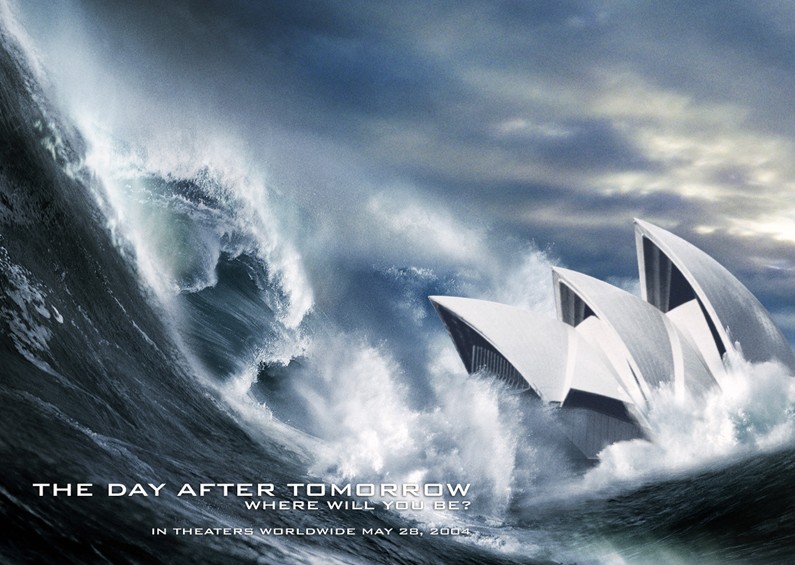
Especially when the consequences are potentially so dramatic – changes in salinity are thought to affect a major ocean current, the North Atlantic Conveyor, which, if interrupted, could “flip” the climate past a “tipping point” into a new Ice Age. They even made a film about it, The Day After Tomorrow, in which the special effects team went completely overboard to create the most terrifying images of what “might” happen if you keep driving your SUV and Australia doesn’t pass the carbon tax legislation:

Faced with such a possibility, who in their right mind could possibly disagree with taking urgent and drastic action to “tackle climate change”? Once the AGW box is ticked, job done.

Except that if our scientist had behaved as a proper scientist should, he/she may have looked deeper, and found that there might be other, more likely or convincing explanations. But taking that path runs the risk of missing out on the AGW angle, which would be a disaster for PR and funding. So that job is put on hold. For a while. Until the day after tomorrow, perhaps.

At least someone was brave enough to do it, however:

A new NASA and University of Washington study allays concerns that melting Arctic sea ice could be increasing the amount of freshwater in the Arctic enough to have an impact on the global “ocean conveyor belt” that redistributes heat around our planet. 

Lead author and oceanographer Jamie Morison of the University of Washington’s Applied Physics Laboratory in Seattle, and his team, detected a previously unknown redistribution of freshwater during the past decade from the Eurasian half of the Arctic Ocean to the Canadian half. Yet despite the redistribution, they found no change in the net amount of freshwater in the Arctic that might signal a change in the conveyor belt.

The team attributes the redistribution to an eastward shift in the path of Russian runoff through the Arctic Ocean, which is tied to an increase in the strength of the Northern Hemisphere’s west-to-east atmospheric circulation, known as the Arctic Oscillation. The resulting counterclockwise winds changed the direction of ocean circulation, diverting upper-ocean freshwater from Russian rivers away from the Arctic’s Eurasian Basin, between Russia and Greenland, to the Beaufort Sea in the Canada Basin bordered by the United States and Canada. The stronger Arctic Oscillation is associated with two decades of reduced atmospheric pressure over the Russian side of the Arctic. Results of the NASA- and National Science Foundation-funded study are published Jan. 5 in the journal Nature.

“Changes in the volume and extent of Arctic sea ice in recent years have focused attention on melting ice,” said co-author and senior research scientist Ron Kwok of NASA’s Jet Propulsion Laboratory, Pasadena, Calif., which manages Grace for NASA. “The Grace and ICESat data allow us to now examine the impacts of widespread changes in ocean circulation.”

Kwok said on [the] whole, Arctic Ocean salinity is similar to what it was in the past, but the Eurasian Basin has become more saline, and the Canada Basin has freshened. In the Beaufort Sea, the water is the freshest it’s been in 50 years of record keeping, with only a tiny fraction of that freshwater originating from melting ice and the vast majority coming from Russian river water. 

“To better understand climate-related changes in sea ice and the Arctic overall, climate models need to more accurately represent the Arctic Oscillation’s low pressure and counterclockwise circulation on the Russian side of the Arctic Ocean,” Morison added. (source)

You’re saying the models aren’t perfect? Who’d have thought.

Link to Nature abstract here.

(h/t The Register)

Chinese airlines refuse to pay EU carbon blackmail


Calling Europe's bluff?

As ACM reported last month, the EU is in danger of triggering a trade war with its demand that airlines pay an additional carbon tax when flying within its territory. Obviously thinking that opposition would crumble, the EU is standing firm. Unfortunately, however, so are the Chinese:

CHINA’S four leading airlines have thrown down the gauntlet to the European Union by saying they will refuse to pay carbon charges levied under Europe’s emissions trading scheme.

The defiant message – which could lead to a ban from European airports – marks an escalation of resistance to the scheme, which came into effect this week and is also opposed by the US.

Despite the growing threat of a trade war, Europe sees the cap-and-trade system for aviation emissions as a crucial tool for reducing greenhouse gases that contribute to climate change.

Since Sunday, any airline using an airport in the EU has been obliged to participate.

But China’s leading aviation body said it would not.

”China will not co-operate with the European Union on the ETS, so Chinese airlines will not impose surcharges on customers relating to the emissions tax,” said the deputy secretary-general of the China Air Transport Association, Cai Haibo.

The association represents Air China, China Southern Airlines, China Eastern Airlines and Hainan Airlines, which fly millions of passengers to Europe each year. (source)

Legal action is being considered. Watch this space.

Cool 2010 and 2011, but planet "still warming" says BoM


Still warming, just you wait…

If there were no agenda of global warming, there would be no need for comments like those of David Jones, reported in The Australian today.

The fact that a senior Bureau meteorologist believes it necessary to defend model projections that the planet will continue to warm, despite two cooler years (and a relatively flat global temperature profile for the last decade), reveals the motivations at work behind the scenes.

Environment editor at The Australian, Graham Lloyd, doesn’t help to dispel this impression, and warns “those looking to disprove climate change” that the planet is still warming [er, who’s trying to “disprove climate change” again?].

“In 2011, the La Nina and heavy rainfall acted like an evaporative cooler for Australia,” said bureau climate change spokesman David Jones.

“The year 2010 was relatively cool in recent historical context and 2011 was cooler again.”

Mr Jones said there was no evidence to link the strong La Nina weather systems with changing global temperatures.

“We have had this regular cycle of La Nina and El Nino,” he said. “The strongest El Nino on record was in 1997 and we have seen one of the strongest La Ninas on record in 2010-11.”

Mr Jones said the climate science was not very clear on what would happen with El Nino and La Nina patterns, particularly at this early stage of global warming.

“We have only seen one degree of warming so far but we will see substantially more as we move through the century, but it is probably too early to draw any concrete relationship between hotter temperatures and La Nina,” he said.

“One simple thing we can say is we know La Nina are historically cooler for Australia but there is a big difference between variability and climate change.”

The BOM climate statement said Australia’s mean rainfall total for last year was 699mm, which was 234mm above the long-term average of 465mm, making it the third-wettest year since comparable records began in 1900.

Where’s Tim Flannery when you need him to explain all his failed predictions of a never-ending drought?

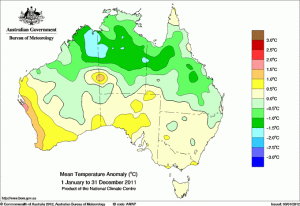
The Australian area averaged mean temperature was 0.14C below the 1961-1990 average of 21.81C. Last year, maximum temperatures averaged 0.25C below normal across the country, while minimum temperatures averaged 0.03C below normal.

And then Jones goes into full prickly defensive mode:

“Despite the slightly cooler conditions, the country’s 10-year average continues to demonstrate the rising trend in temperatures, with 2002-2011 likely to rank in the top two warmest 10-year periods on record for Australia, at 0.52C above the long-term average,” the bureau said.

“If you are interested in determining whether the planet is warming, you look at the global temperature,” Mr Jones said. (source)

And if you look at global temperatures for the last decade, there isn’t much warming to see there either.

If the BoM hadn’t sold out to climate alarmism, there wouldn’t be any need for such awkward justifications.