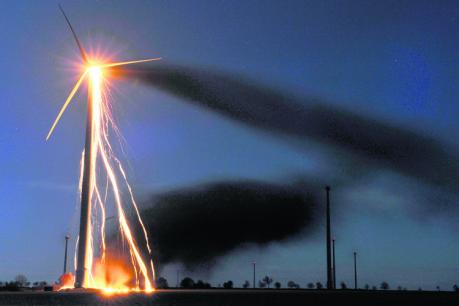
The weather isn't getting weirder


Big weather for sure, but weather just the same

Try telling that to Bob Brown, or Tim Flannery or any of the countless other alarmists who have no concept of geological time, or even recent weather history. All you need to do is search the news archive to find countless stories of terrible disasters well before man’s emissions of carbon dioxide could possibly have had any effect.

But instead, whenever we suffer extreme weather, the Chicken Littles rush to blame “man-made global warming” because they cannot think of anything else, and they have a political agenda to advance by whatever means possible. We saw it with the Queensland floods, and Cyclone Yasi, the Big Dry and the Victorian bushfires, and we will no doubt continue to see it for every extreme weather event in the foreseeable future.

But unfortunately, a recent study shows no evidence of increasing severe or extreme weather, as the Wall Street Journal reports:

Last week a severe storm froze Dallas under a sheet of ice, just in time to disrupt the plans of the tens of thousands of (American) football fans descending on the city for the Super Bowl. On the other side of the globe, Cyclone Yasi slammed northeastern Australia, destroying homes and crops and displacing hundreds of thousands of people.

Some climate alarmists would have us believe that these storms are yet another baleful consequence of man-made CO2 emissions. In addition to the latest weather events, they also point to recent cyclones in Burma, last winter’s fatal chills in Nepal and Bangladesh, December’s blizzards in Britain, and every other drought, typhoon and unseasonable heat wave around the world.

But is it true? To answer that question, you need to understand whether recent weather trends are extreme by historical standards. The Twentieth Century Reanalysis Project is the latest attempt to find out, using super-computers to generate a dataset of global atmospheric circulation from 1871 to the present.

As it happens, the project’s initial findings, published last month, show no evidence of an intensifying weather trend. “In the climate models, the extremes get more extreme as we move into a doubled CO2 world in 100 years,” atmospheric scientist Gilbert Compo, one of the researchers on the project, tells me from his office at the University of Colorado, Boulder. “So we were surprised that none of the three major indices of climate variability that we used show a trend of increased circulation going back to 1871.”

In other words, researchers have yet to find evidence of more-extreme weather patterns over the period, contrary to what the models predict. “There’s no data-driven answer yet to the question of how human activity has affected extreme weather,” adds Roger Pielke Jr., another University of Colorado climate researcher. (source)

And the conclusion makes even more sense: “prosperity and preparedness help”. In other words, we must have strong economies in order to adapt to the inevitable climate changes that will affect humanity in the future, not economies that are fatally crippled by pointless emissions reduction taxes.

(h/t Peter C)

A thousandth of a degree for $2,000 per family


Climate sense

That’s the cost/benefit analysis of a price on carbon in Australia, as Bob Carter points out in a letter to The Australian this morning:

OUR new Climate Commissioner, Tim Flannery, says that his role is to provide accurate information to the public about climate change. (Letters, 15/2).

Perhaps he might start by answering the two most critical questions that taxpayers have in mind.

The first is how many degrees of warming will be averted by a cut in Australian CO2 emissions of, say, 20 per cent by 2020. Second, what extra costs, including all flow-through costs, will be imposed on an average family by the taxation strategy that is aimed at producing such a cut. Available estimates indicate that the answers to these questions are: (i) less than one one-thousandth of a degree Celsius by 2020; and (ii) more than $2000 per family of four per year.

Australian battlers, on whom the extra costs will impinge the most, are unlikely to view this as a good public policy option, and if Flannery has more policy-favourable figures in mind, then now might be a good time to share them with us.

Bob Carter, Townsville, Qld

Seems like great value, doesn’t it?

Source.

Billions wasted on climate gimmicks


Unilateral climate action

I seem to be using the “money down the lavatory” image quite a lot at the moment, because it illustrates so well the pointlessness of unilateral Australian action on climate (and indeed any attempts at climate mitigation for that matter). Anyway, who cares if we shamefully waste your hard-earned taxpayer dollars? We’re “saving the planet”, right?

The Sydney Morning Herald reports that over $5 billion has been wasted on such gimmicks in the last decade – that’s an awful lot of nurses, teachers and policemen by the way. And what difference has it made to the climate? Nothing. Zip. Nada. Zilch. Because Australia’s emissions are a piddling 1.5% of the global total, it wouldn’t make a skerrick of impact even if we reduced our emissions to ZERO overnight (and that is all the while assuming that CO2 has an effect on the climate anyway, which is far from certain):

MORE than $5.5 billion has been spent by federal governments during the past decade on climate change programs that are delivering only small reductions in greenhouse gas emissions.

An analysis of government schemes designed to cut emissions by direct spending or regulatory intervention reveals they have cost an average $168 for each tonne of carbon dioxide abated.

While some have reduced emissions cost-effectively, many of the more expensive schemes are exorbitant ways of tackling climate change, costing far more for each tonne of carbon avoided than any mooted emissions trading scheme or carbon tax.

The worst offenders have included the Labor government’s rebates for rooftop solar panels, which cost $300 or more for every tonne of carbon abated, and the Howard government’s remote renewable power generation scheme, which paid up to $340 for each tonne of carbon.

By contrast, the proposed emissions trading scheme blocked by the Coalition and the Greens in the previous Parliament was expected to put a price on carbon of $20 to $25 a tonne in its early years. (source)

So in the Moonbat Herald’s view, an ETS would be better, because whilst it would still be a total waste of money, it would be less of a waste than the gimmicks we’ve had so far? Great argument…

And similarly, Julia’s deceitful carbon tax, due to be introduced in 2012 in a cynical breach of an express pre-election promise not to do so, will also be a complete waste of money that could better be spent on something (anything) else – health, education, helping the poorest in society etc etc. At least the Herald Sun demonstrates some climate sanity this morning, exposing the pointlessness of unilateral action:

Apart from the most blatant political dishonesty, Gillard’s embrace of a carbon tax is almost exquisite in its stupidity. In 40 years of watching politicians and policy, I cannot think of anything that comes even remotely close.

Analyst and commentator Henry Ergas nailed it exactly in our sister paper, The Australian, last Friday.

Now the core argument propounded for a carbon tax or its equivalent, a price on carbon is that we in Australia have the most to lose from supposed “climate change”, formerly known as global warming.

We’ll leave aside the stupendous self-absorption in that claim. That what happens to 22 million Australians is so far more important than the other seven billion people on the planet, the overwhelming majority of whom live in dramatically more degraded circumstances than us.

That while yes, so the argument goes, there is a big cost in reducing our use of fossil fuels the entire point of the carbon tax; but the benefits to us as a nation will eventually over time exceed those costs.

The critical point is that those benefits of preventing global warming arrive only if, to state the obvious, we do actually prevent global warming. That is to say, only if the world joins us in cutting the use of fossil fuels.

The simple but absolutely fundamental point Ergas made is the devastating double loss we will suffer if we engage in unilateral mitigation (of carbon dioxide emissions).

But international agreement is not reached and the “catastrophic outcome it (Gillard, chief climate hysterics Ross Garnaut and Tim Flannery etc) fears eventuates”.

That is to say our punitive carbon tax wrecks our economy. But we still suffer the droughts, the bushfires, the hurricanes and floods that climate change is supposed to deliver.

It is a simple but extraordinarily important point that I have not seen made by any other commentator. (source)

Except me, that is – he should have been reading my blog for the past two and a half years. It continually amazes me that supposedly intelligent politicians cannot see this blindingly obvious point. But that’s what happens when you are overwhelmed by a faith-based belief which prevents you from seeing sense any more. I really hope the public aren’t that stupid.

ABC: climate models predict "more of whatever we've just had"


Climate astrology

There’s an old scientific saying: “The wonderful thing about standards is that there are so many to choose from.” This could equally be applied to climate models. There’s also an old weather forecasting technique: look at the weather today, and that’s a pretty good indication of what the weather will be tomorrow. It’s actually more accurate than most forecast models, in any case!

The ABC, fully into “Groupthink Mode”, finds a scientist who just happens to say that we’re going to have more of whatever we had last week (that’s because given enough scientists, they will eventually predict everything, so you can choose exactly what you like). So if we have a cyclone, they’ll find a scientist to say climate change will cause more cyclones. If we have a drought, they’ll find a scientist to say climate change will cause more drought. More rain, higher temperatures, lower temperatures, you name it, the ABC will drag up a scientist to say we’re going to have more of whatever we’ve just had. But instead of treating it like the joke it is, the ABC takes the whole thing with a reverential solemnity:

While Queenslanders deal with a summer of natural disasters, climate scientists are warning that Australia faces a future of more frequent extreme weather events.

The Queensland Floods Commission of Inquiry is scrutinising the preparation and response to the 2011 floods, but planners are already looking ahead to minimise the loss of the past.

According to new modelling, Australia can expect 25 per cent more rain than was seen in the Queensland floods by the end of this century, as well as larger, more frequent storms.

“The modelling that’s been done by CLIM Systems in New Zealand has shown that in 2100 there could be a 25 per cent increase in rainfall,” sustainability consultant Stella Whittaker said.

“Now what that means is that the large storms which we currently describe as one-in-100-year storms, they are going to be more likely and it really means that people can see this type of event happening more than once in their lifetime.” (source)

Just like the old weather forecasters looking out of the window and writing tomorrow’s forecast, now climate modellers can look at whatever disaster we had last week and miraculously come up with a model to predict more of them due to “climate change”. They should have a look out of the window in Sydney today – maybe they could develop a model that predicts that climate change will cause more dull, overcast and drizzly weather – then I would feel like I was back home in London…

Why wind won't work


Monument to green stupidity

Wind farms are expensive, inefficient and ugly. And that’s just their good points. They are also a monument to green naiveté and stupidity. The UK is heading down a path to catastrophic energy shortages, as Chris Huhne plugs wind for all its worth, whilst reliable baseload generation falls into disrepair (see here and here for example). Australia isn’t anywhere near this (yet), but given half a chance, Bob Brown and his ilk would be in there like a shot, and the lights would steadily go out…

There is currently a Senate inquiry into the social and economic impact of rural wind farms (see here), and the Carbon Sense Coalition has recently published its submission, which is awash with common sense:

Why are governments still mollycoddling wind power?

There is no proof that wind farms reduce carbon dioxide emissions and it is ludicrous to believe that a few windmills in Australia are going to improve global climate.

Such wondrous expressions of green faith put our politicians on par with those who believe in the tooth fairy.

The wind is free but wind power is far from it. Its cost is far above all conventional methods of generating electricity.

Tax payers funding this “Wind Welfare” and consumers paying the escalating power bills are entitled to demand proof.

Not only is there no climate justification for wind farms, but they are also incapable of supplying reliable or economical power.

It is also surprising those who claim to be defenders of the environment can support this monstrous desecration of the environment.

Wind power is so dilute that to collect a significant quantity of wind energy will always require thousands of gigantic towers each with a massive concrete base and a network of interconnecting heavy duty roads and transmission lines. It has a huge land footprint.

Then the operating characteristics of turbine and generator mean that only a small part of the wind’s energy can be captured.

Finally, when they go into production, wind turbines slice up bats and eagles, disturb neighbours, reduce property values and start bushfires.

Wind power is intermittent, unreliable and hard to predict. To cover the total loss of power when the wind drops or blows too hard, every wind farm needs a conventional back-up power station (commonly gas-fired) with capacity of twice the design capacity of the wind farm to even out the sudden fluctuations in the electricity grid. This adds to the capital and operating costs and increases the instability of the network.

Why bother with the wind farm – just build the backup and achieve lower costs and better reliability?

There is no justification for continuing the complex network of state and federal subsidies, mandates and tax breaks that currently underpin construction of wind farms in Australia. If wind power is sustainable it will be developed without these financial crutches.

Wind power should compete on an equal basis with all other electricity generation options.

The full report can be downloaded here (30 page PDF).

Climate debate on Channel 7 "Sunrise"


Channel 7 results

Associate Professor Mark Diesendorf and Associate Professor Stewart Franks debate climate issues on Channel 7.

Watch here.

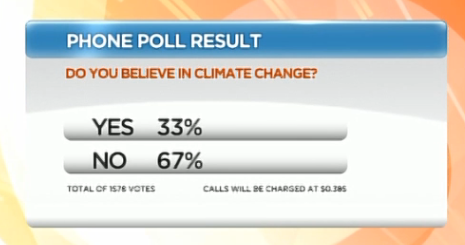
A poll, with the rather blunt and poorly worded question “Do you believe in climate change?”  shows 33% saying yes, and 67% no. It should have read “Do you believe that man-made emissions of CO2 will lead to dangerous changes in the climate?”

(h/t Adam P)

Denialism, Fairfax style


Who are really the deniers here?

I don’t like Fairfax – you might have noticed that. I never buy the Sydney Morning Herald, or bother reading The Age or any of the smaller titles from the Fairfax stable. Their editorial offices made up their mind about climate change years ago, and nothing anyone says or does now is going to make any difference. Unfortunately, the Moonbat Herald is given away in so many places (because they aren’t selling enough, clearly) that some weekends, like this one, it is difficult to avoid.

So, faced with a copy, I opened up the Good Weekend magazine and was confronted with the picture shown on the right, with the headline “True Unbelievers”. In the article (which isn’t available online), it considers a range of subjects for “denial”, such as evolution (with which ACM has no quarrel), HIV-AIDS (ditto), vaccination (ditto), pointless dietary supplements (ditto), and lumps in with those, of course, “human-induced global warming”, which I have to admit, we have a teensy bit of a problem with. So, remembering always that this is viewed through the Fairfax prism, the introduction begins:

There is, in science, a sharp line between scepticism and denial. Scepticism is useful; it’s what makes science tick. A scientist never assumes anything; she sorts fact from theory by setting up hypotheses and testing them.

Denial is something else. Whereas a sceptic may doubt the theory, a denialist throws out the proof. Take global warming. One can be sceptical about the modelled consequences, or about the effectiveness of carbon trading, or about the altruism of AI Gore, but the evidence that humans are warming the planet is in. To contend otherwise is to deny the accumulated findings of sedimentology, chemistry, ecology, climatology, oceanography, marine biology, palaeontology, meteorology, vulcanology, astronomy, physics and geology.

Some scientists claim denialism is on the rise.

It’s not quite clear that it is – flat-earthers were pretty shrill back in Galileo’s day, too. What is confounding, however, is that denialist movements persist so readily in modern times.

What the author does here is brand anyone who disagrees with the consensus a “denier”, with no regard for the possibility that sceptics are indeed “sceptics”, and sets up a flimsy straw man to be hastily blown over on the next page. And isn’t it simply astonishing how the SMH can be so dumb as to mention Galileo within the first four paragraphs? In a primitive 16th century world of fear, ignorance, religion and witchcraft, only Galileo had the guts to stand up to the misguided (and ultimately wrong) geocentric dogma of the Catholic church and advocate for a heliocentric model of the solar system. Galileo was the sceptic of the time, the one that the article is attempting to smear. The Catholic church was the consensus. And he was imprisoned for it – plus ça change.

Anyway, that aside, the SMH then proceeds to recycle all the tired arguments about climate change that we’ve heard too many times before, using the same hysterical alarmism and derogatory language we have all come to accept – tobacco, DDT, etc etc – yawn (I’m not going to even bother rebutting the nonsense and spin presented here, I’m sure you can do it for yourselves by now):

Last year and the past decade were the equal warmest and warmest on record, according to NASA and the World Meteorological Organisation. But such minor details won’t sway climate-change denialists from their objectives, says Professor Peter Doherty, an Australian Nobel laureate. “Denial is driven by big business;’ says Doherty. “It started with tobacco companies fighting the evidence that smoking caused cancer, which is the first time that big business really felt threatened by science. Ever since, big business has learnt to attack the science and to attack the scientists.”

Doherty urges people to read Merchants of Doubt, a new book by Naomi Oreskes and Erik Conway. Climate change, the American coauthors argue, is merely the latest in a long line of issues where vested interests have engaged in the deliberate dissemination of scientific denial [you will note that they don’t mention the biggest vested interest of all, the global green movement, which has, over the past 30 or so years, been funded to an almost obscene degree by panicky governments the world over – Ed]. As the two authors examine various issues in turn – the threats of a nuclear winter, smoking, the accretion of DDT pesticide in the food chain, acid rain, the hole in the ozone layer and, of course, global warming – the same scientists and industry-funded think tanks grimly reappear. [Kind of like the late Stephen Schneider jumping on the New Ice Age bandwagon in the 1970s, only to alight at the early 1990s and jump straight on the Global Warming bandwagon – Ed]

Time and again these men – for they are mostly men, and rather old ones at that [WTF?? – Ed] – are appointed to high places to “fight the facts” in order to protect their ideology, satisfy their employers, confuse the public and delay government action. Hearteningly, in each case science eventually wins through, the world is impelled to act and – the proof of the pudding – the problem is either solved or abated. Curbs on nuclear proliferation, cigarette sales, DDT, sulphur dioxide emissions and CFC (chlorofluorocarbon) pollution have all helped make the world a safer, healthier place.

Similarly, very few scientists on top of their game doubt that a reduction in greenhouse emis- sions will help address global warming. Says Peter Doherty, “We need to beware of those think tanks that draw on the so-called expertise of retired scientists. In science, once you leave the field, you become redundant very fast. “You can remain generally supportive of science and back the consensus – that’s the dignified way to go. Or, you lose your relevance, you miss being up there in the public swing of things, and the only way to get people talking about you again is to take up a contrary position. You see it all too often.”

As a final flourish, it lists the global warming “denialists” – Ian Plimer, Tony Abbott, Steve Fielding, Andrew Bolt, Alan Jones, Vaclav Klaus, Sarah Palin (natch), David Bellamy and “other retired scientists.”

But let’s just think about this for a moment. Do these people really deny that humanity has an effect on climate? I very much doubt it. They know as well as you or I that adding CO2 to the atmosphere will cause some modicum of warming. Their beef is with the catastrophic predictions of half-baked climate models. So what do all these people really want? What would, in all probability, satisfy all or most of their complaints (and mine for that matter)?

  • That science be separated from politics.
  • That climate scientists share their data with their worst enemy.
  • That people stop trying to convince us that the IPCC is an impartial scientific body.
  • That they don’t fudge figures, hide calculations, delete emails, corrupt the peer-review process, stifle Freedom of Information requests, hurl ad hominems about, and generally behave like errant schoolchildren who think they can do what the hell they freaking well like.
  • That supposedly impartial government bodies, like the parliamentary climate committee and the climate commission actually listen to dissenting views.
  • That there is open, impartial, honest debate about the certainties and, more importantly, the uncertainties in climate science.
  • That the AGW hypothesis is subjected to proper scrutiny as any other scientific hypothesis should be.

If this ever happened, I would be happy to quit blogging on this subject tomorrow. But it won’t. Fairfax (and the ABC, most of the mainstream media the world over, and most Western governments for that matter) doesn’t want that. They don’t want to hear any contrary arguments that might undermine their “faith”. They are the ones that have shut their minds to the possibility of any doubt or uncertainty on the part of climate scientists. In their view, the science is settled, and the debate’s over, right?

So who are the real deniers here? Is it the sceptics, who want to engage in debate, share data, scrutinise hypotheses and advance the cause of impartial and apolitical climate science, or is it the “consensus” scientists, who desperately want to shut their eyes, ears and mouth to any possibility of doubt? I’m afraid we know the answer. That image above is the Fairfax editorial board.

Gillard: Carbon tax in 2012


Carbon tax in action

Climate Madness in its purest form. What we suspected all along has been proved right. Julia Gillard’s promise in August 2010 not to introduce a carbon tax “under the government I lead” was a barefaced lie. How many more has she told? Will we ever find out? She has cynically deceived the electorate on this crucial issue, and should suffer the consequences at the next election.

JULIA Gillard plans to introduce a carbon price from July 1 next year and defy the Greens by insisting on compensation for the coal and electricity industries, in a move that will infuriate its minority government partner.

The Weekend Australian understands the government will present its multi-party climate change committee next week with a plan for a fixed carbon price to operate from July 1, 2012, until about 2015-16 when the regime will move to an emissions trading scheme.

Labor is set to demand some “real-world compromise” from the Greens by insisting that compensation for energy-intensive industries such as electricity generation and trade-exposed industries remain close to that offered in the deal former prime minister Kevin Rudd hammered out with then opposition leader Malcolm Turnbull in late 2009.

The Prime Minister has set 2011 as a “year for decision” on a carbon price and is ambitiously pursuing a timetable under which legislation could be introduced into parliament before the end of this year. (source)

But there is no certainty that the Greens will roll over so easily, and I predict an almighty punch-up, as I mentioned a few days ago.

And what was the point of paying Flannery and his commission $5 million when the decision’s already been made? And what’s the point of a parliamentary committee to investigate climate change policy when the decision’s already been made? Who cares? Jobs for the boys. It’s only your taxpayer dollars that they’re wasting – and Labor governments don’t give an s-h-one-t about them (excuse my French). As we would expect, a total whitewash.

So in summary, assuming that the carbon tax is passed into law, let’s remind ourselves what it would achieve:

  • nothing whatsoever for climate
  • nothing whatsoever for global temperatures
  • nothing whatsoever for local temperatures
  • nothing whatsoever for the Arctic
  • nothing whatsoever for polar bears
  • nothing whatsoever for the drought or floods or clyclones
  • nothing whatsoever for the Great Barrier Reef
  • nothing whatsoever for Kakadu
  • nothing whatsoever for Tuvalu and all the other sinking islands
  • nothing whatsoever for the ringtail possum and other cuddly creatures
  • nothing whatsoever for bushfires and heatwaves
  • in fact, nothing whatsoever for anything even remotely related to the climate

On the other hand it will do the following:

  • everything to damage Australia’s economy
  • everything to damage Australia’s competitiveness
  • everything to increase the cost of living for ordinary Australians
  • everything to make the poorest in society worse off
  • everything to damage emissions intensive industries
  • everything to ensure that our industries move offshore
  • everything to create more unemployment
  • everything to raise electricity, gas and food prices
  • everything to assist a pointless global “deal”
  • everything to advance the cause of global government and global wealth distribution

Have I missed anything there? Leave a comment if I have.

(h/t Andrew Bolt)

No upward trend in disaster losses


Pompeii: lava in the living room…

Politicians and the media love to bleat about disasters getting bigger, badder, worser (© George Negus), etc., without actually providing any evidence, but as Andrew Bolt points out, our perception is skewed because we’re building more stuff in dumb places.

We build houses on flood plains and then are surprised when we get flooded. We build houses on the seafront and are surprised when a cyclone brings a storm surge. As George Carlin famously said, we build houses on the slopes of active volcanoes and then wonder why we have lava in the living room…! The unfortunate inhabitants of Pompeii learnt their lesson in AD 79, but we still haven’t learnt ours in AD 2011.

From The Australian’s Cut & Paste:

Ross Gittins in The Sydney Morning Herald on Wednesday:

SCIENTISTS have long predicted one effect of global warming would be for extreme events to become more extreme, which is just what seems to be happening. And, certainly, the insurance industry, which keeps careful records of these events, is in no doubt that climate change is making things worse.

ABC1’s Lateline on Wednesday:

REPORTER Margot O’Neill : Australia’s climate seemed to flip into overdrive this summer. So, are these extremes the new normal? It’s what climate change models have been predicting, after all. Big international insurers are mopping up after more than 850 global weather catastrophes in 2010, and they say there’s no doubt: global warming is destabilising the climate.

Peer-reviewed paper by Eric Neumayer and Fabian Barthe of London School of Economics and funded by re-insurers Munich Re in Global Environmental Change, November 18, 2010:

APPLYING both [conventional and alternative] methods to the most comprehensive existing global dataset of natural disaster loss [provided by Munich Re], in general we find no significant upward trends in normalised disaster damage over the period 1980-2009 globally, regionally, for specific disasters or for specific disasters in specific regions. (source)

Munich Re (or Moonbat Re as they should be called, see here and here) is firmly ensconced on the climate alarmist bandwagon. They must be spitting chips that their hard earned dollars were spent on a report that gave them the wrong answer… oops.

Daily Bayonet GW Hoax Weekly Roundup


Skewering the clueless

As always, a great read!