TONIGHT: ABC Media Watch expected to cover ANU story


I didn't really love it beforehand…

It is likely (although not guaranteed) that ABC’s Media Watch will cover the ANU freedom of information request story tonight.

Regrettably, I think we can all guess that criticism will be reserved for The Australian‘s coverage of the FoI release rather than for the ABC’s original reporting of the story (still, as of 2.10pm AEST, to be corrected or clarified).

See more on ACM’s FoI page here.

Media Watch is at 9.20pm AEST on ABC1.
Will Steffen defends Climate Commission report


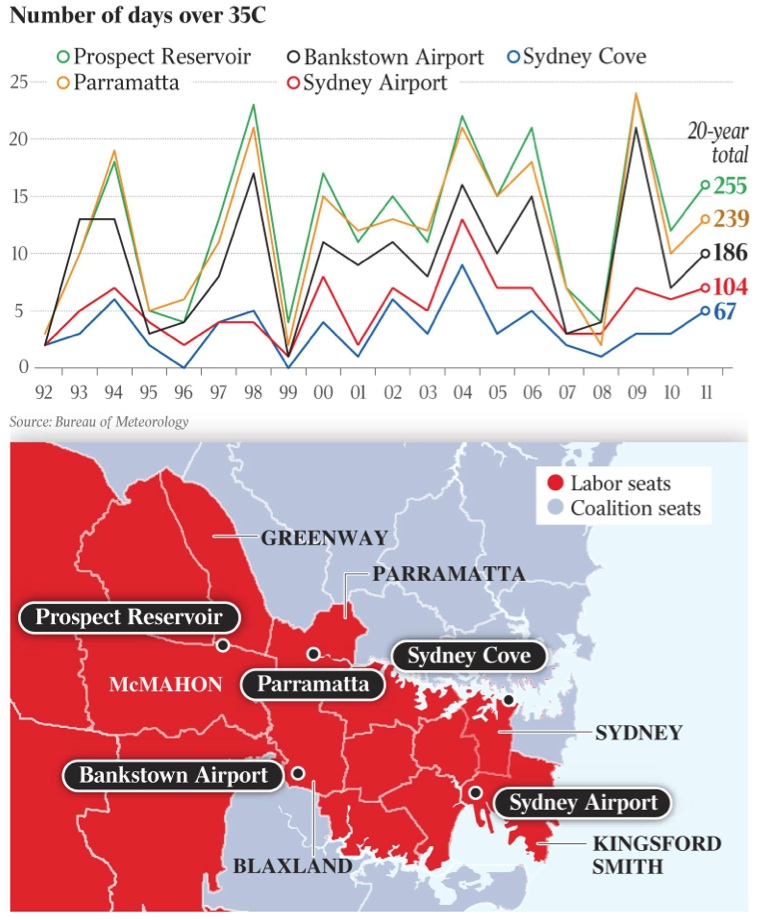
Sydney hot days (click to enlarge)

Will Steffen writes in The Australian today, claiming that the paper’s own articles last week somehow back up the Commission’s own alarmism about hot days in New South Wales:

The Australian apparently asserts that the commission did not look at enough weather stations to provide an accurate overview of changes in hot weather in the Sydney region. It published five graphs of changes in hot weather, the original two from the commission’s report plus graphs for Sydney Airport, Bankstown Airport and Prospect Reservoir. However, these other graphs confirm precisely what the commission has shown – that the number of hot days in western Sydney has risen during the past four decades and has risen at rate greater than that for the eastern suburbs.

In fact, the commission erred on the careful, conservative side by not including the station at Prospect Reservoir, which showed a much more pronounced trend than either Parramatta or Bankstown Airport. In fact the trend is an increase of about 200 per cent in hot days since 1965.

Note how Steffen shifts the goal posts back to 1965, despite the fact that the graphs published by the Australian and the associated article (see here) only relate to the last 20 years. Eyeballing the data for the last 20 years shows a small increase, if you’re being generous, but Steffen cannot say how much can be attributed to increased urbanisation rather than “global warming”, saying it’s “probably” due to a combination of both. What combination, exactly? Er…

Steffen concludes:

The Australian said in its editorial: “We accept that the majority of scientific opinion says human-induced carbon emissions are contributing to a warming climate.” That is correct.

It could have added that human-induced emissions are the main contribution to observed warming in the past half-century. Then it would have been spot-on.

So there is much agreement between The Australian and the Climate Commission on the science of climate change. It is time to stop the phony [sic], divisive, manufactured “debate” on climate science, and move on to solutions to the climate change challenge. (source – paywalled)

Steffen has no idea whether human emissions are the “main contribution” to recent warming because no-one does. It’s all based on incomplete climate models.

And the debate is far from phoney, despite the usual attempts by the consensus side to shut it down. If human effects are small or even of a similar order compared to natural variation, then every dollar we spend trying to mitigate climate change is a dollar thrown away. In other words, until we know climate sensitivity precisely, all of this is based on the precautionary principle, except the costs far outweigh the benefits.

And as for “solutions to the climate change challenge”, I would be grateful if he would kindly explain what the government proposed solution of a carbon tax will actually do for the climate, when China and India’s increasing emissions will swamp anything Australia can achieve unilaterally. Actually, don’t bother. We know the answer: NOTHING.

In any case, why should we trust the Climate Commission at all? There’s no dissenting view present, no alternative opinion to consider, nothing to challenge the accepted consensus, no case for the defence. It’s just a bunch of like minded climate activists pushing AGW propaganda to prop up the government’s climate policies.

UK: Energy prices rise 140% in eight years


Note the curly eco-globe

And we know the reason: misguided climate change policies forcing generators to rely on expensive, unreliable and inefficient renewables like wind, and penalising (or taxing) the use of cheap energy like coal, oil and gas. All to “save the planet”, naturally.

From the UK Telegraph:

The average household’s annual energy bill of £1,252 now accounts for 11pc of a couple’s basic state pension of £11,175 a year, the study by price comparison website uSwitch.com found.

The cost of energy is now the top household worry for Britons (90pc), ahead of the rising cost of food (77pc) and mortgage payments (42pc).

Almost a third of consumers (32pc) say that household energy is unaffordable in the UK, the poll found.

While the average UK household income has increased by 20pc from £32,812 in 2004 to £39,468 today, the average energy bill has risen by 140pc, according to uSwitch figures.

Households were spending an average of £522 a year for their energy in 2004, but now pay £1,252 a year – 3.2pc of income or double the 1.6pc of eight years ago.

Britons now have an average of £297 of disposable income left each month after all essential household bills are paid.

The study found 83pc of people believe that rising energy bills have had an impact on their disposable income, with 17pc of these reporting that they no longer have any disposable income as a result and 27pc saying energy bills have reduced their disposable income dramatically. (source)

Shocking. And once the carbon tax takes effect in Australia, the story will be the same here.

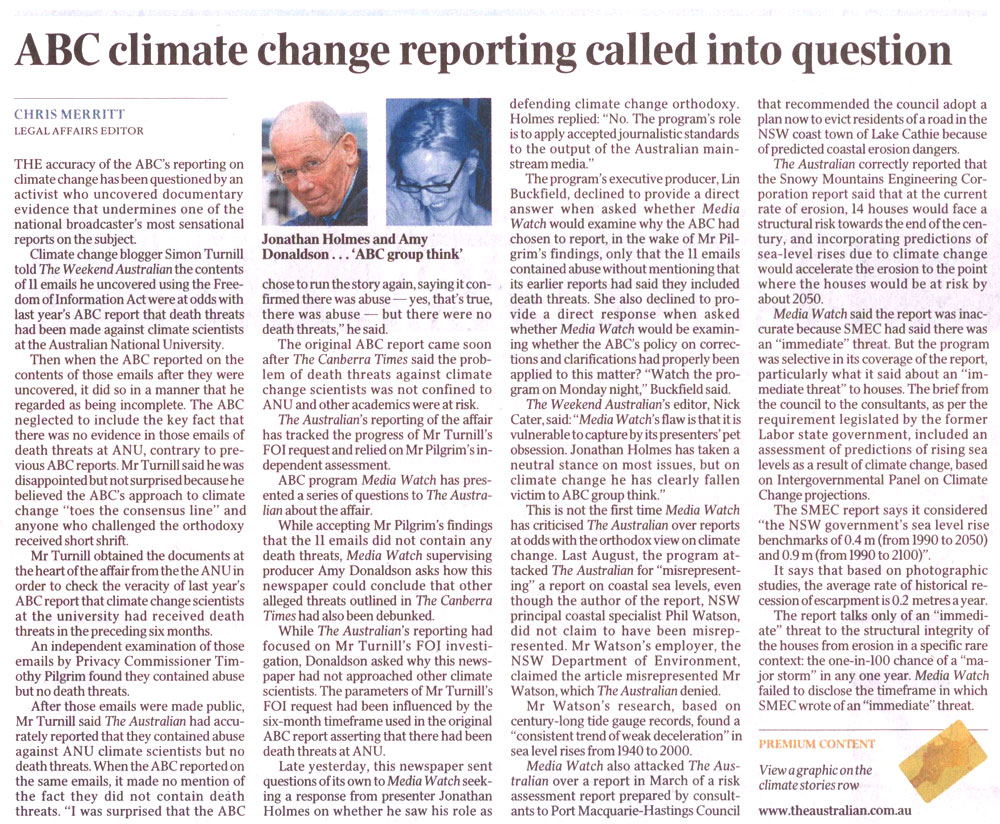
Weekend Australian: ABC's climate 'death threats' report undermined


Australian graphic (Click to enlarge)

Chris Merritt, Legal Editor, writes today in the Weekend Australian of the ABC’s failure to correct their report of 4 June 2011, which claimed that ANU scientists had received “death threats” in the six months prior to the report:

THE accuracy of the ABC’s reporting on climate change has been called into question by an activist who uncovered documentary evidence that undermines one of the national broadcaster’s most sensational reports on the subject.

Climate change blogger Simon Turnill told The Weekend Australian the contents of 11 emails he uncovered using the Freedom of Information Act were at odds with last year’s ABC report that death threats had been made against climate scientists at the Australian National University.

Then, when the ABC reported on the contents of those emails after they were uncovered, it did so in a manner that he regarded as being incomplete. The ABC neglected to include the key fact that there was no evidence in those emails of death threats at ANU, contrary to previous ABC reports. Mr Turnill said he was disappointed but not surprised because he believed the ABC’s approach to climate change “toes the consensus line” and anyone who challenged the orthodoxy received short shrift.

The original ABC article read:

Several of Australia’s top climate change scientists at the Australian National University have been subjected to a campaign of death threats, forcing the university to tighten security.

Several of the scientists in Canberra have been moved to a more secure location after receiving the threats over their research.

Vice-chancellor Professor Ian Young says the scientists have received large numbers of emails, including death threats and abusive phone calls, threatening to attack the academics in the street if they continue their research.

He says it has been happening for the past six months and the situation has worsened significantly in recent weeks. (source)

But instead of conceding that there were no death threats to ANU scientists in the period referred to in the original story, the ABC merely repeated the claim that the emails contained abuse, conveniently forgetting that the original article referred specifically to “death threats”:

The Australian National University has released a series of abusive and threatening emails which were sent to its climate change scientists.

The 11 emails to members of the university’s Climate Change Institute have been made public after a Freedom of Information request. (source)

In reality, only 2 of the 11 emails were seriously abusive (of the crank “f*ck you” variety), with the majority containing language that could simply be viewed as passionate disagreement. Not one single email contained a “death threat”. The ABC has not clarified or corrected the following claim either, which appears in the same article:

One email, dated June 2, 2010, describes a threat to use a gun against an academic because a conference participant reportedly disagreed with the climate change research.

It has subsequently been revealed that the discussion in question related to kangaroo culling in the ACT, and the claim that it was a “threat to use a gun against an academic” is fiction. [Also, why was this email even included in the ANU’s FoI release? It occurred well before the six month period in question – Ed]

The Weekend Australian also reports that ABC’s Media Watch intends to report on the matter on Monday:

While accepting Mr Pilgrim’s findings that the 11 emails did not contain any death threats, Media Watch supervising producer Amy Donaldson asks how this newspaper could conclude that other alleged threats outlined in The Canberra Times had also been debunked.

While The Australian’s reporting had focused on Mr Turnill’s FOI investigation, Ms Donaldson asked why this newspaper had not approached other climate scientists. The parameters of Mr Turnill’s FOI request had been heavily influenced by the six-month timeframe used in the original ABC report asserting that there had been death threats at ANU.

Late yesterday, this newspaper sent questions of its own to Media Watch seeking a response from presenter Jonathan Holmes on whether he saw his role as defending climate change orthodoxy? Holmes replied: “No. The program’s role is to apply accepted journalistic standards to the output of the Australian mainstream media.”

Sounds all very reasonable. But, unfortunately, we know for a fact that Holmes is a believer in catastrophic man-made climate change, and has written about News Limited’s coverage of the issue in the past:

The evidence for climate change, since then [2007], has only got stronger. The reasons for taking precautionary action have only become more compelling. Of course News Ltd can’t, on its own, affect the global climate by reducing its carbon footprint, and nor can Australia. But if every company, and every nation, acted – or refrained from acting – on the basis of that logic, the chances of eventually stabilising global temperatures at less than catastrophic levels would be reduced to zero.

You have to be an alert and habitual reader to notice that week after week, year after year, The Australian and The Weekend Australian massage their news coverage and grossly unbalance their opinion pages so as to send the message that the existence of human-induced climate change is highly debatable, and that any action by Australia to reduce its emissions would be economically ruinous and politically foolish. (source)

And thankfully, Weekend editor Nick Cater spells it out:

“Media Watch’s flaw is that it is vulnerable to capture by its presenters’ pet obsession. Jonathan Holmes has taken a neutral stance on most issues, but on climate change he has clearly fallen victim to ABC group think.”

One has to ask, who benefits from this “death threat” story anyway? And who suffers? Clearly, the climate scientists who are portrayed as the victims of this campaign will be viewed sympathetically, whilst the story also helpfully demonises anyone who questions the consensus view on climate as a crackpot who would go to the extreme measures of sending death threats to silence debate.

Last week’s Media Watch headline reads “Sensational stories invite serious scrutiny”. I wonder if the ABC’s sensational (and inaccurate) story of death threats at ANU will receive the same treatment?

Weekend Australian, p3, 19 May 2012

Are climate scientists a self-selecting set of climate activists?


UPDATE: Gergis’ blog is no longer available (wonder why? Was she embarrassed by the content?), but it can be viewed here and her bio here.

I was prompted to address this issue following the “hottest 50 years in a millennium” story earlier today (see here). A little Googling from regular commenter Baldrick showed that the lead researcher on that story, Joelle Gergis, had posted on her blog in November 2007 about being pleased that Kevin Rudd had been voted in as PM, because now she might finally “see real action on climate”.

She writes:

As a climate scientist, I am hopeful that we will finally see real action on climate change. According to COSMOS, Rudd is expected to receive a “rock star’s welcome” to the world stage at crucial U.N. climate change talks in Bali next month. He will be hailed for agreeing to ratify the Kyoto Protocol, the international agreement aimed at curbing global greenhouse gas emissions.

Up to 140 world environment ministers will attend the conference. It is hoped the meeting will bring vital breakthroughs in the effort to achieve a new climate agreement. It is expected to deliver a road map to show how to keep the planet’s temperature from rising more than two degrees. The agreement must be in place before the Kyoto Protocol’s first phase ends in 2012.

Clearly this person had formed the view, at some time prior to the post in November 2007, that there was a climate crisis of some kind that required action. We can safely assume, I think, that she believed that anthropogenic emissions were causing dangerous climate change, and therefore such emissions must be reduced to “save the planet”. In other words, she’s a true believer. Her biography would tend to confirm this conclusion.

Today in the news, we read that Gergis’ latest paper shows that the last 50 years warming are unprecedented in the last 1000, which, naturally, tends to support the notion of dangerous AGW which requires urgent action, thereby supporting the position she herself expressed back in 2007.

And it made me think: why is no-one complaining about this? Why is it OK for climate activists to be climate scientists? Why is it that association with an environmental advocacy group such as WWF or Greenpeace is perfectly acceptable for certain climate scientists currently working towards IPCC AR5, but association with an oil or energy company isn’t? The hypocrisy and double standards are obvious, aren’t they? Why is Big Green any better than Big Oil?

So the key question, which I do not pretend to have an answer to, is this:

Is the present cohort of emerging climate scientists a self-selecting set based on a pre-existing belief in the seriousness of man-made climate change?

Or in other words, do those with a prior concern about AGW naturally gravitate towards careers in climate science or environmental studies, therefore leading to an unbalanced representation of the genuine spectrum of scientific perspectives on climate change? To put it another way, would a student without such a passion for “environmental causes” choose to enter that area of science? Would anyone other than such a person ever choose to become an environmental or climate scientist?

I’m sure the answer is ‘no’. Why would you choose any branch of environmental science unless you wanted, even in some small way, to save the planet?

The majority of climate scientists are funded by governments which are committed (to different degrees) to taking “action” on climate change. At no point do I allege that people are changing their views because of the funding they receive (something that I do not believe happens on either side of the debate), merely that they are a self-selecting group based on prior beliefs. Which would explain why environmental and climate science departments are full of AGW believers.

And it would also explain why environmental journalists are AGW believers too. If you weren’t, why would you become an environmental journalist in the first place?

It’s the final extrapolation of confirmation bias – you choose your entire career based on your beliefs.

Many teenagers get into the whole “green” thing at some point, whether at school or through friends – for some it’s a passing fad, for others it becomes a passion, and eventually a career. But for those who never had that environmental passion, or for whom it faded, would they still choose to make it their career? I doubt it.

And the same would be true of the other side of the debate. For the vast majority of teenagers who do not have that passion, their careers will take them in a multitude of differing paths, other areas of science, commerce, law, you name it.

And it is only when some of those others, who, much later in life perhaps, have their curiosity piqued by some piece of crazy climate legislation, like Gillard’s carbon tax or Kevin Rudd’s proposed Emissions Trading Scheme, and decide to take a look over the fence in to the world of environmental and climate science in academia, or the machiavellian shenanigans of the IPCC or the CSIRO, or the hopelessly political statements of formerly respected academic institutions, like the Royal Society, and are utterly shocked by what they see. And they start voicing those concerns about the lack of proper scientific integrity or the politicisation of the climate debate on blogs, written in their spare time. Like this one.

Is there a solution? Probably not. It would be along the lines of “funding the defence” in the climate debate, so that those with a prior belief that there was no climate crisis would be equally motivated to pursue a career in environmental or climate science. But that’s not going to happen, is it?

Hockey Stick lives! In Australia, apparently…


Mann's Hockey Stick: on life support in Australia

UPDATE 2: Thanks to Baldrick in the comments for this. Joelle Gergis is, guess what, a climate activist. Her blog is here, and although it hasn’t been updated for some time, a five minute glance found the following, which praises the election of Rudd in 2007, gleefully celebrates the end of Howard, and looks forward to “action on climate change”:

“After 12 long years, we have a progressive prime minister who will ratify the Kyoto protocol, prioritise a rehaul of the education system and have the humility to say sorry to the indigenous people of our country.

This hilarious article by The Age columnist Catherine Deveny sums up how many of us felt about the end of the Howard era. Tracee Hutchison’s piece celebrating the rise of women in politics is also great.

As a climate scientist, I am hopeful that we will finally see real action on climate change.”

Are these the words of an impartial scientist? Which comes first, being a climate activist or a climate scientist? How can we rely on papers written by climate activists?

UPDATE: The paper claims that the MWP was 0.09°C below 1961-1990 levels. That’s 9 HUNDREDTHS of a degree , with a margin of error of over twice that (±0.19°C). The abstract goes on to cite the usual, “we dunno, so it must be us” reason for the recent late 20th century warming:

“The unusual 20th century warming cannot be explained by natural variability alone, suggesting a strong influence of anthropogenic forcing in the Australasian region.”

Full abstract here (paper behind paywall).

More warmism leading up to IPCC AR5:

For the first time scientists have provided the most complete climate record of the last millennium and they found that the last 50 years in Australia have been the warmest.

The researchers from Melbourne University used 27 different natural indicators like tree rings and ice cores to come to their conclusion, which will be a part of the next United Nations intergovernmental panel on climate change report.

The findings show that no other period in the last 1,000 years matches the temperature rises Australia and the region has experienced in the last 50 years.

Report co-author Joelle Gergis says the findings are significant.

“It does show that the post-1950 warming is unusual in the Australasian region,” she said.

27 different proxies? Sounds worryingly like a re-run of the Hockey Stick to me.

But at least we have finally got rid of the Medieval Warm Period! Would you expect anything less from our own David Karoly, committed believer, and one of the authors?

All lovingly reported by the ABC (Alarmist Broadcasting Corporation).

Expect much, much more of the same.

Glass jaw: don't criticise Flannery with 'vicious' attacks, says Steffen


Rapidly losing credibility

Advice to Climate Commission: when you’re in a massive hole of your own making, best stop digging. But they are so horribly compromised that such painfully obvious action is impossible.

The Climate Commission’s sole purpose is to “spruik the government’s case for tackling climate change” as the Sydney Morning Herald article puts it (somewhat too honestly in fact!), so what else are they supposed to do?

Anyone with half a brain (even Steffen and Flannery when they are alone with their consciences) knows that nothing Australia does alone will make any difference to the climate, so the Commission has to rely on blatant and shameless alarmism to scare the public into believing the government’s pointless carbon tax will actually make some discernible difference to the climate.

The latest chapter in this never-ending saga of alarmism from the Climate Commission was released on Monday and predicted dire consequences for New South Wales. Not surprisingly, many regarded the report as hysterical. And when the Commission gets called out for it, they have no response, except to attack their critics:

Climate commissioner Will Steffen has called on critics to stop their “vicious” attacks against the body’s chief Tim Flannery and rejected suggestions the federal government-created commission is alarmist.

Flannery, Steffen and the Climate Commission have a glass jaw. Note how, just with the ANU “death threats” non-story, criticism or disagreement of any kind is immediately emotionalised and exaggerated by being branded “vicious”. The report was described by various commentators and politicians as “alarmist” and “fear mongering”. Which of those terms are “vicious”, Prof Steffen? Maybe he was referring to the bloke in the penguin suit…

Flannery has a track record of making hopeless end-of-pier style crystal-ball gazing prophecies, as Gaia’s self-appointed incarnation here on Earth, which have been wrong virtually every time – and paid very nicely for by taxpayer dollars, lots of them. If he can’t take the heat, maybe he should get out of the kitchen, or take the criticism without resorting to this kind of whining:.

“Climate scientists take exceptional care to be absolutely straight,” [Steffen] told AAP in an interview on Wednesday.

“We don’t use inflammatory language, we don’t overplay and we don’t underplay.” [ACM editor snorts coffee all over the screen – Ed]

The ANU researcher compared climate scientists to the family GP.

While you wouldn’t want them only to give dire warnings, “you certainly don’t want them to underplay the risks you might face and can do something about”. (source)

But this is patently nonsense, and exposes Steffen’s impossible position of having to defend a pointless policy through alarmism. Because there is nothing we can do about it, even if you believe CO2 is the main driver of climate, unless China and India decide to do something about it as well. Otherwise, it is utterly pointless.

Claiming not to overplay the seriousness of the issue is verging on incredible, since the only way the government’s policy can possibly be sold is through fear. Here is what the report says (p10) about health risks:

  • increasing mortality due to heat
  • heat related injuries like dehydration
  • increased cardiac, respiratory and mental health problems and death
  • increased air pollution that would affect asthma, hay fever, lung cancer and heart disease
  • decrease in rainfall would “increase the suicide rate by 8%”
  • behavioural and cognitive disorders increase during heat waves
  • electricity outages due to “extreme weather” may cause refrigerators to fail and cause illness from improperly stored foodstuffs
  • damage to sewage systems may contaminate water supplies
  • droughts will increase algae and contaminants in dam water

It goes on and on. And the report is punctuated by scary graphics like this:

Just in case you weren't scared enough

And that’s just health, let alone all the other issues like sea level rises of a metre by 2100 washing thousands of houses into the sea, despite actual data showing sea level rising at the same rate (about 3mm per year), leading to a rise of perhaps 25cm by the next century. And many, many more.

All, allegedly, from an increase in global average temperature of less than 1 degree in the last 200 years, much of which was likely due to natural variation. And Steffen has the gall to claim that they take “exceptional care to be absolutely straight”.

Steffen also claimed in several interviews that it was like “the climate on steroids”. That’s not inflammatory language? If not, what is, pray?

May I offer the Climate Commission a little more advice. If you want people to start listening again (because right now they are switching off in droves), you must cut the emotionalising, acknowledge areas of doubt, cut the arrogance, display a little more humility, cut the alarmism and stop trying to silence your critics and perhaps, just perhaps, you may be able to regain some credibility, because right now, your credibility is running on empty.

But there’s no chance of any of that – the Climate Commission is hamstrung – the inevitable result of an organisation having to defend the indefensible – a government climate mitigation policy that will do nothing for the climate.

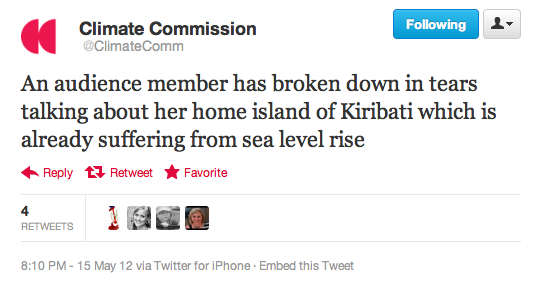
Tweet of the Day – Climate Commission's emotional blackmail


Tugging the emotional heart strings...

I’m sure people were breaking down in tears, but not for that reason… geez. LINK.

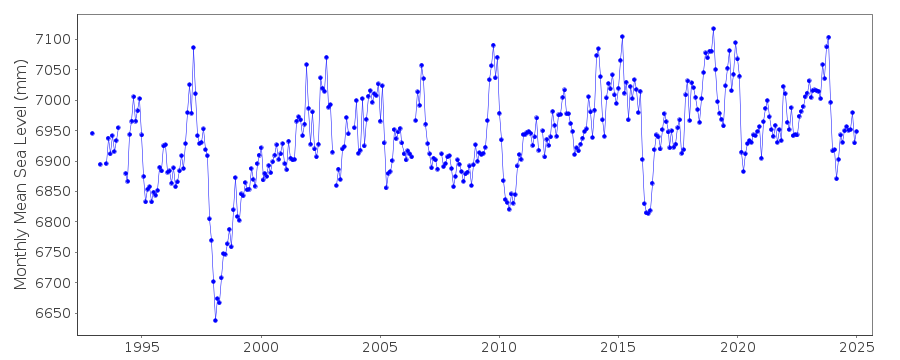
Actually here’s the monthly Kiribati tide gauge data for the last 20 odd years:

Rapid sea level rise is where, exactly?

As Nils-Axel Mörner said:

The graph reveals that there, in fact, is no ongoing sea level rise that threatens the habitation of the islands. This is the hard observational fact, which we should all face before starting to talk about future flooding and the need for evacuation.

If the president of Kiribati, Anote Tong, claims that the islands will soon be flooded and that there is an urgent need to buy new land for possible future refugees, it is the president’s own tactical idea in order to raise money from abroad. Let us respect the observational facts and stay away from invented disasters.

But who cares about reality when we have a policy to sell, right?

There’s plenty more here.

Flying Spaghetti Monster 'cannot be excluded' as driver of Queensland floods


AGW or FSM?

It’s the Holy Grail of alarmism. Even though there is almost no hope of ever doing so, the team are desperate to point to an extreme weather event and say that man-made climate change caused it, or made it worse.

Professor Matthew England (one of Anna Rose’s advisers in ABC’s I Can Change Your Mind about Climate – see here) has another go here, and uses weasel words to hijack a study – unrelated to climate change – to advance The Cause:

Abnormally high ocean temperatures off the coast of northern Australia contributed to the extreme rainfall that flooded three-quarters of Queensland over the summer of 2010-11, scientists report.

A Sydney researcher, Jason Evans, ran a series of climate models and found above average sea surface temperatures throughout December 2010 increased the amount of rainfall across the state by 25 per cent on average.

While the study did not look at the cause of ocean warming in the region, a physical oceanographer, Matthew England, said climate change could not be excluded as a possible driver of this extreme rainfall event.

Matthew England, who was not involved in the study, said ocean temperatures off northern Australia were the highest on record at the time of the Queensland floods.

“While the La Nina event played a big role in this record ocean warmth, so too did the long-term warming trend over the past 50 years,” Professor England, the co-director of the UNSW Climate Change Research Centre, said. (source)

Interfering with SST data now are we?

The study “did not look at the cause of ocean warming”, so the “abnormally high ocean temperatures” may have simply been natural variability at work. But according to England, climate change “could not be excluded”. Similarly, therefore, we cannot exclude the possibility that the Flying Spaghetti Monster was behind it, sneakily raising sea temperatures with his noodly appendage…

ANU scientists just can't help making fools of themselves


Bad hair day?

UPDATE: Jo Nova posts a timely reminder of her online debate with Glikson here.

Apart from the ubiquitous Will Steffen, the other “big name” at the ANU Climate Change Institute is (warmist, naturally) Andrew Glikson (see here for previous form).

Glikson, who is clearly annoyed that Steffen gets all the limelight, has decided to make a complete and utter twit of himself by writing a huffy letter to Richard Bean, the writer of the climate change play currently showing in Melbourne, The Heretic, in terms that can only be regarded by any normally balanced individual as deeply comic (my emphasis):

Dear Mr Richard Bean

As an Earth and paleo-climate scientist of some 45 years-long experience and more than 150 peer-reviewed publications, I suggest the show “The Heretic”, which I have not seen but about which I have read, can only lead to trivialization and further denial of what the scientific world regards as the greatest threat humanity and nature are facing.

I suggest the show plays into the hands of those who support the use of the thin terrestrial atmosphere (breathable thickness of less than 10 km) for further carbon emission on top of the 350 billion tons of carbon already emitted since the 18th century and >150 billion tons carbon released by land clearing, fires etc.. As shown in my enclosed paper, the pace of CO2 rise over the last 40 years, recently reaching >2 ppm CO2/year, has now exceeded any recorded for the last 65 million years, while the atmospheric level of 394 ppm CO2 is now near that of the warm Pliocene era some 3 million years-ago. Our empirical evidence is based on direct observations of the atmosphere-ocean-cryosphere system by the world’s climate monitoring bodies – including NOAA, NASA, NSIDC, Hadley-MET, Tyndale, Potsdam, CSIRO, BOM and other.

Opinion and “belief” are no substitute for evidence. Those who doubt the basic laws of nature and empirical data are always welcome to submit research to peer review journals where their papers will be treated the same as any other. In so far as their propositions are upheld, anyone who is able to demonstrate as if:

  1. The Earth’s climate is not warming, or
  2. The anthropogenic release of >500 billion tons of carbon since the 18th century is not the primary factor responsible for global warming

is bound to receive the highest accolades.

I wonder whether such a show, if concerned with denial of the holocaust of world war II, would have been conceived?

I suggest that, given the threat of anthropogenic global warming to the terrestrial climate and to marine ecosystems, a theatric show making mockery of the gravity of the climate issue for future generations can only be seriously mistaken.

Yours sincerely

Andrew Glikson
Earth and paleo-climate scientist
Australian National University

They really have no idea, do they? How utterly embarrassing for Glikson, ANU and Australia.

Thanks to Bishop Hill.