ACM on vacation


ACM will be taking a break for a while. Other priorities are demanding more of my attention for the time being, and the passing of the pointless carbon tax into law seemed an appropriate juncture for a time out.

Keep checking the blog roll on the right for the latest news on the fight against global climate madness.

ACM will be blogging again soon.

Cheers, Simon
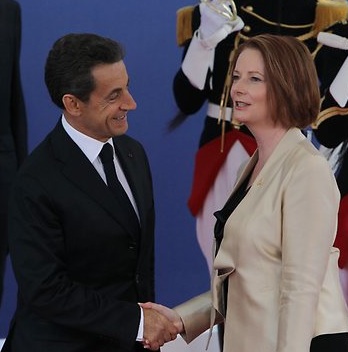
So that's that, then


The carbon tax we would never have will today pass the Senate, finally legislating the tax that Julia Gillard promised there wouldn’t be, back in August 2010. “Australian climate madness” finally comes true.

Let’s remind ourselves. This is a tax that:

  • will do nothing for the climate – nothing at all
  • is based on corrupted and partial science, influenced by environmental activist groups
  • will disadvantage our economy when most other nations are backing away from climate action
  • is a breach of an express pre-election promise
  • is nothing more than a bribe to buy the support of the Greens, who are today crowing at their “success”
  • commits economic suicide when GFC Mk II is just around the corner
  • the majority of the population opposes.
There isn’t much more to be said. We just have to sit and wait until the next election, and pray that the people of Australia have long memories.

G20 to Australia: "You're on your own" on carbon


"Congratulations, Julia, on wrecking your economy"

“Courageous” is how the G20 describes Australia’s action on climate change! What a wonderful euphemism for bat-sh*t crazy. Yet Gillard and Combet will no doubt still argue that Australia is being “left behind” and that it’s all in the “national interest” – delusional!

As Europe sinks into economic oblivion, the US debt creeps up by the day, and a GFC Mk II looks ever more likely, the rest of the world is starting to realise that there are more important things than pointless environmental gestures which will be hugely damaging for standards of living but which will do nothing for the climate.

JULIA Gillard’s introduction of a carbon tax has been praised at the latest economic summit for showing the way on climate change but Australia is being isolated within the G20 on carbon pricing as members retreat due to changing priorities and economic pressure.

As the government prepares to cut the carbon tax debate in the Senate to pass the bills with Greens’ support, the final communique from the G20 summit in France recognises Australia’s leading role on climate change.

But with the increased economic pressures from the global debt crisis and a shift in priority to food security, particularly in Africa, climate change action is dropping down the order of importance.

Critics of the G20’s lack of action on climate change have praised Australia’s action as “courageous” and said the diminishing priority for climate change was a “big problem for the G20”.

The shift at the G20 and the praise for Australia expected in the communique highlights the Gillard government’s move ahead of the developed economies on carbon pricing.

While Australia is pursuing the most comprehensive carbon tax in the world to combat the effects of climate change, other G20 members are retreating from emissions trading schemes to cut greenhouse gas emissions, such as Canada, while others are giving greater emphasis to dealing with the immediate effects of climate change. [In other words, adaptation – Ed.]

Australia (and Gillard) are turning into standing jokes on the world stage. How embarrassing.

Read it here.

A level playing field


Alarmists playing left to right

Carl Sagan famously said “Extraordinary claims require extraordinary evidence.” In the case of climate change, this could be rewritten to say “Extraordinarily expensive mitigation strategies require extraordinarily unbiased and impartial evidence, resulting from research carried out with the greatest possible levels of scientific integrity.”

In other words, it is the “consensus” camp that is insisting that we take drastic climate action costing trillions of dollars in order to avert their projected catastrophe. Therefore, we should subject their claims to the highest levels of scrutiny and examination before acquiescing to their demands.

Is that what we have? No – in fact, precisely the opposite. A compliant media and scientifically illiterate governments give the consensus boys a free pass. Grey literature abounds in the IPCC reports. Environmental activist groups are in bed with lead authors and scientists. Journalists in the mainstream media are unashamedly advocates for action on climate change. Governments, desperate to appear politically correct, have swallowed the hysterical nonsense of the Greens.

Matt Ridley in his brilliant speech on “Scientific Heresy” (see here) argued:

Suppose I am right that much of what passes for mainstream climate science is now infested with pseudoscience, buttressed by a bad case of confirmation bias, reliant on wishful thinking, given a free pass by biased reporting and dogmatically intolerant of dissent. So what?

After all there’s pseudoscience and confirmation bias among the climate heretics too.

Well here’s why it matters. The alarmists have been handed power over our lives; the heretics have not. Remember Britain’s unilateral climate act is officially expected to cost the hard-pressed UK economy £18.3 billion a year for the next 39 years and achieve an unmeasurably small change in carbon dioxide levels.

At least sceptics do not cover the hills of Scotland with useless, expensive, duke-subsidising wind turbines whose manufacture causes pollution in Inner Mongolia and which kill rare raptors such as [this] griffon vulture.

At least crop circle believers cannot almost double your electricity bills and increase fuel poverty while driving jobs to Asia, to support their fetish.

At least creationists have not persuaded the BBC that balanced reporting is no longer necessary.

At least homeopaths have not made expensive condensing boilers, which shut down in cold weather, compulsory, as John Prescott did in 2005.

At least astrologers have not driven millions of people into real hunger, perhaps killing 192,000 last year according to one conservative estimate, by diverting 5% of the world’s grain crop into motor fuel*.

That’s why it matters. We’ve been asked to take some very painful cures. So we need to be sure the patient has a brain tumour rather than a nosebleed.

“The alarmists have power over our lives.” That is the key point that differentiates the alarmists from the sceptics. If we reverse the situation, with the consensus position being that the likelihood of catastrophic climate change is minuscule and in any event climate mitigation is practically useless, and the sceptics arguing that we should turn our economies upside down to counter what they allege to be a real risk, spending billions of dollars which could be otherwise spent on alleviating poverty or disease, which side of this hypothetical argument would be subjected to the greater scrutiny?

I am not suggesting such uneven scrutiny, merely a level playing field. But at the moment, we are a very long way from that.

Daily Bayonet GW Hoax Weekly Roundup


Skewering the clueless

As always, a great read!

Carbon trading "a pyramid marketing scheme"


John Baird - climate sense

So says John Baird, Canadian Foreign Minister. Greg Sheridan writes in The Australian:

The Conservative government of which he is part, under Prime Minister Stephen Harper, won an absolute majority for the first time at the last election on the platform of rejecting a carbon tax or an emissions trading scheme.

Australian policy should pay a lot more attention to Canada, for no other economy is so similarly structured to ours. Baird is a good friend of Australia, feels warmly towards the Gillard government, and speaks glowingly of his friendship with Kevin Rudd. He explicitly did not criticise Australian policy. But the implications of his words are deadly.

The fact that both Canada and the US have rejected a carbon tax or ETS, and that China, India and Indonesia equally will never go down such a road, means there is no prospect of global action on climate change anything like that which Australia is taking. Baird believes that neither Canada nor the US will ever implement a carbon tax or an ETS.

But it is his judgment on the international carbon trading system that is most devastating for the Gillard government’s approach. I asked Baird whether Canada would ever join an international carbon trade. He replied: “There’s nothing to join. Where is it going on today?”

More generally, on carbon trading he said: “One of the problems I have with that (approach) is that everyone just lines up to get credit. My province has a lot of trees, where do we get credit for that? We had an enhanced oil recovery project that pumps carbon into oil wells to get an additional 15 per cent of oil out of them and we had a pipeline importing carbon from the US. So they wanted to get credit for sequestration.

“I said to them ‘You’re not even doing it in our country.’ They said ‘We’re doing something good, we want the credits.’

“(Carbon trading) is like a pyramid marketing scheme. You don’t have to actually sell the dog food, you just have to get 10 of your friends to do it and you’ll get royalties.”

Sheridan’s conclusion is spot on:

“the international trading scheme [in GHGs] lies halfway between a fantasy and a fraud and is never going to make a serious contribution to diminishing greenhouse gases.”

Read it here.

Muller flip-flops on scepticism


PR disaster?

He who lives by the media spin cycle dies by the media spin cycle. Just over a week ago, in an article in the Wall Street Journal, Richard Muller of BEST claimed that you couldn’t possibly be sceptical of global warming alarmism any more (see here), thanks to his temperature data set showing that the planet had indeed warmed – knock me down with a feather.

But now, in a new interview, he’s back-pedalling fast, as Tom Nelson reports:

Around the 2:45 mark of Part 1, referring to his recent Wall Street Journal article, Muller says “I never said you shouldn’t be a skeptic. I never said that.”

From his article:

Without good answers to all these complaints, global-warming skepticism seems sensible. But now let me explain why you should not be a skeptic, at least not any longer.

Just before the 5-minute mark, Muller is asked if he’s in the Al Gore camp. Muller: “Al Gore camp? That’s ridiculous…what I point out is that most of what appears in An Inconvenient Truth is absolutely either wrong, exaggerated, or misleading.”

At the 8:45 mark, he says scientists will “endorse Al Gore, even though they know what he’s saying is exaggerated and misleading. He’ll talk about polar bears dying even though we know they’re not dying…”.

In Part 2, he’s asked about Eugene Robinson’s Washington Post piece.

[Q] It says “What Dr Muller says proves that the skeptics are wrong and they’ve got to get on the cap and trade train”.

Muller: “That’s ridiculous. I mean, some people say I proved that there was no ClimateGate. No. NO! The ClimateGate thing was a scandal. It’s terrible what they did. It’s shameful the way they hid the data.”

Muller is trying very hard to have a foot in both camps, but it’s getting harder and harder to maintain.

Richard Muller interview, Part 1 – YouTube

Richard Muller interview, Part 2 – YouTube

Biofuel obsession wrecks African communities


Communities wrecked

Biofuels – just the latest in the long line of green mirages, which, like all the others, disappears the closer you inspect it. Driven by the madness of climate change zealots who are hectoring and badgering us to abandon cheap coal and oil to “save the planet”, biofuels succeed in only two things – depriving already poor communities of their livelihoods and the world of its precious food resources.

As The Guardian reports:

“The collapse of Sun Biofuels has left hundreds of Tanzanians landless, jobless, and in despair for the future

People feel this is like the return of colonialism,” says Athumani Mkambala, chairman of Mhaga village in rural Tanzania. “Colonialism in the form of investment.”

A quarter of the village’s land in Kisarawe district was acquired by a British biofuels company in 2008, with the promise of financial compensation, 700 jobs, water wells, improved schools, health clinics and roads. But the company has gone bust, leaving villagers not just jobless but landless as well. The same story is playing out across Africa, as foreign investors buy up land but leave some of the poorest people on Earth worse off when their plans fail.

The tale of London-based Sun Biofuels’s misadventure in Kisarawe links the broken hopes of the villagers to offshore tax havens and mysterious new owners, tracked down by the Observer, and ultimately to petrol pumps in the UK and across Europe. The final link results from the mandatory blending of biofuels into European petrol and diesel. The aim is to reduce carbon emissions, but many say biofuels actually increase pollution. The G20 meeting next week will discuss the issue, following a stark report it received in June from the World Bank, World Trade Organisation, UN and others calling for biofuels subsidies to be abandoned.

“The situation in Kisarawe is heartbreaking, but the real tragedy is that it is far from unique. Communities across Africa and beyond are losing their land as a result of the massive biofuel targets set by our government,” said Josie Cohen at development group ActionAid, which works in Kisarawe. “Like it or not, everyone who drives a car or catches a bus is involved in this problem, as all UK petrol and diesel is mixed with biofuels.”

Utterly scandalous, but just par for the course in this wonderful new “green economy”.

Read it here.

(h/t: CL-F)

MUST READ: Matt Ridley on scientific heresy


Brilliant stuff – read it all. From Bishop Hill.

UK: Green subsidies slashed


Fake green jobs

You see? Julia and Greg are right – the rest of the world is “rushing ahead” and Australia will be left behind [sarc off].

So just as Australia is careering headlong into a pointless carbon taxation regime, the government of the UK is waking up to the grim reality of the non-existent “green economy” and cutting solar subsidies. “25,000 green jobs cut” they shriek, but it probably means three times that many real jobs saved:

Hundreds of solar companies are likely to go bust by Christmas after the Department for Energy and Climate Change confirmed it is looking to halve subsidies for new panels.

Greg Barker, minister for climate change, said the “feed-in tariff” subsidies are currently too generous, because the cost of installing solar panels has fallen.

The proposed cuts, due to come into force from December, will see the amount earned from each panel fall from 43.3p per kilowatt hour of solar power to 21p. This will save energy customers around £23 a year – or £700m in total – because the subsidies are funded through electricity bills. (source)

More at WUWT.