Early US tornadoes will 'become the norm as planet warms'


Travesty

It was only ever a matter of time. Any unusual weather event occurs and there will be some rent-seeking climate scientist, aided and abetted by a willing journalist who will blame it on ‘global warming’.

This shameless opportunism does nothing to convince people of the need to ‘tackle climate change’, it merely makes the scientists and journalists look even more desperate and callous, especially given the tragic loss of life in these events (39 deaths as of today).

This time we have über-alarmist Sharon Begley and Kevin ‘Travesty’ Trenberth:

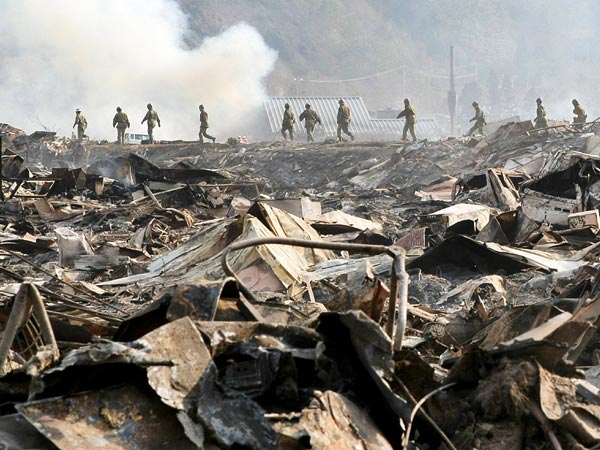
When at least 80 tornadoes rampaged across the United States, from the Midwest to the Gulf of Mexico, last Friday, it was more than is typically observed during the entire month of March, tracking firm AccuWeather.com reported on Monday.

According to some climate scientists, such earlier-than-normal outbreaks of tornadoes, which typically peak in the spring, will become the norm as the planet warms.

“As spring moves up a week or two, tornado season will start in February instead of waiting for April,” said climatologist Kevin Trenberth of the National Center for Atmospheric Research. (source)

Once again, this shouldn’t come as any surprise. Climate change is the unfalsifiable hypothesis – nothing can disprove the alarmists claim that every weather event is being affected by it. It therefore helpfully relegates the theory of catastrophic AGW to the dustbin of astrology and pseudoscience.

On reading the rest of the article, however, the true picture is that scientists really don’t know what effect warming will have on these events. But that doesn’t make a very good headline, does it? And there isn’t really a story there at all, is there?

Desperation: AGW threatens ice hockey (stick?)


No hockey stick visible...

Now there’s an opportunity for a great link with this story – photo of hockey stick (© M Mann), threatened by climate change, geddit? But Sky flunks it.

Oh well, add it to The List. They really are getting desperate:

Man-made climate change is said to be threatening the future of ice hockey in Canada, where the sport is part of the national culture.

Top players have traditionally learned their skills on frozen lakes and backyard rinks.

But as winters get warmer, experts believe aspiring ice hockey stars in years to come will struggle to find suitable outdoor facilities.

Looking ahead, the scientists predicted a complete end to outdoor skating within the next few decades in regions such as British Columbia and Southern Alberta.

Experts believe. Scientists predict. Shit Journalism 101.

Sky News is wearing the cloak of shame for this, both for the appalling story and illustrating it with a photo of a speed skater. Duh.

And by the way, the Hockey Stick isn’t threatened by climate change, it’s threatened, and indeed demolished, by truth and scientific integrity. Just sayin’.

Guardian finally goes batshit crazy


100ppm CO2 causes this?

The global warming narrative is going nowhere, the public are more sceptical than ever of the outrageous claims of climate scaremongers, and the combined efforts of Climategate (I and II) and Peter Gleick’s recent Heartland deceptions have exposed yet again the rotten underbelly of consensus science.

So instead of taking stock and rethinking their approach, perhaps being more frank and open about uncertainties in the science or conceding that the science isn’t as settled as they like to pretend, the headbangers have gone even further, stretching the alarmism to even more unbelievable lengths in order to get people to listen, when in fact such a course of action will have precisely the opposite effect.

Alarmists have attempted to link “global warming” to other geological phenomena in the past (see “Earthquakes linked to “climate change for example) but this time the headbangers have outdone themselves with a string of exaggerations and scares to match the best in the business:

Could it be then, that if we continue to allow greenhouse gas emissions to rise unchecked and fuel serious warming, our planet’s crust will begin to toss and turn once again?

The signs are that this is already happening. In Alaska, where climate change has propelled temperatures upwards by more than 3 degrees Celsius in the last half century, the glaciers are melting at a staggering rate, some losing up to one kilometre in thickness in the last 100 years. The reduction in weight on the crust beneath is allowing faults contained therein to slide more easily, promoting increased earthquake activity in recent decades. The permafrost that helps hold the state’s mountain peaks together is also thawing rapidly, leading to a rise in the number of giant rock and ice avalanches. In fact, in mountainous areas around the world, landslide activity is on the up; a reaction both to a general ramping-up of global temperatures and to the increasingly frequent summer heatwaves.

Whether or not Alaska proves to be the “canary in the cage” – the geological shenanigans there heralding far worse to come – depends largely upon the degree to which we are successful in reducing the ballooning greenhouse gas burden arising from our civilisation’s increasingly polluting activities, thereby keeping rising global temperatures to a couple of degrees centigrade at most. So far, it has to be said, there is little cause for optimism, emissions rocketing by almost 6 per cent in 2010 when the world economy continued to bump along the bottom. Furthermore, the failure to make any real progress on emissions control at last December’s Durban climate conference ensures that the outlook is bleak. Our response to accelerating climate change continues to be consistently asymmetric, in the sense that it is far below the level that the science says is needed if we are to have any chance of avoiding the all-pervasive devastating consequences. (source)

It’s actually funny, really. The desperation is so palpable. There’s plenty more at the link.

Who would have thought that a planet that has survived for 4.5 billion years and allowed the evolution of myriad species of plants and animals, including humans, could be so vulnerable to increasing a harmless trace gas by 100 parts per million? Sorry, no one’s listening any more, and the more this kind of nonsense is spouted as “science”, and regurgitated by complicit media like the Guardian and Fairfax, the less people will take any notice.

(h/t Bolta)

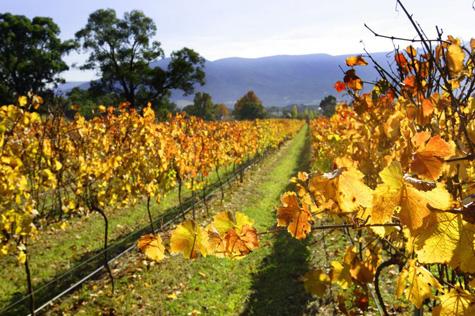
Early ripening of grapes "pinned to warming"


Yarra Valley

So the planet has got a little warmer in the last 200 years, and grapes are ripening a little earlier. Just as it got colder before the Little Ice Age and, no doubt, grapes ripened a little later. It’s called climate and it’s what the planet does.

Maybe it’s because for the first time in history we are examining our planet in such microscopic detail, something that has really only happened in the last hundred or so years (which just happens to coincide with a period of warming) that we are continually worrying about where we are headed.

Grapes were grown in the north of England during the Roman Warm Period, but there isn’t a chance of any decent Château Harrogate or Côtes du Humber in the near future.

Add this to the fact that the range of climates in which grapes are grown would exceed many times over the tiny change in global temperature in the last 200 years, and it should be obvious that adaptation should not be a big issue.

But despite all this, pinning it on global warming (as many scientists, and AAP, are all too eager to do on many occasions) makes it newsworthy, apparently:

RESEARCHERS in Australia say they have pinpointed key factors in the early ripening of grapes, providing potential answers for wine growers threatened by global warming.

In Australia and Western Europe, there is an abundance of anecdotal evidence linking higher temperatures with earlier grape maturation, a phenomenon that can affect the quality of table wine. 

But wine growing and climate change are each highly complex questions.

Until now, no one has sorted out how the variables – warming, sunlight, soil moisture and vineyard management – each play a role in grape maturation.

A team led by Leanne Webb at the CSIRO looked at 10 sites in southern Australia where there were highly detailed records, stretching from 1985 to 2009, for all of these factors.

Only at one site – at Margaret River on Australia’s southwestern tip – did the grapes ripen later. For the others, maturation occurred between six to 34 days earlier.

The commonest driver of earlier ripening was higher temperature, deemed a significant factor at seven sites.

Lower soil moisture, particularly in the drought-stricken southeast, was a major factor for earlier harvests at five sites. Drier soils lead to higher levels of a stress hormone called abscisic acid in vine roots, which drives the plant’s fruit to earlier ripening.

But vineyard management was also important.

In four sites, pruning and fertilisation methods that lowered crop yields contributed strongly to earlier maturation.

And there may be other technological innovations in these and other sites, such as improved disease and pest control, that could have been a ripening factor, says the study. (source)

So out of just 10 sites, warming was “deemed” a significant factor at seven, soil moisture at five, pruning and fertilisation at four, plus there “may be” other unknown factors which they were unable to attribute. Make of that what you will.

But it’s not all doom and gloom, as the study shows that vineyards can (dirty word warning) adapt, like humanity has been doing for centuries.

Call me cynical, but making “global warming” so prominent in this report seems to be purely to sensationalise the story. Its connection to “global warming” is tangential and the focus is clearly more on factors that are important for adaptation.

But let’s not forget this is CSIRO after all – and they have already made up their minds on climate change.

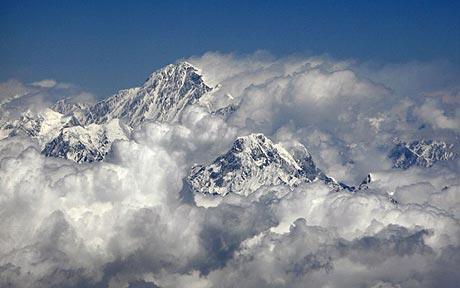
Media recycles two-year-old Everest scare story


You wait two years and the same story comes round again…

“It’s déjà vu all over again” said Yogi Berra, but it describes exactly how I felt on reading this AAP story in the Herald Sun this evening (and no doubt syndicated in plenty of other places as well):

CLIMATE change is altering the face of the Himalayas, devastating farming communities and making Mount Everest increasingly treacherous to climb, some of the world’s top mountaineers have warned.

Apa Sherpa, the Nepali climber who has conquered Mount Everest a record 21 times, said he was disturbed by the lack of snow on the world’s highest peak, caused by rising temperatures.

“In 1989 when I first climbed Everest there was a lot of snow and ice but now most of it has just become bare rock. That, as a result, is causing more rockfalls which is a danger to the climbers,” he said.

“Also, climbing is becoming more difficult because when you are on a mountain you can wear crampons but it’s very dangerous and very slippery to walk on bare rock with crampons.”

Speaking after completing the first third of a gruelling 1,700-kilometre trek across the Himalayas, Apa Sherpa would not rule out the possibility of Everest being unclimbable in the coming years.

“What will happen in the future I cannot say but this much I can say from my own experiences — it has changed a lot,” he said an an interview with AFP in the village of Gati, 16 kilometres from Nepal’s border with Tibet.

The 51-year-old father-of-three, dubbed “Super Sherpa”, began his working life as a farmer but turned to the tourism industry and mountaineering after he lost all his possessions when a glacial lake burst in 1985.

Funny that, because back at the end of May 2010, the UK Telegraph ran an almost identical story, covered by ACM at the time:

Note how, that without a pause for breath, the media return to the term “global warming” when it suits? Even though global warming virtually stopped in 2001? But they need to make the link between “warming” and melting ice for this story:

Mount Everest is becoming increasingly dangerous to climb because global warming is melting glacier ice along its slopes, according to a Nepalese Sherpa who has conquered the world’s highest summit 20 times [one less than above – Ed].

Rising temperatures have melted much of the ice on the steep trail to the summit and climbers are struggling to get traction on the exposed rock surface, according to the 49-year-old[two less than above – Ed] Sherpa, known only as Apa.

The melting ice has also exposed deep crevasses which climbers could fall into, and experts have warned that people scaling the mountain risk being swept away by “outburst floods” from rising volumes of glacial meltwater.

He said there was hardly any exposed rock on the trail to the summit when he first climbed Everest in 1989, but now the slopes are dotted with bare rocks. (source)

Could this possibly be the same Apa who, just four days ago, dedicated his climb with 13 year old American Jordan Romero to the impact of climate change on the Himalayas, a fact not even mentioned in the Telegraph report? Obviously an impartial assessment, then. Add it to the warmlist.

Global warming is such a non-story, the media is now reduced to recycling yesterday’s fish and chip wrappers.

Un-Scientific American's global warming lesson


Scott McNally

After the fizzer that was “Deniergate” (a crap name for a non-event) [UPDATE: “Fakegate” – much more appropriate], back to the usual run of the mill nonsense, this time from Scientific American that bravely sets up a string of straw men and blows them over in a patronising piece entitled “How to explain climate change to a moron skeptic”. This is for presidential hopeful Rick Santorum’s benefit, since he has had the temerity to question the alarmist BS being churned out daily.

It gets off to a less than auspicious start:

The majority of evidence presented by skeptics is anecdotal – evidence that is based on non-scientific observations or studies that may sound compelling in isolation. One example is “It is colder today than the average for this time of year; therefore global warming is not true.” Those who cite this clearly don’t understand the difference between weather and climate. You may have also heard someone say, “The climate is cyclical, and we are just on a warming trend.” Or “The eruption of Mt. Pinatubo has changed the climate more than we have.”

Count the misrepresentations in that paragraph. We continue:

I am not saying that volcanic eruptions, or solar flares, or natural changes in the biosphere don’t change the climate. They do. Sometimes significantly. But that is not the argument. The argument made by skeptics is whether humans are changing the climate.

In order for the anthropomorphic [cringe, it’s actually “anthropogenic”, anthropomorphism is attributing human characteristics to something non-human – Ed] (human caused) climate change ‘theory’ to be true, there are two corollary truths that must also be proven. Find failings with one and you have broken the climate change theory. Prove them both, and human caused climate change must be true.

Corollary #1 – Carbon dioxide is a greenhouse gas.

The ‘theory’ that carbon dioxide is a greenhouse gas has been tested and confirmed thousands of times. But if for some reason you don’t believe it, here is an experiment that you can do at home, courtesy of NASA. 

[ridiculous “fill a soda bottle with CO2” experiment omitted for my readers’ sanity – Ed]

This is just one way to show that CO2 acts as a blanket that traps heat. There are dozens of other ways to show that carbon dioxide is a greenhouse gas, and if you put this blanket around the earth, the earth will get warmer.

Corollary #2 – Humans are putting more CO2 in the atmosphere.

Yes, there is a finite amount of carbon in the biosphere. Humans can’t add to that, but what we can do is convert carbon from a solid or a liquid to a gas. As a gas, it goes into the atmosphere, rather than staying underground. We know that we are doing this because we dig up lots of coal and oil, materials that are mostly made up of carbon, and convert that carbon to a gas. On a large scale, this gas can be measured as it is released from power plants. We can also simply measure the CO2 concentration in the atmosphere. We have measured that the concentration of CO2 in the atmosphere has been increasing by about 2 parts per million every year for the past several decades.

[The rest of the post repeats the above in “blind-em-with-science” mode]

And there the prosecution rests, m’lud. That’s it. Sceptics are dumb and can’t understand the difference between weather and climate, carbon dioxide is a greenhouse gas and humans are putting more of it into the atmosphere, ergo humans cause climate change. Case closed. See, the science really is settled!

I don’t really know where to begin with this, since the arguments so utterly simplistic as to beggar belief, even from Scientific American. You all know the points, but let’s go through them anyway:

  • CO2 is a greenhouse gas – agreed
  • Humans are putting more CO2 in the atmosphere – agreed
  • Humans are changing the climate – also agreed
  • But the question which the author fails to raise is “by how much?”
  • How much do natural drivers compare with the human fingerprint?
  • Where’s the acknowledgement that catastrophic warming is a result of computer-modelled positive feedbacks which have not been adequately tested or proven?
  • Where’s the acknowledgement that if catastrophic warming isn’t happening, then we are wasting billions of dollars that could be used for other, tangible, benefits to humanity?
  • Where’s the acknowledgements that mitigation is highly unlikely to be effective, and adaptation to whatever climate change (human or natural) befalls the planet is a far better option in terms of cost/benefit?

Just embarrassing.

Read it here.

Shark attack increase: AFP blames "global warming"


Now with added global warming

UPDATE: George Burgess responds to ACM (see below).

Crap Journalism Alert. This is the kind of nonsense the brainless media sucks up, like a demented vacuum cleaner:

Sharks killed twice as many swimmers and surfers last year than in 2010, with the increase due largely to a growth in tourism and changing shark patterns due to global warming.

There were 12 deaths in 46 shark attacks in 2011, a mortality rate of more than 25 percent compared to an average of under seven percent in the last 10 years, according to statistics from the University of Florida.

Countries that recorded shark attack deaths included Australia with three fatal out of a total of 11 attacks; South Africa, two fatal out of five; the French island of Reunion, two deaths in four attacks; and Seychelles with two attacks both of which ended in death.

Other countries with non-fatal shark attacks included Indonesia (3), Mexico (3), Russia (3) and Brazil (2).

Three locations not normally associated with high numbers of shark attacks — Reunion, Seychelles and New Caledonia — registered a total of seven attacks with five fatal outcomes, according to Burgess. “Those areas were not traditional area for tourism in recent years,” the scientist explained.

“Over the last decade, more and more tourists have been going there… So we are getting more people coming to places where there are sharks, and the local communities are not prepared for the number of people going into the water at this time.”

He added that medical facilities in these areas may not be developed enough to provide treatment in emergencies of this type.

In addition to the influx of tourists, the effects of global warming has meant sharks migrating to regions where they were not normally seen.

Last August, authorities even in the far east Russian reported three non-fatal shark attacks in the Primorye region — not a normal location for the predator. (source)

Yet when we check the original report, we find that there isn’t a single mention of climate change or global warming. In fact, they acknowledge (as they should) that this is more likely to be a statistical anomaly than any kind of trend:

Twelve fatalities resulted from unprovoked attacks in 2011, considerably higher than totals from recent years (the 2001-2010 yearly average was 4.3) and the highest yearly total since 1993 (also 12). These unprovoked fatalities were recorded from Australia (3), Costa Rica (1), Kenya (1), New Caledonia (1), Reunion (2), the Seychelles (2), and South Africa (2). The annual fatality rate was 16%, similar to the 1990’s average of 13%, but higher than the 6.7% average of the first decade of this century. The trend in fatality rate has been one of constant reduction over the past 11 decades, reflective of advances in beach safety practices and medical treatment, and increased public awareness of avoiding potentially dangerous situations. 

This year’s higher rate no doubt is a statistical anomaly based in part on where the serious attacks occurred geographically. The unusually low proportion of attacks occurring in the United States, particularly in Florida, and a jump in attacks in non-U.S. locales not blessed with as highly-developed safety and medical personnel and facilities lead to an unusually high number of deaths. The fatality rate in the U.S. was zero, elsewhere it was nearly 25%. This contrast highlights the need for increasing efforts to improve beach safety, including education of the public about the risk of sharks, providing well-trained lifeguards, and advancing emergency care and medical capabilities.  

In fact, shark-human interactions have declined in the last decade, and they cite a number of reasons for this:

  • less people in the water
  • less sharks in the water
  • humans getting smarter about dealing with sharks when they’re in the water,

and not a single mention of climate change or global warming.

The original article was written by AFP, an organisation that loves to plug climate alarmism, so they insert “global warming” into a story to sex it up, despite no mention of it being made by the scientist responsible. And because it is an agency piece, it is regurgitated the world over by all the national media organisations.

UPDATE: I emailed George Burgess for his reaction to this story. He commented that the original headline was misleading on both counts (tourism and global warming) but asked the following comment to be published, set out below (emphasis his):

“My concern is over poor journalism, not whether or not global climate change is real.  From a scientific perspective, it is.  We are seeing lots of biological effects associated with warming water temperatures, including distributional changes in some sharks and many other marine species.  As some of these sharks move into higher latitudes they have and will continue to come in contact with more humans (which also are more likely to enter the water in these areas as water temperatures become more tolerable) and we might expect to see a small rise in attacks in some areas that formerly had none (as we saw this year in Russia).  No cause for panic, but check back in about ten years to see how the pattern goes, by then we’ll know better if there was a trend or simply normal variation that occurs in the natural system.”

We are not disputing that the climate is changing – we do dispute attribution, something not raised here. Furthermore AFP’s use of “global warming” in this article as a hook to lure the unsuspecting is, as Burgess states, simply poor journalism.

Himalayan glaciers "melting ten times more slowly than feared"


Embarrassing

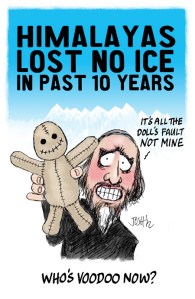
UDPATE: Cartoon by Josh, right.

Remember the IPCC melting glacier scare? Gone by 2035? Glaciergate? It made great publicity for the alarmists. Sadly it was total rubbish. And now further studies reveal that the melting is fully ten times slower than previously thought.

But it’s still bad news, naturally. They’re still melting. Just an order of magnitude more slowly than we had previously been led to believe, as the ABC reports:

Himalayan glaciers and ice caps that supply water to more than a billion people in Asia are losing mass up to 10 times less quickly than once feared, according to a new study.

Based on an improved analysis of satellite data from 2003 to 2010, the findings offer a reprieve for a region already feeling the impacts of global warming.

But they do not mean that the threat of disruptive change has disappeared, the researchers warn. [Of course, any good news has to be tempered with a reminder that the planet is going to hell in a handcart – Ed]

“The good news is that the glaciers are not losing mass as fast as we thought,” says Professor Tad Pfeffer of theUniversity of Colorado‘s Institute of Arctic and Alpine Research and a co-author of the study.

“The bad news is that they are still losing a lot of water. There is still definitely a serious problem for the Himalayas.”

Much of that loss, it turns out, is taking place in the huge plains immediately south of the towering mountain range, where pumping from wells is draining ancient aquifers far faster than precipitation can replenish them.

Earlier estimates, also based on satellite data, mistakenly attributed much of the draining of these water tables to glacier melt-off, says Pfeffer.

So the attribution of the cause was wrong too.

Other calculations now thought to be off the mark were based on scaled-up extrapolations from lower-elevation glaciers that were more accessible to observation, but also more subject to warming trends.

“Many of the high glaciers would still be too cold to lose mass even in the presence of atmospheric warming,” says co-author John Wahr, a physicist at the University of Colorado. (source)

And of course, none of this says anything about the cause of the warming. Amazing that the ABC reported this, but at least the spin cycle made sure that any good news was diluted by more hectoring warnings of disaster.

Even more dire warnings at the press release here.

More at the UK Guardian here, where it is claimed that “the worlds greatest snow-capped peaks have lost no ice in the last ten years”.

WSJ: "When you're a hammer, everything looks like a nail"


WSJ Online

Some wonderful letters in the Wall Street Journal in response to Trenberth et al‘s response to that letter:

As for Mr. Trenberth’s heart-surgeon analogy: You might be better off consulting an intelligent generalist, probably not a dentist, but a primary-care physician who could recommend exercise and diet change before undergoing unnecessary and potentially dangerous surgery. Heart surgeons tend to recommend surgery more often than nonsurgeons because specialists are easily biased by their specialization. When you’re a hammer, everything looks like a nail.

The letter from Kevin Trenberth and his colleagues is straight out of the Saul Alinsky playbook: Marginalize your opponents by demeaning them (“dentists practicing cardiology”); state your position without definitive support (“observations show unequivocally” and computer models show); explain away statements that compromise your position by claiming they were taken out of context; restate your position in such a manner that it looks as if the issue is settled, even when it isn’t (“the science is clear: The world is heating up and humans are primarily responsible”) and then restate it again because if you say it often enough, people just might believe it (“climate change is real and human caused”); and, finally; call for federal funding to remedy the apparent impending crisis (“investing in the transition to a low-carbon economy . . . [is] just what the doctor ordered”). No thanks. I’m glad we got a second opinion, even if it was from a dentist.

The Trenberth letter is little more than an appeal to authority masquerading as a scientific argument. It casts no light, therefore, on the actual substance of the issues, particularly given the corruption of the peer-review process made clear by the East Anglia University emails. The most revealing sentence in the Trenberth letter is the statement that computer models show that smaller increases in surface temperatures are accompanied by warming “elsewhere in the climate system.” Sorry, computer models do not “show” anything. They make predictions that must be tested against the evidence, which in the global-warming context is deeply problematic. Mr. Trenberth’s models may be a magnet for government grants, but their usefulness for policy is far from clear.

Great stuff. Read them all here.

Wall Street Journal war of words continues


Click to enlarge

letter published in the Wall Street Journal on 27 January made the unremarkable and, one would have thought, fairly uncontentious, assertions that global temperatures had flatlined or slowed in the 21st century, that alarmist projections beget more research funding, and that the forecasts of the IPCC were exaggerated. Hardly anything earthshaking in that.

However, since such a letter dilutes “The Cause” and forces the average person to engage their own powers of reasoning, the consensus denial machine (denial of open debate and any kind of climate change other than man-made, that is) swung into action.

Kevin Trenberth and others (including Michael Mann (!), and Aussie alarmists David Karoly and Matthew England) wrote a further letter to the WSJ attempting to rebut the original points and shore up The Cause, relying heavily on the argument from authority (“97% of climate scientists etc” – remember where that figure came from – 75 out of 77 – , various “national academies” agree with us, etc etc), deploying the hackneyed cancer/doctor, smoking/lung cancer, HIV/Aids analogies, claiming that warming hasn’t slowed in the last decade, and that transitioning to a low carbon economy should be a priority. And who said scientists should never get involved in policy?

Patrick Michaels has responded in detail to this letter:

Trenberth et al. is surprisingly weak and incomplete. The 16 original authors are all individuals that are highly competent in their fields, most are physicists of one stripe or another, and all can read and summarize a scientific literature. In fact, most would hold that climate science is nothing more than applied physics.

“Extreme views” lie in the eye of the beholder, and science only grudgingly backs away from established paradigms. For example, despite the obvious jigsaw-puzzle fit of the earth’s continents, it took 100 years of bickering before continental drift was accepted over geological stasis. And, in this case, the “extreme view” of the most prominent climate scientist of the 16, MIT’s Richard Lindzen, is hardly an outrage.

Lindzen holds that the “sensitivity” of surface temperature to changes in atmospheric carbon dioxide has been overestimated because of an inaccuracy in the way that computer models magnify warming. In and of itself, it is mainstream, not extreme, to entertain the hypothesis that doubling carbon dioxide on its own would only cause a bit more than 1 degree (C) of global surface warming. Computer models arrive at much higher values, around 3.5°C, by amplifying the carbon dioxide effect because a slightly warmer atmosphere contains more water vapor, which itself is a potent greenhouse gas. Clouds are also changed in a way that enhances warming. There is evidence from the outgoing radiation signal of the earth that the effects of water vapor and clouds have been overestimated.

The 38 must somehow disagree with Susan Solomon, whose 2010 article in Science attributing the lack of recent warming—that the 39 deny—to unanticipated changes in stratospheric water vapor with no known cause.

The 38 must somehow disagree with the global temperature sensing from satellites, which also shows no net warming for the last 14 years. Now, one could argue that the satellites are measuring temperatures above the surface in the lower atmosphere, but the computer models that the 38 find so accurate, predict that the lower atmosphere should be warming faster than the surface over most of the planet.

Finally “more than 97% of all actively publishing* climate scientists agree that climate change is real and human caused” is probably an underestimate, as virtually everyone acknowledges that the surface temperature is warmer than it was, and that multifarious human activities have some influence on climate. Rather, he misses the point well-made by the original Journal article, which is that the rise in surface temperature is clearly below the values first forecast by the UN in 1990. The core—unsettled—issue in climate science is the “sensitivity” of temperature to carbon dioxide, and there are several independent lines of evidence, including the surface temperature history and the water vapor problems, that argue that it has been substantially overestimated.

In global warming, it’s not the heat, it’s the sensitivity. But don’t expect much sensitivity and expect a lot of heat when climatologists voice their opinions. (source, via WUWT)

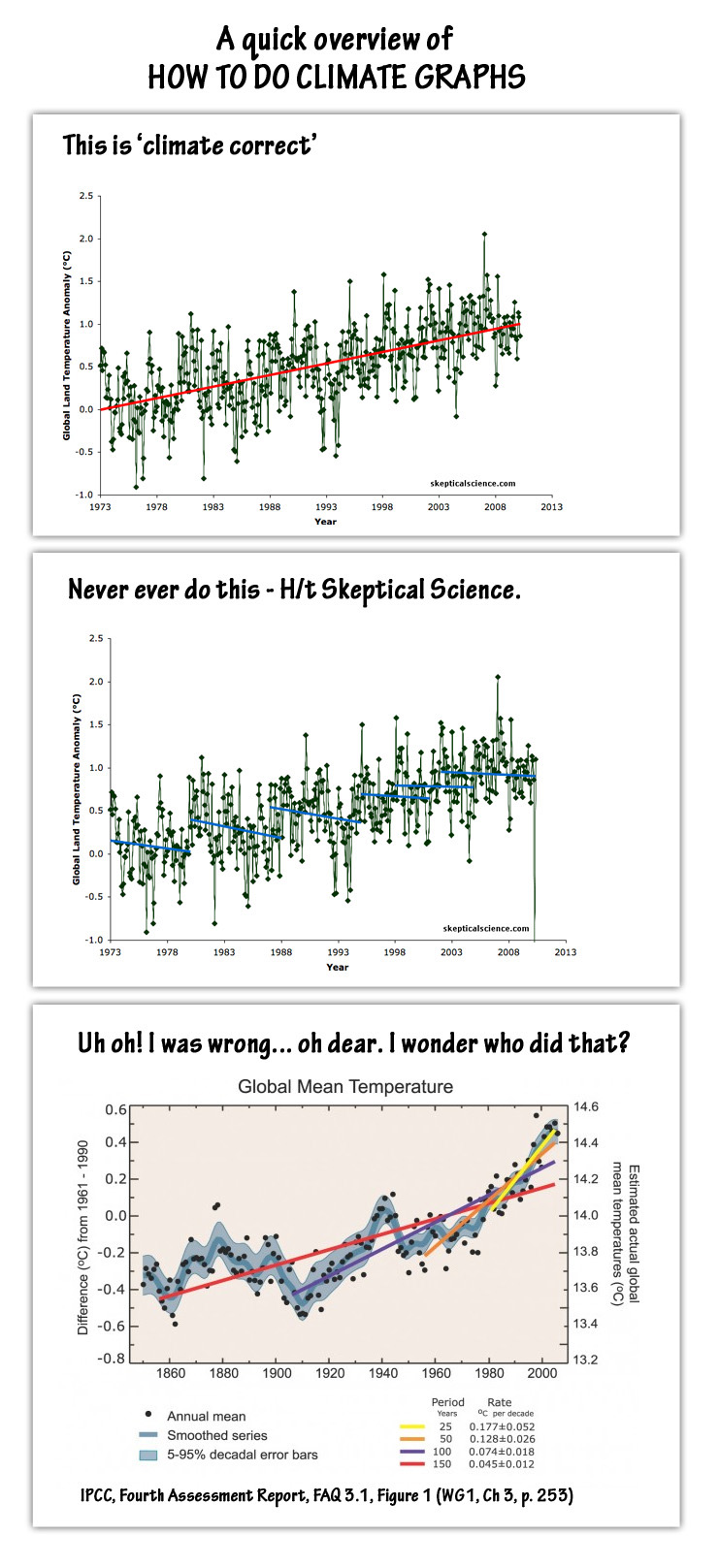
Skeptical Science, home of the smug, fundamentalist climate headbangers, attempted to ridicule any suggestion that global temperatures had plateaued with a smug straw man graph [no link, they’re not having any of my traffic], showing smugly that us dumb sceptics will see declines anywhere in a data set by cherry picking the start and end points (I guess that’s better than hiding the declines, right, Mike and Phil?).

Thankfully, Josh came to the rescue with the sketch above, demonstrating how the IPCC sees accelerating warming in a dataset by, er, cherry picking the start and end points. Oh the ironing. Click to enlarge.

UPDATE: William Kininmonth writes to The Australian on the same subject:

KEVIN Trenberth, responding to an Opinion (to which I was a co-signatory) published in the Wall Street Journal (27/1/12) and The Australian (“Climate change ‘heretics’ refute carbon dangers”, 1/2), claims to have been quoted out of context and misrepresented (“Expertise a prerequisite to comment on climate”, 3/2).

The quote in our opinion is from an email sent by Trenberth to a group of colleagues that became public with the release of emails from the UK University of East Anglia (or climategate). Trenberth wrote: “The fact is that we can’t account for the lack of warming at the moment and it is a travesty that we can’t . . . there should be even more warming: but the data are surely wrong. Our observation system is inadequate.”

The context is an exchange of emails initiated in 2009 in response to a BBC item that there has been no warming since 1998 and that Pacific oscillations will force cooling for the next 20 to 30 years.

Trenberth was certainly lamenting the inadequacy of the observing systems (with which I agree) but at face value he is also acknowledging that the available data do not support warming since 1998. The latter is an inconvenience to the human-caused global warming hypothesis that he and his colleagues are wedded to.

William Kininmonth, Kew, Vic