Michael Asten: cautious on CO2 causation


Climate sense

Writing in The Australian, Michael Asten again questions the climate science orthodoxy in an excellent article (his earlier article was posted here). Here he addresses the Palaeocene-Eocene thermal maximum, a time when CO2 levels rose sharply and temperatures also rose, often cited by the warmists as “proof” that CO2 causes rapid and dangerous warming:

I argue there are at least two possible hypotheses to explain the data in this study: either the link between atmospheric CO2 content and global temperature increase is significantly greater (that is, more dangerous) than the existing models show or some mechanism other than atmospheric CO2 is a significant or the main factor influencing global temperature.

The first hypothesis is consistent with climate change orthodoxy. Recent writings on climate sensitivity by James Hansen are consistent with it, as was the Intergovernmental Panel on Climate Change in its pre-Copenhagen update, The Copenhagen Diagnosis.

Indeed, the 26 authors of the IPCC update went a step further, and encouraged the 46,000 Copenhagen participants with the warning: “A rapid carbon release, not unlike what humans are causing today, has also occurred at least once in climate history, as sediment data from 55 million years ago show. This ‘Palaeocene-Eocene thermal maximum’ brought a major global warming of 5C, a detrimental ocean acidification and a mass extinction event. It serves as a stark warning to us today.”

We have to treat such a warning cautiously because, as Pearson and his colleagues pointed out in their letter two weeks ago, “We caution against any attempt to derive a simple narrative linking CO2 and climate on these large time scales. This is because many other factors come into play, including other greenhouse gases, moving continents, shifting ocean currents, dramatic changes in ocean chemistry, vegetation, ice cover, sea level and variations in the Earth’s orbit around the sun.”

Sound science also requires us to consider the second of the above two hypotheses. Otherwise, if we attempt to reconcile Zeebe’s observation by inferring climate sensitivity to CO2 is greater than that used for current models, how do we explain Pearson’s observation of huge swings in atmospheric CO2, both up and down, which appear poorly correlated with temperatures cooling from greenhouse Earth to moderate Earth.

The two geological results discussed both show some discrepancies between observation and model predictions. Such discrepancies do not in any sense reduce the merit of the respective authors’ work; rather they illustrate a healthy and continuing process of scientific discovery.

Read it here.

CFCs and cosmic rays responsible for changes in climate


Waterloo's Science Isn't Settled department

Fresh from the “Science is Settled Department.”

Cosmic rays and chlorofluorocarbons (CFCs), both already implicated in depleting the Earth’s ozone layer, are also responsible for changes in the global climate, a University of Waterloo scientist reports in a new peer-reviewed paper.

In his paper, Qing-Bin Lu, a professor of physics and astronomy, shows how CFCs – compounds once widely used as refrigerants – and cosmic rays – energy particles originating in outer space – are mostly to blame for climate change, rather than carbon dioxide (CO2) emissions. His paper, derived from observations of satellite, ground-based and balloon measurements as well as an innovative use of an established mechanism, was published online in the prestigious journal Physics Reports.

“My findings do not agree with the climate models that conventionally thought that greenhouse gases, mainly CO2, are the major culprits for the global warming seen in the late 20th century,” Lu said. “Instead, the observed data show that CFCs conspiring with cosmic rays most likely caused both the Antarctic ozone hole and global warming. These findings are totally unexpected and striking, as I was focused on studying the mechanism for the formation of the ozone hole, rather than global warming.”

He wasn’t even looking for something on global warming! It must be so frustrating to the alarmists when researchers actually carry out unbiased research and come up with interesting, challenging results, instead of just fudging data, destroying emails and hiding inconvenient facts in order to fit a pre-conceived political agenda.

Read it here.

More data CRU-cifixion: only warmest Russian stations chosen


Man-made warming in Russia?

Man-made warming in Russia?

From Watts Up With That:

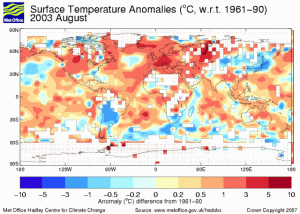
It’s true, and it’s huge. Today another example of CRU having their foot on the scale, Russian papers are reporting that the Russian surface station data was sorted by CRU to use the highest warming stations only.

Analysts say Russian meteorological stations cover most of the country’s territory, and that the Hadley Center had used data submitted by only 25% of such stations in its reports.

Over 40% of Russian territory was not included in global-temperature calculations for some other reasons, rather than the lack of meteorological stations and observations.

The data of stations located in areas not listed in the Hadley Climate Research Unit Temperature UK (HadCRUT) survey often does not show any substantial warming in the late 20th century and the early 21st century.

They specifically state that lack of measurement is not the cause. If they claim the full set of Russian data does NOT support global warming, imagine how different the bright red dot over Russia would look. Again the accusation is completely believable, yet is completely unverifiable because CRU has refused to release the data. This data and code release is the subject of illegal blocking of FOIA’s is one of the keys in the Climategate emails. We need to know the list of stations used and we must have copies of the raw data.

This is a very powerful accusation, which if true could change much about the climate science debate. Many papers are based on this dataset which has the highest trend of the major ground datasets.

Read it here.

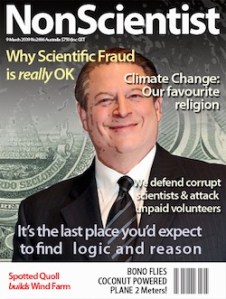
Not "New Scientist", but "Non Scientist"


Joke publication

Joke publication

Jo Nova takes the global warming alarmist science mag to pieces:

It’s beyond silly. The mindless, irrelevant attacks go on. They attack Nigel Lawson for using a misleadingly short time (eight years) to argue that the world is not warming (which is exactly what the satellite data shows). Eight years is too short for New Scientist to announce a flat trend, but in every other article with a single flood, a single cyclone, or a single heat wave, one week is long enough for New Scientist to imply that global warming might be to blame. So a season of hurricanes is significant, but years of cooling is misleading. Righto. (And Amen).

They attack Christopher Monckton’s paper, not because they can summarize why it was in error, but because another group disagree, and there are some technicalities of whether it jumped through the right hoops to be called “peer review.” Attack the man and not the message eh? New Scientist stands up for the bureaucratic details of “peer review” (only some peers count), but they won’t stand up for the independent scientists, the whistleblowers who want access to data, just to check those “peer reviewed papers” didn’t turn out to be baseless frauds like the Hockey Stick.

We subscribers buy New Scientist in the hope it will impartially give us both sides of the story, in a summary form which is accurate… and the subscribers are rebelling. The comments below the article are 90% skeptics, 2% believers, and the rest are presumably so angry their’s were deleted.

Brilliant. Read it here.

Tony Blair: Act now "even if science is wrong"


Fan of the precautionary principle

Fan of the precautionary principle

Tony Blair makes a stunning acknowledgement: that the science may not be “as certain as proponents suggest.” But that doesn’t stop him relying on the precautionary principle to urge a deal at Copenhagen:

“It is said that the science around climate change is not as certain as its proponents allege. It doesn’t need to be. What is beyond debate, however, is that there is a huge amount of scientific support for the view that the climate is changing and as a result of human activity,” he said.

“Therefore, even purely as a matter of precaution, given the seriousness of the consequences if such a view is correct, and the time it will take for action to take effect, we should act. Not to do so would be grossly irresponsible.”

So even though the science may be wrong, Copenhagen should press ahead regardless? In what other area of policy are the same criteria used? The “precaution” he advises will cost the developing world trillions of dollars, and set back standards of living decades. How about building underground bunkers for everyone on earth in case of an asteroid impact? Surely that’s just as deserving a cause – perhaps even more so given the number of unknown bodies in eccentric orbits? Or providing breathing apparatus in case there is a deadly viral mutation?

Funnily enough, it seems that TB is a fan of the precautionary principle – he just admitted he used it in relation to Saddam Hussein and WMD, and I can only begin to imagine the mess that admission will get him into… He should be more careful advocating it in future, especially when the costs of the precaution itself are huge.

Read it here.

Climategate in the UK House of Lords


Palace of Westminster

Palace of Westminster

H/t: Watts Up With That. From a speech in the House of Lords by the rather ironically named Lord Turnbull – notable because it questions the science. Many politicians believe that public opinion dictates that the science be left alone, and arguments made purely on economic grounds. ACM believes this is wrong, and that the whole scientific basis of AGW should be thoroughly reviewed.

There is the issue of the science, which I had previously taken as given; but many people’s faith is being tested. We are often told that the science is settled. I suppose that is what the Inquisition said to Galileo. If so, why are we spending millions of pounds on research? The science is far from settled. There are major controversies not just about the contribution of CO2, on which most of the debate is focused, but about the influence of other factors such as water vapour, or clouds-the most powerful greenhouse gas-ocean currents and the sun, together with feedback effects which can be negative as well as positive.

Worse still, there are even controversies about the basic data on temperature. The series going back one, 10 or 100,000 years are, in the genuine sense of the word, synthetic. They are not direct observations but are melded together from proxies such as ice cores, ocean sediments and tree rings.

Given the extent to which the outcome is affected by the statistical techniques and the weightings applied by individual researchers, it is essential that the work is done as transparently as possible, with the greatest scope for challenge. That is why the disclosure of documents and e-mails from the Climatic Research Unit is so disturbing. Instead of an open debate, a picture is emerging of selective use of data, efforts to silence critics, and particularly a refusal to share data and methodologies.

It is essential that these allegations are independently and rigorously investigated. Naturally, I welcome the appointment of my old colleague, Sir Muir Russell, to lead this investigation; a civil servant with a physics degree is a rare beast indeed. He needs to establish what the documents really mean and recommend changes in governance and transparency which will restore confidence in the integrity of the data. This is not just an academic feud in the English department from a Malcolm Bradbury novel. The CRU is a major contributor to the IPCC process. The Government should not see this as a purely university matter. They are the funders of much of this research and their climate change policies are based on it.

We need to purge the debate of the unpleasant religiosity that surrounds it, of scientists acting like NGO activists, of propaganda based on fear, for example, the quite disgraceful government advertisement which tried to frighten young children – the final image being the family dog being drowned-and of claims about having “10 days to save the world”. Crude insults from the Prime Minister do not help.

Well said indeed.

Read the whole speech here.

Idiotic Comment of the Day: David Jones, BoM


ICOTD: Worthy winner

ICOTD: Worthy winner

Here’s the head of climate analysis at the Australian Bureau of Meteorology, showing astonishing ignorance about what is happening in the climate:

The decade 2000-2009 is very likely to be the warmest on record,” said World Meteorological Organisation secretary-general Michel Jarraud.

Head of climate analysis at the Bureau of Meteorology Dr David Jones said the data should silence climate sceptics.

Clearly climate change hasn’t stopped, global warming hasn’t stopped,” he said. “The planet is continuing to warm – and it’s warming in our back yard.”

Shall we take it apart?

  1. First off, the climate is warming gently from the depth of the Little Ice Age, and therefore it is no surprise that temperatures this decade are warmer than last. This proves nothing about the influence of human emissions of CO2.
  2. The present warming is not unusual in magnitude or rate.
  3. “On record” means since 1850, ignoring the Holocene Climate Optiumum and the Medieval and Roman warm periods, all of which were warmer than present.
  4. Sceptics do not believe that climate change isn’t happening, but they question the extent of human influence. To claim that rising temperatures on their own will “silence sceptics” is laughable.
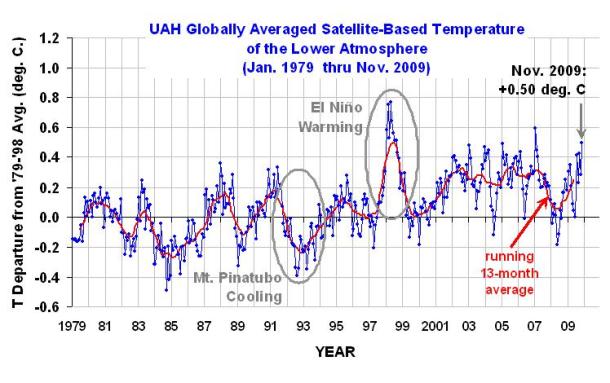
  5. Check the satellite records:

November 2009 temperature plot from UAH

November 2009 temperature plot from UAH

There has been no statistically significant warming since about 2001. It’s true that the fudged surface station data shows warming, most of which is man made (i.e. man made “adjustments”), but the satellite data isn’t open to such manipulation, and shows no warming.

Verdict: 0/10. Must try harder.

Read it here.

Climate claims fail science test


Climate sense

Climate sense

A must-read article in The Australian from Monash University professorial fellow in geosciences, Michael Asten. Again, it deals with the key factor in climate models: feedback. We know that the effect of a doubling of CO2 in the atmosphere will produce a negligible increase in temperature, but such increase may trigger “positive feedbacks” which will amplify the warming. Equally possible, however, is that the warming will trigger “negative feedbacks” which will work to counteract the warming.

Guess which one the IPCC chooses? Correct, but because the science on feedbacks is woefully incomplete, current climate model projections are next to useless. Two pieces of research seem to indicate that the feedbacks are no where near as strong as the IPCC models claim, leading to a huge overestimation of future warming:

Building on a methodology published 15 years ago in Nature, climatologist and NASA medallist John Christy and colleague David Douglass studied global temperature impacts of volcanic activity and ocean-atmospheric oscillations (the “El Nino” effect) and separated these from global temperature trends over the past 28 years.

The result of their analysis is a CO2-induced amplification factor close to one, which has implications clearly at odds with the earlier IPCC position.

The result was published this year in the peer-reviewed journal Energy and Environment and the paper has not yet been challenged in the scientific literature.

What this means is that the IPCC model for climate sensitivity is not supported by experimental observation on ancient ice ages and recent satellite data.

So are we justified in concluding that the concentration of atmospheric CO2 is not the only or major driver of current climate change? And if so, how should we re-shape our ETS legislation?

I don’t know the answer to these questions, but as Nobel prize winning physicist Richard Feynman observed: “It doesn’t matter how beautiful your theory is, it doesn’t matter how smart you are. If it doesn’t agree with experiment, it’s wrong.”

Read it here.

Hilarious: Rudd enlists Galileo's help


I know ten facts about climate change now, and they're still all wrong.

I know ten facts about climate change now, and they're still all wrong.

Except he gets it completely back to front! Kevin Rudd is, you know, quite frankly, stunned at the response of the Opposition to his wondrous ETS and just can’t believe that anyone could possibly have a bad word to say for it:

“I’m constantly stunned. It’s as if we’re back into the trial of Galileo or something and they’re simply arguing somehow that the science is fiction and that they alone in their own prejudiced universe occupy fact.

“I mean, we are back almost in a medieval court.”

What a classic own goal! If Rudd had any idea of the history of science (or in fact about anything at all), he would have realised that it was Galileo who was in the position of today’s climate sceptics, bravely proposing a scandalous sun-centred model of the solar system in the face of the religious dogma of the Catholic church (or in the present analogy, the High Church of Global Warming), which stood firmly by the biblical, faith-based, earth-centred model. And for this (ultimately correct) interpretation of the workings of the solar system, Galileo was sentenced by the Pope to house arrest for the remainder of his life. The Catholic church took until 1992, three hundred and fifty years after his death, to admit it was wrong, and a statue of him now stands in the Vatican. How’s that for rehabilitation?

So in order to attack the climate sceptics in the Opposition, Kevin Rudd enlists the help of probably the most famous scientific sceptic in history, who was eventually shown to have been right all along. I always knew our PM was no brain surgeon, but honestly…

Read it here.

Shock: Murray-Darling warming 'not due to CO2'


"It's the Murray, darling."

"It's the Murray, darling."

Another Science is Settled Alert, as researchers at Newcastle University conclude that elevated temperatures in the Murray-Darling basin were a combination of natural factors:

Lead researcher Associate Professor Stewart Franks, from the University’s Faculty of Engineering and Built Environment, said the findings were based on known principles of physics.

“Senior climate change researchers have claimed that higher temperatures lead to higher moisture evaporation and that this is why the Murray Darling Basin has experienced such a harsh drought,” Associate Professor Franks said.

“This is incorrect and ignores the known physics of evaporation.

“During drought, when soil moisture is low, less of the sun’s radiant energy goes into evaporation and more goes into the heating of the atmosphere which causes higher temperatures.

“Most importantly, the elevated air temperatures do not increase evaporation but are actually due to the lack of evaporation and this is a natural consequence of drought.

“Therefore any statement that the drought experienced in the Murray Darling Basin is a direct result of CO2 emissions is fundamentally flawed.”

Associate Professor Franks said the findings of the study highlighted the importance of getting the science right.

“A key concern is that the Intergovernmental Panel on Climate Change – which advises governments around the world – has used the Murray Darling Basin and incorrect science as an example of CO2 induced climate change.

Read it here.