More supercomputers!


Steam computing at the Met Office?

All that’s standing between the UK Met Office and better forecasts is bigger and more expensive supercomputers. So says chief scientist Julia Slingo, in an interview in Nature:

What’s the biggest obstacle to creating better, hazard-relevant weather forecasts?

Access to supercomputers. The science is well ahead of our ability to implement it. It’s quite clear that if we could run our models at a higher resolution we could do a much better job — tomorrow — in terms of our seasonal and decadal predictions. It’s so frustrating. We keep saying we need four times the computing power. We’re talking just 10 or 20 million a year — dollars or pounds — which is tiny compared to the damage done by disasters. Yet it’s a difficult argument to win. You just think: why is this so hard? (source)

So here’s a report from the BBC in May 2009 which the Met Office would probably like to stay posted down the memory hole:

One of the most powerful computers to predict the weather in the UK is being tested in Devon.

The giant IBM machine fills two special halls, said to be about the size of two football pitches, at the Met Office headquarters in Exeter.

By 2011, the computer should have a peak performance of about one PetaFlop – equivalent to more than 100,000 PCs.

It is 30 times more powerful than what is currently in place and will give more accurate and detailed forecasts.

The Met Office “supercomputer” will offer 15 million megabytes of memory and requires 1.2 megawatts of energy to run.

The system, which is expected to be fully up and running by August, will also be used for research on climate change and its impacts on society and the economy.

Met Office chief executive John Hirst said the new computer was an important step.

“In a world where the effect of extreme weather events is becoming more severe and the potential impact of global warming is becoming ever more apparent, the Met Office plays an increasingly vital role in researching and forecasting these events,” he said. (source)

And getting them spectacularly wrong. It doesn’t matter how many Petaflops your supercomputer can crunch through, if the models suck (which they do, since they have been warm-mongerized to minimise natural climatic forces and maximise the effect of anthropogenic CO2) then the output will suck too. And here’s another from the UK Telegraph in 2007:

The Met Office wants to buy a super computer costing as much as £200m to make its forecasts more accurate.

It said a bigger and more sophisticated computer was a key element of being able to predict severe weather events – such as the Great Storm of 1987 – earlier and more accurately.

In a briefing to mark the 20th anniversary of the storm on October 15 the Met Office said the use of satellite imagery and modelling by computers meant the mistakes made then would not be repeated. [Ha, ha, my aching sides – Ed]

Much of the country was unaware of the huge storm that was to sweep across the southern half of the country on the night of October 15/16.

Although the Met Office had been warning of severe weather in the days before they “lost sight” of the severity and path of the storm in the final few hours. (source)

And another, from 2004:

The Met Office is celebrating 150 years by unveiling a new supercomputer which they predict will put them at the forefront of weather forecasting.

It will allow meteorologists to provide more accurate advice to the government and the public in the face of increasingly extreme weather patterns.

The Met Office made the announcement at the British Association’s Festival of Science at the University of Exeter.

The new system is one of the most sophisticated in Europe.

It allows forecasters to track weather patterns across the world – from a massive dust storm to a single cloud.

Such technology makes it easy to forget how far forecasting has come, the Met Office says. (source)

The list goes on. Plus ça change, plus c’est la même chose. You’d get better forecasts on a Sinclair ZX Spectrum if the models actually represented the climate system realistically. Autonomous Mind asked what kind of supercomputers Piers Corbyn and Joe Bastardi use… and got a reply from both.

Chairman of UK Met Office awarded CBE


Once proud organisation

For “public service” – Robert Napier is the head of the UK’s Met Office, you know, the one that couldn’t predict the outcome of a one-horse race, the “barbecue summer” Met Office, the “warmer winters” Met Office that somehow missed the coldest UK winter in 300 years (possibly longer). It is an organisation so blinded by global warming theology that it now spectacularly fails to do what it is supposed to do: forecast the weather. It’s the Meteorological Office after all.

As commenter Froggy UK reminded me a few days ago, Napier is an eco-fruitcake, totally conflicted out of his role at the Met Office, as is evident from his appointments:

  • Chairman of the Green Fiscal Trust
  • Chairman of the trustees of the World Centre of Monitoring of Conservation
  • a director of the Carbon Disclosure Project
  • a director of the Carbon Group
  • Chief executive of the World Wildlife Fund UK

He clearly has an environmentalist agenda to push, which, sadly he is doing very well, at the expense of timely and accurate weather forecasting. The Met Office’s flawed advice to the government, which as a result failed to prepare adequately for the extreme cold, has resulted in the unnecessary suffering of millions of people in the UK. And on top of all that, he is handed a gong in the New Year’s Honours List. Someone is playing a very sick joke on the British public.

(h/t Richard North)

ABC: climate still warming


Heaviest global warming in US for 60 years

Of course it is. No matter how much snow, ice and cold, the ABC will always be there to find a CSIRO scientist (funded by a government which is committed to the global warming narrative) to tell us not to believe our senses, but to put our trust in their flaky models: the climate is still warming, and don’t you forget it! The same is happening in the UK and the US as well, where the faithful are on a desperate crusade of spin to convince an ever more suspicious public that extreme cold is a sign of global warming, even though last year we said there wouldn’t be any more extreme cold, because of… er, global warming:

Snow storms in the northern hemisphere and torrential rainfall in parts of drought stricken Australia could have you wondering whether there’s been a permanent shift in average temperatures.

According to the CSIRO, the recent extreme weather in both northern and southern hemispheres reflect short-term variability’s [sic] in climate.

Barrie Hunt, an Honorary Research Fellow with CSIRO Marine and Atmospheric Research , says periodic short-term cooling in global temperatures should not be misinterpreted as signalling an end to global warming.

“Despite 2010 being a very warm year globally, the severity of the 2009-2010 northern winter and a wetter and cooler Australia in 2010 relative to the past few years have been misinterpreted by some to imply that climate change is not occurring,” Mr Hunt said. (source)

Neither side of the argument should use individual short term weather events to claim that climate change is or is not occurring. The point is, however, the glaring hypocrisy of the warmists: on the one hand, they claim no single short-term weather event can prove or disprove climate change (especially when it is a cold event), but on the other, when it suits, they cite bush fires and heatwaves as “evidence” of global warming, and on the third hand, as a last ditched effort, try to argue that extreme cold is evidence of global warming as well! And you will never, ever read the opposite, but equally valid, assertion, namely that bushfires and heatwaves are ” entirely consistent with global cooling”…

With twisted logic like that, you can’t possibly lose.

UK/Australian seasonal forecasts: FAIL


Verdict on Met Office and BoM

Both the UK Met Office and the Australian Bureau of Meteorology are strapped in tight to the global warming rollercoaster. Their models staunchly ignore or play down any natural effects on the climate, and artificially enhance the effects of CO2 in order to prop up the pre-conceived alarmist agenda. As a result, their seasonal forecasts generally point towards warmer conditions [despite the fact that now there are freezing conditions in the UK, the alarmists are happy to bleat that such conditions are “consistent with global warming” – nobody in the MSM seems to bat an eyelid at the howling inconsistency there – why didn’t the models predict harsher winters? – Ed]. It really doesn’t matter how many teraflops your multi-million-pound supercomputer can crunch through – if the models suck, it’s still Garbage In, Garbage Out.

The result of all this is particularly obvious in the UK right now, where the government, relying on such skewed forecasts, failed to adequately prepare the country for the heavy snowfalls and freezing conditions it has endured over the past week or so. The Met Office is suffering from a case of sudden short-term amnesia, as it claims that it never forecast milder conditions. Unfortunately, highly recommended UK blog Autonomous Mind has a longer memory, and posts a chart showing precisely that:

click to enlarge

The post also links to an article from October in the UK Daily Express, in which an independent forecaster challenges the Met Office’s prediction:

Positive Weather Solutions senior forecaster Jonathan Powell said: “It baffles me how the Met Office can predict a milder-than-average winter when all the indicators show this winter will have parallels to the last one.

“They are standing alone here, as ourselves and other independent forecasters are all predicting a colder-than-average winter.

“It will be interesting to see how predictions by the government-funded Met Office compare with independent forecasters.” (source)

Interesting indeed. Epic FAIL for the Met Office.

Now onto the BoM, which, as Jo Nova points out, has hit the jackpot with a trifecta of duff predictions, which are no doubt a result of models which are skewed towards the global warming narrative:

For this spring the Australian BOM predicted it would be dry and warm, instead we got very wet and quite cold.  The models are so bad on a regional basis, it’s uncannily like they are almost useful… if they call things “dry”, expect “wet”.

On August 24 the Australian BoM had pretty much no idea that any unusual wetness was headed their way. Toss a coin, 50:50, yes or no. Spring 2010 was going to be “average”, except in SW Western Australia where they claimed “a wetter than normal spring is favoured.” What follows were 100 year floods, or at least above average rain to nearly every part of the nation bar the part that was supposed to be getting more rainfall. In the chart below, all shades of “blue” got above average rainfall. The dark blue? That’s the highest rainfall on record.

Spring rainfall - click to enlarge

On August 24 the BOM predicted that spring would be “hot across the north”. Instead it was cold everywhere except in the west of WA.

Max spring temperatures - click to enlarge

Epic FAIL for the Australian BoM.

It seems that we can now rely only on those forecasters who are independent of any government-linked body. The virus of AGW alarmism has spread so far in Western governments and their agencies that they can no longer be trusted to produce unbiased forecasts, and the results of blinkered reliance on such forecasts is plain to see in the UK and Europe.

UK: Wind farm hell


Replace “wind” with “solar” and you have the carbon-priced future in Australia, except Australia doesn’t have a nuclear power backup for when it all goes horribly wrong. A truly enlightening, and shocking, video entitled “Europe’s Ill Wind” lifts the lid on the European wind farm fiasco. Thanks to the almost incomprehensible idiocy of politicians like Chris Huhne and Ed Miliband, the UK is heading towards deep Green oblivion. Last person to leave, please turn out the lights … no wait, they’ll be out already.

[hana-flv-player video=”http://blip.tv/file/get/Europesillwind-EIWfinal720993.flv”
width=”480″
height=”300″
description=””
player=”4″
autoload=”true” autoplay=”false”
loop=”false” autorewind=”true”
/]

Also, pay a visit to the web site: Europe’s Ill Wind, and leave a comment to show your support.

Postcards from the future of climate change


Buckingham Palace surrounded by shanty towns full of "climate refugees"

Another post that had to interrupt my short break. The UK Telegraph, which used to be a respectable newspaper, but which has been changing slowly into little more than an upmarket gossip rag, has lost its mind completely and has published a gallery of ridiculous postcards depicting a post-climate change London. There are the hackneyed images of a flooded River Thames and “extreme weather”, but the two “artists” have here gone much further. From the introduction:

A display of photomontages imagining how London could be affected by climate change is on display at the Museum of London from 1 October 2010 to 6 March 2011. The display and events form part of the Mayor’s Story of London festival and the events are funded by Renaissance London. Like postcards from the future, familiar views of the capital have been digitally transformed by illustrators Robert Graves and Didier Madoc-Jones. They bring home the full impact of global warming, food scarcity, rising sea levels and how all Londoners will need to innovate and adapt to survive.

That the Telegraph chose to publish, with serious and weighty captions, and without any rational comment or criticism, these fictitious, alarmist images, whose purpose is solely to advance by fear the agenda of taking urgent action climate change, shows clearly how far journalism has sunk.

You can view the gallery here, but I couldn’t resist posting one more – the Houses of Parliament surrounded by rice paddies (honestly, you couldn’t make this stuff up):

UK Climate madness: build more wind farms!


Freaking useless, and expensive

The UK is way ahead of Australia in the climate madness stakes, having already enacted crippling legislation that will hamstring its energy policy by requiring 15% of its energy to be generated from “green” [i.e. useless] sources by 2020, and committing itself to a massive 80% reduction in CO2 emissions by 2050. But unfortunately, not everyone wants ugly wind farms in their back yards, and the planning system is grinding to a halt:

The planning system must allow more wind farms or Britain will fail to meet key climate change targets, Government advisers have warned.

The UK is committed to generating 15 per cent of energy from green sources like wind and solar by 2020.

But at the moment only 3 per cent of energy comes from renewables. [Only 12% to go in less than a decade – good luck with that!]

Lord Adair Turner, Chairman of the Committee on Climate Change (CCC), said the UK is likely to miss the target unless there is massive investment in wind, wave and solar.

In a strongly-worded letter to Chris Huhne, the Energy and Climate Change Minister, he called for the Government to “ramp up” efforts to build turbines both on land and at sea.

He said the average wind farm is stuck for more than three years in the planning system. In the last year planning approval rates fell from 68 per cent to 53 per cent.

Despite concerns about wind farms in beauty spots, he said planning permission needs to be given faster so that three times as many turbines can be installed every year. (source)

I guess common-sense will eventually prevail at some point, when the utter lunacy of all this is too obvious to ignore, but how supposedly intelligent people can be so freaking dumb is quite frankly staggering.

Until that happens, however, it’s a case of “Adios”, Great Britain.

(h/t EU Referendum)

UK climate madness: Huhne wants more wind farms


Expensive, inefficient, ugly. Like Huhne.

Here in Aus, we haven’t yet got to this level of lunacy, but we’re well on the way. So as we watch the lights slowly fizzle out in the country formerly known as Great Britain, but which should now be known as piss-weak Britain [and I should add it is the country of my birth, so I don’t say that lightly], it is a salutary lesson to the rest of us.

The Conservative/Liberal coalition has only been in power for five minutes, but has already demonstrated that it is as nauseatingly deep green as the outgoing Labourites, if not worse. Christopher Booker is incredulous:

The penny is fast dropping that by far the most disastrous appointment made by David Cameron to his Coalition Cabinet was that of the ultra-green, Lib Dem millionaire Chris Huhne as our Secretary of State for Energy and Climate Change.

Yesterday, after Mr Huhne issued his first annual statement on Britain’s energy future, it was clear that we should all be very, very concerned about the future of Britain.

As was only too predictable, the overall theme of Mr Huhne’s message was that ‘climate change is the greatest global challenge we face’.

We must do everything we can and more to cut down very drastically on our ‘carbon emissions’, as we are now legally committed to do by the Climate Change Act – at a cost of £18 billion a year.

But in the real world, the £100 billion-plus energy question that confronts us all in Britain today is how we are going to fill that massive, fast-looming gap in our electricity supplies when the antiquated power stations which currently supply us with two-fifths of the power needed to keep our economy running are forced to close.

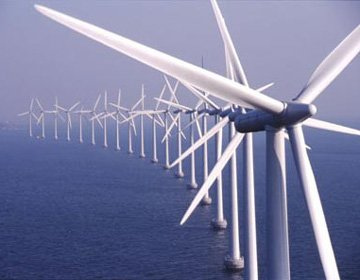
The headline answer given by Mr Huhne is that we must build thousands more giant wind turbines.

As a 24-carat green ideologue, he is viscerally opposed to replacing the ageing nuclear and coal-fired plants which currently provide us with more than half our electricity.

Like Tony Blair and Gordon Brown before him, he dreams we can somehow fill that gap by erecting 6,000 wind turbines in the seas around Britain’s shores, and thousands more across many of the most beautiful parts of our countryside.

What is truly terrifying about Mr Huhne as our energy minister is that he seems so astonishingly ignorant about even the most basic principles of how electricity is produced.

He boasts about how the 3,000 wind turbines we have already built have the ‘capacity’ to generate 4.5 gigawatts of electricity.

Capacity is the crucial word here. As he could see from figures on his own department’s website, thanks to the fact that the wind blows only intermittently, the amount of power these windmills actually produce is barely a quarter of that.

In other words, the amount of electricity generated by all those turbines put together, at a cost of billions of pounds, is no more than that provided by a single medium-size conventional power station – equivalent to a mere two per cent of the electricity we need.

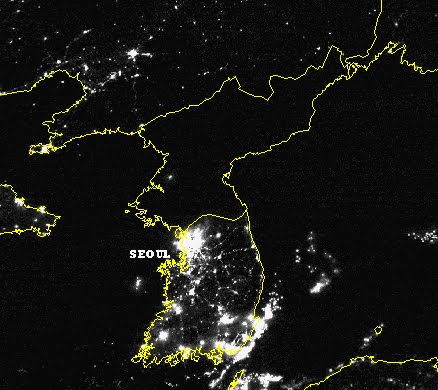
The lights will be going out in the UK pretty soon.

READ IT ALL.

UK Climate Madness: switch off motorway lights to reduce emissions


The UK will soon look like North Korea

Never mind the fact that, you know, drivers might need them to, er, see where the f**k they’re going? Another example of utter, total, jawdroppingly stupid moonbattery from the UK, and yet another example of where imaginary, computer-modelled deaths from climate change will be spared at the expense of real deaths in car accidents from unlit motorways.

The Highways Agency announced that an eight-mile stretch of the M6 in Lancashire would be the seventh site in England where the lights are turned off between midnight and 5am. The quango, which is responsible for more than 4,000 miles of motorway and trunk road, said the move will save money and carbon emissions and even stop light pollution.

Andy Withington, the area performance manager for south Lancashire, said only quiet stretches of road are chosen [oh, that’s OK then] and pointed out that junctions, where most accidents happen, will be lit.

“This is the seventh site in England and we expect it to work as successfully as everywhere else – achieving up to a 40 per cent saving in carbon emissions and energy use as well as giving local communities reduced light pollution of the night sky,” he said.

There is literally no end to the madness.

Read it here.

UK windfarms being paid to turn off turbines


Spectacular failure

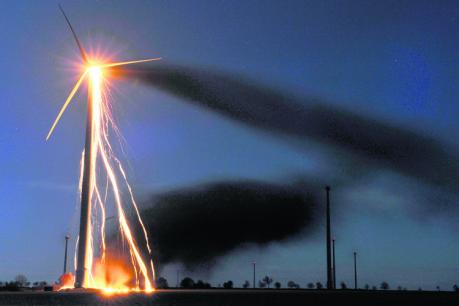
No, you did read that correctly. Wind farms are being paid to turn off their turbines – even when the wind is blowing! But hang on a minute, isn’t wind power a key plank in the whole “green economy” that we’re seamlessly transitioning towards? Aren’t we supposed to be able to decommission our coal and gas fired power stations and rely on wind and solar instead? From the UK Telegraph:

Energy firms will receive thousands of pounds a day per wind farm to turn off their turbines because the National Grid cannot use the power they are producing.

Critics of wind farms have seized on the revelation as evidence of the unsuitability of turbines to meet the UK’s energy needs in the future. They claim that the ‘intermittent’ nature of wind makes such farms unreliable providers of electricity.

The National Grid fears that on breezy summer nights, wind farms could actually cause a surge in the electricity supply which is not met by demand from businesses and households.

The electricity cannot be stored, so one solution – known as the ‘balancing mechanism’ – is to switch off or reduce the power supplied.

The system is already used to reduce supply from coal and gas-fired power stations when there is low demand. But shutting down wind farms is likely to cost the National grid – and ultimately consumers – far more. When wind turbines are turned off, owners are being deprived not only of money for the electricity they would have generated but also lucrative ‘green’ subsidies for that electricity.

The first successful test shut down of wind farms took place three weeks ago. Scottish Power received £13,000 for closing down two farms for a little over an hour on 30 May at about five in the morning.

Can we finally abandon this nonsensical “green economy” myth now please?

Read it here. (h/t WUWT)