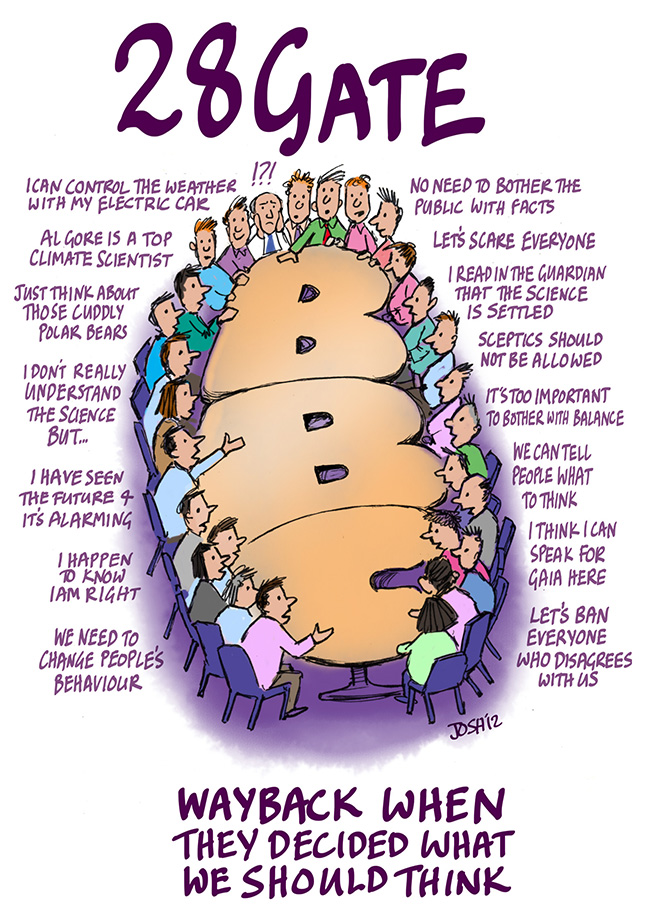
BBC’s shameful climate propaganda seminar exposed


Activists, all of them...

Activists, all of them…

I wonder how much of the same goes on at our own publicly funded broadcaster? Probably all of it.

Whenever there is a climate change story to be covered, the ABC will rush to its favourites: David Karoly (alarmist), Matthew England (alarmist), Clive Hamilton (Green, activist), Stephan Lewandowsky (“scepics are conspiracy theorist fruit cakes”), Will Steffen (alarmist), Tim Flannery (alarmist), and the list goes on.

After lawyering up and spending thousands of licence fee payer’s cash on opposing Freedom of Information requests, the story is finally out, as the Daily Mail reports:

The BBC has spent tens of thousands of pounds over six years trying to keep secret an extraordinary ‘eco’ conference which has shaped its coverage of global warming, The Mail on Sunday can reveal.

The controversial seminar was run by a body set up by the BBC’s own environment analyst Roger Harrabin and funded via a £67,000 grant from the then Labour government, which hoped to see its ‘line’ on climate change and other Third World issues promoted in BBC reporting.

At the event, in 2006, green activists and scientists – one of whom believes climate change is a bigger danger than global nuclear war – lectured 28 of the Corporation’s most senior executives.

Then director of television Jana Bennett opened the seminar by telling the executives to ask themselves: ‘How do you plan and run a city that is going to be submerged?’ And she asked them to consider if climate change laboratories might offer material for a thriller.

A lobby group with close links to green campaigners, the International Broadcasting Trust (IBT), helped to arrange government funding for both the climate seminar and other BBC seminars run by Mr Harrabin – one of which was attended by then Labour Cabinet Minister Hilary Benn.

Applying for money from Mr Benn’s Department for International Development (DFID), the IBT promised Ministers the seminars would influence programme content for years to come.

The BBC began its long legal battle to keep details of the conference secret after an amateur climate blogger spotted a passing reference to it in an official report.

Tony Newbery, 69, from North Wales, asked for further disclosure under the Freedom of Information Act. The BBC’s resistance to revealing anything about its funding and the names of those present led to a protracted struggle in the Information Tribunal. The BBC has admitted it has spent more than £20,000 on barristers’ fees. However, the full cost of their legal battle is understood to be much higher.

Read it all, then go and visit Tony’s blog: Harmless Sky

Greens to wither back to irrelevancy


Not so much Green, as brown… and dead.

Not so much Green, as brown… and dead.

For a few brief months, their star shone bright. Bob Brown, Christine Milne, Sarah Hansen-Young and their band of environmental ideologues basked in the limelight of being junior partner in a coalition of convenience with a desperate minority Labor government.

With their grubby hands finally on the levers of power, the Australian people were treated to a staggering display of ignorance, ineptitude, naiveté, extreme green dogma and ivory-tower logic that was quite the spectacle. In doing so, Labor’s support from its blue collar power base evaporated, allowing Tony Abbott to win government last September in a landslide.

Federal Labor abandoned the extreme left activists ages ago (too late to save their electoral prospects, however), and now the Labor premier in Tasmania is expected to axe the agreement with the Greens as soon as Monday. Not unexpectedly, the knives are out. Union leader Paul Howes yesterday:

“The Greens are a separate, different, independent political force whose views and ideology are contrary to the views and ideology of the labour movement.

“We don’t think it is in the interests of the labour movement to be forming formal allegiances with the Greens.”

Mr Howes said the Tasmanian experience, and the failure of the federal power-sharing agreement between the Greens and the Gillard government struck in 2010, showed the Greens were “not trustworthy”.

He took particular aim at Mr McKim for publicly undermining investment in mining projects in the Tarkine region and the proposed Tamar Valley pulp mill. “Nick McKim has behaved atrociously during his time in that cabinet and hasn’t acted like a normal member of any other cabinet,” Mr Howes said.

I suppose we should be glad that some in the Labor party have come to their senses.

Now, however, we can delight in watching the Greens wither and shrivel as they retreat to the political irrelevancy to which they belong. Theirs is a failed ultra-left agenda which is completely at odds with the views of the vast majority of the Australian people – the exception being inner-city urban trendoids who rarely leave the cosy surroundings of Brunswick or Ultimo and have no understanding of the real environmental issues that the country faces.

And if that weren’t galling enough, on a global scale, the Green movement is losing at every turn. Harsh realities, to which the ivory-tower-bound Greens are oblivious, such as the need to keep the lights on in many European countries, has resulted in a rapid return to cheap, dependable coal, over expensive and unreliable wind and solar, ensuring that emissions will continue to rise. Not only that, but massive expansion in coal production in both India and China over the next few decades will ensure that extremist environmental dogma will slip further into the dustbin of history.

The Australian has a lengthy article on the subject here.

Of course, we should all aim to use finite resources sparingly, avoid despoiling the environment, conserve water – these are all common sense actions any reasonable person would take. However, crippling our economies with pointless “weather taxes”, depriving the world’s poorest of a cheap source of energy, and subsidising inefficient, expensive and unreliable renewables is not what people (or governments, it seems) want.

The Greens are feeling the sharp end of those sentiments right now.

Paper: ‘no clear increase in blocking’


US-blockingA paper, accepted for publication in Geophysical Research Letters just two days ago, challenges the warmist hypothesis that reducing ice in the Arctic is causing more blocking events resulting in more frequent instances of extreme weather. The paper, by Elizabeth Barnes, is available in PDF here.

Given the weather in the US at the moment (see previous post here), which the headbangers are using as evidence of extreme weather arising from Arctic warming, the paper shows how difficult it is to make such a link. From the abstract (my emphasis):

Observed blocking trends are diagnosed to test the hypothesis that recent Arctic warming and sea ice loss has increased the likelihood of blocking over the Northern Hemisphere. To ensure robust results, we diagnose blocking using three unique blocking identification methods from the literature, each applied to four different reanalyses. No clear hemispheric increase in blocking is found for any blocking index, and while seasonal increases and decreases are found for specific isolated regions and time periods, there is no instance where all three methods agree on a significant trend. Blocking is shown to exhibit large interannual and decadal variability, highlighting the difficulty in separating any potentially forced response from natural variability.

Of course, the paper has provoked the ire of the true believers, in particular a certain Jennifer Francis, for whom this appears to be her pet theory. She gave an interview back in August last year, when the paper was first made public, in which she questions the ‘motivation’ of the author, and labels Barnes’ approach “less than objective” and “a direct attempt to disprove [Francis’] work”.

Judith Curry expresses the views of the majority reading such comments:

So why on earth would Elizabeth Barnes be out to ‘get’ Jennifer Francis and discredit her work?  Its very hard to imagine a reason, beyond the obligation of a scientist to challenge existing findings and push forward at the knowledge frontier.

JC message to Jennifer Francis:  I’ve found that your credibility is reduced and your own motivations are questioned when you attack the motives of another scientist, particularly a young scientist without any apparent agenda beyond doing good science and advancing her academic career.  The high ground is a much better place to be, and not just in a hurricane.

US: Freezing weather is global warming in disguise


Proving a negative

Proving a negative

Damn tricky this global warming.

The US is currently experiencing one of the worst periods of cold weather for some time, with temperatures down to -40s, and of course it was only a matter of time before somebody linked it to ‘global warming.’

As we all know, AGW is the unfalsifiable hypothesis to end all unfalsifiable hypotheses. Nothing can disprove it, and any weather phenomenon you care to mention can be regarded as ‘not inconsistent with global warming’.

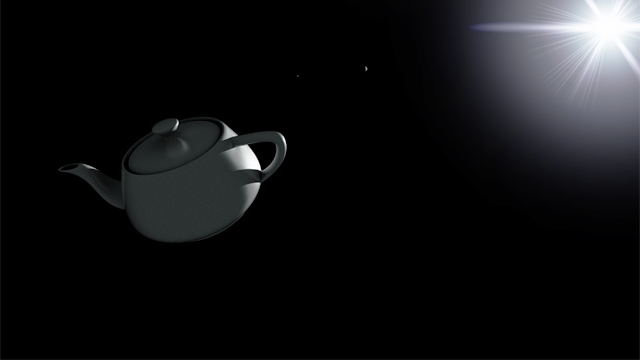
Bertrand Russell’s teapot, allegedly orbiting in an elliptical orbit somewhere between Earth and Mars isn’t much different – impossible to disprove, and almost as ludicrous as the ‘global warming causes everything’ refrain.

In the words of Karl Popper, what is unfalsifiable is unscientific, and therefore pseudo-science, climate astrology, reading the tea-leaves.

That doesn’t stop Time magazine, however, which reports:

But not only does the cold spell not disprove climate change, it may well be that global warming could be making the occasional bout of extreme cold weather in the U.S. even more likely. Right now much of the U.S. is in the grip of a polar vortex, which is pretty much what it sounds like: a whirlwind of extremely cold, extremely dense air that forms near the poles. Usually the fast winds in the vortex—which can top 100 mph (161 k/h)—keep that cold air locked up in the Arctic. But when the winds weaken, the vortex can begin to wobble like a drunk on his fourth martini, and the Arctic air can escape and spill southward, bringing Arctic weather with it. 

What does that have to do with climate change? Sea ice is vanishing from the Arctic thanks to climate change, which leaves behind dark open ocean water, which absorbs more of the heat from the sun than reflective ice. That in turn is helping to cause the Arctic to warm faster than the rest of the planet, almost twice the global average. The jet stream—the belt of fast-flowing, westerly winds that essentially serves as the boundary between cold northern air and warmer southern air—is driven by temperature difference between the northerly latitudes and the tropical ones. Some scientists theorize that as that temperature difference narrows, it may weaken the jet stream, which in turns makes it more likely that cold Arctic air will escape the polar vortex and flow southward. Right now, an unusually large kink in the jet stream has that Arctic air flowing much further south than it usually would.

Just as a cold spell does not disprove climate change, a hot spell does not prove it. Any number of arguments can be advanced to link a particular weather event to global warming, just as the same number of different arguments could be applied to link such an event to something else, like the Green Climate Monster, who I personally blame for all occurrences of extreme weather:

Blamed for more extreme weather

Blamed for more extreme weather

ACM on Chris Turney and the Akademik Shokalskiy fiasco


Enjoy…! Right click for menu to play again.

Australia warming at just 0.1C per decade, despite 2013 being “hottest year”


Catastrophic warming?

Catastrophic warming? Click to enlarge

The ABC/Fairfax media axis has been hard at work plugging the “hottest year on record” meme, my response to which is, so what?

The planet has been warming slowly since the Little Ice Age, and so it is hardly surprising that this decade is warmer than the last, and that individual years in the recent past are likely to be warmer than earlier years as well.

But to read the breathless reporting of this fact on the ABC and the Bureau of Meteorology websites, you would think that this is something shocking. The ABC:

Australia has just sweltered through its hottest year on record, according to the Bureau of Meteorology. Average temperatures were 1.20 degrees Celsius above the long-term average of 21.8C, breaking the previous record set in 2005 by 0.17C, the bureau said in its Annual Climate Statement.

All states and territories recorded above average temperatures in 2013, with Western Australia, Northern Territory and South Australia all breaking annual average temperature records. And every month of 2013 had national average temperatures at least 0.5C above normal, according to the statement.

The country recorded its hottest day on January 7 – a month which also saw the hottest week and hottest month since records began in 1910. A new record was set for the number of consecutive days the national average temperature exceeded 39C – seven days between January 2 and 8, 2013, almost doubling the previous record of four consecutive days in 1973.

The highest temperature recorded during 2013 was 49.6C at Moomba in South Australia on January 12, which was the highest temperature in Australia since 1998. Further, with mean temperatures across Australia generally well above average since September 2012, long periods of warmer-than-average days have been common, with a distinct lack of cold weather, the statement says. (source)

The BoM’s Annual Climate Statement is a picture of alarmism, with scary graphics implicitly linking every weather event during the year to man-made climate change.

Yes, 2013 was warm in Australia, but 2010, 2011 and 2012 were cooler – it’s what the climate does.

Despite all the hyperventilating, the BoM’s own data show a temperature increase of only 0.1C per decade since 1979, equating to a 1C increase over a century. In the same period, atmospheric CO2 has increased by 18%, from 340ppm to 400ppm. UAH data for the same period actually shows slightly larger warming of 0.16C (data here in the AUST column).

With the Sherwood paper predicting increases of 4C by 2100, the rate of warming would have to more than quadruple (to 0.44C/decade) to reach that level. And how likely is that?

What would you do if all your models overestimated warming and a ship investigating Antarctic climate change was stuck in ice?


That's the only consensus there is…

That’s the only consensus there is…

You’ve guessed it – come up with a new model which increases warming still further! As the Fairfax/Guardian/ABC media axis reports:

Climate change models underestimate likely temperature rise, report shows

Forecasts predicting less global warming fail to properly take into account cloud formation, say scientists.

The Earth’s climate is far more sensitive to carbon dioxide emissions than previously thought, heightening the likelihood of a 4C temperature rise by 2100, new Australian-led research of cloud systems has found.

The study, published in Nature, provides new understanding on the role of cloud formation in climate sensitivity – one of the key uncertainties in predictions of climate change.

Report authors Steven Sherwood, Sandrine Bony and Jean-Louis Dufresne found climate models which show a low global temperature response to CO2 emissions do not factor in all the water vapour released into the atmosphere.

As you can see from the graphic, the models are already overestimating warming. Sherwood, who is an Australian from the University of New South Wales (the shame, the shame…), said:

“Climate sceptics like to criticise climate models for getting things wrong, and we are the first to admit they are not perfect, but what we are finding is that the mistakes are being made by those models which predict less warming, not those that predict more.”

I’m having trouble seeing which of those models are predicting less warming that that which we have actually had in the last 15 years, since all of them comfortably exceed the satellite record. Wait, I forgot. Atmospheric temperatures don’t matter any more (despite being the most important measure of global temperature for centuries), having been replaced by the missing “ocean heat” – i.e. the “dog ate my warming” theory.

And ACM’s least favourite alarmist, David Karoly, gets hot under the collar (again) because Maurice Newman blamed manufacturing decline on “climate madness”:

From the UN down, the climate change delusion is a gigantic money tree. It is a tyranny that, despite its pretensions, favours the rich and politically powerful at the expense of the poor and powerless. But the madness of the crowds is waning and, as Mackay writes of the perpetrators: “Punishment is sure to overtake them sooner or later.” We can only hope it comes before most of us descend into serfdom.

P.S. You can keep up with all the MV Akademik Shokalskiy hilarity at WUWT.

[Update 2 Jan: post title corrected]

‘Mediacracy’ creates consensus


"Stop telling me what to think!"

“Stop telling me what to think!”

People don’t have to think for themselves any more, because the media does it for them.

The ABC, like the BBC in the UK and the majority of mainstream media outlets in the US, parrots the same liberal-left slant on every story, including the absolute belief in the alarmist position on climate change. Daniel Greenfield writes:

A nation where governments are elected by the people is most vulnerable at the interface between the politicians and the people. The interface is where the people learn what the politicians stand for and where the politicians learn what the people want. The bigger a country gets, the harder it is to pick up on that consensus by stopping by a coffee shop or an auto repair store. That’s where the Mediacracy steps in to control the consensus.

The media is no longer informative, it is conformative. It is not interested in broadcasting events unless it can also script them. It does not want to know what you think, it wants to tell you what to think. The consensus is the voice of the people and the Mediacrats are cutting its throat, dumping its body in a back alley and turning democracy into their own puppet show.

Media bias was over decades ago. The media isn’t biased anymore, it’s a player, its goal is turn its Fourth Estate into a fourth branch of government, the one that squats below the three branches and blocks their access to the people and blocks the people’s access to them. Under the Mediacracy there will still be elections, they will even be mostly free, they just won’t matter so long as its upper ranks determine the dialogue on both sides of the media wall.

The Mediacracy isn’t playing for peanuts anymore. It’s not out to skew a few stories, it’s out to take control of the country. In military empires, the military can act as a Praetorian Guard. In political empires, it’s the people who control the political conversation who also control the succession.

The remainder of the article looks at the US angle, but from an Aussie perspective, so much of this is applicable.

We have the ABC, a conservative-free zone, which never, EVER, reports any story about climate change which challenges the accepted consensus, and which demonises and ridicules those who do, supported by liberal-left academics who claim that any media outlet which does, or which criticises their politically correct opinions, is part of an evil “hate media” which should be muzzled by legislation.

For those of the population which rely on the ABC for their news, there is no doubt about climate change, just as Tony Abbott is as wicked as John Howard, and that Julia Gillard had nothing to do with a union slush fund which was allegedly defrauded by her ex-boyfriend.

Fortunately, however, the media cannot control the direct effects of their agenda on the population, such as losing one’s job or house because the economy has slumped, or losing one’s property rights because of crazy planning laws resulting from climate change alarmism, and people wake up to realise they have been duped.

We can see this happening in Australia, as more and more people are discovering just how much of a lefty echo-chamber the ABC has become. Despite all attempts by the ABC to derail Abbott and the Coalition at the election in September, the people weren’t fooled, and for that we should be grateful.

Extreme weather deaths at lowest ever despite ‘global warming’


Rocketing downwards

Rocketing downwards

If ‘global warming’ is such a big problem, and extreme weather events are becoming more common and more intense, we should expect deaths from such events, both in absolute and specific terms, to be increasing. But they aren’t. In fact, they have plummeted in the last century, as the graphic on the right shows (click to enlarge)†.

And in case you’re wondering what happened after 2008, the figures for 2009—2013 are continuing to decline even further, with deaths per year down to under 25,000 for this most recent period.*

Why is this? It’s not because extreme weather events are decreasing – increased reporting, better communication and greater population spread in remote areas has meant such events have increased significantly. No, it’s because as global wealth has steadily increased, our ability to deal with such events has improved out of sight. Better adaptation, construction and planning, affordable thanks to economic progress, has enabled a much larger population to cut death rates from 241 per million per year to just 5.

As Fraser Nelson writes in The Spectator (and to whom the hat is duly tipped):

We tend not to hear about all this because journalists, like politicians, are in the business of identifying and drawing attention to problems. And rightly: it’s human nature to be never satisfied, to always raise the definition of success, to always strive for something better. For as long as food banks remain needed, for as long as people are sleeping rough in Britain and hungry in Asia, for as long as anyone dies of a preventable disease like Malaria then there’s still plenty to be outraged about.

But what is going wrong with the world is vastly outweighed by what is going right.And the run of depressing news stories can actually blind us to the greatest story of our age: we really are on our way to making poverty history. Thanks to the way millions of people trade with each other, via a system known by its detractors as global capitalism.

It’s a story that no one organisation or government can take credit for – and a story that doesn’t particularly suit anyone’s agenda. But the story is there, for those with an eye to see it.

I don’t believe there can be a clearer message from these data – crippling the global economies with pointless carbon taxes will not change the weather, and will seriously hamper our ability to adapt to and prepare for whatever climate change may occur in the future, be it warming or cooling.

† from Goklany (2009), available here (PDF) * Data is here.

Group-think described


Group-think rules…

Group-think rules…

Christopher Booker, writing in the UK Telegraph, points to a fascinating extract from a book entitled “The Blunders of our Governments” by Anthony King and Ivor Crewe. The extract in question refers to the work of an American psychology professor in the 1960s, Irving J. Janis, who studied the cultural phenomenon of group-think.

When reading the following paragraphs, keep in the forefront of your mind the following:

  • the ABC (and its ideological twin the BBC);
  • John Cook and Dana Nuccitelli of Skeptical Science;
  • Stephan Lewandowsky and his psychology mates, and
  • the majority of the ‘consensus’ community in climate science

and see how much of it can be applied to them.

Janis became intrigued by a sequence of unfortunate episodes in modern American history that seemed to him to display a number of common characteristics: the Roosevelt administration’s faiure in 1941 to prepare for a Japanese attack on Pearl Harbor; the Truman administration’s rash decision in late 1950 to invade North Korea; the launching of President John F. Kennedy’s clownish Bay of Pigs expedition in 1961; and Lyndon B. Johnson’s escalation of American involvement in the Vietnam War during the mid-1960s. To that original list, he later added President Richard M. Nixon’s attempt to cover up his own and his henchmen’s complicity in the notorious Watergate break-in of 1972.

According to Janis, whose views are now almost universally accepted, group-think is liable to occur when the members of any face-to-face group feel under pressure to maintain the group’s cohesion or are anyway inclined to want to do that. It is also liable to occur when the group in question feels threatened by an outside group or comes, for whatever reason, to regard one or more outside individuals or groups as alien or hostile. Group-think need not always, but often does, manifest itself in pathological ways. A majority of the group’s members may become intolerant of dissenting voices within the group and find way, subtle or overt, of silencing them. Individual group members may begin to engage in self-censorship, suppressing any doubts they harbour about courses of action that the group seems intent on adopting. Latent disagreements may thus fail to surface, one result being that the members of the group come to believe they are unanimous when in reality they may not be. Meanwhile, the group is likely to become increasingly reluctant to engage with outsiders and to seek out information that might run counter to any emerging consensus. If unwelcome information does happen to come the group’s way, it is likely to be discounted or disregarded. Warning signs are ignored. The group at the same time fails to engage in rigorous reality-testing, with possible alternative courses of action not being realistically appraised.

And the following paragraph could have been written for our friend Professor Lewandowsky:

Group-think is also, in Janis’s view, liable to create “an illusion of invulnerability, shared by most or all the members, which creates excessive optimism and encourages taking extreme risks”. Not least, those indulging in group-think are liable to persuade themselves that the majority of their opponents and critics are, if not actually wicked, then at least stupid, misguided and probably self-interested.

Denial, conspiracy ideation, extreme free-market adherents – add those to the list and we’re done! It continues:

Irving Janis’s own conception of group-think is tightly bounded. It refers only to situations in which members of a face-to-face group feel, consciously or subconsciously, a need to maintain the internal cohesion of the group. It is, in that sense, a purely psychological concept. But of course the notion of group-think can be extended and used more widely to refer to a variety of situations in which there exists such widespread agreement among the members of a group about the desirability of a given course of action that no threats to the group’s internal cohesion ever arise. Because there really are no dissenters in the group, no one in the group ever expresses dissent. There are no nay-sayers. Everyone is agreed. But such situations can be just as dangerous as the ones Janis describes. The decision-making processes associated with unforced agreement may be just as defective as the ones associated with suppressed dissent.

As Booker concludes:

[Janis’s] account of “the illusion of unanimity”, and how group-thinkers regard anyone daring to question their belief-system as an “enemy” to be discredited, superbly characterises the mentality of that small group of “climate scientists” at the heart of driving the warming scare. This was never more clearly brought home than by those Climategate emails, showing how they were ready to fiddle their data to promote what they themselves called “the cause”, and to suppress the views of any scientists they saw as a threat to their illusory “consensus”. We all casually use the term “group-think”, but I had not known how comprehensively Janis explains so much that is puzzling about this world we live in.

Perhaps Cook, Lew, Nuccitelli and the rest of the “consensus” crew should take a good, long, hard look in the mirror now and again, instead of applying pseudo-psychology to their critics.