WSJ: "When you're a hammer, everything looks like a nail"


WSJ Online

Some wonderful letters in the Wall Street Journal in response to Trenberth et al‘s response to that letter:

As for Mr. Trenberth’s heart-surgeon analogy: You might be better off consulting an intelligent generalist, probably not a dentist, but a primary-care physician who could recommend exercise and diet change before undergoing unnecessary and potentially dangerous surgery. Heart surgeons tend to recommend surgery more often than nonsurgeons because specialists are easily biased by their specialization. When you’re a hammer, everything looks like a nail.

The letter from Kevin Trenberth and his colleagues is straight out of the Saul Alinsky playbook: Marginalize your opponents by demeaning them (“dentists practicing cardiology”); state your position without definitive support (“observations show unequivocally” and computer models show); explain away statements that compromise your position by claiming they were taken out of context; restate your position in such a manner that it looks as if the issue is settled, even when it isn’t (“the science is clear: The world is heating up and humans are primarily responsible”) and then restate it again because if you say it often enough, people just might believe it (“climate change is real and human caused”); and, finally; call for federal funding to remedy the apparent impending crisis (“investing in the transition to a low-carbon economy . . . [is] just what the doctor ordered”). No thanks. I’m glad we got a second opinion, even if it was from a dentist.

The Trenberth letter is little more than an appeal to authority masquerading as a scientific argument. It casts no light, therefore, on the actual substance of the issues, particularly given the corruption of the peer-review process made clear by the East Anglia University emails. The most revealing sentence in the Trenberth letter is the statement that computer models show that smaller increases in surface temperatures are accompanied by warming “elsewhere in the climate system.” Sorry, computer models do not “show” anything. They make predictions that must be tested against the evidence, which in the global-warming context is deeply problematic. Mr. Trenberth’s models may be a magnet for government grants, but their usefulness for policy is far from clear.

Great stuff. Read them all here.

Island states want "climate justice"


Sinking?

Island states that claim they are being threatened by “climate change” are considering taking the matter to the International Court of Justice:

The International Court of Justice should take action against states unwilling to combat the causes of climate change, according to the President of the Pacific island of Palau.

President Johnson Toribiong was speaking [link to UN document] at the United Nations Headquarters in New York, after meeting the Prime Minister of Grenada to discuss his proposals.

The Palau President wants the International Court of Justice to force states to take action to cut their carbon emissions – a plan he first announced to the General Assembly in September 2011.

“While we continue to negotiate, we should renew our faith in a system of law that has guided States’ actions in the past and gives them legitimacy today,” he said.

“The rule of law must reflect the interests of the entire international community – for us, it’s about survival.”

The proposal would see the International Court of Justice provide an advisory opinion on damages from climate change, a move the President insists would complement the UNFCCC’s efforts to build a binding treaty through negotiation.

Palau’s Permanent Representative to the UN Stuart Beck says roads are unusable and staple crops have been threatened in Palau and other Pacific nations because of the rising sea waters. (source)

An opportunity to get the climate alarmists’ case before a court to be cross-examined in a judicial environment sounds too good to miss. The claimants will have to prove an extremely long chain of causation, namely that the rising sea levels are a result of rising temperatures, which are themselves a result of increased CO2 emissions, which are a result of man’s burning of fossil fuels.

They will also hope they can explain away all the confounding factors – natural climate change, solar variation, sinking landmasses – that might break that chain.

Some states, like the Maldives, will need to explain why they are building new airports whilst at the same time claiming compensation for sinking islands…

Good luck with that. Although with the UN on their side, justice will no doubt disappear out of the window…

Cambridge Engineering professor on climate


Mike Kelly

Richard Black has a piece up at the BBC about consensus in which his shaky point (I think) is that sceptics are just as bad as alarmists because they keep saying that the “consensus” is broken – or something – thereby acknowledging that consensus is important – or something.

Black is an eco-headbanger, so despite relying on the existence of the “consensus” for the last billion articles or so to justify his AGW alarmism, suddenly he’s happy to throw it under a bus if it gives him the opportunity to diss a few crazy deniers. Weird.

Anyway, what was of more interest to me (having read Engineering at Cambridge a fairly long time ago) was the views of one of its current professors, Michael Kelly, one of the signatories of that WSJ letter, whom Black interviewed for the article:

His basic position is that the kind of energy transformation through which the UK, for example, is planning to go is really tough to achieve in engineering terms, and would be financially ruinous.

To meet the goals of the Climate Change Act (notably an emissions cut of 80% from 1990 levels by 2050) he argues that “we’d really need a command economy of the kind we had in World War 2 if we were really serious about meeting the targets in full.

“What we need to do will bankrupt us if we really go for it and ignore the rest of the world.”

He would, he says, still endorse the rapid transformation if he thought the scientific evidence for needing it was compelling.

“Are you convinced that the world’s going to hell in a handbasket on the basis of the predictions and what’s been happening for the last 10 or 12 years?

“The answer is simply ‘no’.

“I look back 300 years and I find that the temperature went up by more than it’s gone up recently – in Central England from about 1699 to 1729 it went up by nearly 2C – and nobody said that was carbon dioxide.”

(UPDATE by Black: The full CET time series is graphed here, while one of the original science papers on analysis of its early years is here)

Other components of his argument are that money is better spent on aid to Africa than on a dash to renewables, that higher CO2 levels will boost plant growth, that current climate models are not trustworthy – in particular, because they project an acceleration of warming whereas over the last 17 years we have seen a deceleration – and that wind turbines may be left derelict in future when the cost of replacing the nascelles proves uneconomic.

He also cites a recent study on ocean acidification showing that natural short-term variability in ocean pH is greater than the change in the average projected to occur over the next century or so.

And he has a bet with other Fellows of the Royal Society that temperatures during the current decade will be lower, on average, than during the preceding one, the stake being a case of wine.

All of the points above are challengeable, and – playing Devil’s advocate – I did challenge him on some.

What we agreed on is that formulating climate change polity is first and foremost a question of risk judgement.

In Prof Kelly’s view, the risks of rushing into a low-carbon future, as opposed to taking the transition more slowly, outweigh the risks of not doing so; hence the WSJ article’s title, “No need to panic”.

I’m sure his arguments will find favour with many regular readers, and equally infuriate many others who contend that political leaders aren’t panicking enough.

But it is surely the arguments themselves that ought to be the focus for discussion – not what they purport to say about a cracking consensus. (source)

Suddenly it’s all about the arguments and not about consensus. How amusing, especially coming from Black.

Bob Carter's Climate Review Part 2


Climate sense

Part 2 of Bob Carter’s Climate Review in Quadrant Online is now available:

January to June, 2011

Stimulated by research spending of billions of dollars, inexorably, and month by month. torrents of new scientific information appear that are relevant to the twin issues of global warming and climate change.

No one scientist, or group, can possibly absorb and précis accurately the full range of this literature, though valiant efforts are made both by the IPCC and by its essential counterpart, the Non-governmental International Panel on Climate Change(NIPCC).

To date, research findings are consistent with a largely natural, though still incompletely understood, origin for modern climate change. Discounting virtual reality computer model studies, no recent paper has provided empirical evidence that dangerous human-caused global warming is occurring; and neither the atmosphere nor the ocean are currently warming despite the continuing increases in atmospheric carbon dioxide.

With no pretence of being comprehensive, Parts II and III of this Review provide summaries of a representative selection of events, enquiries and new scientific publications that occurred in 2011 and were germane to the topic of global warming.

33 of these events are analysed, presented in the monthly order in which they occurred. A hot-linked index of selected topics, also arranged in date order to match the text, is here.

Provided in parallel, too, are monthly examples of some of the often painfully conflicting, and at times exquisitely ironic, political statements that accompanied the bulldozing of carbon dioxide policy through the Australian parliament, and finally into law on November 8th.

Read it here.

Part 1 is here.

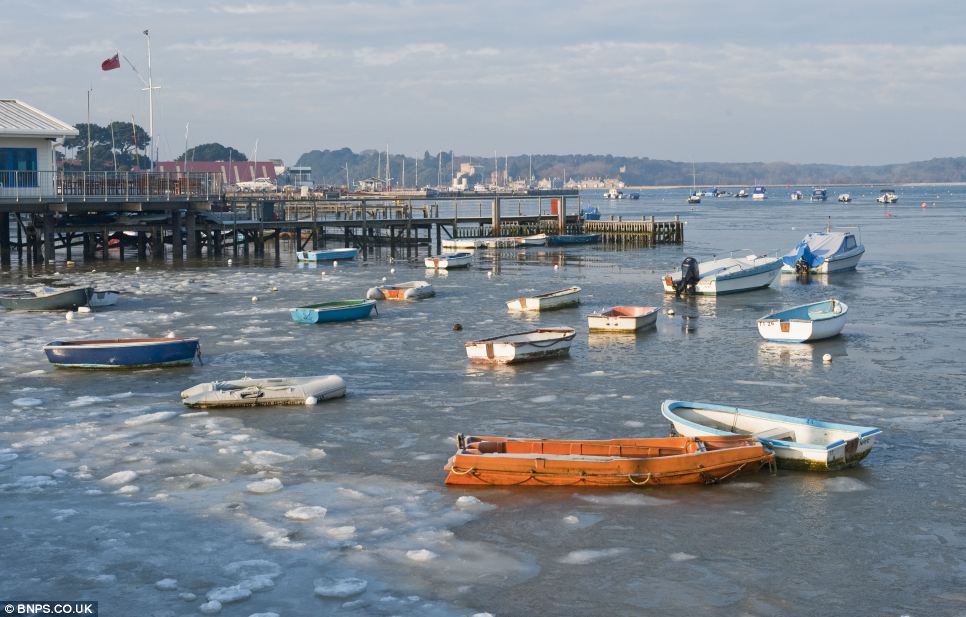
Euro cold snap: The day the sea froze


Freezing Britain

From the Weather Isn’t Climate department. Just as warmer winters are blamed on “global warming” so are colder winters too! Which is it? Both? Yes, of course.

It’s our old friend the unfalsifiable hypothesis. Ask “The Cause” what weather phenomenon would be evidence that man-made global warming was NOT happening and all you would receive in return is a blank stare and a thud as jaw hits ground.

Whatever the real cause, it’s very cold in the UK at the moment (and in much of Europe as well):

  • Temperatures as low as Himalayas overnight, plunging to nearly -11C in Buckinghamshire and Oxfordshire
  • Third of flights out of Heathrow tomorrow cancelled
  • Much of England under ‘Level 3’ cold weather alert, which warns of ‘100% probability’ of severe cold weather, icy conditions and heavy snow
  • Drivers warned to check ‘gritter Twitter’ updates as breakdowns attended by AA double
  • British Gas puts fleet of 4X4s on standby as call-outs soar
  • Salt stocks across Britain stand at 2.4m tons – a million more than last year
  • Sporting events called off including Portsmouth v Hull City Championship football match

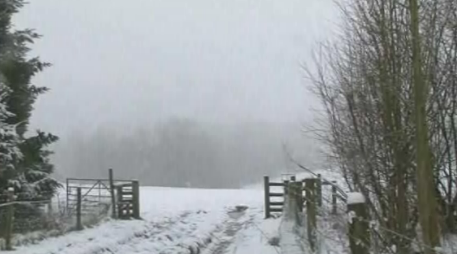
Snow showers are sweeping across Britain tonight – with forecasters warning that most of the country will be covered by snow by the morning.

Widespread snow of up to 15cm deep is forecast to fall overnight across much of the country, with flurries already hitting Scotland, northern England and the Midlands this afternoon.

Up to 15cm of snow is expected to cover parts of Cumbria, Lincolnshire, East Anglia, North Yorkshire, the Peak District and the Midlands, while South East and eastern England is predicted to see up to 10cm of snow fall overnight.

Passengers travelling through Heathrow Airport have been warned that a third of tomorrow’s flights will be grounded, and the RAC has warned of a ‘dangerous cocktail of driving conditions’.

The freezing conditions have caused daytime temperatures to plummet four or five degrees lower than average for February – traditionally the coldest month of the year.

Motorists faced a ‘dangerous cocktail of driving conditions’ while forecasters warned the freezing weather was here to stay.

Kevin Andrews, RAC patrol ambassador, said the wintry weather and sub-zero temperatures had left roads ‘extremely treacherous’.

He added: ‘It looks like we’re going to get a dangerous cocktail of driving conditions this weekend.’

The motoring organisation said it had attended 70 per cent more breakdowns than normal while a spokesman for the AA said it dealt with around 1,500 call-outs per hour this morning.

The total figure was predicted to reach up to 15,000 by the end of the day – almost double the 8,500 of a usual Saturday.

Most parts of the country are expected to wake up to a blanket of snow tomorrow morning, including Cumbria, Lincolnshire, East Anglia, North Yorkshire and the Peak District and temperatures will remain low, with -9C expected in the snowy Midlands.

Meteo Group forecaster Paul Mott said the deep freeze was likely to continue into next week – meaning the snow is likely to settle and much of Britain will remain carpeted in white. (source)

There are also some great photos at the link. And elsewhere in Europe, temperatures have plunged:

TEMPERATURES have plunged to new lows in Europe, where a week-long cold snap has now killed more than 200 people as forecasters warned that the big freeze would tighten its grip at the weekend.

In the Czech Republic, the mercury dropped to as low as minus 38.1 degrees Celsius overnight yesterday while even Rome was sprinkled in snow.

In the past seven days, a total of 218 people have died from the cold weather, according to an AFP tally.

Ukraine’s emergencies ministry said the cold snap had now killed 101 people, substantially raising the previous toll of 63. Sixty-four of the victims died on the streets, it added.

Almost 1600 people have requested medical attention for frostbite and hypothermia.

As they try to prevent the toll from rising even further, authorities announced that 2940 shelters had been set up across the Ukraine where people could find warmth and food and another 100 would be opened in the next hours.
There was no sign of an immediate let-up in the weather, with forecasters saying temperatures would hover between minus 25 to 30 degrees Celsius at night and minus 16 to 21 in the day.

The ferocious temperatures killed eight more people over the past 24 hours in Poland, bringing the death toll to 37 since the deep freeze began a week ago, police said.

Temperatures plunged to as low as minus 35 degrees Celsius in parts of Poland – but even that was three degrees warmer than the temperatures in the southwestern Sumava region of the Czech Republic.

Temperatures have been so cold in Bulgaria that parts of the River Danube have been frozen over.

Sixty per cent of the surface near the port of Ruse was iced over, severely hindering navigation, the Danube exploration agency said.

Elsewhere in Bulgaria, another six people were found dead from the cold, bringing the overall tally to 16 in the past week, according to a tally of local media. No official figures have been released.

Most of the dead in the European Union’s poorest country were people in villages, found frozen to death on the side of the road or in their unheated homes, the reports said.

More than 1000 Bulgarian schools remained closed for a third day on Friday amid fresh snowfalls and piercing winds in the northeast of the country.

Residents in Rome experienced only their second day of snow in the past 15 years. Up to five centimetres of snow fell in suburbs of the Italian capital, although there was little precipitation in the city centre.

Temperatures in the Alpine region of Piedmont in northern Italy went as low as minus 30 degrees Celsius.

And the Met Office, always keen to make sure the public doesn’t get the wrong idea, provides the best quote of all:

The Met Office said there was a danger that the cold weather would catch people off-guard after the warmer-than-normal winter so far. (source)

Not any more it isn’t.

Wall Street Journal war of words continues


Click to enlarge

letter published in the Wall Street Journal on 27 January made the unremarkable and, one would have thought, fairly uncontentious, assertions that global temperatures had flatlined or slowed in the 21st century, that alarmist projections beget more research funding, and that the forecasts of the IPCC were exaggerated. Hardly anything earthshaking in that.

However, since such a letter dilutes “The Cause” and forces the average person to engage their own powers of reasoning, the consensus denial machine (denial of open debate and any kind of climate change other than man-made, that is) swung into action.

Kevin Trenberth and others (including Michael Mann (!), and Aussie alarmists David Karoly and Matthew England) wrote a further letter to the WSJ attempting to rebut the original points and shore up The Cause, relying heavily on the argument from authority (“97% of climate scientists etc” – remember where that figure came from – 75 out of 77 – , various “national academies” agree with us, etc etc), deploying the hackneyed cancer/doctor, smoking/lung cancer, HIV/Aids analogies, claiming that warming hasn’t slowed in the last decade, and that transitioning to a low carbon economy should be a priority. And who said scientists should never get involved in policy?

Patrick Michaels has responded in detail to this letter:

Trenberth et al. is surprisingly weak and incomplete. The 16 original authors are all individuals that are highly competent in their fields, most are physicists of one stripe or another, and all can read and summarize a scientific literature. In fact, most would hold that climate science is nothing more than applied physics.

“Extreme views” lie in the eye of the beholder, and science only grudgingly backs away from established paradigms. For example, despite the obvious jigsaw-puzzle fit of the earth’s continents, it took 100 years of bickering before continental drift was accepted over geological stasis. And, in this case, the “extreme view” of the most prominent climate scientist of the 16, MIT’s Richard Lindzen, is hardly an outrage.

Lindzen holds that the “sensitivity” of surface temperature to changes in atmospheric carbon dioxide has been overestimated because of an inaccuracy in the way that computer models magnify warming. In and of itself, it is mainstream, not extreme, to entertain the hypothesis that doubling carbon dioxide on its own would only cause a bit more than 1 degree (C) of global surface warming. Computer models arrive at much higher values, around 3.5°C, by amplifying the carbon dioxide effect because a slightly warmer atmosphere contains more water vapor, which itself is a potent greenhouse gas. Clouds are also changed in a way that enhances warming. There is evidence from the outgoing radiation signal of the earth that the effects of water vapor and clouds have been overestimated.

The 38 must somehow disagree with Susan Solomon, whose 2010 article in Science attributing the lack of recent warming—that the 39 deny—to unanticipated changes in stratospheric water vapor with no known cause.

The 38 must somehow disagree with the global temperature sensing from satellites, which also shows no net warming for the last 14 years. Now, one could argue that the satellites are measuring temperatures above the surface in the lower atmosphere, but the computer models that the 38 find so accurate, predict that the lower atmosphere should be warming faster than the surface over most of the planet.

Finally “more than 97% of all actively publishing* climate scientists agree that climate change is real and human caused” is probably an underestimate, as virtually everyone acknowledges that the surface temperature is warmer than it was, and that multifarious human activities have some influence on climate. Rather, he misses the point well-made by the original Journal article, which is that the rise in surface temperature is clearly below the values first forecast by the UN in 1990. The core—unsettled—issue in climate science is the “sensitivity” of temperature to carbon dioxide, and there are several independent lines of evidence, including the surface temperature history and the water vapor problems, that argue that it has been substantially overestimated.

In global warming, it’s not the heat, it’s the sensitivity. But don’t expect much sensitivity and expect a lot of heat when climatologists voice their opinions. (source, via WUWT)

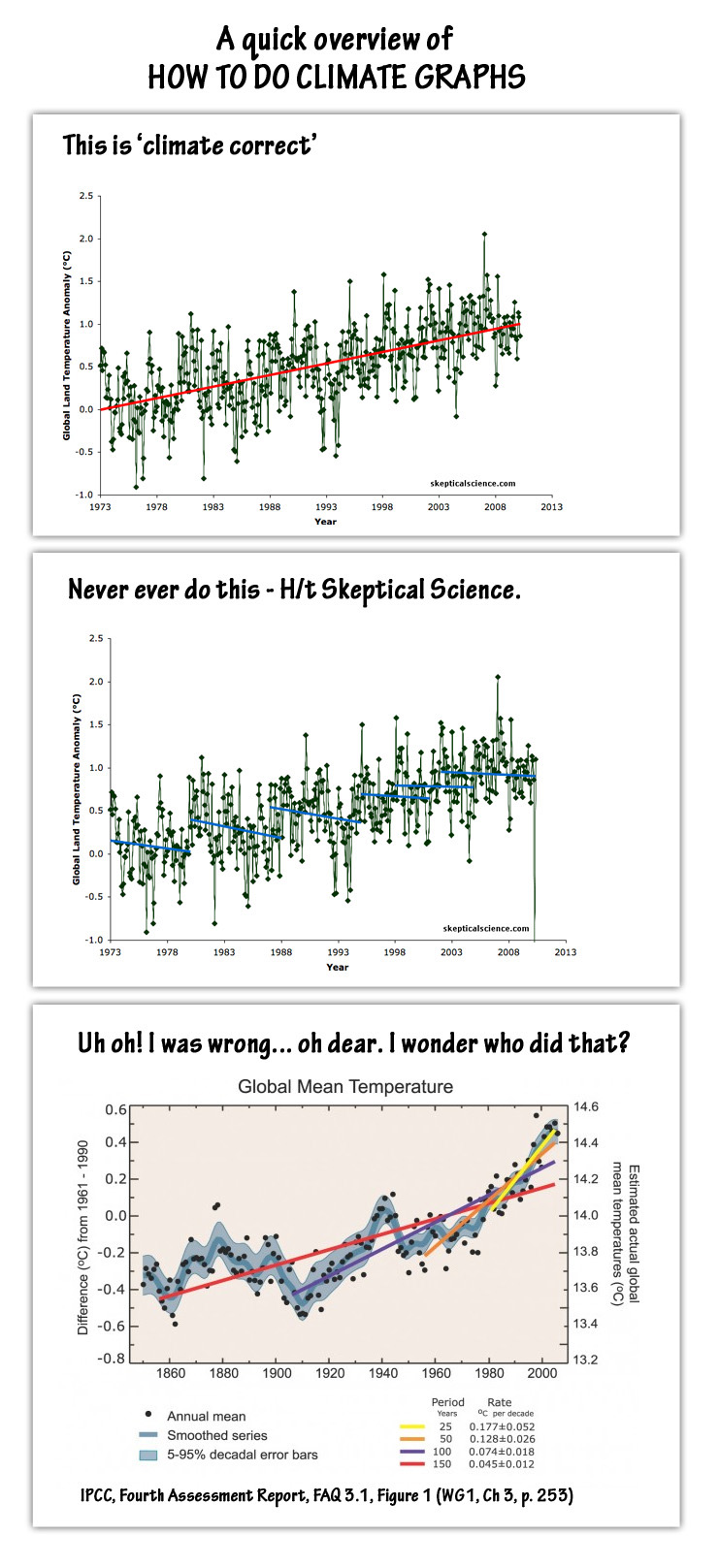
Skeptical Science, home of the smug, fundamentalist climate headbangers, attempted to ridicule any suggestion that global temperatures had plateaued with a smug straw man graph [no link, they’re not having any of my traffic], showing smugly that us dumb sceptics will see declines anywhere in a data set by cherry picking the start and end points (I guess that’s better than hiding the declines, right, Mike and Phil?).

Thankfully, Josh came to the rescue with the sketch above, demonstrating how the IPCC sees accelerating warming in a dataset by, er, cherry picking the start and end points. Oh the ironing. Click to enlarge.

UPDATE: William Kininmonth writes to The Australian on the same subject:

KEVIN Trenberth, responding to an Opinion (to which I was a co-signatory) published in the Wall Street Journal (27/1/12) and The Australian (“Climate change ‘heretics’ refute carbon dangers”, 1/2), claims to have been quoted out of context and misrepresented (“Expertise a prerequisite to comment on climate”, 3/2).

The quote in our opinion is from an email sent by Trenberth to a group of colleagues that became public with the release of emails from the UK University of East Anglia (or climategate). Trenberth wrote: “The fact is that we can’t account for the lack of warming at the moment and it is a travesty that we can’t . . . there should be even more warming: but the data are surely wrong. Our observation system is inadequate.”

The context is an exchange of emails initiated in 2009 in response to a BBC item that there has been no warming since 1998 and that Pacific oscillations will force cooling for the next 20 to 30 years.

Trenberth was certainly lamenting the inadequacy of the observing systems (with which I agree) but at face value he is also acknowledging that the available data do not support warming since 1998. The latter is an inconvenience to the human-caused global warming hypothesis that he and his colleagues are wedded to.

William Kininmonth, Kew, Vic

BREAKING: UK climate change minister resigns


Just like the Belgrano... (image from Guido)

Yesss! Chris Huhne, UK Energy and Climate Change minister (or Mr Windmill 2011, as he should be named) has resigned after being advised he will face charges relating to a speeding violation – but there’s more to it than that.

It’s alleged he arranged for his ex-wife to take penalty points on his behalf, which I guess you would call “perverting the course of justice”, perhaps?

Huhne will not be missed for a nanosecond, by this blog or the poor suffering population of the UK – his dangerous brand of environmental extremism has done more to damage the UK’s economy and future energy security than anyone else in living memory.

Here is a selection of previous posts on Huhne, just for old time’s sake:

Guido Fawkes has more here.

Australian politics update


Parliament House, Canberra

Primarily for our international readers, I thought it might be useful to review the current political situation in Australia. Why? Because if the present government loses power, our famous (or should I say, infamous) carbon tax will go too.

In August 2010, the general election was so close that it came down to three independents holding the balance of power to determine which party formed government. In the end, the independents sided with Julia Gillard’s Labor party, with two of them, Rob Oakeshott and Tony Windsor, betraying their naturally conservative electorates.

Gillard signed a deal with the Greens, effectively buying their support with a promise to take urgent action on climate change. As a result, the carbon tax legislation was enacted and is due to come into force later this year.

Gillard also came to an arrangement with another independent MP, Andrew Wilkie, promising to introduce “pre-commitment” technology on the country’s many “pokies” or slot machines as they are known elsewhere.

However, in the past few months a number of events have occurred which have put Gillard’s minority government on even shakier ground.

Firstly, Labor MP Craig Thomson has been embroiled in a rather unsavoury saga involving allegations concerning the use of a union-funded credit card to procure the services of prostitutes. More of this later.

Secondly, Gillard welched on the pokie deal with Andrew Wilkie, who has withdrawn his support for the Gillard government. Gillard would never have been able to force the legislation through, since pokies are essential to the survival of many Labor-dominated workers clubs in the suburbs. Maybe Gillard forgot this obvious fact when she signed the agreement with Wilkie…

Thirdly, at the end of last year Gillard poached maverick Liberal MP Peter Slipper to take on the role of Speaker of the House of Representatives (a position formerly held by a Labor MP, Harry Jenkins). This added an extra vote to Gillard’s numbers. However, “Slippery Pete” (as he’s affectionately known in the media) has a few issues himself, having been accused of making excessive claims for travel expenses. See Andrew Bolt here for more on this subject.

As for Craig Thomson, allegations are flying that Labor has been involved in delaying the inquiry into Thomson’s actions in order to protect the tiny majority on which it operates. I predict this is going to blow up spectacularly in the next few weeks. Again, Bolt has more here.

Finally, many of you will have seen the appalling pictures of Julia Gillard and Tony Abbott being herded out of a restaurant in Canberra by security staff, after a demonstration by occupiers of the “Tent Embassy”, who are protesting for aboriginal rights (and have been for 40 years).

It transpires that one of Gillard’s own staff tipped off the embassy occupiers (indirectly) that Tony Abbott was in a particular restaurant, fanning the flames by claiming that Abbott said the embassy should be removed. What he actually said was that those at the embassy should “move on” from the 1970s mindset, given that so much has been done to improve the lives of aborigines since then.

Gillard (as always) pleads ignorance (she does however sack the staffer concerned), and the Labor spin machine grinds into action with its default response: blame Abbott. No apology, no remorse, just vicious attacks. Except this time it’s not working, and the few conservative journalists we have here are digging deeper and deeper into this sordid little episode.

So the upshot of this is that Gillard’s wafer thin majority may be compromised from a number of directions in the near future. If there were to be an election now, the Liberals (in coalition with the Nationals) would romp home. Currently the two party preferred lead is 54% to 46%, which is huge. Labor is so desperate that there is even talk of bringing back Kevin Rudd, who Gillard knifed in 2010 to steal the leadership!

Tony Abbott has vowed to repeal the carbon tax in government. There may still be hope for Australia.

Interesting times!


Warmer waters "good for coral growth"


Doing OK?

It’s rare to find anyone with a good word to say about warmer temperatures. If you believe the media and the consensus boys, the global temperature we had in year x (where x is any random year you care to choose) was the “right” one for the planet, and any change, whether up or down, is invariably bad.

We’ve already seen that temperatures heading down generally causes more hardship, but why should a modicum of warming immediately be bad? There is no “right” temperature for the planet – such a construct is pure alarmist fiction.

So it is interesting to read that a new study in Science (peer-reviewed, for what that’s worth these days) shows that corals around Australia are thriving in slightly warmer temperatures:

A GOVERNMENT-RUN research body has found in an extensive study of corals spanning more than 1000km of Australia’s coastline that the past 110 years of ocean warming has been good for their growth.

The findings undermine blanket predictions that global warming will devastate coral reefs, and add to a growing body of evidence showing corals are more resilient than previously thought, up to a certain point.

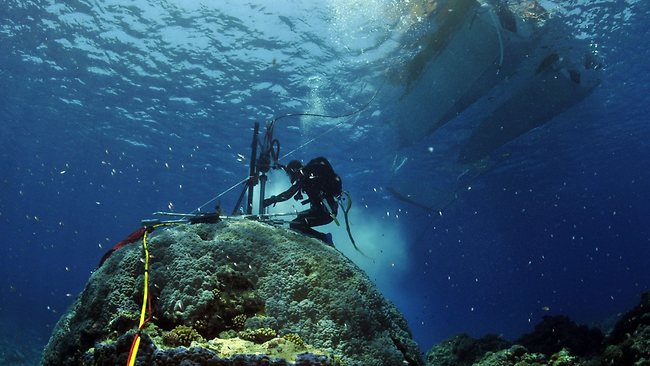
The study by the commonwealth-funded Australian Institute of Marine Science, peer-reviewed findings of which are published in the leading journal Science today, examined 27 samples from six locations from the West Australian coast off Geraldton to offshore from Darwin.

At each site, scientists took cores from massive porites corals – similar to a biopsy in humans – and counted back to record their age in much the same way tree rings are counted. Although some cores extended back to the 18th century, they focused on the period from 1900 to 2010.

The researchers found that, contrary to their expectations, warmer waters had not negatively affected coral growth. Quite the opposite, in fact: for their southern samples, where ocean temperatures are the coolest but have warmed the most, coral growth increased most significantly over the past 110 years. For their northern samples, where waters are the warmest and have changed the least, coral growth still increased, but not by as much.

“Those reefs have actually been able to take advantage of the warmer conditions,” said Janice Lough, a senior AIMS research scientist and one of the study’s authors.

Maria Byrne, a professor of marine biology at Sydney University, said after reading the paper that its findings “made perfect sense”. “Temperature rules metabolism, so it’s a no-brainer that if you get more temperature you will get more metabolism.”

She compared the findings to studies of sea urchins, where higher temperatures had been shown to offset the negative effects of ocean acidification, and to commercial aquaculture farms, in which some organisms are deliberately raised in warmer water to increase their growth rate.

The key question is how warm the water can get before the positive effects are reversed.

Lab studies have typically measured the effect of short-term, rapid changes in temperature and water chemistry; these mimic, for example, coral-bleaching events that are known to be devastating. Much harder to measure are the long-term effects of gradual warming, such as is caused by climate change.

A recent paper published in the journal Nature Climate Change, reported in The Australian, showed Zooxanthellae – the symbiotic organisms that live inside corals – can adapt much better to warming water than was previously thought [see here for ACM’s post on this – Ed] It is also known corals can, to a degree, change their Zooxanthellae with changing conditions. (source)

The Science abstract can be found here, a quote from which is set out below:

“In situ studies have documented alarming recent declines in calcification rates on several tropical coral reef ecosystems. We show there is no widespread pattern of consistent decline in calcification rates of massive Porites during the 20th century on reefs spanning an 11° latitudinal range in the southeast Indian Ocean off Western Australia.”

UPDATE: Scientific American spins this into the following headline:

 “Temperatures – not acid – could cook coral to death”

No, really, “cook coral to death” – that’s what it says. Check the link.

UK freeze may kill 2000 a week


Brass monkeys

A bit of gentle warming is catastrophic, so we are repeatedly warned, but in reality, it’s cold that’s the real killer:

BRITAIN’S big freeze could kill up to 2,000 people a week, as temperatures plunge lower than at the South Pole, health chiefs warned last night.

The Department of Health warned the elderly and vulnerable to take extra care as temperatures fall to -11C (12F) in parts of the country and icy winds make it feel closer to -12C.

In comparison, yesterday the   research centre in Antarctica was a relatively mild -3C.

Chief Medical Officer Sally Davies said the number of cold-related deaths could rise “substantially”.

In one week in last year’s big freeze the number in England and Wales rose from 9,220 to 11,193.

Forecasters, who have warned that the cold snap could last all month, said today would be one of the winter’s chilliest days.

And by Friday, temperatures will fall as low as -11C at night in the North and -8C in the South. In some places they are not expected to rise above freezing during the day. (source)

And the effects of this dangerous cold will be greatly exacerbated by the spiralling cost of energy, a direct result of the UK government’s mad emissions reduction targets and renewable energy policies to “tackle climate change”, inevitably leading to many more of the population being unable to heat their homes. UK climate madness.

(h/t EU Referendum)