New Zealand's climate disaster


Climate disaster

I’m not talking about some disaster caused by climate change (because there haven’t been any), but an economic disaster caused by pointless efforts to “tackle climate change”. Not only is New Zealand’s ETS “beyond rescue”, but it also has a liability of up to $5bn under the Kyoto protocol for failing to meet emissions targets. Now $5bn is a truckload of money, which could have been far better spent on health, education, employment, infrastructure etc – in fact, anything rather than trying to change the planet’s climate:

The authors of The Carbon Challenge – Victoria University researcher and economist Geoff Bertram and climate-change analyst and researcher Simon Terry – also describe the Government’s current ETS as “technically obsolete” and “beyond rescue” as a sustainable framework for tackling climate change.

They say the scheme will not make any inroads into cutting New Zealand’s gross emissions levels.

On top of that, the ETS was so unfair in the way it distributed benefits to high emitters with political influence, while placing a regressive quasi-tax burden on households, that there was a risk it could undermine the public’s willingness to support a stronger regime in the future. [So I guess the news isn’t all bad.]

The authors say the bulk of the financial liabilities of several billion dollars arising from New Zealand exceeding its Kyoto Protocol target will fall on future taxpayers, making it a “massive intergenerational transfer of liability”.

The ETS completely fails as a mechanism to make today’s polluters meet today’s emissions bill.”

The book says there is complacency in New Zealand that credits for storing carbon in forestry crops will save the country from having to seriously address reductions in greenhouse gas emissions.

But this year’s Budget had broken with the past by flagging the real cost of New Zealand’s 22 per cent overshoot of its Kyoto target. Depending on the price of carbon, it said the Kyoto liability could be as much as $5.7 billion.

That Budget reference officially scotched the myth that the Government did not face any financial effects under the protocol because it could rely on offsetting credits from plantation forests.

“The credits must be paid back when the trees are harvested in the 2020s.” The authors say using these credits to pay the Kyoto bill is like putting it “on the plastic” for the next generation to pay.

And Australia is heading straight down the same path.

Read it here. (h/t Andrew Bolt)
Wong: Gillard wants carbon trading


Get back in the cave

Penny Wong has crawled out from the cave she’s been in since December to tell a climate conference that Julia Gillard wants a carbon trading scheme.

Some of the world’s leading climate change scientists have gathered on the Gold Coast to discuss how the world can best adapt to a warming world.

Climate Change Minister Senator Penny Wong welcomed almost 1000 delegates to the event, stressing the importance of the science behind the debate. [Ha, ha – my aching sides]

Senator Wong said the government would listen carefully to what the conference had to say.

“Julia Gillard has made clear her commitment to this issue, and her views about the need for a price on carbon,” she told reporters.

“The reason we don’t have a price on carbon is Tony Abbott tore down a leader (Malcolm Turnbull) and installed himself on the basis that he doesn’t believe climate change is real, and the Australian Greens voted with Mr Abbott. [You mean like faceless factional bosses tore down Kevin Rudd and installed Julia Gillard? The irony is clearly lost on Penny]

“All of us who understand the risks climate change poses to Australia and its future have a responsibility to work and build a consensus, which Tony Abbott torpedoed.”

Ahh, how I’ve missed Penny (not).

Read it here.

Save the planet – paint the Andes


This guy's serious

Wacky Scheme Alert as an “inventor” from Peru decides the best way to save the planet is to start whitewashing mountains. The World Bank considered this idea worthy of a prize in its competition “100 Ideas to save the planet”. That, by the way, tells you all you ever need to know about the World Bank. ACM reported on Eduardo Gold’s plan to go ape with a tin of paint here, but now it’s actually happening:

Gold has already begun work while he waits for the 200,000-dollar prize money [200 G’s for that? The World Bank is truly insane] to fund his pilot project. His plan is to paint a total area of 70 hectares (173 acres) on three peaks in the Andean region of Ayacucho in southern Peru.

Chalon Sombrero, the name of an extinct glacier which used to irrigate a valley and several rivers, is where he’s started with a team of four men from the local village, Licapa.

The workers use jugs – rather than paintbrushes – to splash the whitewash onto loose rocks around the summit. So far they have painted some two hectares, just a tenth of the total area they aim to cover on that peak.

A white surface reflects the sun’s rays back through the atmosphere and into space, in doing so it cools the area around it too,” explains Gold.

“In effect in creates a micro-climate, so we can say that the cold generates more cold, just as heat generates more heat.”

It’s pure climate madness. At least there is an small injection of sanity:

But Antonio Brack, Peru’s Environment Minister, told the World Bank that its funding would be better spent on other “projects which would have more impact in mitigating climate change.”

He said: “It’s nonsense.”

Actually it would be better spent on anything rather than idiotic schemes to “tackle climate change” – which we can’t anyway.

Read it here.

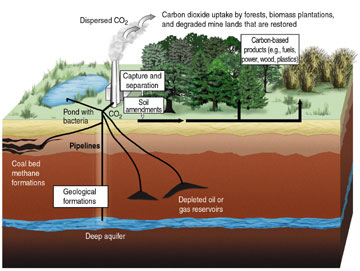
Carbon capture flaws exposed


Flawed idea

The enviro-headbangers can’t abide nuclear power, despite the fact that it is the “greenest” form of energy generation available, because of the problem of storing waste. So it is ironic that the technology which the warmists believe will save the planet, carbon capture and storage (CCS), suffers from the same flaw:

Professor Gary Shaffer from the Danish Centre for Earth System Science examined a range of CCS methods to determine their effectiveness and long-term impacts.

Reporting in the journal Nature Geoscience, Professor Shaffer says there are still questions over which sequestration process is best and which is least likely to leak carbon.

“CCS has many potential advantages over other forms of climate geoengineering,” he said.

“However, potential short and long-term problems with leakage from underground storage should not be taken lightly.”

The study reveals leakage of sequestered CO2 could cause large scale atmospheric warming, sea level rise and oxygen depletion, acidification and elevated CO2 concentrations in the ocean.

Professor Shaffer says storing CO2 in the deep ocean is a bad idea because of the problems it creates for deep sea life by creating a “large dead zone”.

He says deep ocean stored CO2 would return to the atmosphere relatively quickly.

Geological storage of CO2 – either underground or below the ocean floor – may be more effective, but only if leakage can be kept down to 1 per cent or less per 1,000 years.

Professor Shaffer says any long term leakage would need to be actively countered by re-sequestration, which would need to be carried out over many thousands of years.

Another brilliant idea down the pan.

Read it here.

Gillard wants more renewables to tackle climate change


Pushing renewables

Which means more money wasted on subsidising solar panels and wind farms, both hopeless for baseload electricity generation. But at least she talks vague sense on an ETS and acknowledges that there isn’t a consensus for a price on carbon… yet.

Labor sources have confirmed the focus of her pitch for the environment vote will be on renewables — boosting the use of solar and wind power to help meet the government’s pledge to slash greenhouse gas emissions.

But arguing that community consensus is “not there yet” on an ETS, Ms Gillard yesterday backed the need to put a price on carbon to encourage businesses to change their practices; she offered no timetable on delivering one.

The newly-installed Prime Minister said yesterday she accepted “my fair share” of the responsibility for the decision to delay the introduction of an ETS, a policy backflip that coincided with a collapse in Kevin Rudd’s polling.

Asked if it were true she had argued for the ETS to be dumped as part of the Rudd government’s powerful kitchen cabinet, Ms Gillard confirmed she had.

“I was concerned that if you were going to do something as big to your economy as put a price on carbon, with the economic transformation that implies, with changing the way in which we live, you need a lasting and deep community consensus to do it,” she told the Nine Network.

“And I don’t believe we have that lasting and deep community consensus now.

“Now, I believe we should have a price on carbon, and I will be prepared to argue for a price on carbon . . . so that we get to that lasting and deep community consensus, but we are not there yet.”

Ms Gillard pledged that she would soon be making further statements on new policy measures to “address the challenge of climate change”.

I am not a denier — I am not a denier, but I’m someone who believes that you have got to take the community with you when you make lasting and deep changes,” she said.

All I can say is that it’s extraordinary to hear Gillard use the word “denier” in the context of her own beliefs, especially after her post-ETS vote down speech (see here).

Read it here.

Shock: poll by climate activists shows "public want climate action"


No we don't, we peddle self-serving propaganda

Gee, what a surprise – never would have thought that, hmm? Blatant Vested Interests Alert as a poll conducted by the Climate Institute and The Australian Conservation Foundation (which runs Al Gore’s despicable Climate Project indoctrination seminars) shows that “more and more Australians are concerned over growing pollution.” Skating over the fact that <shouts>carbon dioxide isn’t pollution</shouts>, how much of a surprise is that, given that the Climate Institute and ACF are climate advocacy groups full of enviro-headbangers, whose very existence depends on the continuation of the climate scare, and who wage campaigns of misinformation against filthy sceptics and “deniers”? But hey, the media will report anything these days, as long as it fits the politically correct notion of man-made climate change.

It says voters would welcome action on climate change, giving new Prime Minister Julia Gillard a clear indication on what the public want.

CEO of the Climate Institute John Connor has told Sky News of the public’s concern over the ETS.

‘The backflip over the ETS had a very significant backlash that damaged brand Rudd but also damaged brand ALP, and so we’ve seen ALP as a better party for handling climate change go to historic lows,’ Connor said.

The research also shows global warming could be a key issue for undecided voters.

‘If there’s a strong plan on pollution and climate change, that will reward the government or the opposition, and the government in this instance by about three to one’.

Yawn.

Read it here (if you can be bothered)

Daily Bayonet GW Hoax Weekly Roundup


Skewering the clueless

Just a day late – still a great read!

Scientist agrees with herself – creates "consensus"


Consensus of one

An easy way to make a consensus if ever I’ve heard one – just agree with yourself! Not that consensus has anything to do with science anyway, but since the warmists insist consensus is important, we have to deal with it. Here we have a single scientist and a single paper (co-authored by said scientist) being relied upon by the IPCC to ignore solar effects on the climate:

Klimaskeptik.cz, a Czech climate skeptic blog, has posted today an interesting article “Judithgate: The IPCC was only one Solar Physicist” (google rough translation). Her name is Judith Lean (photo at right). On the basis of this “consensus of one” solar physicist, the IPCC proclaimed solar influences upon the climate to be minimal. Objection to this was raised by the Norwegian government as shown in the AR4 second draft comments below (and essentially dismissed by the IPCC):

“I would encourage the IPCC to [re-]consider having only one solar physicist on the lead author team of such an important chapter. In particular since the conclusion of this section about solar forcing hangs on one single paper in which J. Lean is a coauthor. I find that this paper, which certainly can be correct, is given too much weight”

What a ridiculous concept even to think that the sun, the only significant source of energy for the entire climate system, could possibly have anything to do with the climate! </sarc>

Read it here.

Japanese told to go to bed early to cut emissions


Wacky Scheme No. 2: Japanese sleeping hat

Wacky Scheme Alert as those crazy Japanese decide they are going to save the planet by … going to bed earlier. Simple! Yet more interference in the way people live their lives by the ever-present green police:

The Morning Challenge campaign, unveiled by the Environment Ministry, is based on the premise that swapping late night electricity for an extra hour of morning sunlight could significantly cut the nation’s carbon footprint.

A typical family can reduce its carbon dioxide footprint by 85kg a year if everyone goes to bed and gets up one hour earlier, according to the campaign.

The amount of carbon dioxide emissions potentially saved from going to bed an hour early was the equivalent of 20 per cent of annual emissions from household lights, “Many Japanese people waste electric power at night time, for example by watching TV until very late,” a ministry spokesperson told The Daily Telegraph.

“But going to bed early and getting up early can avoid wasting electrical power which causes carbon dioxide emissions. If people change their lifestyle, we can save energy and reduce emissions.” The campaign also proposes that people take advantage of an extra hour of morning sunlight by improve their lifestyles in general by running, doing yoga and eating a nutritious breakfast. [That’s the great thing about environmentalism – you get to tell everybody else what they should and should not do, kind of like a green dictatorship]

It is the latest initiative tackling climate change by the Japanese environment ministry, which is faced with the challenge of reducing carbon dioxide emissions by 25 per cent from 1990 levels within the next decade.

Not a hope in Hell, especially with barking mad schemes like that one.

Read it here.

Julia's backflip on climate


First of many?

Looking back through the ACM archives, I was reminded of the speech by Julia Gillard after the defeat of the ETS in December last year, where she used the phrase “national interest” no less than sixteen times:

We are doing this to give the Liberal Party one chance to work through and deal with this legislation in the national interest. We all know the Liberal Party is deeply divided on this question and there have been many Liberal voices prepared to speak up for the national interest and to speak in favour of our plan to tackle climate change.

We believe that over the Christmas period there is time for the calmer heads in the Liberal Party to consider this question: to consider acting in the national interest and to join with the Government on the first sitting day when Parliament resumes to take decisive steps to deal with climate change.

We will bring this Bill back into the Parliament because it’s the right thing to do in the national interest. We are determined to see this legislation pass the Parliament.We know that there are Liberals who are prepared to support this legislation. We know supporting this legislation was the position of the Liberal Party only a few short days ago.

We call on those in the Liberal Party over the summer period who believe in taking responsible action on climate change to consider their position, to consider the position of their Party and to come back to the Parliament next year ready to take action on climate change. (source link dead)

Paul Sheehan in The Sydney Morning Herald summarised it well:

When Julia Gillard faced the media outside Federal Parliament in Canberra on Wednesday she looked shell-shocked. She then proceeded to give the most jittery, hollow, nonsensical performance of her career. It was pantomime of the lowest order.

Today the climate change extremists and deniers in the Liberal Party have stopped this nation from taking decisive action on climate change,” the Deputy Prime Minister said, deadpan, into a thicket of cameras and recorders.

Extremists and deniers. In case anyone had missed the point, she repeated the phrase five times. ”Now [we] have been stopped by the Liberal Party extremists and the climate change deniers. This nation has been stopped from taking a major step in the nation’s interests by Liberal Party extremists and climate change deniers.”

This is clearly going to be the mantra the Rudd Government uses to describe anyone who opposes its pointless legislation on an emissions trading scheme.

Gillard used the terms ”denier” or ”denial” 11 times, pointed words because they carry the connotation of Holocaust denial. The last time that tactic was used in the national debate, after the release of the Bringing Them Home report, it exploded on those who used it.

So this is going to get interesting because the political ground has shifted in the past six months. It is now the Rudd Government that appears to be in a state of denial. (source)

And now she is waiting for community consensus? Sounds like a Rudd-style backflip to me.