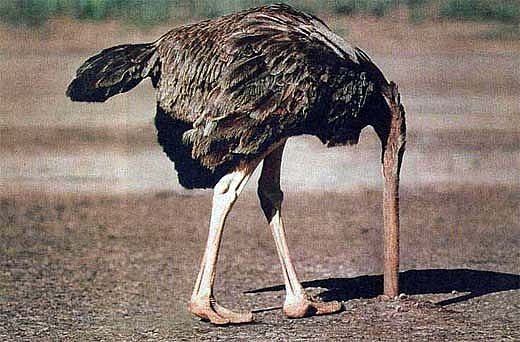
Skeptical Science: heads in the sand


Un-Sk Ps-Sc on the Pause and models

Un-Sk Ps-Sc on the Pause and model accuracy

Even Nature has acknowledged that the Pause is real, and that the models are missing something:

Average global temperatures hit a record high in 1998 — and then the warming stalled. For several years, scientists wrote off the stall as noise in the climate system: the natural variations in the atmosphere, oceans and biosphere that drive warm or cool spells around the globe. But the pause has persisted, sparking a minor crisis of confidence in the field. Although there have been jumps and dips, average atmospheric temperatures have risen little since 1998, in seeming defiance of projections of climate models and the ever-increasing emissions of greenhouse gases. […]

But none of the climate simulations carried out for the IPCC produced this particular hiatus at this particular time. That has led sceptics — and some scientists — to the controversial conclusion that the models might be overestimating the effect of greenhouse gases, and that future warming might not be as strong as is feared.

But let’s take a look at the headbangers over at Un-Skeptical Pseudo-Science. To start with, the Pause. In 2008, the page read as follows:

Did global warming stop in 1998?

1998 was an unusually hot year as it featured the strongest El Nino of the century. In fact, from Jan to May, 2007 is tied with 1998 as hottest year on record. The WMO reported in August that January and April 2007 were the hottest on record.

However, when determining trends, you don’t pick one month or year out of isolation – particularly if that year features a short term weather anomaly like El Nino. By this method, based on the fact that 2005 was .17°C hotter than 2000, you could conclude that the rate of global warming doubled from 2000 to 2005.

Using the fudged surface temperature sets, Un-Sk Ps-Sc was still able to claim the climate was still warming (phew). Fast forward to 2014. Another six years of no warming, and the only alternative is to… er, change the subject to ocean heat instead:

There’s also a tendency for some people just to concentrate on surface air temperatures when there are other, more useful, indicators that can perhaps give us a better idea how rapidly the world is warming. Oceans for instance — due to their immense size and heat storing capability (called ‘thermal mass’) — tend to give a much more ‘steady’ indication of the warming that is happening. Here records show that the Earth has been warming at a steady rate before and since 1998 and there’s no signs of it slowing any time soon.

And the evidence for this is from a paper by one of their own – Dana Nuccitelli. Handy!

How about the accuracy of models in 2008? Un-Sk Ps-Sc used some graphs cut and pasted from the IPCC’s third assessment report (in 2001), to fool the sheep into believing that models were just perfect:
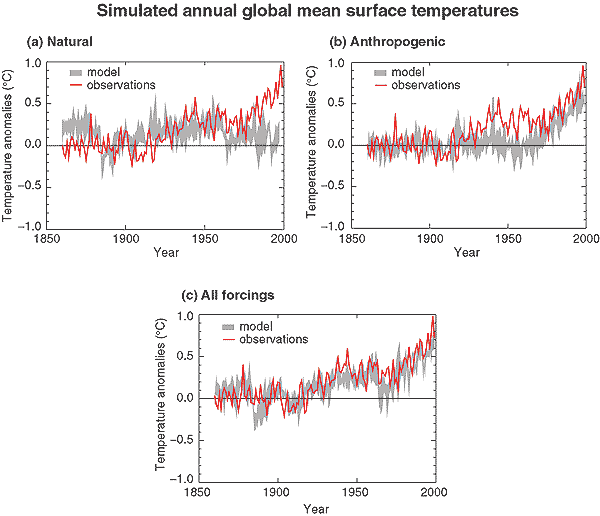
Cut and paste from 2001

Cut and paste from 2001

They then claim that observed temperatures “closely match” Hansen’s Scenario B, helped no doubt by the multiple fudge factors applied to GISS temperature data. If satellite data had been used instead, the argument would be far less compelling.

Today’s version of the page is still using those graphs from 2001, now a whole two IPCC reports out of date. It still plugs the Hansen Scenario B, despite the observed temperature series ending in 2005.

And just today, Nuccitelli, writing in his ‘97%’ column in the Guardian uses a figure which conveniently supports the same position, despite the fact that balloon and satellite data show an increasing divergence between observations and models.
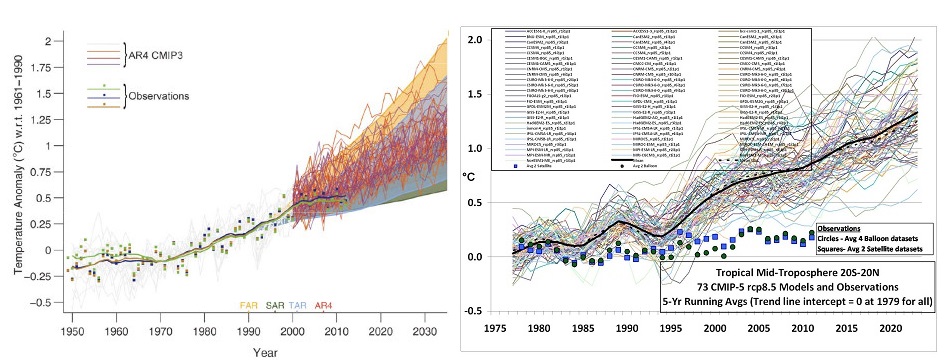
Which image do Cook & Nuccitelli pick?

Which image do Cook & Nuccitelli pick?

When the usually warmist Nature concedes that something is happening to the climate system which was not forecast by the models, then you should listen.

And in fact, most ‘proper’ scientists would look at this as an opportunity to further the understanding of the drivers of climate change, both natural and anthropogenic, but the headbangers at Un-Sk Ps-Sc would much rather stick their heads in the sand and pretend nothing has changed.

It could almost be said that they were denying the reality… but that would be petty, wouldn’t it?

Extreme El Niño events ‘to double’ with AGW


El Niño

El Niño

A new paper in Nature Climate Change claims that extreme El Niño events are set to double with a warming climate. The ABC reports:

The findings mean not just a rise in the number of devastating droughts and fires in Australia and Indonesia, and major floods in the normally cold and dry Peru and Ecuador, but also a rise in extreme weather events around the world.

“The influence of extreme El Niños reaches every continent,” says Dr Wenju Cai, of CSIRO Marine and Atmospheric Research, who is lead author on a new paper published today in the journal Nature Climate Change.

Cai says the last extreme El Niño in 1997/98 led to 23,000 deaths and $50 billion worth of losses globally.

Under the El Niño weather pattern, the ocean in the eastern Pacific heats up more than normal, bringing more rain to that area and less rain to the western Pacific.

When the warming in the eastern Pacific passes a certain temperature, an extreme El Niño results. This causes extreme droughts in the western Pacific and a 10-fold increase in rain in the eastern equatorial Pacific region.

“Imagine an average of 5 millimetres a day everyday for three months,” says Cai.

To investigate how extreme El Niños would respond to a warming planet in the future, Cai and colleagues aggregated 20 different climate models.

Each model covered a 200-year period between 1891 and 2090, and incorporated measurements of CO2 and other factors, both historical and future, as predicted by the IPCC.

The researchers then compared the historical period 1891-1990 with the period 1991-2090 and found an increase in extreme El Niño events.

“The model is simulating an extreme El Niño event 1 per 20 years from 1891-1990 on average,” says Cai. “But from 1991 to 2090 the model simulates a doubling of the frequency of extreme El Niño events.”

The fact that the modelling of the El Niño events is based on existing climate models means the conclusions drawn should be treated with a heap of caution. With a single model, garbage in equals garbage out, but with two models, it’s garbage in equals garbage-squared out.

Sun ‘falling silent’


Not global cooling, OK? It's just a regional cold snap

Not global cooling, OK? It’s just a regional cold snap

This may prove to be tricky for The Cause. If solar activity continues to drop, CO2 levels continue to rise, and global temperatures don’t follow, then the question is, why?

The IPCC has painted itself into a corner on solar effects on climate, claiming that changes in irradiance are too small to make any significant difference to global temperatures. We may have the opportunity to separate these variables over the next decades, as CO2 goes up and solar activity goes down. Where will global temperature go?

The BBC reports:

“I’ve been a solar physicist for 30 years, and I’ve never seen anything quite like this,” says Richard Harrison, head of space physics at the Rutherford Appleton Laboratory in Oxfordshire.

He shows me recent footage captured by spacecraft that have their sights trained on our star. The Sun is revealed in exquisite detail, but its face is strangely featureless.

“If you want to go back to see when the Sun was this inactive… you’ve got to go back about 100 years,” he says.

This solar lull is baffling scientists, because right now the Sun should be awash with activity.

It has reached its solar maximum, the point in its 11-year cycle where activity is at a peak.

This giant ball of plasma should be peppered with sunspots, exploding with flares and spewing out huge clouds of charged particles into space in the form of coronal mass ejections.

But apart from the odd event, like some recent solar flares, it has been very quiet. And this damp squib of a maximum follows a solar minimum – the period when the Sun’s activity troughs – that was longer and lower than scientists expected.

“It’s completely taken me and many other solar scientists by surprise,” says Dr Lucie Green, from University College London’s Mullard Space Science Laboratory.

The drop off in activity is happening surprisingly quickly, and scientists are now watching closely to see if it will continue to plummet.

“It could mean a very, very inactive star, it would feel like the Sun is asleep… a very dormant ball of gas at the centre of our Solar System,” explains Dr Green.

The Maunder Minimum coincided with the Little Ice Age, yet the Cause claims that the LIA was a ‘regional’ event, and the two are not connected. Mike Lockwood makes sure we don’t draw any sceptical conclusions:

He explains: “If we take all the science that we know relating to how the Sun emits heat and light and how that heat and light powers our climate system, and we look at the climate system globally, the difference that it makes even going back into Maunder Minimum conditions is very small.

“I’ve done a number of studies that show at the very most it might buy you about five years before you reach a certain global average temperature level. But that’s not to say, on a more regional basis there aren’t changes to the patterns of our weather that we’ll have to get used to.”

I guess we’ll see, won’t we? The Sun maybe about to give us a set of experimental conditions where two variables which have, until now, been rising together, will in future be moving in opposite directions. Interesting times.

Chief Scientist’s arguments for alarmism don’t wash


Models fail

Models fail

Professor Ian Chubb, writing in The Australian, responds to Maurice Newman’s recent articles on climate change. But in my view, he fails to make a case for urgent action. The following two sentences encapsulate Chubb’s approach:

I start in a different place and ask a simple question. We have so far pumped two trillion tonnes of a greenhouse gas, CO2, into our atmosphere since the Industrial Revolution, at a rate faster than ever before. Why would we presume that it would have no effect?

If the answer were simple, we would know it. So we have to use the evidence we have to assess the impact now; and we have to use the data to build models to estimate what the impact might be in the future.

Firstly, the reference to “two trillion tonnes” is classic misdirection, of which any magician would be proud, since to the lay reader, it sounds like a truly gargantuan amount – and in absolute terms, it is. However, it isn’t until one realises the entire atmosphere has a mass of five quadrillion tonnes (2,500 times Chubb’s figure), that the sleight of hand is exposed.

But rather embarrassingly for a Chief Scientist, even the figure of two trillion tonnes he cites is wrong. The mass of CO2 in the atmosphere today is approximately 3.16 trillion tonnes (591ppm by mass, 400 ppm by volume). Prior to the Industrial Revolution, CO2 accounted for approximately 290ppm by volume in the atmosphere (equivalent to 428ppm by mass), so pre-industrial mass of CO2 would have been 2.3 trillion tonnes – the difference being about 0.9 trillion tonnes. “We” have “pumped” less than half the amount of CO2 into the atmosphere that Chubb claims.

Furthermore, nobody “presumes that it would have no effect”. We acknowledge that CO2 is a greenhouse gas which will cause some degree of warming. Chubb’s rhetorical question sets up a straw man. The question is not if, but how much?

The models that have been built to estimate the impact of this warming in the future have been shown to be significantly overestimating the contribution of CO2. The IPCC’s blinkered approach has ensured that the majority of natural climate drivers (including the Sun) have been ignored, discounted or dismissed. As a result, the sensitivity of CO2 had to be cranked up (by invoking large positive water vapour feedbacks) to enable to models to match the past. Because CO2 continued to increase, the models predicted continually increasing temperature, but real-world measurements are diverging from model predictions and there is no ‘consensus’ on the reason why (see The Cause has seven excuses for The Pause).

None of this is entirely surprising, given the UN’s scapegoating of CO2 as the culprit at least thirty-odd years ago, and IPCC’s remit to investigate ‘human-caused’ warming.

Similar “why would we presume” arguments are put forward in relation to ocean ‘acidification’ (which he correctly labels as ‘less alkaline’) and ocean heat content. The former is not disputed (although the magnitude of its effects might be), but the latter has been dredged up as one of the convenient excuses for the models failing to match observations (see Rapid increase in ocean heat?).

Chubb quotes a Nature article on models:

“Some have argued, in part on the basis of current temperature trends, that climate models tend to overestimate warming … (but) the evidence cuts both ways.” Some seem always to presume the errors only occur in the direction favourable to their argument. Notwithstanding the range, current models point out a direction, and the direction is up.

Looking at the plot above, can you see the evidence ‘cutting both ways’? How many models have underestimated warming? Since 2005, none. And errors at the IPCC are always in the ‘it’s worse than we thought’ direction – despite the fact that statistically, one would expect a fairly even balance both better and worse.

Chubb concludes:

I am sure Maurice Newman and I would agree that much of what should be a debate has turned into “low-grade” and often personalised argument. What it should be is a healthy and constructive discussion based on all the empirical evidence, not bits of it, and with an eye to the implications for our health, wellbeing and prosperity in the longer term.

With ‘denier’ smear-sites like Skeptical Science, RealClimate and Think Progress still around, I won’t be holding my breath.


Full article here:

Surely CO2 is a climate culprit

AFTER his three recent articles on climate change, most recently on Wednesday, in The Australian, it is clear that Maurice Newman and I can agree on a number of things.

We can now agree, for example, that climate change is real, not a myth or a delusion. We can agree that he is not a climate scientist; and we would agree that I am not one either. We would, I think, agree that a “climate” is the result of complex interactions of multiple variables, many of them natural, but I would say not all.

We diverge when it comes to the impact of greenhouse gases. While we agree that carbon dioxide is a greenhouse gas, Newman wrote of “the myth of anthropological climate change” (The Australian Financial Review, September 13, 2013) and suggested that it is one in a list of popular delusions.

Others will doubtless address some of the details he has raised. I start in a different place and ask a simple question. We have so far pumped two trillion tonnes of a greenhouse gas, CO2, into our atmosphere since the Industrial Revolution, at a rate faster than ever before. Why would we presume that it would have no effect?

If the answer were simple, we would know it. So we have to use the evidence we have to assess the impact now; and we have to use the data to build models to estimate what the impact might be in the future.

Right now we know that as CO2 levels in the atmosphere increase, so too does the amount of CO2 absorbed by the ocean, with the effect of making the water less alkaline (or more acid). Why would we presume that would have no effect on marine life? We also know that the heat content of the oceans has increased consistently although the rise in atmospheric temperature recently is flatter. Why would we presume no effect on the currents, winds and evaporation, and a subsequent impact on climate? We know the planet is warmer than pre-industrial times. While some might dismiss this as just a few tenths (0.9C) of a degree, I wonder if they’d be as sanguine if their core body temperature increased by the same few tenths of a degree.

There will be regional variations. There are differences even within Australia: temperatures in some regions have increased by 2C over 50 years while others have experienced little or no change. Our average change is 0.7C.

We know that greenhouse gases in the atmosphere are important. If there were none, it has been estimated that the global temperature would be around -18C rather than the average near 15C we currently enjoy.

We also know that the relationship between CO2 and temperature is not linear. Uncertainty about the sensitivity of the climate to changing CO2 means models yield different projections. As an editorial in this week’s Nature says: “Some have argued, in part on the basis of current temperature trends, that climate models tend to overestimate warming … (but) the evidence cuts both ways.” Some seem always to presume the errors only occur in the direction favourable to their argument. Notwithstanding the range, current models point out a direction, and the direction is up.

So we know that climate is a complex, complicated matter and that there are multiple variables. Does that mean we don’t use all the information that we have to estimate what might be ahead? Does it mean that we do nothing about one variable over which we have some control – the emission of greenhouse gases? Does it mean that because there are uncertainties, we do nothing?

I am sure Maurice Newman and I would agree that much of what should be a debate has turned into “low-grade” and often personalised argument. What it should be is a healthy and constructive discussion based on all the empirical evidence, not bits of it, and with an eye to the implications for our health, wellbeing and prosperity in the longer term.

Professor Ian Chubb is Australia’s Chief Scientist. (source)

Settled science: ‘The Cause’ has seven excuses for ‘The Pause’


Climate witchcraft

Climate witchcraft (© Flickr)

Paraphrasing Andrew S Tanenbaum, the nice thing about warmist excuses is that you have so many to choose from.

The science is so settled that ‘the Cause’ has at least seven different explanations for ‘the Pause’. And of course, they all studiously avoid the obvious answer: that the climate’s actual sensitivity to increasing CO2 is less than the warmists want it to be.

So here we present the Seven Excuses of the Cause:

Excuse 1 – Low Solar Activity

We all know, from the IPCC down, that high solar activity had absolutely nothing whatsoever to do with late 20th century warming. How ridiculous to suggest such a thing! But oddly, low solar activity can be invoked as a reason for a sudden stop in that warming. Go figure.

Excuse 2 – Ocean heat

Ah yes, the old ‘dog ate my warming’ excuse. The oceans have mysteriously sucked all the heat out of the atmosphere and have hidden it deep down, conveniently where nobody can measure it. This makes perfect sense, as everybody knows that in order to heat up a cold bath, all we need to do is turn the fan heater on in the bathroom, right?

Excuse 3 – Coal burning in China

Burning coal has added more particulates to the atmosphere, which has reduced insolation and therefore reduced warming. So burning coal good because it stops global warming, but er, burning coal bad because it causes global warming… ouch, my head hurts.

Excuse 4 – Montreal Protocol

The ‘success’ of the Montreal Protocol in reducing CFCs in the atmosphere, themselves greenhouse gases, is the reason why the planet is not warming as fast. At least it achieved something, then, because the Ozone Hole is still there. But David Karoly says CFCs are a far smaller component of warming than CO2… oh dear, another quandary.

Excuse 5 – Pause? What pause?

The Wilful Blindness excuse. Rather than actually work out why the pause has occurred, it’s much easier just to disappear it (a la Medieval Warm Period) by miraculously cooling the past and pretending that warming is continuing exactly the same, or even better, accelerating. I mean, GISS do it all the time, so who will notice?

Excuse 6 – Volcanoes, not pollution

Please forget you just read Excuse 3 above. It’s the volcanoes what done it.

Excuse 7 – Stratospheric water vapour

Please forget you just read all of the above excuses. It’s this one. No, really. Or all of them. Whatever. Just give us more money.

Thanks to Marc Morano, who has all the links over at the ‘Depot.

You’d think we’d never had a heatwave before…


Safe CO2 heatwave…

Safe CO2 heatwave… (source)

The ABC is acting as the taxpayer-funded PR agent for the privately-funded Climate Council, which itself is behaving as if it had never seen a heatwave before:

Heatwaves in Australia are becoming more frequent, hotter and are lasting longer because of climate change, a report released today by the Climate Council says.

The interim findings of the report, titled Australian Heatwaves: Hotter, Longer, Earlier and More Often, come as southern Australia swelters through a heatwave, with the temperature in Adelaide today forecast to hit 46 degrees Celsius.

The report says heat records are now happening three times more often than cold records, and that the number of hot days across Australia has “more than doubled”.

It says the duration and frequency of heatwaves increased between 1971 and 2008, and the hottest days have become hotter.

And it predicts that future heatwaves will last up to three days longer on average, they will happen more often, and the highest temperatures will rise further.

“It is clear that climate change is making heatwaves more frequent and severe,” report co-author Professor Will Steffen said in a statement.

“Heatwaves have become hotter and longer and they are starting earlier in the season.”

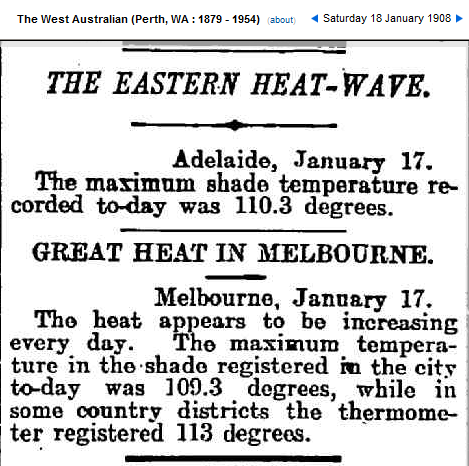
After notching up two consecutive days over 40C, Melbourne is on track to record its second-longest heatwave since records began in the 1830s.

Second-longest?

The longest heatwave in Melbourne was in 1908, when there were five consecutive days over 40C.

When CO2 was under 300ppm, well below the ‘safe’ 350ppm. Shurely shome mishtake?

Despite the IPCC and many other climate scientists refusing to link ‘extreme weather’ to climate change, the Climate Council and the ABC are quite happy to do so as part of a co-ordinated scare campaign:

Professor Steffen says the extreme weather patterns can be attributed to climate change, with the continued burning of fossil fuels trapping more heat in the lower atmosphere.

Professor Steffen says large population centres of south-east Australia stand out as being “at increased risk from many extreme weather events, including heatwaves”.

“The current heatwave follows on from a year of extreme heat, the hottest summer on record and the hottest year on record,” he said. (source)

But where’s the warming, Willy? Global temperatures have barely risen for over a decade. Whilst Australia is experiencing a heatwave, the US is freezing. Oh wait, that’s climate change too. Everything’s climate change.

All of the above is ably abetted, naturally, by the Bureau of Meteorology, which suddenly finds it an appropriate time to announce that it has introduced a definition of “heatwave”. Which begs the question, in a country which has been ravaged by heat waves since the dawn of time, why has it taken until now to define what one actually is? I’m surprised that the Bureau stopped at ‘severe’ in their heatwave categories, and didn’t jump the shark with ‘catastrophic’ (like the bush fires), or even ‘calamitous’, ‘apocalyptic’ or ‘cataclysmic’! My own suggestion would be ‘OMG we’re all gonna fry’…

Once again, the ABC dutifully does the Bureau’s PR work here.

‘The party’s over’ for IPCC


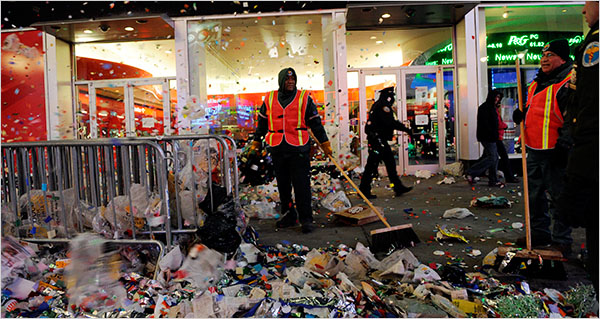
Now the cleanup begins…

Now the cleanup begins…

It’s sure been great (for the climate rent-seekers and hangers-on, that is), but now it’s over.

Maurice Newman, in The Australian:

What we now see is the unravelling of years of shoddy science and sloppy journalism. If it wasn’t for independent Murdoch newspapers around the world, the mainstream media would be almost completely captured by the IPCC establishment. That is certainly true in Australia. For six or seven years we were bullied into accepting that the IPCC’s assessment reports were the climate science bible. Its chairman, Rajendra Pachauri, told us the IPCC relied solely on peer-reviewed literature. Then Murdoch papers alerted us to scientific scandals and Donna Laframboise, in her book The Delinquent Teenager, astonished us with her extraordinary revelation that of 18,000 references in the IPCC’s AR4 report, one-third were not peer reviewed. Some were Greenpeace press releases, others student papers and working papers from a conference. In some chapters, the majority of references were not peer reviewed. Many lead authors were inexperienced, or linked to advocate groups like WWF and Greenpeace. Why are we not surprised?

The IPCC was bound to be captured by the green movement. After all, it is a political body. It is not a panel of scientists but a panel of governments driven by the UN. Its sole purpose is to assess the risks of human-induced climate change. It has spawned industries. One is scientists determined to find an anthropogenic cause. Another is climate remediation. And, naturally, an industry to redistribute taxes to sustain it all. With hundreds of billions of dollars at stake, this cartel will deny all contrary evidence. Its very survival depends on it. But the tide is turning and Mother Nature has signalled her intention not to co-operate.

In the meantime, childish personal attacks on those who point out flaws in IPCC reasoning and advice only increase scepticism. They are no substitute for empirical evidence and are well into diminishing returns. The party’s over. (source)

Switzer: Game up for carboncrats


Where's Brendan Nelson?

Alarmists ice bound, like Chris Turney

Given that this is in the Silly Moaning Herald, we can expect at least five articles over the next week, from the usual suspects, all rubbishing Tom Switzer’s piece and lashing him with predictable ad homs.

But at least the chai-latte-sipping, sandal-wearing, yoghurt-knitting, muesli-chomping, inner-city, urban-Green readers of the Silly will be exposed to a different point of view (for once) …

Contrary to media stereotypes, many so-called sceptics – such as Abbott, John Howard, Maurice Newman and this writer – recognised that the rise in carbon dioxide as a result of the burning of fossil fuels led to moderate warming.

But because we questioned the doomsday scenarios and radical, costly government-directed plans to decarbonise the economy, we were denounced as “deniers”.

Those days are over.

Thanks to Abbott’s forceful critique of Labor’s ETS/carbon tax, and the persistent failure of the carboncrats to reach legally binding global agreements, Australians have risen up against this madness.

At last, there is recognition not just that there are at least two sides to every story, but that when sophisticates seek to shut down debate, it amounts to an attack on the public interest.

That is why the anti-carbon zealots have become so defensive. The game is up.

The idea of climate mitigation – carbon taxes, cap and trade, channelling taxpayer subsidies to wind and solar power – destroyed the leaderships not only of Malcolm Turnbull in 2009 and Rudd in 2010, but also of Julia Gillard and Rudd (again) last year.

And although the Coalition’s approval ratings have declined since the election, polls also show that opposition to the carbon tax remains high.
Last year’s Lowy Institute survey said that only 40 per cent (down from nearly 70 per cent in 2006) think climate change is serious and requires action.

And yet, despite this changing (political) climate, Opposition leader Bill Shorten still opposes the repeal of the carbon tax.

If Labor’s divorce from the Greens is genuine, he should support the PM’s legislation, lest he meet the same fate as his fellow deniers [sic] and become a laughing stock.

Hilarious! The sub-ed’s brain, soaked with incessant green dogma, was so used to slagging off the sceptics that he subconsciously replaced “alarmists” with “deniers”. LOL, as they say.

Read it here.

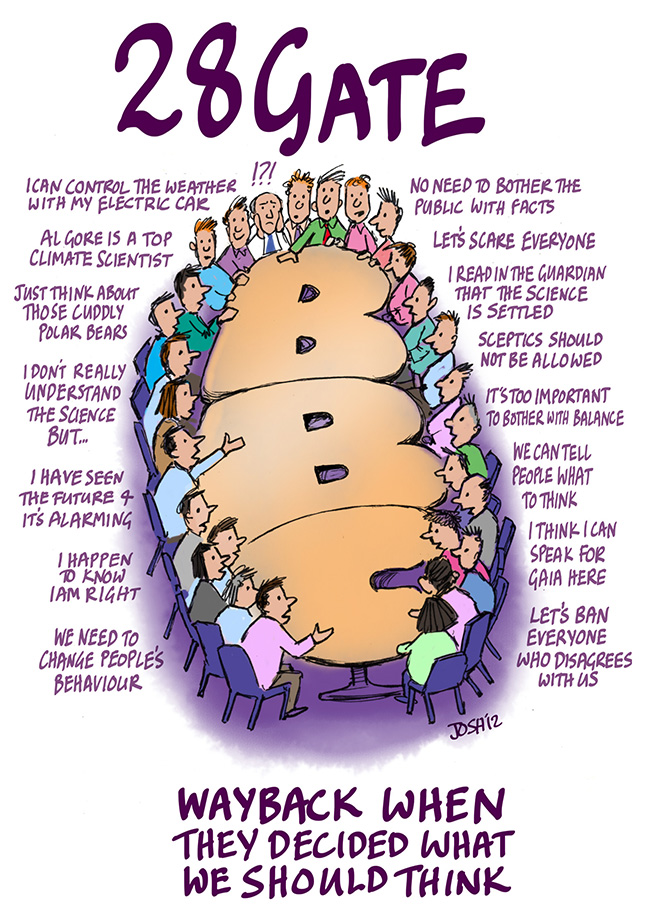
BBC’s shameful climate propaganda seminar exposed


Activists, all of them...

Activists, all of them…

I wonder how much of the same goes on at our own publicly funded broadcaster? Probably all of it.

Whenever there is a climate change story to be covered, the ABC will rush to its favourites: David Karoly (alarmist), Matthew England (alarmist), Clive Hamilton (Green, activist), Stephan Lewandowsky (“scepics are conspiracy theorist fruit cakes”), Will Steffen (alarmist), Tim Flannery (alarmist), and the list goes on.

After lawyering up and spending thousands of licence fee payer’s cash on opposing Freedom of Information requests, the story is finally out, as the Daily Mail reports:

The BBC has spent tens of thousands of pounds over six years trying to keep secret an extraordinary ‘eco’ conference which has shaped its coverage of global warming, The Mail on Sunday can reveal.

The controversial seminar was run by a body set up by the BBC’s own environment analyst Roger Harrabin and funded via a £67,000 grant from the then Labour government, which hoped to see its ‘line’ on climate change and other Third World issues promoted in BBC reporting.

At the event, in 2006, green activists and scientists – one of whom believes climate change is a bigger danger than global nuclear war – lectured 28 of the Corporation’s most senior executives.

Then director of television Jana Bennett opened the seminar by telling the executives to ask themselves: ‘How do you plan and run a city that is going to be submerged?’ And she asked them to consider if climate change laboratories might offer material for a thriller.

A lobby group with close links to green campaigners, the International Broadcasting Trust (IBT), helped to arrange government funding for both the climate seminar and other BBC seminars run by Mr Harrabin – one of which was attended by then Labour Cabinet Minister Hilary Benn.

Applying for money from Mr Benn’s Department for International Development (DFID), the IBT promised Ministers the seminars would influence programme content for years to come.

The BBC began its long legal battle to keep details of the conference secret after an amateur climate blogger spotted a passing reference to it in an official report.

Tony Newbery, 69, from North Wales, asked for further disclosure under the Freedom of Information Act. The BBC’s resistance to revealing anything about its funding and the names of those present led to a protracted struggle in the Information Tribunal. The BBC has admitted it has spent more than £20,000 on barristers’ fees. However, the full cost of their legal battle is understood to be much higher.

Read it all, then go and visit Tony’s blog: Harmless Sky

Greens to wither back to irrelevancy


Not so much Green, as brown… and dead.

Not so much Green, as brown… and dead.

For a few brief months, their star shone bright. Bob Brown, Christine Milne, Sarah Hansen-Young and their band of environmental ideologues basked in the limelight of being junior partner in a coalition of convenience with a desperate minority Labor government.

With their grubby hands finally on the levers of power, the Australian people were treated to a staggering display of ignorance, ineptitude, naiveté, extreme green dogma and ivory-tower logic that was quite the spectacle. In doing so, Labor’s support from its blue collar power base evaporated, allowing Tony Abbott to win government last September in a landslide.

Federal Labor abandoned the extreme left activists ages ago (too late to save their electoral prospects, however), and now the Labor premier in Tasmania is expected to axe the agreement with the Greens as soon as Monday. Not unexpectedly, the knives are out. Union leader Paul Howes yesterday:

“The Greens are a separate, different, independent political force whose views and ideology are contrary to the views and ideology of the labour movement.

“We don’t think it is in the interests of the labour movement to be forming formal allegiances with the Greens.”

Mr Howes said the Tasmanian experience, and the failure of the federal power-sharing agreement between the Greens and the Gillard government struck in 2010, showed the Greens were “not trustworthy”.

He took particular aim at Mr McKim for publicly undermining investment in mining projects in the Tarkine region and the proposed Tamar Valley pulp mill. “Nick McKim has behaved atrociously during his time in that cabinet and hasn’t acted like a normal member of any other cabinet,” Mr Howes said.

I suppose we should be glad that some in the Labor party have come to their senses.

Now, however, we can delight in watching the Greens wither and shrivel as they retreat to the political irrelevancy to which they belong. Theirs is a failed ultra-left agenda which is completely at odds with the views of the vast majority of the Australian people – the exception being inner-city urban trendoids who rarely leave the cosy surroundings of Brunswick or Ultimo and have no understanding of the real environmental issues that the country faces.

And if that weren’t galling enough, on a global scale, the Green movement is losing at every turn. Harsh realities, to which the ivory-tower-bound Greens are oblivious, such as the need to keep the lights on in many European countries, has resulted in a rapid return to cheap, dependable coal, over expensive and unreliable wind and solar, ensuring that emissions will continue to rise. Not only that, but massive expansion in coal production in both India and China over the next few decades will ensure that extremist environmental dogma will slip further into the dustbin of history.

The Australian has a lengthy article on the subject here.

Of course, we should all aim to use finite resources sparingly, avoid despoiling the environment, conserve water – these are all common sense actions any reasonable person would take. However, crippling our economies with pointless “weather taxes”, depriving the world’s poorest of a cheap source of energy, and subsidising inefficient, expensive and unreliable renewables is not what people (or governments, it seems) want.

The Greens are feeling the sharp end of those sentiments right now.