Idiotic Comment of the Day: James Hansen


Hansen (L), Homer (R)

James Hansen, Homer Simpson lookalike, is in Melbourne – lucky old Melbourne – spouting his usual mix of hysteria and lunacy. The Age fawns and grovels at his feet – not surprising since acres of Age copy is thanks to Hansen and his ilk. A few quotes deserve mention. On the plus side, he acknowledges that nuclear power has to play a part in Australia’s energy mix:

Renewable sources cannot be relied on solely, he believes, and ”it becomes a choice between coal and nuclear for baseload power”.

He would welcome Australia making a commitment to move to 100 per cent renewable energy – but said it would be a mistake. ”I think the chances of that working and being at a price that the public would be willing to pay is not very good,” he said.

But then it goes downhill:

”I don’t intend to be telling Australia what they should do for their energy source except that they can’t continue to burn coal without screwing everybody – including my grandchildren.

Charming. And my favourite:

”And exporting coal, and increasing exports of coal, is almost equivalent to being a drug dealer to the world.”

No hyperbole there, clearly.

Read it here.

More heat than light


Climate sense

Paul Monk, writing in The Australian Literary Review, skillfully sums up the current parlous state of the climate debate, with reference to a number of recently published books from both sides of the debate. It is a long read, but very well worth it, and the conclusion is spot on:

Collectively we need to do better than this. Not only is that so because the stakes in climatic and economic terms, as everyone agrees, are about as high as they can get, whether the AGW hypothesis is correct or not; but because we need to cultivate better habits of debating matters of moment, as regards both what is so and what is to be done.

And it is for precisely this reason that the recent disclosures about the IPCC’s sloppy handling of evidence and the scandalously anti-scientific behaviour of the “hockey stick” team led by Americna climatologist Michael Mann and the East Anglia Climate Research Centre are so disturbing. These people have been supposedly conducting the AGW Solvay conference for about 20 years. What we are beginning to see is that they have not been following the Solvay rules at all. In fact, they have been seeking for some considerable time to prevent or discredit any attempt to refute their hypothesis and have manipulated evidence in an effort not merely to confirm it, as bona fide evidence might be taken to do, but to appear to confirm it, when they knew that there were all kinds of uncertainties in the data. This is, quite simply, inadmissible.

Georges Monbiot has lamented recently, in the wake of the Copenhagen conference, that “climate scepticism” is “spreading like an infectious disease”. He may or may not be right, but his attitude is dead wrong. The AGW hypothesis is, in the nature of the case contestable, a claim based on highly complex data. Where inferences from the data or the reliability of the data itself seem unclear or tendentious, scepticism is completely natural.

But more importantly, scepticism is the life blood of science and democracy. Those who sincerely believe AGW is threatening civilisation should themselves be as rigorously sceptical as possible. They should be soliciting challenges to their data and inferences. That’s what the scientific method is and it doesn’t end because someone, scientist or otherwise, feels certain of their ground. It goes on and we need it to do so.

It is the same with the proposal for an ETS as public policy. Let’s have an end of denunciation, vituperation and exasperation.

For the sake of science, civilisation and democratic governance, we need clarity in this matter. And clarity comes through making one’s arguments explicit and then trying to find where one could be in error. That’s the gold standard for all parties to all serious debates.

Read it here.

VIDEO: Phil Jones at the UK Parliamentary Select Committee


Video of Prof. Phil Jones’ entire appearance at the UK Science and Technology Select Committee on 1 March 2010 (courtesy of live stream from Parliament TV, but converted and uploaded to YouTube by ACM). There are five parts, each of about 9 or 10 minutes. Jones is accompanied by the Vice Chancellor of the University of East Anglia, Prof. Edward Acton. Part 1 is here, links to the others follow:

Part 2

Part 3

Part 4

Part 5

They don’t exactly give PJ a tough ride, do they? To quote the former UK Labour Chancellor Denis Healey, it was like being savaged by a dead sheep…

Thanks to reader Pete for the original Parliament link (here) which is highly Mac unfriendly, the rats.

"Standard practice"? Apparently not…


As Anthony at WUWT reports, learned and respected societies are distancing themselves from Phil Jones’ claim that withholding data was “standard practice” (see here):

The Royal Statistical Society:

The RSS believes that a crucial step in improving the quality of the debate on global warming will be to place the data, the analysis methods and the models in the public domain. (source)

The Royal Society of Chemistry:

The RSC firmly believes that the benefits of scientific data being made available and thus open to scrutiny outweigh the perceived risks. To this end, scientific information should be made available on request as outlined in the Freedom of Information Act. (source)

And earlier, and even more stinging rebuke from the Institute of Physics:

The CRU e-mails as published on the internet provide prima facie evidence of determined and co-ordinated refusals to comply with honourable scientific traditions and freedom of information law. The principle that scientists should be willing to expose their ideas and results to independent testing and replication by others, which requires the open exchange of data, procedures and materials, is vital. The lack of compliance has been confirmed by the findings of the Information Commissioner. This extends well beyond the CRU itself – most of the e-mails were exchanged with researchers in a number of other international institutions who are also involved in the formulation of the IPCC’s conclusions on climate change.

As a step towards restoring confidence in the scientific process and to provide greater transparency in future, the editorial boards of scientific journals should work towards setting down requirements for open electronic data archiving by authors, to coincide with publication. Expert input (from journal boards) would be needed to determine the category of data that would be archived. Much ‘raw’ data requires calibration and processing through interpretive codes at various levels.

Where the nature of the study precludes direct replication by experiment, as in the case of time-dependent field measurements, it is important that the requirements include access to all the original raw data and its provenance, together with the criteria used for, and effects of, any subsequent selections, omissions or adjustments. The details of any statistical procedures, necessary for the independent testing and replication, should also be included. In parallel, consideration should be given to the requirements for minimum disclosure in relation to computer modelling. (source)

Phil, mate, you’re on your own (apart from the rest of the AGW movement, that is).

Phil Jones hid data because it was "standard practice"


In the hot seat

And, more importantly, it also shows the peer-review process is meaningless in alarmist climate science. That’s the ludicrous quote from Jones’ appearance before a Parliamentary committee. From The Daily Mail, via WUWT:

The scientist at the heart of the ‘Climategate’ row over global warming hid data ‘because it was standard practice’, it emerged today.

Professor Phil Jones, director of the University of East Anglia’s prestigious climatic research unit, today admitted to MPs that the centre withheld raw station data about global temperatures from around the world.

The world-renowned research unit has been under fire since private emails, which sceptics claimed showed evidence of scientists manipulating climate data, were hacked from the university’s server and posted online.

Now, an independent probe is examining allegations stemming from the emails that scientists hid, manipulated or deleted data to exaggerate the case for man-made global warming.

Prof Jones today said it was not ‘standard practice’ in climate science to release data and methodology for scientific findings so that other scientists could check and challenge the research.

He also said the scientific journals which had published his papers had never asked to see it.

The journals never asked to see it? Well of course, they wouldn’t would they? The peer-review process for alarmist climate science is non-existent. As long as a paper supports the consensus, it will be waived through without any scrutiny – and now we have the evidence to prove it: journals never asked to see the original data.

So the next time anyone says the peer-review process ensures that only decent research gets published, you know how to respond.

Read it here.

Phil Jones to face UK Parliamentary enquiry today


Tricky questions ahead

AP (via the SMH) reports that Phil Jones and the Met Office head are due to testify at a UK Parliamentary enquiry:

The scientist at the center of the controversy over e-mails stolen from a British climate research center is due to be questioned by lawmakers.

Climatologist Phil Jones is among the experts due to testify before Parliament’s Science and Technology committee.

Jones figured prominently in more than 1,000 e-mails hacked [leaked – Ed] from the University of East Anglia’s Climate Research Unit last year.

The e-mails appeared to show [did show – Ed] Jones and colleagues denigrating skeptics of man-made global warming and discussing ways to dodge Freedom of Information requests.

Critics said the e-mails were evidence of a conspiracy to exaggerate the threat of climate change.

Also testifying Monday are other top researchers, including the British weather office’s chief scientist. (source)

More bad science from the IPCC


@ Compweather.com

Wrong again - click for full size

Another story on the global warming/hurricane non-link:

RESEARCH by hurricane scientists may force the UN climate panel to retract its claims that greenhouse gas emissions have caused an increase in the number of tropical storms.

The benchmark 2007 report by the Intergovernmental Panel on Climate Change said an increase in cyclone-force storms since 1970 was probably caused by climate change.

It followed some of the most damaging tropical storms in history, such as Hurricane Katrina, which hit New Orleans, and Hurricane Dennis, which struck Cuba, both in 2005.

The IPCC added that the world could expect a big increase in such storms over the 21st century unless greenhouse gas emissions were controlled. The warning helped turn hurricanes — also known as cyclones or typhoons — into one of the most widely cited threats posed by global warming, with politicians including British Energy Secretary Ed Miliband and former Us vice-president Al Gore describing them as a growing threat to humanity.

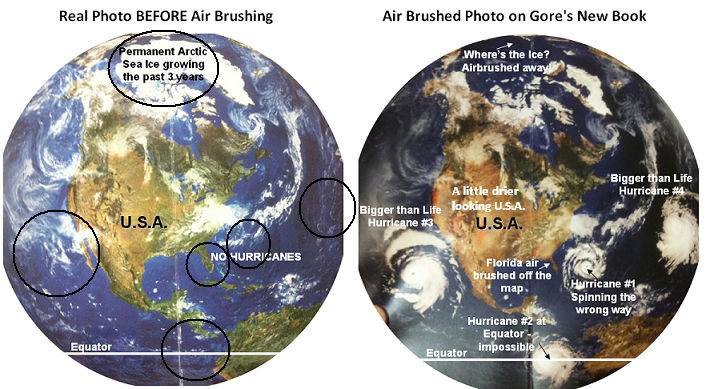
The cover of some editions of Mr Gore’s latest book, Our Choice, even depicts a world beset by super-cyclones as a warning of what might happen if carbon emissions keep rising.

However, the latest research, just published in the Nature Geoscience journal, paints a very different picture.

It suggests the rise in cyclone frequency since 1995 was part of a natural cycle and that several similar previous increases have been recorded, each followed by a decline. (source)

And don’t worry, Tim Lambert’s smug-blog Deltoid will no doubt add this article to his catalogue of  “The Australian‘s War on Science”, because in Lambert’s book, the war on science is anything which doesn’t fit with his pre-conceived agenda of alarmism.

And also in the news is a worrying sign that Rudd (who is a walking moral and principle vacuum) may do a deal with the Greens to get some kind of carbon trading scheme in place:

KEVIN Rudd has raised the prospect of a deal on climate with the Greens, who want an interim carbon price to end the Senate deadlock over an emissions trading scheme.

But he is playing down the likelihood of using the impasse as a double dissolution election trigger in October, as talks continue between Climate Change Minister Penny Wong and the Greens’ Christine Milne.

“This bill of ours for the Carbon Pollution Reduction Scheme is in the Senate now. Penny Wong and others are working with the Greens to see what can be done,” Mr Rudd told ABC TV’s Insiders program. “This is not over yet. And we will see what action emerges from the Senate.”

To secure a Senate deal, the government would, together with the five Greens, need an additional two votes, such as independent Nick Xenophon and a Coalition senator crossing the floor.

And if any Coalition senator did so, and thereby handed the government an ETS or a carbon tax, they should be strung up with piano wire. And prize for the most blindingly obvious headline goes to the Courier Mail:

Carbon Pollution Reduction Scheme could attract fraudsters

Now tell me something I didn’t know…

Green Left Weekly: The case for ecosocialism


Socialism through climate

Following on from the earlier post concerning post-normal science, this article in Green Left Weekly (whose articles appear in my regular news feeds every Sunday evening) caught my eye for the same reason: the whole climate change movement isn’t about the climate at all. It is a means to a socialist end, this time even more clearly annunciated. Even the title of the publication gives it away! The article begins with the usual alarmist statements about the climate system:

The rapid melting of the Arctic sea-ice is one of the most alarming examples of the looming climate change catastrophe. But where most see disaster, some of the world’s richest corporations see a business opportunity.

The rate of Arctic ice melt in recent years has surprised and worried experts. It is not just the fragile Arctic ecosystem that is under threat. As the ice retreats due to global warming, less sunlight is reflected back into space by the white surface.

This means the whole planet has likely already begun to warm faster, as more heat is absorbed by the darker ocean. This, in turn, could help trigger other climate tipping points — such as the release of millions of tonnes of methane gas trapped in Siberia’s frozen soils — and make runaway climate change a reality.

In 2007, NASA glaciologist Jay Zwally delivered a blunt warning: “The Arctic is often cited as the canary in the coal mine for climate warming. Now as a sign of climate warming, the canary has died. It is time to start getting out of the coal mines.”

Unfortunately, little of this has any merit, since there is no evidence of any such climate tipping points existing. Temperatures have been warmer in the past, and yet climate has never spiralled out of control. That we are still here after 4.5 billion years is evidence enough of that. Next, the cause of the strife is identified, and you guessed it – capitalism:

In 1950, the German-American economist William Kapp came up with an apt description of the capitalist system: “Capitalism must be regarded as an economy of unpaid costs.”

He described the reality of an economic system that creates immense waste and pollution but makes nature (and the sections of human society that did not reap the profits) bear the “disposal” costs.

For centuries, capitalism has treated the air, rivers and oceans as a global sewer. The long-term damage to natural ecosystems are never reflected in any corporate bottom-line. And as capitalism has developed into a global system, the environmental havoc it creates has been globalised too.

As public concern about the climate crisis rises, pro-capitalist economists and politicians are under pressure to find answers. But the business-as-usual solutions they offer generally rely on extending the market to more aspects of nature.

But what about green capitalism? No good:

US sociologists Brett Clark and Richard York have argued that the short-term need of capitalist markets to constantly expand is at odds with the long-term cycles of regeneration required by the natural world.

They said in the November 2008 Monthly Review: “The pursuit of profit is the immediate pulse of capitalism, as it reproduces itself on an ever-larger scale. A capitalist economic system cannot function under conditions that require accounting for the reproduction of nature, which may include time scales of a hundred years or more, not to mention maintaining the particular, integrated natural cycles that help sustain living conditions.”

In a talk at Green Left Weekly’s 2009 World at a Crossroads conference in Sydney, Canadian ecosocialist Ian Angus said green capitalism is a contradiction in terms.

“Capitalism combines an irresistible drive to grow, with an irresistible drive to create waste and pollution”, he said. “If nothing stops it, capitalism will expand both those processes infinitely. But the Earth is not infinite. The atmosphere and oceans and the forests are very large, but ultimately they are finite, limited resources — and capitalism is now pressing against those limits.”

And finally, the promise of a socialist utopia:

The ecosocialist vision of change is grounded in a vision of grassroots democracy and full equality for all people in the world. Unlike capitalism, the purpose of the economy would be to make sure everyone had enough. Under capitalism, much of the world’s population is condemned to extreme material hardship, while others are constantly urged to consume more.

A central goal of ecosocialists is to fight for a society that allows every human being to develop to their full potential — free of racism, war, poverty and discrimination. This goal of genuine human development, which applies to current and future generations, is unachievable unless society can be transformed to exist in harmony with nature’s limits.

This point was made forcefully by Venezuelan President Hugo Chavez at December’s UN climate summit in Copenhagen. “A spectre is haunting the streets of Copenhagen, and walks silently through this room”, he said.

“This spectre is capitalism — almost nobody wants to mention it … Capitalism, the model of destructive development, is killing people, and threatens to put an end to the human species. They are saying in the streets: If the climate were a bank, it would have been saved already.”

That the article quotes Hugo Chavez tells you all you need to know. But I think it is important for sceptics on the other side of the climate debate to understand where the true aim of “climate action” really lies. As the scientific consensus crumbles, the extremist environmental minority (as represented by publications such as Green Left Weekly) will see their dream of global socialism disappear, but they won’t let it go without a fight. So expect more alarmism and more hysteria (and worse) as they desperately cling to the sinking ship.

Read it here.

Climate change: global socialism and global governance


Climate change science

Thanks to Peter “Batts” Garrett and his insulation fiasco, climate change has taken a back seat in the media (despite the fact that “tackling climate change” is the reason behind the incompetent insulation programme in the first place). But a piece by James Delingpole in the UK Telegraph pointed me to a devastating article, on the blog Buy the Truth, about “Post-normal Science” which I find chimes exactly with my feelings on the climate change debate. Climate science is the perfect example of this new theory of Post-normal Science. But first, a few definitions:

Normal science

[Normal] Science is a logic inductive process leading to theory formulation, while all the way put through critical tests that have been deductively derived from the theory; Popper’s critical rationalist concept of science is an objective progression toward the truth…The term normal science refers to the routine work of scientists within a paradigm; slowly accumulating knowledge in accord with established theoretical assumptions…The paradigm is enlarged and frontiers of knowledge and techniques pushed forward.

The exercise of scholarly activities is defined by the dominance of the Mertonian CUDOS norms of science. They include:

(C)ommunalism – the common ownership of scientific discoveries, according to which scientists give up intellectual property rights in exchange for recognition and esteem;

(U)niversalism – according to which claims to truth are evaluated in terms of universal or value-free criteria;

(D)isinterestedness – according to which scientists are rewarded for acting in ways that appear to be selfless;

(O)rganized (S)kepticism – all ideas must be tested and are subject to structured community scrutiny.

Post-normal science

A new concept of science was introduced by Funtowicz and Ravetz during the 1990s…The concept of post-normal science goes beyond the traditional assumptions that science is both certain and value-free…The exercise of scholarly activities is defined by the dominance of goal orientation where scientific goals are controlled by political or societal actors…Scientists’ integrity lies not in disinterestedness but in their behaviour as stakeholders. Normal science made the world believe that scientists should and could provide certain, objective factual information…The guiding principle of normal science – the goal of achievement of factual knowledge – must be modified to fit the post-normal principle…For this purpose, post-normal scientists should be capable of establishing extended peer communities and allow for ‘extended facts’ from non-scientific experts…In post-normal science, the maintenance and enhancement of quality, rather than the establishment of factual knowledge, is the key task of scientists… Involved social actors must agree on the definition of perceptions, narratives, interpretation of models, data and indicators…scientists have to contribute to society by learning as quickly as possible about different perceptions…instead of seeking deep ultimate knowledge. (source: Eva Kunseler, Towards a new paradigm of Science in scientific policy advising)

So in essence, post-normal science is just another term for post-modern science: there are no absolute truths, value systems are always imposed on results, in other words a relativistic system of scientific investigation. Now any proper scientist would be horrified at this concept (as any proper science teacher would be horrified at the proposed new Australian National Curriculum in science, steeped as it is in marxist theory, cultural relativism and outcomes – where aboriginal dreamtime stories are as “relevant” as Newton or Einstein and the periodic table isn’t taught until Year 10, but don’t get me started on that…). Read what Mike Hulme, climate scientist at the University of East Anglia (of Climategate fame) has to say:

Philosophers and practitioners of science have identified this particular mode of scientific activity as one that occurs…where values are embedded in the way science is done and spoken.

It has been labelled “post-normal” science. Climate change seems to fall in this category. Disputes in post-normal science focus…on the process of science – who gets funded, who evaluates quality, who has the ear of policy…The IPCC is a classic example of a post-normal scientific activity.

Within a capitalist world order, climate change is actually a convenient phenomenon to come along.

The largest academic conference that has yet been devoted to the subject of climate change finished yesterday [March 12, 2009] in Copenhagen…I attended the Conference, chaired a session…[The] statement drafted by the conference’s Scientific Writing Team…contained…a set of messages drafted largely before the conference started by the organizing committee…interpreting it for a political audience…And the conference chair herself, Professor Katherine Richardson, has described the messages as politically-motivated. All well and good.

The danger of a “normal” reading of science is that it assumes science can first find truth, then speak truth to power, and that truth-based policy will then follow…exchanges often reduce to ones about scientific truth rather than about values, perspectives and political preferences.

…‘self-evidently’ dangerous climate change will not emerge from a normal scientific process of truth-seeking…scientists – and politicians – must trade truth for influence. What matters about climate change is not whether we can predict the future with some desired level of certainty and accuracy.

Climate change is telling the story of an idea and how that idea is changing the way in which our societies think, feel, interpret and act. And therefore climate change is extending itself well beyond simply the description of change in physical properties in our world…

The function of climate change I suggest, is not as a lower-case environmental phenomenon to be solved…It really is not about stopping climate chaos. Instead, we need to see how we can use the idea of climate change – the matrix of ecological functions, power relationships, cultural discourses and materials flows that climate change reveals – to rethink how we take forward our political, social, economic and personal projects over the decades to come.

There is something about this idea that makes it very powerful for lots of different interest groups to latch on to, whether for political reasons, for commercial interests, social interests in the case of NGOs, and a whole lot of new social movements looking for counter culture trends.

Climate change has moved from being a predominantly physical phenomenon to being a social one…It is circulating anxiously in the worlds of domestic politics and international diplomacy, and with mobilising force in business, law, academia, development, welfare, religion, ethics, art and celebrity.

Climate change also teaches us to rethink what we really want for ourselves…mythical ways of thinking about climate change reflect back to us truths about the human condition…

The idea of climate change should be seen as an intellectual resource around which our collective and personal identifies and projects can form and take shape. We need to ask not what we can do for climate change, but to ask what climate change can do for us…Because the idea of climate change is so plastic, it can be deployed across many of our human projects and can serve many of our psychological, ethical, and spiritual needs.

…climate change has become an idea that now travels well beyond its origins in the natural sciences…climate change takes on new meanings and serves new purposes…climate change has become “the mother of all issues”, the key narrative within which all environmental politics – from global to local – is now framed…Rather than asking “how do we solve climate change?” we need to turn the question around and ask: “how does the idea of climate change alter the way we arrive at and achieve our personal aspirations…?”

We need to reveal the creative psychological, spiritual and ethical work that climate change can do and is doing for us…we open up a way of resituating culture and the human spirit…As a resource of the imagination, the idea of climate change can be deployed around our geographical, social and virtual worlds in creative ways…it can inspire new artistic creations in visual, written and dramatised media. The idea of climate change can provoke new ethical and theological thinking about our relationship with the future….We will continue to create and tell new stories about climate change and mobilise these stories in support of our projects. Whereas a modernist reading of climate may once have regarded it as merely a physical condition for human action, we must now come to terms with climate change operating simultaneously as an overlying, but more fluid, imaginative condition of human existence. (various sources – see original article, including a Guardian article here)

The American Thinker’s review of Mike Hulme’s book, Why We Disagree About Climate Change, from where many of the quotes above are taken, sums it up nicely:

More than a few people will be tempted to buy this book based on the promise, implicit in its title, that it offers an examination of the ideas and motives of both sides in the global warming debate. But that is not what this book is about. Rather, it is the musings of a British socialist about how to use the global warming issue as a means of persuading “the masses” to give up their economic liberties. The fact that the author, Mike Hulme, is a scientist who helped write the influential reports of the Intergovernmental Panel on Climate Change (IPCC) and many other influential government agencies makes this book more disturbing than informative.

…socialists like Hulme can frame the global warming issue in such as way as to achieve seemingly unrelated goals such as sustainable development, income redistribution, population control, social justice, and many other items on the liberal/socialist wish-list.

It is troubling to read a prominent scientist who has so clearly lost sight of his cardinal duty — to be skeptical of all theories and always open to new data. It is particularly troubling when this same scientist endorses lying by others to advance his personal political agenda.

Read this book if you want insight into the mind of a scientist who has surrendered all moral authority to speak truthfully about global warming. Avoid it if you are looking for a book that explains why we disagree about climate change.

And as the article concludes:

From what Hulme has admitted, the climate change debate is not about truth and physical reality, but a way of making it the “mother of all issues” in order to achieve socialist and Marxist aims, including de-capitalizing the West, and bringing about global governance by an elite. Hulme is delighted to be in the vanguard, and it is paying him handsomely. Critical to this is capture of the scientific institutions. Hulme says, we are all actors “in the unfolding story…alongside the personal gods of the heavens”. Climate change is a new lying narrative serving an agenda as old as the hills.

You will recall Lord Monckton speaking about how climate change is a tool to achieve global governance and socialist/marxist aims, and how the warm-bloggers scoffed and ridiculed such a suggestion? Well, there you have it – Hulme has let the cat out of the bag.

Read the article in its entirety here.

IPCC to be "independently reviewed"


How independent will it be?

Hmm. We’ll see. Let me guess, it will be an “independent” review stacked with climate alarmists (much like the IPCC itself, in fact) who will say the IPCC has done a fantastic job and if only filthy deniers would stop asking awkward questions and picking holes in our flawless data we could all get on with shutting down our developed economies and sending everyone back to the Dark Ages:

The world’s top climate science panel, the Intergovernmental Panel on Climate Change (IPCC), is set for review by an independent board of scientists, a UN climate spokesman said.

The IPCC has been under fire since it was discovered one of its 2007 reports incorrectly predicted Himalayan glaciers could vanish by 2035. The figure should have been 2350. [And what about the other errors? And Climategate? And Pachauri’s conflicts of interest? The ABC conveniently forgets all those, of course – Ed]

Despite a resurgence of climate change scepticism [we’ve been here all along, it’s just that the media had all made up their minds and weren’t listening – Ed] because of the mistake, the UN says the IPCC’s fundamental claim that humans are causing dangerous climate change remains.

UN Environment Program (UNEP) spokesman Nick Nuttall, attending a conference in Bali, told reporters the panel would form part of a broader review of the IPCC to be announced next week.

“It will be [made up of] senior scientific figures – I can’t name who they are right now,” he said. [Can’t wait. Let me see: Mann, Hansen, Jones, Santer, Trenberth, Karoly, Pitman, Brook, Steffen, Flannery etc etc – Ed]

“It should do a review of the IPCC and produce a report by August, and there is a plenary of the IPCC in South Korea in October.

“The report will go there for adoption.”

He says member states are insisting on a fully independent panel, appointed from scientists outside of the IPCC.

The proof of the pudding and all that. I am yet to be convinced this won’t be just another whitewash.

Read it here.