What have the Romans ever done for us?


Microdot reader required

UPDATE: WUWT reports that the climate angle was spliced in at the last minute…

“Apart from the sanitation, medicine, education, wine, public order, irrigation, roads, the fresh water system and public health, what have the Romans ever done for us?” *

Given us warmer weather, that’s what!

Just as we must get rid of the Medieval Warm Period, the inconvenient Roman Warm Period must also be dealt with, and here’s a novel way of doing it: claim that it was man-made. In a single stroke, the RWP is scrubbed from the list of “natural warmings” that the planet has experienced in recent history, helping the Cause by demonstrating that it too was anthropogenic. The ABC reports:

A period covering the heyday of both the Roman Empire and China’s Han dynasty saw a big rise in greenhouse gases, according to a new study.

The finding challenges the view that human-made climate change only began around 1800.

A record of the atmosphere trapped in Greenland’s ice found the level of heat-trapping methane rose about 2000 years ago and stayed at that higher level for about two centuries.

Methane was probably released during deforestation to clear land for farming and from the use of charcoal as fuel, for instance to smelt metal to make weapons, says lead author Celia Sapart of Utrecht University in the Netherlands.

“Per capita they were already emitting quite a lot in the Roman Empire and Han Dynasty,” she says of the findings by an international team of scientists published today in the journal Nature (link to abstract). (source)

But the per capita emissions are irrelevant in terms of climate, since it is absolute concentrations that will affect greenhouse warming. The population, as the article goes on to say, was about 300 million, barely 4% of what it it today, and without any industrialisation apart from burning charcoal. I will leave it to you to consider the likelihood of such a tiny agrarian population having a significant effect on the climate.

The ABC’s coverage is similarly disingenuous. I’m not going to pay thirty bucks for the full article in Nature (if anyone has access, I would be grateful for a PDF – Update: PDF received from a generous reader – thank you!), but eyeballing the tiny graphics published with the abstract (see above) seems to indicate that centennial scale changes in CH4 mixing ratio in the Roman period were in the order of a 20-40 parts per billion (that’s billion with a b). How the ABC can call this a “big rise in greenhouse gases” is unfortunately yet more evidence of agenda-driven journalism. It’s a tiny fraction compared with the industrial rise in CH4, which took mixing ratios to over 1800 ppb, yet the paper claims it is responsible for the significant warming that occurred around the time of the Roman empire?

However, if we could blame the RWP on the Romans, then we can subtract it from the natural warming column and add it to the AGW column. Nice try.

* Monty Python Life of Brian:

Climate talks set to fail – yet again


Carbon-spewing gab-fest

The latest in the merry-go-round of lavish climate talks will take place next month in Doha, and we should thank the Brazilians for making it crystal clear well in advance that there won’t be any progress – just like there hasn’t been any progress at any of the previous gatherings.

With luck, we will be spared all the environmental hand-wringing and preaching that has accompanied every other pointless “save the planet” gab-fest since 1992:

Major emerging economies’ obligations to cut emissions under a climate change agreement should not be the same as those of rich countries, Brazil’s chief negotiator said, signalling a retreat to an old position that has hamstrung years of UN negotiations.

Ambassador Luiz Alberto Figueiredo Machado told Reuters during last week’s UN General Assembly that Brazil is committed to working toward a global pact to cut emissions in both developed and developing nations as agreed at last year’s climate talks in Durban, South Africa.

But Figueiredo said that agreement should adhere to the UN’s principle of “common but differentiated responsibilities,” a line between developing and developed countries drawn in 1992 that enabled countries such as Brazil, China and India to escape mandatory carbon cuts, which the Durban summit had supposedly eliminated.

“Different countries would have different contributions in this fight against climate change, and these different contributions have to do with a number of factors of national circumstances,” Figueiredo said, referring mainly to the belief that rich countries are responsible for “generating the problem.”

The so-called BASIC bloc (Brazil, South Africa, India and China) i n the UN climate negotiations stressed the point at a joint meeting in Brasilia last week to harmonize their position for the next round of negotiations in Doha, Qatar, which begin next month.

An agreement is to be formalized by 2015 and to take effect by 2020. (Reuters, via SMH)

Ironic that Qatar is the country with the largest per capita emissions on the planet. It also happens to have the largest GDP per capita on the planet. What does that tell you about the effects of plans for “massive emissions cuts” on the global economy?

The COP18 website is here.

Lewandowsky YouTube video


UPDATE [30 September]: Video appears broken. Still on YouTube, but black screen… mysterious. No – problem with browser – sorry! But we and WUWT did manage to make the video (and another related one by the Lew) The Conversation’s most watched video, with over 4500 views. Next one down is 2500, and after that 700, with most of the rest between a few hundred and almost nothing.

Watch in wonder:

(h/t WUWT)

ABC's twaddle on Tuvalu


Silliest van on earth

The ABC, keen as always to prop up The Cause, hijacks the visit of the Duke and Duchess of Cambridge to the island of Tuvalu to bang on about climate change:

Once the Duke and Duchess of Cambridge are carried from their aircraft on multi-coloured throne chairs in Tuvalu, the view will be of climate change.

The tiny Pacific nation, final stop on their tour, is at the forefront of small island countries already feeling the effects of rising sea levels.

Prince William and his wife will not have a chance to talk to non-government organisations in Tuvalu working on keeping back the sea.

Bet they’re gutted.

But Maina Talia, secretary of the Tuvalu Climate Action network, says the effects of climate change will be obvious as they tour on Tuesday.

“I’m not really sure of like what is the arrangement between the government of Tuvalu and the royal couple,” Maina Talia told Radio Australia’s Pacific Beat.

“But I must say that on their arrival, they must see how vulnerable we are to climate change.

“Even they can see the impact on gardens, on our food security and even we have lost a lot of traditional root crops due to the long drought that we faced last year and the beginning of this year. (source)

Hang on, it was sea level rises a minute a go – make your mind up…

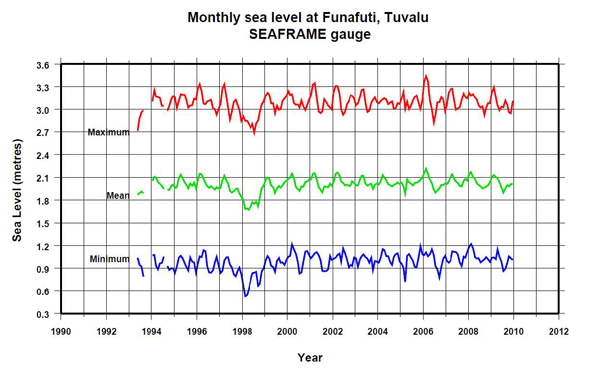
Anyway, there you have it. Unfortunately, sea level rises at Tuvalu are virtually nil, and any that do exist are probably more to do with subsidence of a coral atoll than rising sea levels caused by dangerous AGW:

Sea levels at Tuvalu

And if that wasn’t enough, the ABC reported back in 2010 that the islands were actually growing.

More twaddle from the ABC…

Lew – a few final thoughts


Cook and Lew – best buddies

UPDATE: Take a look at this article [backup link] on ABC’s The Drum, from May 2010, which reveals that Lewandwosky had already made the link between scepticism and conspiracy theories well before his paper was published – he just needed the right survey to confirm it:

Why would anyone believe that Prince Phillip is running the world drug trade? Why do some people believe that NASA faked the moon landing? Why is the internet abuzz with claims that 9/11 was an “inside job” of the Bush administration?

Conspiracy theories are part and parcel of modern life and some people clearly find their allure irresistible.

Likewise, climate “sceptics” obsessively yelp at the alleged frailties of the surface temperature record and accuse respectable scientific agencies of “fudging” data, oblivious to the fact that multiple independent analyses of the temperature record give rise to the exact same conclusion. The further fact that the satellite data yield precisely the same result without any surface-based thermometers is of no relevance to climate “sceptics.” It is also of no relevance to climate “sceptics” that their claims about the absence of global warming are logically incoherent with their simultaneous claim that humans didn’t cause the warming.

The conspiracy theory known as climate “scepticism” will soon collapse because it must be extended to include even the macrolepidoptera, including the rhopalocera, geometroidea andnoctuoidea. Yes, the European moths and butterflies must be part of the conspiracy, because they mate repeatedly every season now, rather than once only as during the preceding 150 years.

I’m not planning on posting any more on this ridiculous paper until I have some more news on FOI, but I do have a few final thoughts.

Steve McIntyre is doing sterling work digging into the data in great detail. But my question is, why bother? It’s lending credibility to a study which had zero to start with.

Let’s look at the facts:

  • Lew is well known as a vociferous critic of anyone who questions the “consensus”
  • He’s buddies with John Cook, he of climate alarmist heaven Skeptical Science fame
  • He’s previously published a lengthy catalogue of patronising articles relentlessly and repetitively attacking “deniers”, and often questioning their psychological health
  • He has already decided that he can besmirch his ideological opponents by linking climate scepticism to kooky conspiracy theories, and designs an online survey accordingly [see article in the update above]
  • Alongside questions regarding the effect of CO2 on the climate, there are questions about HIV/Aids, smoking and cancer, JFK, the moon landings, and a bunch of other crazy conspiracies
  • He gets the survey published on a bunch of headbanger blogs, many of which have undisguised contempt for realists, and probably think that they can help achieve his unstated pretty clear goals
  • None of the sceptic blogs approached publish it (maybe because it’s so painfully obvious to them what he’s attempting to achieve and don’t want a bar of it)
  • 10 out of 1100 or so survey responses express belief in the faking of the NASA moon landings, a large proportion of which were probably faked by alarmists having a laugh…
  • Despite the fact that six of those ten also believe the consensus on climate change, he submits the paper for publication in a journal with a title linking moon landing “denial” to climate “denial”
  • Newspapers in the UK pick up on the story (Telegraph, Guardian) and in passing at the Sydney Morning Heraldmaking sure the moon landing bit features heavily in the stories
  • Objective to portray sceptics as nut-jobs achieved

And as a postscript, when any of the above is questioned by the great unwashed, Lew labels that a conspiracy theory as well. Enough said.

Last word goes to A Scott on WUWT:

For the first time, in a now total 9 blog posts on this paper, [Lewandowsky’s] most recent story is more talk, less condescension and derision towards those who would dare challenge his work. Well OK, mostly, sorta less. It is a long story, with lots of fancy terms, initials, equations and descriptions.

In it he reminds us lowly unwashed masses that we are knowledge-less simpletons – merely “toying” with his data. That we couldn’t possibly understand all the important stuff real scientists like him know. Or maybe he didn’t say it exactly that way, but it’s just how it came across.  

He takes the long way around to re-tell us why skeptics are somehow conspiracy theorists who believe the moon landing, and (science), is fake, or something like that. I guess the parentheses mean because the answers to some of the other questions about science were true, that we can perform a latent variable analysis, and prove we actually DO believe in that fake old moon landing even though we said we didn’t. Or maybe not.

That’s this cool new idea he shares – we can’t just look at the simple answers to the questions – like whether we believe the moon landing was fake, nah, those 10 people don’t know nothing – they’re just noise. Nothing to see here – no one behind this curtain – now move along …

No – we must look to the answers of the other questions, to determine if we believe the moon landing was fake and thus are nasty old science rejecters. And motivated ones at that. Or something like that.

I think we’ve given Lew enough oxygen for now.

Lew Paper: 'Everything that could have been done wrong, was done wrong'


Lots of questions…

William Briggs (statistician to the stars) rips the Lew Paper to shreds:

Everything that could have been done wrong, was done wrong. Every bias that could have been manifested, was manifested. Every fallacy pertinent to the matter at hand was made. The conclusions, regurgitated from unnecessarily complicated statistical procedures, did not follow from the evidence gathered, which itself was suspect. In its way, then, the paper is a jewel, a gift to the future, a fundamental text to how easy it is to fool oneself.

Consider that its errors are not far to seek. Take the opening sentence: “Although nearly all domain experts agree that human CO2 emissions are altering the world’s climate, segments of the public remain unconvinced by the scientific evidence.” Isn’t that gorgeous? I count at least seven mistakes, and we are only at the very beginning!

  • Mistake 1: Lewandowsky is not a domain expert, and by his argument is not qualified to speak on matters climatic, yet speak he does.
  • Mistake 2: His opinion about how to consider the science of climate change is therefore no more valuable than any other non-domain expert’s (about the physics), but he considers by this act of publishing that it is.
  • Mistake 3: He conflates voting with truth. His fallacy is to suppose that because the majority of domain experts say X, X is therefore true.
  • Mistake 4: He conflates numbers with weight of evidence. His fallacy is to suppose the minority of domain experts who do not agree with the majority are not to be listened to because they are only a minority.
  • Mistake 5: He confuses physics with economics, a vulgar but common error. It may be true that, say, temperatures will rise by 0.5o C in the next five decades, but it does not follow that any theory of what will happen because of this temperature rise is true, nor is it true that anybody’s suggestion to combat the adverse consequences of what will happen is therefore worthy of consideration.
  • Mistake 6: Since Lewandowsky committed this howler, and is obviously unaware of it, he cannot see it in the people he interviews, who often make a similar error. That is, when a civilian is asked, “Do you believe in climate change?” he often answers “No,” but the mistake is to assume he is answering the question as stated, when in reality he has answered the modified question, “Do you believe in climate change and should the government regulate, rule, tax, control, mandate, penalize, etc., etc. to combat this change?” Such an elementary mistake by a psychologist shows us just how far the madness has progressed.
  • Mistake 7: Lewandowsky, because he is not a domain expert, misunderstood the basic physics. There are no domain experts who do not agree that mankind changes the climate. The only matters in question are: how much? where? when? with what certainty can we know? Notice the absence of “What can be done?” because this requires expertise in human behavior, and that expertise is what is suspiciously missing in this paper.

My dears, I emphasize that this was merely the opening sentence, and that much worse was to come.

Read it all.

'Lew, get a clew'


Inspector Clew-seau

Quote of the Day comes from Judith Curry, who skewers the ridiculous antics of Lewandowsky:

The latest ‘explanation’ for lack of belief in the IPCC consensus ‘truth’ is that these non believers are conspiracy theorists.  See Stephan Lewandowsky’s editorial Evidence is overrated if you are a conspiracy theorist.  Lewandowsky’s ‘evidence’ was a scammed internet survey.  Bloggers such as Steve McIntyreAnthony WattsBishopHill, Lucia, JoNova are all over this, and have exposed the scam (note: there are multiple posts on each of these blogs).  BS detection in action.  While I have used the term ‘auditors’ for deep investigations of problems with climate data, BS detection seems much more apt for this particular issue.

Lew, get a clew.  I hope this experience with the skeptical bloggers has revealed what they are really all about, as they have revealed YOUR conspiracy by finding a really big pile.

The ‘conspiracy’ among green climate bloggers has been further revealed by the leak of John Cook’s secret forum (link).  SkepticalScience seems to becoming the ringleader for conspiratorial activities by the green climate bloggers.  All this is high entertainment for those of us who follow the climate blog wars.  But take a step back, and consider how bad this makes you look, and how poorly it reflects on the science and ’cause’ that you are trying to defend. (source)

In other Lew News, Steve McIntyre reports that the Professor has now taken to deleting whole bunches of inconvenient comments on his blog:

Today, Lewandowsky (who is being assisted by an SkS squadron) liquidated every single comment by Fuller on the entire blog, leaving rebuttals to Fuller in place without the protagonist. This is different from not approving the blog comments: it’s an after-the-fact cleansing of Fuller from the blog.

The University of Western Australia should hang its head in shame at Lewandowsky’s Gleickian antics. (source)

And WUWT unearths an interesting few comments from the secret Un-Sk Ps-S database that was inadvertently “left open” earlier in the year (oh dear, how sad, never mind):

And this isn’t about science or personal careers and reputations any more. This is a fight for survival. Our civilisations survival. .. We need our own anonymous (or not so anonymous) donors, our own think tanks…. Our Monckton’s … Our assassins.

Anyone got Bill Gates’ private number, Warren Buffett, Richard Branson? Our ‘side’ has got to get professional, ASAP. We don’t need to blog. We need to network. Every single blog, organisation, movement is like a platoon in an army. ..This has a lot of similarities to the Vietnam War….And the skeptics are the Viet Cong… Not fighting like ‘Gentlemen’ at all. And the mainstream guys like Gleick don’t know how to deal with this. Queensberry Rules rather than biting and gouging.

..So, either Mother Nature deigns to give the world a terrifying wake up call. Or people like us have to build the greatest guerilla force in human history. Now. Because time is up…Someone needs to convene a council of war of the major environmental movements, blogs, institutes etc. In a smoke filled room (OK, an incense filled room) we need a conspiracy to save humanity.

Ohhh kayyy… scary stuff.

Lewandowsky update


Cook and Lew – best buddies

It’s almost impossible to keep up with the flood of articles on the Lew Paper.

From Climate Audit we have:

From WUWT:

From The Air Vent:

And from Jo Nova:

Lewandowsky’s responses can be found here, a website which is coincidentally maintained by John Cook of Skeptical Science. And the UWA Climate Science web page has a link back to Un-Sk Ps-S… So Cook writes the stuff on SkS, and then Lew then says anyone who doesn’t believe it is a nut job! Brilliant.

IPCC: 'an embarrassment to science'


Embarrassment

Hang on, surely the IPCC is the ‘gold standard’ of climate science, impartially reviewing all the available peer-reviewed (and peer-reviewed only) papers and presenting a balanced and apolitical position? Why else would governments around the world base their entire climate policies on its pronouncements?

Hardly. Not only is it an organisation that was established specifically to find evidence to prop up a conclusion already reached (namely that CO2 emissions will cause dangerous climate change), but it is riddled with environmental activism posing as science. Grey literature? Just fine – as long as it supports the Cause, of course.

It also regularly fails to correct errors, as Roger Pielke Jr reports:

Alleged errors in the treatment of disaster trends in Chapter 1, WGII, AR4
CLA response from Cynthia Rosenzweig and Gino Casassa
August 23, 2012

Alleged Error #1

Text from Roger Pielke, Jr.

Error #1: IPCC p. 110: “These previous national U.S. assessments, as well as those for normalised Cuban hurricane losses (Pielke et al., 2003), did not show any significant upward trend in losses over time, but this was before the remarkable hurricane losses of 2004 and 2005.”

FACTUALLY INCORRECT: Figure 5 in the following paper, in press prior to the IPCC AR4 WGII publication deadline, clearly shows that the addition of 2004 and 2005 losses do not alter the long-term trend in hurricane losses:

Pielke, Jr., R. A. (2006), Disasters, Death, and Destruction: Making Sense of Recent
Calamities. Oceanography 19 138-147. (link – PDF)

This same information was also in the report of the 2006 Hohenkammer Workshop on Climate Change and Disaster Losses, which was cited by the AR4 WGII: (link – PDF)

RECOMMENDED CORRECTION: “These previous national U.S. assessments, as well as those for normalised Cuban hurricane losses (Pielke et al., 2003), did not show any significant upward trend in losses over time, and this remains the case following the remarkable hurricane losses of 2004 and 2005.”

CLA Finding

There is no error in the statement. No correction is needed and the text can stand as is.

Rationale

The clause about the published analyses being before the 2004 and 2005 hurricane seasons is a statement of fact about the time line, and it is not a statement that the results were different after including 2004 and 2005. The statement does not infer that the overall pattern of losses would be different; instead it suggests that 2004 and 2005 were remarkable years in terms of hurricane losses, which they were.

PIELKE RESPONSE SEPTEMBER 13:  This boggles the mind. The time line was such that published analyses (I provided 2!) that were available to the IPCC when drafting the AR4 included 2004 and 2005. The IPCC is say that up is down, and with a straight face. Did they not even read what I wrote? (source)

Why should the IPCC dilute its political message, just because it’s factually incorrect? As Pielke tweets, the IPCC is an embarrassment to science.

Predicting rainfall: climate models flawed


More likely over drier soils

A new paper in Nature reveals that afternoon storms are more likely over dry soils as opposed to soils that were moist, calling into question climate models that predict increasing drought with rising temperatures.

The paper provides evidence that rather than drier soil increasing drought, by having less moisture available for evaporation and precipitation, it actually increases the likelihood of convective rainfall.

The abstract highlights the fact that current climate models incorrectly represent this relationship:

We find no evidence in our analysis of a positive feedback—that is, a preference for rain over wetter soils—at the spatial scale (50–100 kilometres) studied. In contrast, we find that a positive feedback of soil moisture on simulated precipitation does dominate in six state-of-the-art global weather and climate models—a difference that may contribute to excessive simulated droughts in large-scale models. (source)

Associate Professor Stewart Franks, a hydrologist at the University of Newcastle and president of the International Commission on the Coupled Land Atmosphere System (ICCLAS), comments on the paper:

“The study is important in that it demonstrates yet again that when we scrutinise the models against the observations, the models fail to simulate reality. The climate models represent the interactions between the land surface and the atmosphere in only a very crude way. The exchange of moisture and energy between the land and the atmosphere is represented by a single ‘big leaf’ over areas the size of 400x400kms. What this means is that the small-scale physics of rainfall generation, especially by well-known convective processes, are entirely missed.

The models fail to represent the large-scale drivers of global climate variability such as the El Nino – Southern Oscillation (ENSO). The models fail to represent the regional scale rainfall processes.  Given this, no-one can have any confidence in any prediction of future rainfall regimes when using climate models. Climate modellers argue that they are the best we have – that might be right, but if they don’t work, they don’t work.”