MUST LISTEN: Lord Oxburgh speaks on climate and Climategate


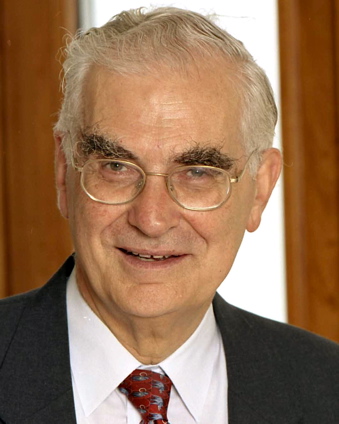
Lord Ron Oxburgh

Lord Oxburgh is in Queensland for the 34th International Geological Congress and granted a 20 minute audience to ABC host Steve Austin. Oxburgh’s inquiry into the Climategate affair was superficial and failed to ask the right questions of the right people. It was also hopelessly biased, and allowed the “accused” to select the “evidence” on which the inquiry was based.

Andrew Montford’s review of the inquiries (PDF here) concluded:

The Scientific Assessment Panel headed by Lord Oxburgh was chosen so that only a minority of members could be expected to look at the evidence with ‘questioning objectivity’. Despite their claim to the contrary, the research papers the panel examined were not selected “on the advice of the Royal Society.” They were, in reality, selected by UEA itself and were apparently approved by its director, Professor Phil Jones. The papers examined avoided most of the key criticisms of CRU scientists’ published work and all of the criticisms relating to their involvement in IPCC report. No records were kept of interviews and important papers have been destroyed.

Oxburgh himself was compromised from the outset, being president of the Carbon Capture and Storage Association and chairman of a company involved in construction and operation of windfarms. This obvious conflict of interest didn’t trouble Oxburgh clearly. I wonder if the same blind eye would have been turned if he was chairman of a fossil fuel company.

That said, he had some interesting things to say on a variety of subjects and I highly recommend listening to the whole interview here. I have transcribed some key sections below.

On Climategate:

“Most of the allegations that had been made basically by bloggers and others against the UEA, certainly against their honesty and reputation, were really unfounded.”

“[Scientists] were like rabbits in the headlights and they did some stupid things, but they weren’t dishonest and really anything that happened then didn’t reflect on the fundamental science of climate change.”

On climate in general:

Austin: You are very worried about climate change – tell me why.

Oxburgh: Well the science is pretty clear, that the things that human beings are doing are likely to be having a big effect on the climate.”

“Doing things about climate change now is equivalent to taking out fire insurance on your house. You hope it’s not going to burn down but it’s smart to be provident.”

On climate models:

“As a modeller myself, the models are only as good as the numbers and the assumptions that you put into them. It isn’t as if there is just one set of models, there are a very very large number of models and they all point in the same direction… is a very strong indicator that they are right.”

Oxburgh and Shell:

Austin: Here you are, the former head of a major oil company and you’re one of the people most worried about climate change.

Oxburgh: Correct.”

On shale gas:

“Gas is the big new kid on the block. You have it in Queensland as coal-bed methane, other parts have it as shale gas. […] The attraction of gas is that it is far less environmentally damaging than coal.”

On fracking:

“Like almost any job it can be done badly or it can be done well and if it’s done badly it can have poor local environmental consequences, but I think done responsibly and sensibly it should be just fine.”

On carbon sequestration:

“There is no doubt that it will work. I can say that categorically. It can be done. […] All of the elements of the process have been established. What hasn’t been done, but which should not present a major problem, is doing these in sequence as a single coherent process. […] The doubts and the questions arise over cost. I think that what you’ve been doing here in Australia with the CCS Institute is a real lesson to the world.”

“Where we really want to see this deployed is in China and India because these are the big burners of coal and we’re talking about the global commons here, doing something for our grandchildren and their children and so on and we need to get the CCS process at a cost which can be afforded in these relatively poor countries.”

On China:

“I think China has as part of its strategy to become the clean tech capital of the world. China is a country with a lot of problems, a third of its population not on mains electricity and extreme poverty, so China is building power stations, dirty power stations by anyone’s standards, because they see this as the path to internal stability.

What they’re doing in parallel, they have the biggest wind turbine industry in the world, they have more wind turbines set up in China, perhaps not all connected to the grid, than any country in the world, obviously they’ve got the solar panel business and I think that they are really pushing to become the clean tech capital of the world. […]

They realise that if everything that the climate scientists predict happens, China will be one of the really big losers and they don’t want that.”

On Peak Oil:

“We’ve got oil around $100 a barrel at the moment, spiking up, spiking down and so on, but I think that the price of oil is likely to rise somewhat, but if the price of oil gets significantly above $100 and looks as if it’s going to stay there, other ways of making oil are going to cut in. For example, you can take natural gas, which is your coal seam gas or gas from any source, and you can actually make a very nice clean liquid from it. The economics of that are quite good – the implications for climate change are not good because it’s a fairly carbon intensive process. […] You may see synthetic oils coming in from other sources as well.

[…]

It looks as if we are going to run out [of oil] gradually, and I say ‘run out’, but perhaps your listeners should appreciate, when an oil company abandons an oil field, in many cases there can be 40 or 50% of the oil still there in place, because it wasn’t worth getting out for the price that they thought they would get for it, so if we become desperate for oil and we can’t find an alternative there are many places you can go back in and actually pull some more out, at enormous cost, but it’s there.”

On biodiesel:

Biodiesel is of local significance and where it’s sensible to produce it locally by all means use it. Crop fuels are not likely to be a global solution simply because plants are very inefficient at the way they use sunlight – about 2% efficiency – and really for this to be a global solution, to transport fuels would just be too area intensive – you just can’t spare the land.”

On ethanol:

It depends how you make ethanol. I said that plants have about 2% efficiency use of sunlight. Sugar cane has 8% and the Brazilians make ethanol from sugar cane and probably you can justify that on environmental grounds, but if you look at the other big source of ethanol, which is for example the United States, where it tends to be made from corn, and where farming subsidies have been used to do this and we have seen corn diverted from human consumption to the production of liquid fuels, I don’t think it makes common sense or environmental sense.”


 

Why should we believe anything James Hansen says?


Climate activist (source: PA)

UPDATE [1.35pm AEST]: Pat Michaels writes “[Hansen’s] hypothesis is a complete and abject failure.” and quotes from the paper itself, which states:

“we were motivated in this research by an objective to expose effects of human-made global warming as soon as possible…”

So there you have it. From the horse’s mouth.

The lamestream media has pounced upon James Hansen’s latest announcement, blaming “global warming” for recent heat waves. This article, from the UK Telegraph is as good an example as any, illustrated as it is with a flattering portrait of the great man:

Recent heat waves can only be attributed to climate change, a top US scientist has warned.

James Hansen, who cautioned of the dangers of climate change as long ago as 1988, said the deadly European heat wave of 2003, the Russian heat wave of 2010 and the catastrophic droughts in Texas and Oklahoma last year could all be linked to climate change.

He predicted the same would also be true of the hot summer the US is currently experiencing.

Dr Hansen, director of the NASA Goddard Institute for Space Studies, reached his conclusions after he and his colleagues analysed the past 60 years of global temperatures.

Writing in The Washington Post, he said: “Our analysis shows that for the extreme hot weather of the recent past there is virtually no explanation other than climate change. (source)

The Telegraph doesn’t bother to look for any alternative viewpoint, merely parroting what Hansen says with no critical questioning or thought. It’s left to the blogosphere to provide that.

The ABC does much the same, including rehashing the Richard Muller “conversion” non-story, just in case you missed it the first time (unlikely if you rely on ABC for your news).

But in any case, why should we believe anything Hansen says in the first place? This is a person whose activism has completely swamped any vestige of impartial scientific enquiry, even going so far as to get himself arrested four times at environmental demonstrations. How can Hansen be relied upon to provide unbiased scientific conclusions in such circumstances?

What would happen if Hansen were to be confronted with evidence that challenges his entrenched position? Would he come out publicly and say it or simply post it down the memory hole because it doesn’t fit the agenda? You decide.

Even some of Hansen’s colleagues are sick of his surrender to activism (and kudos to the New York Times for actually bothering to seek an alternative perspective):

Martin P. Hoerling, a researcher with the National Oceanic and Atmospheric Administration who studies the causes of weather extremes, said he shared Dr. Hansen’s general concern about global warming. But he has in the past criticized Dr. Hansen for, in his view, exaggerating the connection between global warming and specific weather extremes. In an interview, he said he felt that Dr. Hansen had done so again.

Dr. Hoerling has published research suggesting that the 2010 Russian heat wave was largely a consequence of natural climate variability, and a forthcoming study he carried out on the Texas drought of 2011 also says natural factors were the main cause.

Dr. Hoerling contended that Dr. Hansen’s new paper confuses drought, caused primarily by a lack of rainfall, with heat waves.

“This isn’t a serious science paper,” Dr. Hoerling said. “It’s mainly about perception, as indicated by the paper’s title. Perception is not a science.” (source)

In reality, I suppose we should be glad that Hansen is out there making this kind of noise. Every exaggerated claim gradually chips away at the credibility of The Cause. And the eagerness with which the mainstream media regurgitated the story with barely a second thought (with notable exceptions) shows how out of touch they are with reality.

John Christy on climate change


Lubos Motl at The Reference Frame posts a video of Dr John Christy’s testimony to the US Environment and Public Works Committee on global warming. It is well worth watching:

Australia's shivering start to August


More brazen monkeys

More from the Weather Isn’t Climate Department – I can hardly keep up!

It’s all meaningless of course, it’s just weather after all.But you don’t hear the mainstream media, or Tim Flannery, or Clive Hamilton or David Karoly or Will Steffen, all rushing to bleat that this is evidence that “global warming” has slowed, or that such weather “is not consistent” with global warming models.

Whereas, if it was a heatwave on the other hand, as we will no doubt get come summer, all the above will be whining on about how it was “entirely consistent with” projections for climate change.

That’s the great thing about double standards and unfalsifiable hypotheses, right lads?

In New South Wales:

Sydney’s coldest start to August in 14 years

Sydney has shivered through its coldest start to August in over a decade.

On Wednesday, the first morning of the month started out on a cool note, dipping to seven degrees just after 5am. While this was only two degrees below average, it was the coldest first morning of the month in 14 years. (source)

and:

Icy morning in NSW

Parts of New South Wales endured the coldest August morning in 12 years as fog and frost descended on the state.

The Central West Slopes and Plains saw their lowest August temperatures since 2000 this morning. Trangie and Condobolin Airport cooled to -4 degrees, which was eight and seven degrees below average respectively. 

Clear skies and light winds last night combined with lingering cold air, following days of persistent southerly winds. This set up allowed heat to radiate away from the surface during the night, providing the ideal conditions for the mercury to plummet this morning. (source)

In South Australia:

Temperatures plunge across SA

August has made a chilly entrance in South Australia.

It has been the coldest August night in Adelaide for 13 years.

The temperature dropped to 2.2 degrees Celsius about 6:20am at the weather bureau at Kent Town and to just 1.3 at Adelaide Airport. (source)

In Queensland:

Coldest morning in years in Brisbane and Bundaberg

It was one of the coldest mornings of the year for Queensland with a few places having their coldest morning in over a decade. 

All of Queensland recorded temperatures below the August average except for parts of the Peninsula.

People felt the chill as Brisbane had its coldest morning in four years, dropping to a chilly 4.6 degrees, six below the August average.

Bundaberg Airport was a standout, falling to 3.4 degrees this morning. This was its coldest morning in 17 years and was eight degrees below average.

Mount Isa was very cold, dropping below freezing for only the second time this year and registering its coldest morning in 10 years. It was a staggering 11 degrees below average, reaching minus one.

Blackall in the Central West also recorded its coldest morning in 9 years, dropping to minus two. (source)

All courtesy of Weatherzone.

Adelaide's coldest August morning in 13 years


Brass monkeys

From the Weather Isn’t Climate Department:

 It has been a chilly start to August for Adelaide, plunging down to 2.2 degrees this morning, making it the coldest August morning in 13 years.

Just before sunrise, Adelaide dipped down to its lowest August temperature since 1999, when it dropped to 1.7 degrees. This morning’s 2.2 degrees was six below the August average minimum of 8.2 degrees.

This has been a particularly rare morning with Adelaide actually being colder than Canberra.

This freezing morning can be attributed to the combination of several influences. A cold front which passed recently brought a pool of cold air. A large high pressure system then moved overhead which cleared skies and made winds become light.

The city was not the only place which felt the cold. Adelaide Airport recorded 1.3 degrees, their lowest August temperature in 10 years. Elizabeth got down to 0.1 degrees, which is also a 10-year low for August. Noarlunga plunged to 4.2, their coldest August morning since 2006.

It won’t remain too cold all day with a top of 15 degrees expected during the early afternoon. The next few mornings also look like being warmer, due to extra cloud cover and wind bringing temperatures closer to average. (source)

Reaction to Muller's BEST announcement


BEST or worst?

The media have lapped up Richard Muller’s “Damascene conversion” story, with some journalists even going so far as to call him, laughably and shamefully, a “denier”.

It’s a story too good to be true. A man who has erred and strayed from the Cause has “seen the light” and realises the error of his ways. Funny how the religious imagery keeps cropping up in relation to climate change…

Anyway, the reality is that Muller was never a sceptic and by carrying out science by press release is simply engaging in acts of self-aggrandisement (not my words, but those of Michael Mann).

Andrew Orlowski writing in The Register takes apart the claims:

Richard Muller’s Berkeley Earth Surface Temperature (BEST) project, which began with goodwill from all corners of the climate debate, has made a series of bold announcements (without benefit of peer review) to the effect that global warming is definitely serious and definitely caused by humans. This has aroused derision among formerly supportive climate sceptics, caused an eminent climatologist to abandon the project, and even drawn criticism from generally alarmism-sympathetic media commentators.

Muller, professor of physics at UC Berkeley, is often regarded as a climate sceptic because he has frequently criticised the techniques used by climate scientists in the past and because he accepted funding for BEST from libertarian oil billionaire Charles Koch. When BEST launched in the wake of Climategate, it vowed to be “an independent, non-political, non-partisan group”, with Muller promising that “there will be no spin, whatever we find”. Critics of the existing temperature establishment, including well known sceptics Anthony Watts and Doug Keenan, welcomed it.

However each announcement has been aggressively trialled in the press not only before the peer review process had judged them ready for publication – which may not be a major issue – but also before anyone outside the BEST project could examine the papers at all. This requires the ordinary reader to take BEST’s accompanying press releases on blind faith – which is not a barrier for some journalists, but is far short of acceptable practice. (source)

Read the whole thing.

Also take a look at Jo Nova’s response:

Almost all the coverage of the Muller and BEST results confounds three different points, is poorly researched and mixes up cause and effect. Richard Muller is shamelessly promoting himself as something he is not, and his conclusions are nonsense on stilts that defy rational explanation.

Everyone knows hot air rises off concrete, yet scores of people get befuddled by statistics. The maths-talk is irrelevant. If your analysis tells you that thermometers next to combustion engines and industrial exhaust vents is recording global warming — your analysis is bunk, and we don’t need a peer reviewed paper to say so.

Muller’s three claims:

  1. He’s a converted skeptic. (Naked, demonstrably wrong, PR.)
  2. The world has warmed by 0.3C/decade. (He’s half right — he’s only exaggerating 100%.)
  3. That it’s mostly due to man-made emissions. (Baseless speculation.)

As far as public policies go the only point that matters is 3, but most of the conversation is about 1 and 2. Worse, most journalists and many so-called scientists think evidence for warming is the same as evidence that coal fired power stations did it. How unscientific. (source)

Kudos to Ben Cubby at Fairfax for actually deigning to speak to Jo about this and reporting it. They still manage to illustrate the story with a picture of cooling towers which are giving off … steam.

Josh on Watts and BEST


Skewered

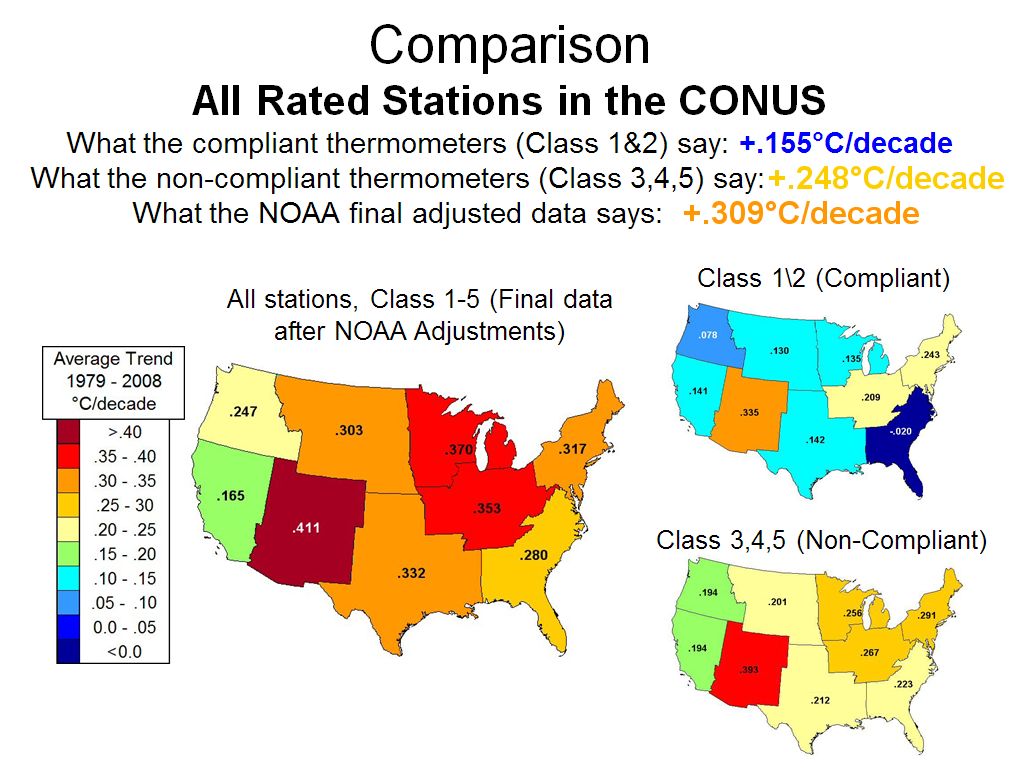
Watts' announcement: US temperature records contaminated with urban warming


(Click to enlarge)

Wasn’t quite the bombshell I was expecting, and hardly of ‘global’ significance, but interesting none the less.

UPDATE: In my haste to post this morning, I missed a key point, which Anthony kindly writes to correct:

“This paper means that every surface temperature record national or global must now be examined. See what Dr. Roger Pielke Sr. says here.”

Apologies for the misunderstanding.

Here’s the extract from Anthony’s post:

A reanalysis of U.S. surface station temperatures has been performed using the recently WMO-approved Siting Classification System devised by METEO-France’s Michel Leroy. The new siting classification more accurately characterizes the quality of the location in terms of monitoring long-term spatially representative surface temperature trends. The new analysis demonstrates that reported 1979-2008 U.S. temperature trends are spuriously doubled, with 92% of that over-estimation resulting from erroneous NOAA adjustments of well-sited stations upward. The paper is the first to use the updated siting system which addresses USHCN siting issues and data adjustments.

The new improved assessment, for the years 1979 to 2008, yields a trend of +0.155C per decade from the high quality sites, a +0.248 C per decade trend for poorly sited locations, and a trend of +0.309 C per decade after NOAA adjusts the data. This issue of station siting quality is expected to be an issue with respect to the monitoring of land surface temperature throughout the Global Historical Climate Network and in the BEST network.

One particularly interesting point is that the NOAA adjustments increase the temperatures despite UHI effects. How can they get it so spectacularly wrong (unless there’s an agenda at work in the background – perish the thought)?

Read it all here.

Ironically, this information comes at precisely the time that Richard Muller, of BEST fame, continues to plug the line that his temperature set has “settled the science”:

CALL me a converted skeptic. Three years ago I identified problems in previous climate studies that, in my mind, threw doubt on the very existence of global warming. Last year, following an intensive research effort involving a dozen scientists, I concluded that global warming was real and that the prior estimates of the rate of warming were correct. I’m now going a step further: Humans are almost entirely the cause.

My total turnaround, in such a short time, is the result of careful and objective analysis by the Berkeley Earth Surface Temperature project, which I founded with my daughter Elizabeth. Our results show that the average temperature of the earth’s land has risen by two and a half degrees Fahrenheit over the past 250 years, including an increase of one and a half degrees over the most recent 50 years. Moreover, it appears likely that essentially all of this increase results from the human emission of greenhouse gases. (source)

Call me cynical, but maybe he’s worked out which side his bread’s buttered.

UPDATE: Morano does the required demolition here. Even Michael Mann is peeved:

“My view is that Muller’s efforts to promote himself by belittling the collective efforts of the entire atmospheric/climate research community over several decades, though, really does the scientific community a disservice. Its great that he’s reaffirmed what we already knew. But for him to pretend that we couldn’t trust this entire scientific field until Richard Muller put his personal stamp of approval on their conclusions is, in my view, a very dangerously misguided philosophical take on how science works. It seems, in the end–quite sadly–that this is all really about Richard Muller’s self-aggrandizement 😦 “

Like I said in a post a while ago, the surface temperature sets are a crock. On that point, we have consensus.

Watts Up With That – 'major announcement' due Sunday


Announcement due?

Well this has certainly got the blogosphere buzzing:

Something’s happened. From now until Sunday July 29th, around Noon PST, WUWT will be suspending publishing. At that time, there will be a major announcement that I’m sure will attract a broad global interest due to its controversial and unprecedented nature.

To give you an idea as to the magnitude of this event, I’m suspending my vacation plans. I weighed the issue, and decided (much to my dismay) this was more important. I can go on vacation trips another time, but this announcement is not something I can miss now and do later.

Media outlets be sure to check in to WUWT on Sunday around 12PM PST and check your emails. (source)

“Something’s happened” – indicates it was unplanned.

“controversial and unprecedented” – very specific language to use. WUWT rules out FOIA in an update, so it’s unlikely to be Climategate 3.

“suspending vacation plans” – wow, this is serious…

For us Aussies, 12pm PST Sunday is (I think) 5am Monday morning Sydney time. Thanks, Anthony! It had better be worth it!

Perth on track for 'coldest month on record'


Not quite snowman weather, but still…

From the Weather Isn’t Climate department.

Damn you, global warming:

Perth is on track to have the coldest month on record.

This morning the temperature dipped to 0.4 degrees at 6.24am – and at 8am, it was still only three degrees.

That is the coldest day since July 5, 2010 when 0.3 degrees was recorded in the city.

Bureau of Meteorology senior forecaster Matt Boterhoven told WAtoday.com.au that today’s minimum took this month’s tally of cold mornings to 15.

The bureau counts temperatures of less than five degrees as cold mornings.

Mr Boterhoven said the record for cold mornings was 16 in a month, which was reached in July 2010, 2001 and 1998.

He said with forecasts predicting a minimum of two degrees for tomorrow and four degrees on Friday, there was a good chance that record would be beaten. 

The days ahead for Perth: Thursday: Partly cloudy. Min 2, max 18. Friday: Partly cloudy. Min 4, max 19. Saturday: Mostly sunny. Min 5, max 20. Sunday: Mostly sunny. Min 5, max 21. (source)

h/t Ice Age Now