Business demands carbon tax be slashed


Australia's economy post 1 July

Even businesses supportive of the carbon tax in principle are beginning to tremble at the prospect. At the government’s set rate of $23 per tonne, it is way above anything else anywhere in the world, and will send Australia’s economy into a tailspin at a time of global financial uncertainty.

KEY business backers of carbon pricing have called on the government to amend the carbon tax legislation to cut the price from $23 a tonne of carbon emissions to close to the European price of about $10, warning that the difference amounts to a “tax on industry” and will hit competitiveness.

The outgoing head of the Australian Industry Group, Heather Ridout, who this week took up her seat on the Reserve Bank board, warned that industries slugged by the high dollar could “ill afford” to pay the $23 a tonne slated to take effect from July 1, when other international prices were less than half that.

She said the gap between the legislated Australian price and international prices represented “a tax on industry, and I think it’s not what it was meant to be”.

Business Council of Australia chief executive Jennifer Westacott called for the $23 a tonne price to be scrapped, and the price set at $10.

“It is clear there is a substantial gap between the international permit price and the starting price in our fixed-price period, and this is a concern for the competitiveness of Australia’s industries and the impact this might have on our economy,” she said.

The two comments came after economists Judith Sloan and Warwick McKibbin called this week for the government to lower the rate of the carbon tax.

“A figure of $10 a tonne would be closer to the mark,” Professor Sloan wrote in The Australian on Tuesday.

Her comments were echoed by Professor McKibbin, a former Reserve Bank board member, who said: “It is in Australia’s national interest to have the price of carbon on July 1 this year starting at closer to $10 per tonne.”

So as this is a sensible, responsible government, they will no doubt take the concerns of business into account? Er, not a chance:

Wayne Swan, asked yesterday whether the government would reopen the carbon package after Professor McKibbin’s call for a $10-a-tonne price, said: “No.”

Yes, the government continually insists on signing its own death warrant – over and over again.

Read it here.

Flannery out of his depth as flooding rains return


Stewart Franks

Tim Flannery is little short of a national joke. Appointed by the Labor government as “Climate Commissioner” (whatever that is) on a juicy $180k salary for a 3 day week, his string of failed predictions would make even the most hopeless astrologers blush.

He has spread relentless alarmism about climate change, including rising sea levels (despite owning a waterfront property), and now had embarrassed himself yet further by claiming that even if it rained again, it wouldn’t fill the dams, as I sit here in Sydney with an east coast low sitting just offshore dumping widespread rain over the region (nearly 50mm in the last 12 hours at my station), Warragamba spills for the first time in 14 years, and dams across the eastern states are full.

Professor Stewart Franks, from Newcastle University, writing in The Australian, twists the knife:

TIM Flannery, Australia’s Chief Climate Commissioner, once declared that “even the rain that falls will not fill up the dams”.

This was back in 2007 at the height of the protracted drought that afflicted eastern Australia. Now, for the second year in a row, we see the effects of El Nino’s twin sister — La Nina — bringing extreme rainfall across great swaths of Australia. This is hardly the climate change future envisaged by Flannery.

Flannery has recently been the target of growing criticism for his wildly speculative claims, in particular from Andrew Bolt and Alan Jones.

Perhaps of even greater significance, Flannery is being publicly criticised by prominent meteorologists. Indeed, The Weather Channel’s Dick Whitaker recently stated: “People ideally suited to (weather forecasting) are meteorologists. From what I can see on Tim Flannery, meteorology wasn’t one of his specialties.”

In response to this growing criticism, Flannery has declared that the recent “big wet” cannot be taken as evidence that climate change is not happening — it is merely an interlude before we continue with the drying of the continent.

In a statement of extreme chutzpah, he also has declared that interpreting the recent wet is merely confusing weather with climate.

But as Franks explains, Flannery himself is confusing climate variability with climate change:

Despite our uncertainty about the PDO-IPO, one thing should be abundantly clear: to look at simple trends across a relatively short 40-year period is meaningless. If one looks at the trends in eastern Australian climate from 1950 to the present, one can see a marked, statistically significant decline in rainfall and flood risk.

However, if one looks at a similar length of records from, say, 1925 to 1975, we see a statistically significant trend, but in the opposite direction: upward. If Flannery were hawking his climate change message back in 1975, he would probably be claiming that the carbon climate future would be one of permanent flood.

Relatively short trends are clearly irrelevant given the multidecadal variability of eastern Australian climate driven by El Nino-La Nina Southern Oscillation and the PDO-IPO.

Flannery in his opinion piece has also stated: “Some commentators jump on any cold spell or rainy period to claim climate change is not happening. This cherry-picking is irresponsible and misleading.”

It is also true that some commentators jumped on the recent drought to claim climate change was happening. This cherry-picking is indeed irresponsible and entirely misleading.

Read it here.

Professor Stewart Franks writes at The Conversation


Flannery and Combet in the good old days…

Congratulations to Stewart on getting this piece, highly critical of Tim Flannery and other alarmist doomsayers, published at The Conversation (which, let’s face it, until now has been more like The [Warmist] Lecture). In particular, the article focusses on the recent severe drought in Australia:

Farmers struggled through very desperate times. The conditions were so bad that Tim Flannery, now Australia’s Chief Climate Commissioner, declared that cities such as Brisbane would never again have dam-filling rains. Rather bizarrely, in 2007 he stated that hotter soils meant that “even the rain that falls isn’t actually going to fill our dams and river systems”.

Fast forward to 2012 and we see widespread drenching rains, flooded towns and cities, and dams full to the brim and overtopping. Indeed, the rainfall that we had last year not only filled Brisbane City’s Wivenhoe Dam water supply storage, but also all of its flood mitigation capacity. The resultant releases of water required to prevent a truly catastrophic dam failure contributed to the inundation of large parts of metropolitan Brisbane.

How is it that Tim Flannery could have got it so spectacularly wrong? The most obvious factor could well be Flannery’s lack of background in a climate science. He is an academic, however his background is mammalogy – he studied the evolution of mammals.

Flannery obviously has a great interest in climate change and no doubt has read some of the scientific literature and no doubts consults with other climate commissioners. I have no doubt either that he by and large understands what he reads.

The one thing he cannot do without a solid education in climate science is critique what he reads; without the background surely he cannot perceive the underlying and often unstated assumptions associated with what he reads or is told. He is perhaps best described as an amateur enthusiast, in which case I could actually have a little sympathy for him for getting it so wrong.

As I speak, the comments are pretty fair, much to my amazement.

A step in the right direction – towards sensible dialogue.

Read it here.

Legal advice sinks bloggers' Finkelsteinian Nightmare


Part of UNSW

Scouring the internet for opinions on the constitutional powers of the Commonwealth to regulate the media in the manner proposed in the Finkelstein report, I came across a submission to Finkelstein’s own inquiry from the Gilbert + Tobin Centre of Public Law, part of the University of New South Wales (website here).

The submission is dated 14 November 2011, and does not appear in the official list of submissions (as far as I can see, let me know if it is there) and deals precisely with the issue in question: namely, to what extent the Commonwealth has the power to regulate traditional and new media.

One question that must be asked immediately is why the submission is omitted from the list on the Inquiry web site. It was sourced via the Gilbert + Tobin Centre’s own index of submissions. There may be a reasonable explanation for this, but in the interests of transparency it should be stated.

UPDATE: The Inquiry responded to my email about this, stating:

“It is an oversight that the submission has not been published.  The submission will be published shortly.”

The submission now appears on the consultation page.

Here are a few relevant extracts (my emphasis):

The Australian Constitution does not confer upon the Commonwealth any general power to regulate the all types of news media. Instead, the degree to which the Commonwealth can regulate in this area varies across mediums. 

PRINT MEDIA

The Commonwealth has no direct head of legislative power with respect to the print media. However, the Commonwealth may nonetheless regulate the print media by virtue of indirect heads of power such as those relating to trade and commerce, taxation, corporations, external affairs and the Territories. The most significant of these is the corporations power – its potential application to news media regulation is expanded on below. In addition, the Commonwealth may regulate print media where doing so is incidental to the exercise of a direct head of power – for example, it can limit ownership and control of print media as a condition of radio and television broadcasting licenses issued by virtue of section 51(v).

THE INTERNET AND ONLINE JOURNALISM

The extent of Commonwealth power over matters concerning the internet, including journalism that is published online, is yet to be considered by the High Court. However, it is likely that the internet falls within the scope of section 51(v) either as a ‘telephonic’ or ‘other like service’, and that federal regulation could validly extend to the means of online communication, such as infrastructure (eg, the installation of fibre optic cables) and the conduct of internet service providers (ISPs). Other heads of power, such as those mentioned above, may also support Commonwealth regulation of online content. The potential for this is explored further below. 

So far, then, the Commonwealth has the power to regular print media indirectly, through the corporations power, or incidentally to the postal and telegraphic power. It also appears the Commonwealth may regulate internet and online media through the means of communication. However, the following paragraph reveals that Finkelstein’s desire to regulate every blogger in Australia with more than 15,000 hits is beyond the powers of the Commonwealth:

To the extent that online journalism is carried out by constitutional corporations, it will be open to federal regulation via the corporations power in the same way the print journalism is. However, the extent of federal power is less certain where the online content is published by an entity that is not a constitutional corporation. A large number of individuals and bodies fall into this category, including any news outlets that operate as sole traders or partnerships, individual bloggers, and individuals posting on social media sites such as Facebook and Twitter. 

So where an organisation is a corporation, it can be regulated under the corporations power, but apart from that, there is no power to regulate their activities.

The extent of Commonwealth power to regulate online journalism of this nature is unclear. As noted above, it seems likely that section 51(v) authorises regulation of ISPs as bodies responsible for the transmission of online content. However, on current authority, it is doubtful that it extends to the regulation of the creators of content such as individual bloggers. Where news or other content appears online through a service such as Facebook which is controlled by a foreign or for-profit corporation, this could be regulated under the corporations power. 

“Doubtful that it extends to the regulation of the creators of content such as individual bloggers” – this means that if Finkelstein’s regime were to be enacted, it would have to place the burden on ISPs to censor content from blogs which fell foul of the regulatory framework, since there would be no power to act against the blogs themselves (unless they were corporations, and let’s face it, few are).

Furthermore, the submission concludes:

The Commonwealth has extensive, unrealised potential to further regulate the Australian media, including the print media. The corporations power in particular provides a basis upon which to establish new regulation in this field. However, such regulation is subject to the limits of existing powers. In particular, the corporations power only extends to entities that are incorporated and operate as a financial, trading or foreign corporation. In the circumstances, it must be recognised that, although it has extensive power, the Commonwealth does not possess the legislative power to comprehensively regulate the media in Australia. The only means of achieving this would be via cooperation with the States. 

And with New South Wales, Victoria, Western Australia and Queensland (any day now) controlled by Coalition state governments, they can kiss that idea goodbye.

Any such federal legislation presuming to regulate individual bloggers who did not fall within the corporations power would be ruled unlawful in any court challenge, and it appears that Finkelstein’s “tenuous connection with Australia” test is little more than fantasy.

Furthermore, Finkelstein’s “finger in the air” figure of 15,000 hits a year is meaningless in the above context, since the advice above points out that regulatory legality is dependent upon the legal status of the entity (corporation or not) rather than the size of its internet readership.

Surprisingly, nowhere in the report’s 400-odd pages does it acknowledge the vast constitutional mountain the regime would have to climb in order to be lawful against bloggers, which is set out clearly in the above submission. Maybe someone should let His Lordship know.

The submission (PDF) is available here (G + T site) or backup here (ACM).

Early US tornadoes will 'become the norm as planet warms'


Travesty

It was only ever a matter of time. Any unusual weather event occurs and there will be some rent-seeking climate scientist, aided and abetted by a willing journalist who will blame it on ‘global warming’.

This shameless opportunism does nothing to convince people of the need to ‘tackle climate change’, it merely makes the scientists and journalists look even more desperate and callous, especially given the tragic loss of life in these events (39 deaths as of today).

This time we have über-alarmist Sharon Begley and Kevin ‘Travesty’ Trenberth:

When at least 80 tornadoes rampaged across the United States, from the Midwest to the Gulf of Mexico, last Friday, it was more than is typically observed during the entire month of March, tracking firm AccuWeather.com reported on Monday.

According to some climate scientists, such earlier-than-normal outbreaks of tornadoes, which typically peak in the spring, will become the norm as the planet warms.

“As spring moves up a week or two, tornado season will start in February instead of waiting for April,” said climatologist Kevin Trenberth of the National Center for Atmospheric Research. (source)

Once again, this shouldn’t come as any surprise. Climate change is the unfalsifiable hypothesis – nothing can disprove the alarmists claim that every weather event is being affected by it. It therefore helpfully relegates the theory of catastrophic AGW to the dustbin of astrology and pseudoscience.

On reading the rest of the article, however, the true picture is that scientists really don’t know what effect warming will have on these events. But that doesn’t make a very good headline, does it? And there isn’t really a story there at all, is there?

Delingpole on the Finkelstein report


JD

James Delingpole has devoted his column today to Australia’s teetering on the brink of a Finkelsteinian Nightmare. He argues that we must suffer the full totalitarian reality of the progressive Left in order then to comprehensively reject it:

But as far as I’m concerned, the man’s a total bloody hero and when I come to Oz in mid-April I’d like to buy him a pint. Why? Because thanks to good old Raymond I’m going to sell loads more copies of my book Killing The Earth To Save It: How Environmentalists are Ruining the Planet, Destroying the Economy and Stealing Your Jobs (Connor Court).

Raymond – or Pinkie Finkie, as I’m sure he’d preferred it if I called him, because the Aussies do love a bit of informality, don’t they? – has produced a report on media regulation in Australia so terrifyingly authoritarian it makes the Leveson Enquiry look like a model of balance, sanity and restraint. (According to Mark Steyn – via Jo Nova – the Chinese have been eyeing Pinkie Finkie’s report with gobsmacked admiration, wondering whether they could ever get away with producing something quite so extreme…)

But let’s allow lefties like Pinkie Finkie and Gillard and Tim Flannery and Bob Brown their hour in the sun because the longer they stay there, the more damage they do and the more damage they will be seen to have done. This is important. (The same applies to Obama’s US; sadly it’s not going to work here, not with Cameron poisoning the wells for Conservatism for ever). If Australia is to get the government it needs (and deserves) it must first experience the full horror of the government it doesn’t deserve. The more easily ordinary people can see just how authoritarian, petty-minded, bullying, meddling and grotesquely biased the left can be when it holds the reins of power, the more enthusiastic they’ll be about throwing the bastards into the croc pit come 2013. (Or sooner, if we’re lucky). (source)

Read it all. And just to repeat, James’ excellent book is here. Full review to follow.

Media report recommendations 'would make any communist dictator proud'


Finkelstein

An excellent examination of the potentially draconian powers of the News Media Council is undertaken at Kangaroo Court of Australia and is well worth a read:

Former Federal Court of Australia judge Ray Finkelstein QC has handed down his report into the media which having a quick read seems to have been co-signed by Julia Gillard and Craig Thomson.

Make no mistake, it is a political document designed to protect corrupt politicians and dodgy policies from scrutiny and outing by the media. If The Fink’s recommendations had already been in effect we would not of heard about a lot of the dodgy dealings of the politicians because the reporting would have been closed down in record time.

The recommendations by The Fink would make any communist dictator proud.

When complaints are made against media organisations they will be denied natural justice and procedural fairness in their attempt to defend themselves against the compliant. Yep, you guessed it, just like a Kangaroo Court.

The new laws would also apply to bloggers so it is from this perspective that I mainly write about as I am what is considered a blogger. (source)

I am too. It’s a frightening read.

Desperation: AGW threatens ice hockey (stick?)


No hockey stick visible...

Now there’s an opportunity for a great link with this story – photo of hockey stick (© M Mann), threatened by climate change, geddit? But Sky flunks it.

Oh well, add it to The List. They really are getting desperate:

Man-made climate change is said to be threatening the future of ice hockey in Canada, where the sport is part of the national culture.

Top players have traditionally learned their skills on frozen lakes and backyard rinks.

But as winters get warmer, experts believe aspiring ice hockey stars in years to come will struggle to find suitable outdoor facilities.

Looking ahead, the scientists predicted a complete end to outdoor skating within the next few decades in regions such as British Columbia and Southern Alberta.

Experts believe. Scientists predict. Shit Journalism 101.

Sky News is wearing the cloak of shame for this, both for the appalling story and illustrating it with a photo of a speed skater. Duh.

And by the way, the Hockey Stick isn’t threatened by climate change, it’s threatened, and indeed demolished, by truth and scientific integrity. Just sayin’.

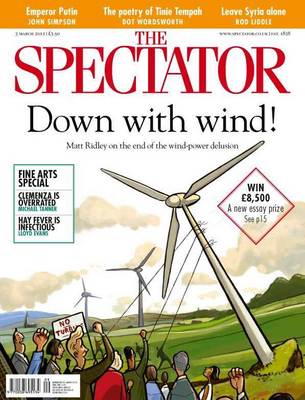
Matt Ridley: The Winds of Change


Climate sense

Matt Ridley’s latest article in The Spectator is a must read:

To the nearest whole number, the percentage of the world’s energy that comes from wind turbines today is: zero. Despite the regressive subsidy (pushing pensioners into fuel poverty while improving the wine cellars of grand estates), despite tearing rural communities apart, killing jobs, despoiling views, erecting pylons, felling forests, killing bats and eagles, causing industrial accidents, clogging motorways, polluting lakes in Inner Mongolia with the toxic and radioactive tailings from refining neodymium, a ton of which is in the average turbine — despite all this, the total energy generated each day by wind has yet to reach half a per cent worldwide.  

If wind power was going to work, it would have done so by now. The people of Britain see this quite clearly, though politicians are often wilfully deaf. The good news though is that if you look closely, you can see David Cameron’s government coming to its senses about the whole fiasco. 

Read it here.

Bwahahahaha! Peter Gleick recommends Skeptical Science


Recommendation you could do without

In a YouTube video (here), Gleick, he of Fakegate fame, says:

“There are some excellent websites that have debunked them one by one. SkepticalScience.com I believe is one that has a list of the favourite problems and misconceptions about climate change and the scientific refutations of those.”

I really wish I could get an endorsement from someone of Gleick’s standing in the scientific community… But I guess it takes a special kind of website to deserve such a recommendation, and Un-Skeptical Pseudo-Science fits the bill perfectly.