Cosmic rays and the Titanic


Titanic link?

Nigel Calder explores the correlation between cosmic ray flux and its effect on the climate, in particular in relation to the sinking of the Titanic (100 years ago on 15 April):

Although it seems a strange thing to celebrate, the Titanic Festival in Belfast, where the ship was built, will very soon mark the 100th anniversary of the liner’s foundering on 15 April 1912 after hitting a south-wandering iceberg, with the loss of a multitude of passengers and crew.

Comparing the £100-million Titanic complex newly built in Belfast with the Guggenheim Museum in Bilbao, the travel writer Simon Calder has commented, “There is a great shipbuilding heritage, it is a divided city, but the Guggenheim is great on the outside but rubbish on the inside – unlike the Titanic building.”

What’s more, James Cameron’s movie “Titanic” has been remastered in 3D for the centenary.

Time then for me to dig out some slides that I’ve used off and on in lectures since 1999 as an illustration of Henrik Svensmark’s cosmic rays in action, controlling our climate. But first, just to show that I’m not being kooky, here’s a graph from a 2000 paper by E. N. Lawrence of the UK Meteorological Office. “The Titanic disaster – a meteorologist’s perspective,” related iceberg abundance at low latitudes to a scarcity of sunspots (see image top right).

And Steven Goddard recalls a much older article, from the Chicago Tribune in 1923, that also linked icebergs with sunspots.

The notion that the Sun is dimmer when there are few sunspots goes right back to William Herschel at the beginning of the 19th Century. The trouble is that the variations in solar brightness, as measured by satellites, are too small to explain the strong influence of the Sun on climate as recorded over thousands of years, and continuing into the 21st Century. That’s where Svensmark’s discovery of 16 years ago comes in, with the amplifier. Cosmic rays coming from the Galaxy are more intense when there are fewer sunspots and they increase the global cloud cover, so cooling the world.

Read it all here.

And while we’re on the subject of Svensmark and cosmic rays, Anthony on Facebook linked to an interesting series of videos in which Svensmark and Nir Shaviv are both interviewed. First three parts are excellent, will get to watch the remainder soon. There doesn’t appear to be a date, but from the upload information, it was made prior to the results of the CLOUD experiment.

One of the most astonishing quotes comes from Bert Bolin (he of the IPCC, who had decided prior to the IPCC’s formation that CO2 was responsible for the present warming), who says of Svensmark’s work:

“Scientifically extremely naive and irresponsible”

Yes, you read that right. The head of the IPCC said that reporting scientific results from an experiment was “irresponsible”. It is a wonderful quote to cite, because it exposes at a stroke the political agenda of Bolin and the IPCC, where the risk of derailing the pre-conceived plan to regulate CO2 is deemed “irresponsible”.

It’s also instructive to witness the hostility that Svensmark receives from The Cause. And they accuse the sceptics of being “anti-science”?

Here is the first:

Bloggies: Congratulations Jo Nova


Well done, Jo Nova

Congratulations Jo Nova, for winning the Best Aussie or NZ Blog – a great blog that fully deserved to win.

As soon as I saw you were nominated I knew I didn’t stand a chance!

Thanks to all my readers who voted for ACM.

Simon

BREAKING: Australian leadership ballot result


Julia Gillard has trounced Kevin Rudd 71-31.

As one tweet remarked:

“You will sit quietly on the back bench for 18 months, won’t you, Kevin?”

Will the independents call a no confidence vote? Unlikely.

Labor still in a quandary: voters prefer Rudd, caucus prefers Gillard. Voters hate Gillard, caucus hates Rudd…

More later.

Early ripening of grapes "pinned to warming"


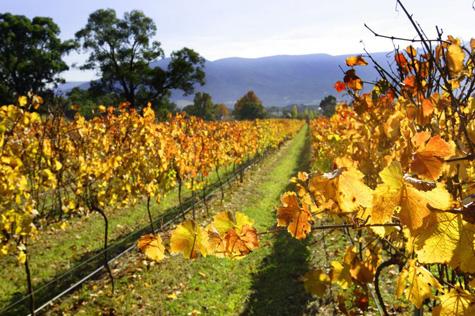
Yarra Valley

So the planet has got a little warmer in the last 200 years, and grapes are ripening a little earlier. Just as it got colder before the Little Ice Age and, no doubt, grapes ripened a little later. It’s called climate and it’s what the planet does.

Maybe it’s because for the first time in history we are examining our planet in such microscopic detail, something that has really only happened in the last hundred or so years (which just happens to coincide with a period of warming) that we are continually worrying about where we are headed.

Grapes were grown in the north of England during the Roman Warm Period, but there isn’t a chance of any decent Château Harrogate or Côtes du Humber in the near future.

Add this to the fact that the range of climates in which grapes are grown would exceed many times over the tiny change in global temperature in the last 200 years, and it should be obvious that adaptation should not be a big issue.

But despite all this, pinning it on global warming (as many scientists, and AAP, are all too eager to do on many occasions) makes it newsworthy, apparently:

RESEARCHERS in Australia say they have pinpointed key factors in the early ripening of grapes, providing potential answers for wine growers threatened by global warming.

In Australia and Western Europe, there is an abundance of anecdotal evidence linking higher temperatures with earlier grape maturation, a phenomenon that can affect the quality of table wine. 

But wine growing and climate change are each highly complex questions.

Until now, no one has sorted out how the variables – warming, sunlight, soil moisture and vineyard management – each play a role in grape maturation.

A team led by Leanne Webb at the CSIRO looked at 10 sites in southern Australia where there were highly detailed records, stretching from 1985 to 2009, for all of these factors.

Only at one site – at Margaret River on Australia’s southwestern tip – did the grapes ripen later. For the others, maturation occurred between six to 34 days earlier.

The commonest driver of earlier ripening was higher temperature, deemed a significant factor at seven sites.

Lower soil moisture, particularly in the drought-stricken southeast, was a major factor for earlier harvests at five sites. Drier soils lead to higher levels of a stress hormone called abscisic acid in vine roots, which drives the plant’s fruit to earlier ripening.

But vineyard management was also important.

In four sites, pruning and fertilisation methods that lowered crop yields contributed strongly to earlier maturation.

And there may be other technological innovations in these and other sites, such as improved disease and pest control, that could have been a ripening factor, says the study. (source)

So out of just 10 sites, warming was “deemed” a significant factor at seven, soil moisture at five, pruning and fertilisation at four, plus there “may be” other unknown factors which they were unable to attribute. Make of that what you will.

But it’s not all doom and gloom, as the study shows that vineyards can (dirty word warning) adapt, like humanity has been doing for centuries.

Call me cynical, but making “global warming” so prominent in this report seems to be purely to sensationalise the story. Its connection to “global warming” is tangential and the focus is clearly more on factors that are important for adaptation.

But let’s not forget this is CSIRO after all – and they have already made up their minds on climate change.

Media recycles two-year-old Everest scare story


You wait two years and the same story comes round again…

“It’s déjà vu all over again” said Yogi Berra, but it describes exactly how I felt on reading this AAP story in the Herald Sun this evening (and no doubt syndicated in plenty of other places as well):

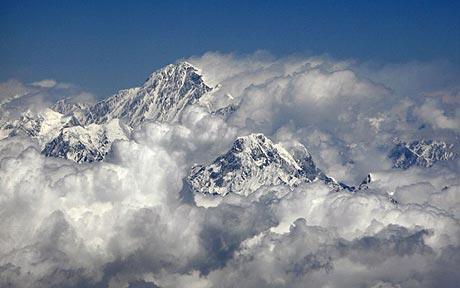
CLIMATE change is altering the face of the Himalayas, devastating farming communities and making Mount Everest increasingly treacherous to climb, some of the world’s top mountaineers have warned.

Apa Sherpa, the Nepali climber who has conquered Mount Everest a record 21 times, said he was disturbed by the lack of snow on the world’s highest peak, caused by rising temperatures.

“In 1989 when I first climbed Everest there was a lot of snow and ice but now most of it has just become bare rock. That, as a result, is causing more rockfalls which is a danger to the climbers,” he said.

“Also, climbing is becoming more difficult because when you are on a mountain you can wear crampons but it’s very dangerous and very slippery to walk on bare rock with crampons.”

Speaking after completing the first third of a gruelling 1,700-kilometre trek across the Himalayas, Apa Sherpa would not rule out the possibility of Everest being unclimbable in the coming years.

“What will happen in the future I cannot say but this much I can say from my own experiences — it has changed a lot,” he said an an interview with AFP in the village of Gati, 16 kilometres from Nepal’s border with Tibet.

The 51-year-old father-of-three, dubbed “Super Sherpa”, began his working life as a farmer but turned to the tourism industry and mountaineering after he lost all his possessions when a glacial lake burst in 1985.

Funny that, because back at the end of May 2010, the UK Telegraph ran an almost identical story, covered by ACM at the time:

Note how, that without a pause for breath, the media return to the term “global warming” when it suits? Even though global warming virtually stopped in 2001? But they need to make the link between “warming” and melting ice for this story:

Mount Everest is becoming increasingly dangerous to climb because global warming is melting glacier ice along its slopes, according to a Nepalese Sherpa who has conquered the world’s highest summit 20 times [one less than above – Ed].

Rising temperatures have melted much of the ice on the steep trail to the summit and climbers are struggling to get traction on the exposed rock surface, according to the 49-year-old[two less than above – Ed] Sherpa, known only as Apa.

The melting ice has also exposed deep crevasses which climbers could fall into, and experts have warned that people scaling the mountain risk being swept away by “outburst floods” from rising volumes of glacial meltwater.

He said there was hardly any exposed rock on the trail to the summit when he first climbed Everest in 1989, but now the slopes are dotted with bare rocks. (source)

Could this possibly be the same Apa who, just four days ago, dedicated his climb with 13 year old American Jordan Romero to the impact of climate change on the Himalayas, a fact not even mentioned in the Telegraph report? Obviously an impartial assessment, then. Add it to the warmlist.

Global warming is such a non-story, the media is now reduced to recycling yesterday’s fish and chip wrappers.

Australian Labor chaos: new Liberal advert


Remember Kevin O’Lemon? Now we have a new advert, just in time for Labor’s leadership ballot tomorrow morning at 10am Australian Eastern Daylight Time (11pm GMT): “Lemons never change their spots”:

All I am hoping for is that whoever wins will be so damaged that there will be a general election and the Coalition can dump the carbon tax.

Wall Street Journal: Sceptics respond to Trenberth et al


Warming exaggerated every time

You will recall the article in the Wall Street Journal “No need to panic about global warming” (see here). Then came the response from the headbangers, swiftly dealt with by Pat Michaels here (“Wall Street Journal war of words continues”) and letter writers  here (“WSJ: When you’re a hammer, everything looks like a nail”).

Now the original writers have responded in detail:

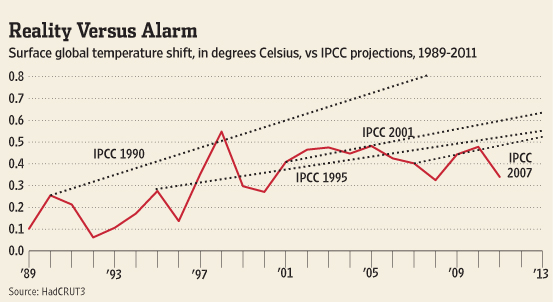
[…] an important gauge of scientific expertise is the ability to make successful predictions. When predictions fail, we say the theory is “falsified” and we should look for the reasons for the failure. Shown in the nearby graph is the measured annual temperature of the earth since 1989, just before the first report of the Intergovernmental Panel on Climate Change (IPCC). Also shown are the projections of the likely increase of temperature, as published in the Summaries of each of the four IPCC reports, the first in the year 1990 and the last in the year 2007.

These projections were based on IPCC computer models of how increased atmospheric CO2 should warm the earth. Some of the models predict higher or lower rates of warming, but the projections shown in the graph and their extensions into the distant future are the basis of most studies of environmental effects and mitigation policy options. Year-to-year fluctuations and discrepancies are unimportant; longer-term trends are significant.

From the graph it appears that the projections exaggerate, substantially, the response of the earth’s temperature to CO2 which increased by about 11% from 1989 through 2011. Furthermore, when one examines the historical temperature record throughout the 20th century and into the 21st, the data strongly suggest a much lower CO2 effect than almost all models calculate.

Read it here.

More indoctrination: Future Sparks website will 'fill classrooms with the buzz from the clean energy future industry'


Get 'em while they're young, right?

New Scientists wants climate indoctrination in schools, so it would be very proud of Australia, where such propaganda is disseminated widely thanks to Labor’s “Clean Energy Future” legislation. Yes, you read that right – a new website aims to indoctrinate school children with political propaganda on climate change.

This email popped into my inbox earlier today from the Department of Climate Change and Energy Efficiency:

Engaging our future bright sparks

Australian teachers and students can now harness the kinetic energy of a soccer ball to charge a mobile phone or power a light bulb, as part of ‘Future Sparks – our clean energy show and tell’ program, which was launched on Tuesday 21 February 2012.

Read the full story ‘Engaging our future bright sparks’ about the Future Sparks program on the Clean Energy Future website.

So here’s the flannel from the website:

Green Cross AustraliaCSIRO and the Clean Energy Council have joined forces to showcase the latest scientific and engineering developments to inspire and amaze students about the transition to cleaner sources of energy.

This initiative is proudly supported by the Department of Climate Change and Energy Efficiency.

The Future Sparks website is now live and has been designed to fill classrooms with the buzz and excitement from the clean energy future industry. The website features a video and persuasive writing competition giving students the chance to flex their creative muscle and participate in the wider clean energy future conversation.

CSIRO have provided lesson plans that are flexible and fun, catering for a wide range of school settings. Future Sparks is compatible with the Australian Curriculum, particularly with English and Science, and the cross-curriculum priority of sustainability.

This website also provides core information on clean energy options, climate change science, emerging technology and includes many links, videos and games enabling students to explore further. Schools can readily access most videos and animations as they do not require YouTube access. (source)

Wow – the “buzz and excitement from the clean energy future industry”. I can hardly wait. You want indoctrination? We’ve got indoctrination. In spades. And when you visit the website, which is colourful and pretty and instantly attractive to youngsters, the climate propaganda is all there:

The Earth’s climate has changed dramatically since the beginning of time, but evidence now shows that human activity is creating a sharp increase in the amount of greenhouse gases in the atmosphere.

Scientists agree this causes the temperatures on Earth to rise, which influences the climate – more extreme weather events, more often.

In some areas, the sea level will rise – and this is very worrying for people who live on small islands, particularly our Pacific Island neighbours.

There are now 7 Billion people on Earth – more than any other time in history – and this number is expected to continue to rise, putting further strain on the planet’s resources and adding greatly to climate change.

Animals will have to seek out climates to suits them – this will be a problem for alpine species in Australia!

Diseases will spread to new areas where the changed conditions will now suit microorganisms that can cause them.

So the change in climate will bring widespread change to our way of life and environment.

Take a look at this really cool video made by some other students to explain climate change.  It is a perfect example of a Future Spark video – make sure you keep yours under 3 minutes for this competition. (source)

Click the video link (if you can stand it) to see how some children have been totally brainwashed already. It’s truly, truly shocking. Links to CSIRO propaganda feature prominently, as do photos of polar bears and bush fires.

This tidal wave of propaganda will continue until our government is changed, finally, and this kind of political indoctrination is taken out of the classroom. It is utterly disgraceful.

New Scientist wants indoctrination, not balance, in climate education


Joke publication (from Jo Nova)

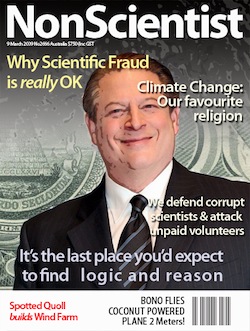
New Scientist (or “Non-scientist” as it should be more accurately called) continues to smear any attempt at balance in climate education with misrepresentations, straw men and half-truths. Citing the Heartland documents, it recycles the same, tired old arguments that we have heard a thousand times before:

Children should be taught honestly what we know about climate change, as well as what we don’t know and where the uncertainties lie. Yet a plan outlined in documents allegedly from Heartland would build a curriculum around statements such as “whether humans are changing the climate is a major scientific controversy”. This is to create controversy where none exists.

There simply is no credible scientific alternative to the theory that humans are warming the atmosphere.

We all acknowledge that humans are warming the atmosphere. The question, and where the doubt lies, is in the magnitude of that warming, in particular relative to natural climate cycles. Why are supposedly intelligent publications incapable of understanding this obvious difference? If that warming is one degree, then this isn’t a problem. As we keep repeating, the catastrophic projections come from multiple positive feedbacks in climate models.

In 2010, a survey of 1372 climate scientists found that 97 per cent of those who publish most frequently in the field were in no doubt. They agreed with the Intergovernmental Panel on Climate Change that human activity had caused most of Earth’s warming over the second half of the 20th century. By comparison with these scientists, the climate expertise of the small group of contrarians was substantially lower (Proceedings of the National Academy of Sciences, DOI: 10.1073/pnas.1003187107).

Ah yes, science by head count, and the politicised statements of a political organisation, the IPCC.

In the face of such broad agreement, the leaked strategy smacks of tactics used by tobacco companies as the evidence linking smoking to fatal diseases continued to grow. They employed accusations of scientific conspiracy, selective use of evidence and dissenting scientists to contradict public health experts and confuse the public. Oil companies have already used such tactics in the climate change debate. (source)

Smears, smears and more smears. And hints at a scientific conspiracy and selective use of evidence were both clearly exposed in the Climategate emails, but that doesn’t seem to concern the editorial writers today.

Why do they bother? Only total indoctrination will satisfy the headbangers at Non Scientist.

Quote of the Day: Megan McArdle


Quote of the Day

Wonderful quote from The Atlantic on Gleick:

And ethics aside, what Gleick did is insane for someone in his position–so crazy that I confess to wondering whether he doesn’t have some sort of underlying medical condition that requires urgent treatment.  The reason he did it was even crazier.  I would probably have thrown that memo away.  I might have spent a few hours idly checking it out. I would definitely not have risked jail or personal ruin over something so questionable, and which provided evidence of . . . what?  That Heartland exists?  That it has a budget? That it spends that budget promoting views which Gleick finds reprehensible? 

Exactly. Global warming alarmists (and the Left in general) can’t handle dissent, so they try to suppress it at all costs.