Climate Commission’s emotive alarmist blackmail


You just need to take a close look at this image to see all that’s wrong with the government funded propaganda mouthpiece the Climate Commission. It has been annotated with some ACM comments:
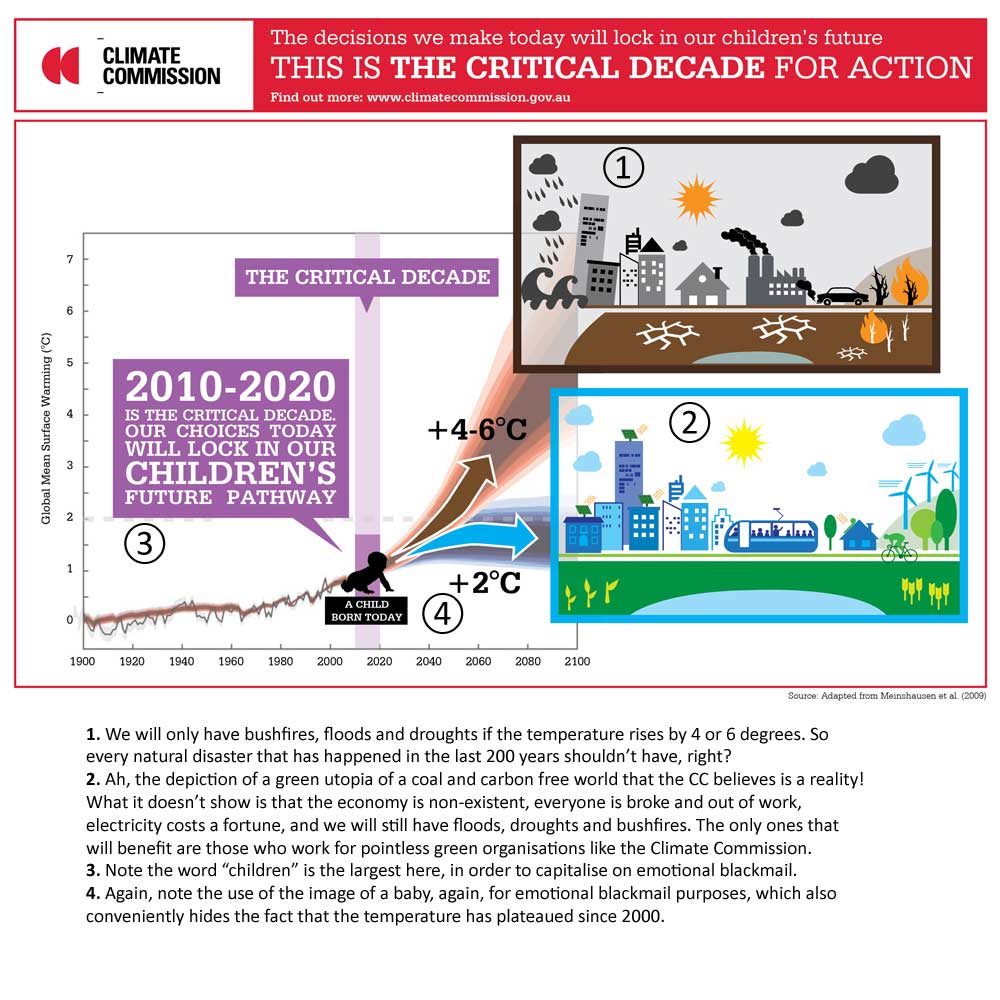
Propaganda, alarmism and blackmail

Propaganda, alarmism and blackmail

Planet’s been here for four and a half billion years, yet this microscopic blink of ten years is critical, right chaps?

Read the whole sorry thing here – and see if you can find any reference to the divergence between models and reality. Most of it is just a cut-and-paste job from IPCC AR4. This is where your tax dollars are going. Aren’t you glad?

Rising scepticism and falling alarmism


seesaw

Swings and roundabouts

Three articles of note today. First, UK chair of climate committee says warming may be natural, second, Met Office admits that warming of last century isn’t statistically significant, and finally, Aussie scientists downgrade alarmist predictions.

To the UK first, where Tim Yeo, chairman of the parliamentary Energy and Climate Change Committee, has embraced free-thinking, rational scepticism and has abandoned dogmatic and quasi-religious alarmism, in a shift which will send shock waves through the climate community.

As the Telegraph reports, in 2009 Yeo said this:

“The dying gasps of the deniers will be put to bed. In five years time, no one will argue about a man-made contribution to climate change.”

We didn’t need to wait five years for that, since Yeo has now finally acknowledged the uncertainties himself:

Humans may not be responsible for global warming, according to Tim Yeo, the MP who oversees government policy on climate change.

The chairman of the Commons Energy and Climate Change committee said he accepts the earth’s temperature is increasing but said “natural phases” may be to blame.

Such a suggestion sits at odds with the scientific consensus. One recent survey of 12,000 academic papers on climate change found 97 per cent agree human activities are causing the planet to warm [that’s John Cook’s crock on consensus, by the way. What has consensus got to do with it anyway? If more people think the Sun goes round the Earth, does that somehow make it true? “8 out of 10 cats prefer Whiskas“… – Ed].

Mr Yeo, an environment minister under John Major, is one of the Conservative Party’s strongest advocates of radical action to cut carbon emissions. His comments are significant as he was one of the first senior figures to urge the party to take the issue of environmental change seriously.

He insisted such action is “prudent” given the threat climate change poses to living standards worldwide. But, he said, human action is merely a “possible cause”.

Asked on Tuesday night whether it was better to take action to mitigate the effects of climate change than to prevent it in the first place, he said: “The first thing to say is it does not represent any threat to the survival of the planet. None at all. The planet has survived much bigger changes than any climate change that is happening now.

He went on: “Although I think the evidence that the climate is changing is now overwhelming, the causes are not absolutely clear. There could be natural causes, natural phases that are taking place.” (source)

Still in the UK, the Met Office has been forced, by a climate system that simply wouldn’t comply with the wishes of the alarmist “consensus”, to admit that the past 140 years of modest temperature rises are statistically insignificant, after six questions were raised in the House of Lords:

The issue here is the claim that “the temperature rise since about 1880 is statistically significant”, which was made by the Met Office in response to the original Question (HL3050). The basis for that claim has now been effectively acknowledged to be untenable. Possibly there is some other basis for the claim, but that seems extremely implausible: the claim does not seem to have any valid basis.

Plainly, then, the Met Office should now publicly withdraw the claim. That is, the Met Office should admit that the warming shown by the global-temperature record since 1880 (or indeed 1850) might be reasonably attributed to natural random variation….

Lastly, it is not only the Met Office that has claimed that the increase in global temperatures is statistically significant: the IPCC has as well. Moreover, the IPCC used the same statistical model as the Met Office, in its most-recent Assessment Report (2007)…

To conclude, the primary basis for global-warming alarmism is unfounded. The Met Office has been making false claims about the significance of climatic changes to Parliament—as well as to the government, the media, and others — claims which have seriously affected both policies and opinions. When questioned about those claims in Parliament, the Met Office did everything feasible to avoid telling the truth. (h/t Bolta)

Finally, David Karoly, arch warmist of Melbourne University starts hedging bets as he has to admit that ludicrously scaremongering claims of 6 degrees of warming were “unlikely”, but given Karoly’s well-known ideological and activist stance on the subject, the press release makes sure that the bandwagon still rolls on:

Scientists from the University of Melbourne and Victoria University have generated what they say are more reliable projections of global warming estimates at 2100.

The paper, led by Dr Roger Bodman from Victoria University with Professors David Karoly and Peter Rayner from the University of Melbourne and published in Nature Climate Change today, found that [good news…] exceeding 6 degrees warming was now unlikely while [bad news…] exceeding 2 degrees is very likely for business-as-usual emissions…

This was achieved through a new method combining observations of carbon dioxide and global temperature variations with simple climate model simulations to project future global warming.

Dr Bodman said while continuing to narrow the range even further was possible, significant uncertainty in warming predictions would always remain due to the complexity of climate change drivers. “This study ultimately shows why waiting for certainty will fail as a strategy,” he said. “Some uncertainty will always remain, meaning that we need to manage the risks of warming with the knowledge we have.” (source – h/t WUWT)

Interesting times…

UPDATE: The headbangers over at Un-Skeptical Pseudo-Science (no link) respond to these developments with balanced and open-minded scientific curiosity… Nah, only joking! With yet more alarmism, this time from Kevin Trenberth, who, like most of the headbangers, must be worried he’ll be out of a job in a few years’ time, when “climate scientists” go the way of spear-makers, rag and bone men and gas lamp lighters:

Focusing on the wiggles and ignoring the bigger picture of unabated warming is foolhardy, but an approach promoted by climate change deniers. Global sea level keeps marching up at a rate of more than 30cm per century since 1992 (when global measurements via altimetry on satellites were made possible), and that is perhaps a better indicator that global warming continues unabated. Sea level rise comes from both the melting of land ice, thus adding more water to the ocean, plus the warming and thus expanding ocean itself.

Global warming is manifested in a number of ways, and there is a continuing radiative imbalance at the top of atmosphere. The current hiatus in surface warming is temporary, and global warming has not gone away.

Bigger, badder hurricanes say climate scare-mongers


Wrong again

Wrong again

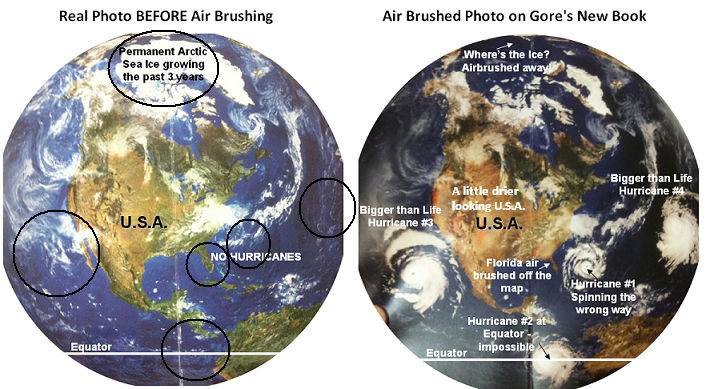
A good old fashioned scare story from the Silly Moaning Herald, just like the good old days. Remember the cover of Al Gore’s book (see right), showing multiple hurricanes approaching the US (one even spinning the wrong way for the Northern Hemisphere…!)? Well it’s time for that scare to be recycled once again:

The number of Atlantic storms with magnitude similar to killer Hurricane Katrina, which devastated the U.S. Gulf Coast in 2005, could rise sharply this century, environmental researchers reported on Monday.

Scientists have long studied the relationship between warmer sea surface temperatures and cyclonic, slowly spinning storms in the Atlantic Ocean, but the new study attempts to project how many of the most damaging hurricanes could result from warming air temperatures as well.

The extreme storms are highly sensitive to temperature changes, and the number of Katrina-magnitude events could double due to the increase in global temperatures that occurred in the 20th century, the researchers reported in the journal Proceedings of the National Academy of Sciences.

If temperatures continue to warm in the 21st century, as many climate scientists project, the number of Katrina-strength hurricanes could at least double, and possibly rise much more, with every 1.8 degree F (1 degree C) rise in global temperatures, the researchers said. (source)

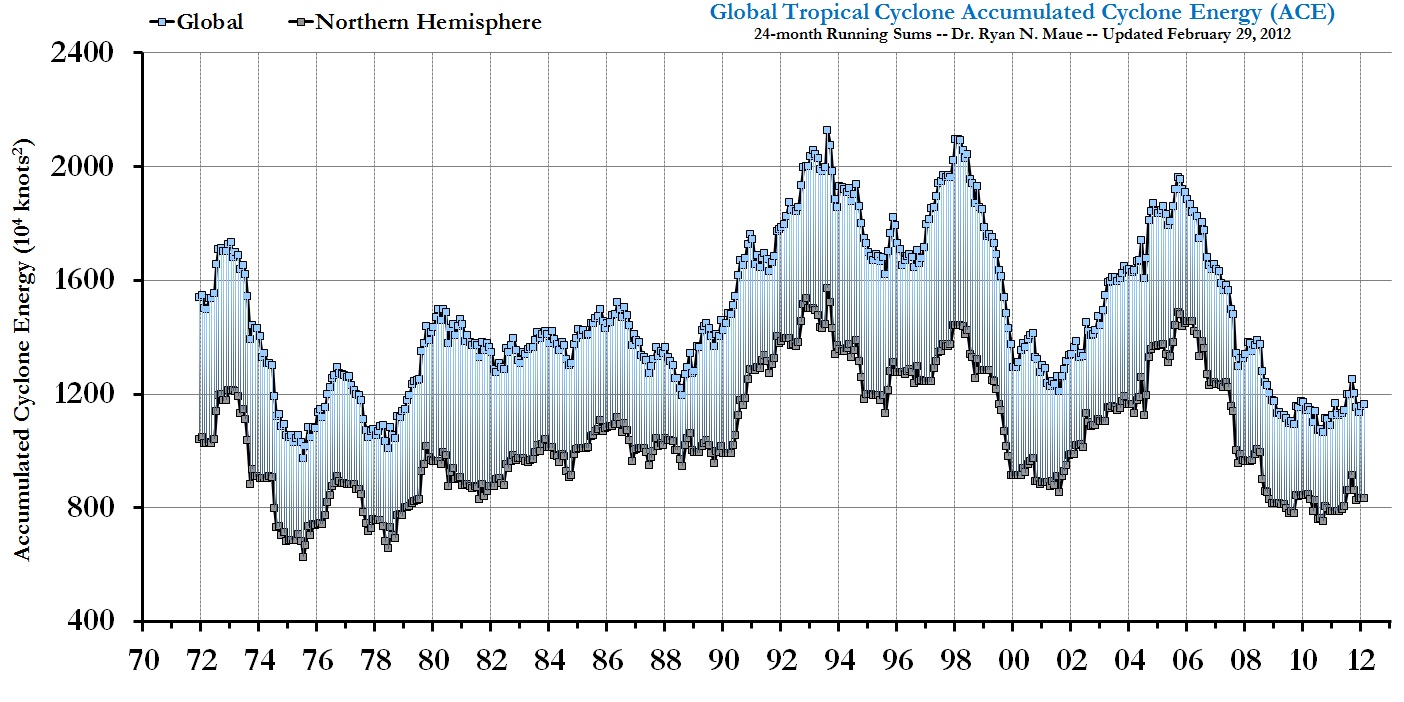
Funny that the accumulated cyclone energy is now almost as low as in the mid 1970s, when a new Ice Age was the environmental scare du jour. Apparently, 30+ years of man made warming hasn’t made much of an impact on cyclone and hurricane activity. But don’t let the facts get in the way of a good scare, eh?

Catastrophic increase in cyclone energy?

Catastrophic increase in cyclone energy?

ABC's alarmism fest


Alarmist Broadcasting Corporation

Alarmist Broadcasting Corporation

UPDATE: They just keep on comin’…

Warming planet to threaten native species

What effect will climate change have on Australia’s animal and plant species? This is the fourth of a five-part series in which environment reporter Sarah Clarke sets out to provide answers. [Oops, Sarah is at it again…]

Taskforce names regions most at risk of coastal inundation

The National Seachange Taskforce says coastal communities between Mackay and the Gold Coast are the most at risk in Queensland from predicted sea level rises.

Fish in hot water as climate changes

What effect will climate change have on Australia’s oceans and reefs? This is the final report in a five-part series in which environment reporter Sarah Clarke sets out to provide answers. [And again…]

Experts say oceans likely to continue warming

Scientists have recorded what they describe as the most dramatic marine heatwave in recent history off the WA coast.

And just for luck, another from ABC Science:

The 2013 climate change wake-up call

OPINION: Is an extreme heatwave enough for people to start taking the science of climate change seriously in Australia? Dr Paul Willis hopes so.

Enjoy that last one – “Dr” Willis uses “denier” or variants thereof five times. Just what exactly are we supposed to be denying exactly?

More to come, no doubt…

Timed to coincide nicely with the IPCC gas-a-thon in Tasmania, the ABC has gone gangbusters on climate alarmism – and that’s some achievement given previous form.

Ignoring the biggest story of the past couple of weeks, the UK Met Office’s downgrading of its warming forecast for the next five years, ABC News publishes no less than twelve alarmist climate stories in four days. Here they are in all their horrible glory:

Heart attacks and strokes: the climate change link

Heatwaves kill more Australians than car accidents – and medical authorities say that amplifies the risk posed by climate change.

Human health to feel impact of warmer future

What effect will climate change have on health in the Pacific? This is the third of a five-part series in which environment reporter Sarah Clarke sets out to provide answers.

UN group links heatwave to climate change

The United Nations’s (UN) chief climate science body says there is no doubt last week’s extreme heat in Australia is part of a global warming trend.

Extreme weather driving up food prices: Oxfam 

Simon Bradshaw from Oxfam says extreme weather patterns are beginning to affect the food chain.

Climate change will force farmers to adapt: CSIRO

What effect will climate change have on agriculture and food production? This is the second of a five-part series in which environment reporter Sarah Clarke sets out to provide answers.

IPCC meets in Australia for first time

Chair of the Intergovernmental Panel on Climate Change, Dr Rajendra Pachauri says the latest research is still a work in progress but Australia’s recent weather events are part of an unmistakable trend.

Bushfires and heat a sign of climate change: Milne

The Greens leader Christine Milne says this summer’s bushfires and record temperatures are providing a glimpse of what Australia’s climate might look like in the future.

Scientists warn of glacier melt acceleration

The Government has scoped the potential areas of the Australian coastline at greatest threat after a sea level rise.

Coastal properties facing rising seas risk

Professor Alan Stokes from the National Seachange Taskforce says rising sea levels are a serious risk and coastal councils need to deal with the issue right now.

Rising seas may put $300b of property at risk: scientists

What impact are sea-level rises predicted to have on Australian cities?

Climate change increases fire risk

A Climate Commission report says a warmer globe increases the risk of extreme fire danger conditions.

Heatwave exacerbated by climate change: Climate Commission

A new report from the Federal Government’s Climate Commission says the heatwave and bushfires that have affected Australia this week have been exacerbated by global warming.

And a couple from ABC Science, just in case you haven’t had enough:

Emissions could cut climate damage by 60%

The world could avoid much of the damaging effects of climate change this century if greenhouse gas emissions are curbed more sharply.

Heatwave suddenly shrinks seaweed’s range

SHRINKING SEAWEED: A recent marine heatwave off Western Australia rapidly shrank the distribution range of an ecologically-important seaweed, researchers report.

There must be a policy in force at the ABC. All I need is someone to leak it…

ABC's Doha climate-gasm


Climate porn

It’s that time of year again. The climate wonks all disappear on a carbon-fuelled jolly to a six-star hotel to work out how to save the planet, and the leftard media spew out acres of climate alarmism to help The Cause.

No media organisation does this better than our very own ABC, a clone of the once-great-but-now-shite BBC.

Here’s their latest serving of climate porn:

The latest snapshot from climate scientists has found the planet is on track for a 4 to 6 degree Celsius temperature rise by the turn of the century.

As United Nations climate talks enter their final week in Doha on the Persian Gulf, scientists are increasing the pressure on governments to do more to cut the discharge of heat-trapping greenhouse gases.

The Global Carbon Project report, published in the journal Nature Climate Change, has calculated that emissions rose by 3 per cent last year, and 2.6 per cent this year, despite the weak global economy.

Pep Canadell from the CSIRO was one of the lead authors of the report, and says the growth in emissions is shocking.

“Our analysis showed that by the end of this year, 2012, global emissions from fossil fuels are set to reach an unprecedented amount of 36 billion tonnes of carbon dioxide,” he told AM.

“Just to put this thing in perspective, this is 58 per cent over 1990, which is the Kyoto Protocol reference year, and growing at about three times faster than they were growing during the 90s.

He says on current trends, governments globally will have no chance of averting dangerous climate change.

“We are now following perfectly on track of the emissions path that will take us to anywhere between 4 and 6 degrees by 2100, if we don’t do anything different from what we are doing now,” he said. (source)

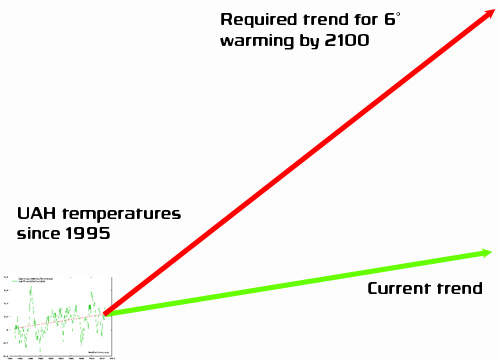
But despite emissions growing faster than ever, temperature rises have slowed to a crawl in the last decade or so. A six degree rise by 2100 would require a 0.7 degree rise every decade from now until the end of the century. What happens if we splice this on to the current temperature chart?

Likely?

Not only that, but this graphic uses temperature trends since 1995, if you take the trend since 2001, it’s even less. You would have thought, if CO2 were the main driver of global temperatures, that accelerating emissions would result in accelerating rises in temperature, but in fact it is precisely the reverse.

ABC's twaddle on Tuvalu


Silliest van on earth

The ABC, keen as always to prop up The Cause, hijacks the visit of the Duke and Duchess of Cambridge to the island of Tuvalu to bang on about climate change:

Once the Duke and Duchess of Cambridge are carried from their aircraft on multi-coloured throne chairs in Tuvalu, the view will be of climate change.

The tiny Pacific nation, final stop on their tour, is at the forefront of small island countries already feeling the effects of rising sea levels.

Prince William and his wife will not have a chance to talk to non-government organisations in Tuvalu working on keeping back the sea.

Bet they’re gutted.

But Maina Talia, secretary of the Tuvalu Climate Action network, says the effects of climate change will be obvious as they tour on Tuesday.

“I’m not really sure of like what is the arrangement between the government of Tuvalu and the royal couple,” Maina Talia told Radio Australia’s Pacific Beat.

“But I must say that on their arrival, they must see how vulnerable we are to climate change.

“Even they can see the impact on gardens, on our food security and even we have lost a lot of traditional root crops due to the long drought that we faced last year and the beginning of this year. (source)

Hang on, it was sea level rises a minute a go – make your mind up…

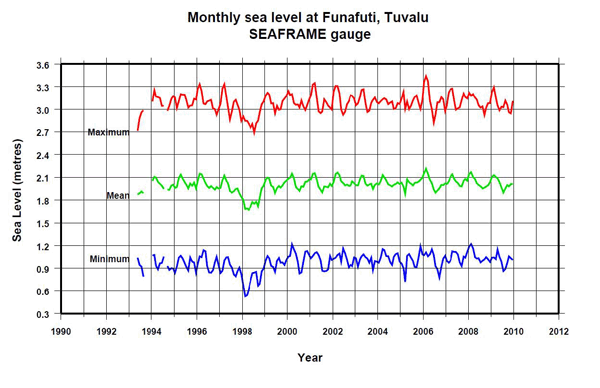
Anyway, there you have it. Unfortunately, sea level rises at Tuvalu are virtually nil, and any that do exist are probably more to do with subsidence of a coral atoll than rising sea levels caused by dangerous AGW:

Sea levels at Tuvalu

And if that wasn’t enough, the ABC reported back in 2010 that the islands were actually growing.

More twaddle from the ABC…

Apocalypse – not


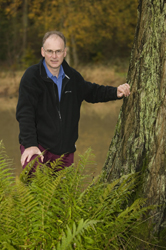
Matt Ridley (from rationaloptimist.com)

Matt Ridley, writing in Wired, exposes the end-of-the-world cultism that infects environmental activism, and shows how in almost every case, they got it spectacularly wrong.

From SARS to mad cow disease to acid rain to ozone holes, the environmentalists cannot resist the temptation to invoke apocalyptic prophesies to scare the public witless (and secure more funding perhaps?).

What’s the betting that climate alarmism will eventually be relegated to the dustbin of failed environmental scares? They all have several things in common:

  • an element of reality, which can be large or small;
  • which in each case is elevated to a full-blown scare;
  • by activists, who are usually driven by emotional, political, financial or other non-scientific motives;
  • the scare will command wall-to-wall media coverage, often for many years;
  • eventually, however, possibly decades later, it will be shown to have been exaggerated;
  • followed by a collective wringing of hands and gnashing of teeth from those in power;
  • and the public becomes ever more cynical and untrusting of such prophesies in the future.

In the climate debate, the extraordinary hysteria of the alarmists has polarised the debate to such an extent that outright denial (no matter how irrational) has sprung up almost out of necessity to counter it. Balanced elucidation of a potential crisis usually results in balanced responses – frenzied Chicken Little rants will inevitably result in precisely the same in response.

Ridley correctly concludes that the middle ground is where the debate should be focussed:

So, should we worry or not about the warming climate? It is far too binary a question. The lesson of failed past predictions of ecological apocalypse is not that nothing was happening but that the middle-ground possibilities were too frequently excluded from consideration. In the climate debate, we hear a lot from those who think disaster is inexorable if not inevitable, and a lot from those who think it is all a hoax. We hardly ever allow the moderate “lukewarmers” a voice: those who suspect that the net positive feedbacks from water vapor in the atmosphere are low, so that we face only 1 to 2 degrees Celsius of warming this century; that the Greenland ice sheet may melt but no faster than its current rate of less than 1 percent per century; that net increases in rainfall (and carbon dioxide concentration) may improve agricultural productivity; that ecosystems have survived sudden temperature lurches before; and that adaptation to gradual change may be both cheaper and less ecologically damaging than a rapid and brutal decision to give up fossil fuels cold turkey.

We’ve already seen some evidence that humans can forestall warming-related catastrophes. A good example is malaria, which was once widely predicted to get worse as a result of climate change. Yet in the 20th century, malaria retreated from large parts of the world, including North America and Russia, even as the world warmed. Malaria-specific mortality plummeted in the first decade of the current century by an astonishing 25 percent. The weather may well have grown more hospitable to mosquitoes during that time. But any effects of warming were more than counteracted by pesticides, new antimalarial drugs, better drainage, and economic development. Experts such as Peter Gething at Oxford argue that these trends will continue, whatever the weather.

Just as policy can make the climate crisis worse—mandating biofuels has not only encouraged rain forest destruction, releasing carbon, but driven millions into poverty and hunger—technology can make it better. If plant breeders boost rice yields, then people may get richer and afford better protection against extreme weather. If nuclear engineers make fusion (or thorium fission) cost-effective, then carbon emissions may suddenly fall. If gas replaces coal because of horizontal drilling, then carbon emissions may rise more slowly. Humanity is a fast-moving target. We will combat our ecological threats in the future by innovating to meet them as they arise, not through the mass fear stoked by worst-case scenarios.

Read it all, and enjoy Ridley’s list of apocalyptic predictions that didn’t come to pass.

Matt Ridley blogs at Rational Optimist.

(h/t WUWT)

Lomborg on extreme weather myths


© Scientific American

Climate sense

UPDATE: Australia’s own local alarmism “sausage factory”, CSIRO, comes up trumps right on cue, predicting “more droughts, floods and cyclones” as a result of “global warming”:

“SOUTH Pacific island nations will be hit by almost twice as many droughts, floods and extreme tropical cyclones over the next 80 years due to global warming, according to research led by the CSIRO.

The study, published in Nature today, suggests that the countries will face an even tougher time adapting to climate change than previously thought. Most previous studies have focused on sea level rise.” (source)

Apparently, they selected the best climate models (translation: least worst) and used those. So that’s OK, then.

As has been said many times on this blog, there is no weather condition that would not be “consistent with” some global warming model somewhere or other. More rain: global warming. More drought: global warming. More snow: global warming. Less snow: global warming. Etcetera etcetera.

So whenever there is an episode of extreme weather, the alarmists crawl out of their holes to link it to “global warming” in order to advance The Cause™. As always, we should ask what weather would “not be consistent” with their projections? None. Zip. Nada. It’s our old friend the unfalsifiable hypothesis again. Not so much science as astrology.

Bjørn Lomborg, writing in The Australian, takes apart the latest hysteria in the US over links between extreme weather and climate change:

A hot, dry summer (in some places) has triggered another barrage of such claims. And, while many interests are at work, one of the players that benefits the most from this story is the media: the notion of “extreme” climate simply makes for more compelling news.

Consider Paul Krugman, writing breathlessly in The New York Times about the “rising incidence of extreme events” and how “large-scale damage from climate change is happening now”.

He claims that global warming caused the current drought in the US midwest and that supposedly record-high corn prices could cause a global food crisis.

But the UN climate panel’s latest assessment tells us precisely the opposite: for “North America, there is medium confidence that there has been an overall slight tendency toward less dryness (wetting trend with more soil moisture and runoff)”.

Moreover, there is no way Krugman could have identified this drought as being caused by global warming without a time machine: climate models estimate that such detection will be possible by 2048, at the earliest.

[…]

Bill McKibben similarly frets in The Guardian and The Daily Beast about the midwest drought and corn prices.

Moreover, he confidently tells us that raging wildfires from New Mexico and Colorado to Siberia are “exactly” what the early stages of global warming look like.

In fact, the latest overview of global wildfire incidence suggests that, because humans have suppressed fire and decreased vegetation density, fire intensity has declined during the past 70 years, and is now close to its pre-industrial level.

When well-meaning campaigners want us to pay attention to global warming, they often end up pitching beyond the facts.

And while this may seem justified by a noble goal, such “policy by panic” tactics rarely work and often backfire.

Remember how, in the wake of Hurricane Katrina in 2005, Al Gore (and many others) claimed that we were in store for ever more devastating hurricanes?

Since then, hurricane incidence has dropped off the charts; indeed, by one measure, global accumulated cyclone energy has decreased to its lowest levels since the late 70s. Exaggerated claims merely fuel public distrust and disengagement. (source – paywalled)

In which case, I say to Krugman and McKibben: carry on!

Tweet of the Day: ABC's Dr Karl 'loves the carbon tax'


“Dr Karl” is a regular fixture of the ABC’s pop science output (see here), and therefore, almost inevitably, like all his colleagues at Auntie, a climate alarmist.

In response to a tweet about the carbon tax yesterday, Dr Karl replied:

Apart from not addressing the question, Dr Karl actually loves the carbon tax! What a surprise from an ABC science journo! A pointless political gesture which will damage our prosperity at a time when the global economy is spiralling into GFC Mark II – and Dr Karl “loves” it.

Obviously, he fails to spare a thought for the millions of ordinary Australians whose finances will be stretched even closer to breaking point by a policy which serves no purpose apart from keeping Gillard in power by appeasing the Greens.

I replied, naturally, enquiring what effect the carbon tax would have on the climate. I have yet to receive a reply. Quelle surprise

Greenhouse gases 'largely to blame' for ocean warming


Alarmist Broadcasting Corporation

Instead of reporting the problems with its last alarmist story, namely the fact that bloggers have once again found holes in a supposedly “peer-reviewed” paper propping up the consensus, the ABC just moves on and runs another:

A new US-led study, featuring research by Tasmanian scientists, has concluded that warming ocean temperatures over the past 50 years are largely a man-made phenomenon.

Researchers from America, India, Japan and Australia say the study is the most comprehensive look at how the oceans have warmed.

The study, published today in the journal Nature Climate Change, examined a dozen different models used to project climate change, and compared them with observations of ocean warming over the past 50 years.

It found natural variations accounted for about 10 per cent of rising temperatures, but man-made greenhouse gases were the major cause. (source)

Authors supporting “the Cause” include Aussie John Church and Ben Santer. Need I say more?

Judith Curry gets technical about it here, and ocean temperature records in general were pretty rough before the ARGO era, but concludes that the latest paper will no doubt win out in AR5. Why? Because it’s the “right answer”, according to the consensus. Politics and activism win out over impartial science every time.