Wall Street Journal on Gillard's carbon tax


WSJ Online

Not exactly a vote of confidence:

The plan is economically damaging enough that even the normally timid business lobby—many of whose members originally supported climate-change legislation—is speaking up. Opposition leader Tony Abbott slammed the plan as “socialism masquerading as environmentalism,” and he has a point. The government plans to use some of the carbon tax receipts to triple the income threshold before the income tax hits. In other words, this is in part a scheme to redistribute income from energy users to Labor voters. It is an odd kind of tax reform that narrows the tax base.

All of this for negligible environmental benefits. Australia emits 1.5% of the world’s greenhouse gases. Even if the country cut its emissions to zero, the move would do little to reduce global emissions. Australia’s per-capita emissions are high compared to other developed nations because it’s a sparsely populated continent blessed with an abundance of natural resources. Aussies have developed profitable, world-class natural resource and energy businesses that have lifted incomes at home and helped supply developing countries like China and India. This is bad?

It is if you believe in the theology that loathes carbon fuels and wants government to allocate the means of power production. In a speech Thursday, Ms. Gillard vowed to press forward with cap and tax and said that her convictions are “very deeply held.” We’ll see if her government can survive them.

Read it here.

Clean Energy Future advert: count the lies


Government propaganda at its very worst. Let’s go through it:

  • Lie Number 1: Carbon Pollution. It isn’t carbon and it isn’t pollution.
  • Lie Number 2: The majority of scientists agree that climate change is a result of human activity. A manufactured consensus from a politicised organisation (the IPCC) which was formed to find evidence of a pre-conceived conclusion. How much climate change is actually a result of human activity? We don’t know.
  • Lie Number 3: We can avoid the worst impacts by reducing “pollution”. No we can’t. The carbon tax will do nothing to change the climate.
  • Lie Number 4: Climate change is predicted to lead to further rises in temperature, rises in sea levels and some extreme weather events becoming more common, making life more difficult. Temperatures and sea levels have been rising slowly for centuries, without any help from man-made emissions. There are no confirmed links to more extreme weather events despite what the media tries to tell you.
  • Lie Number 5: Countries around the world are already taking action [lists China, USA, India and Europe]. No, they are not. China’s emissions will rise for the foreseeable future despite a few token environmental gestures, India’s carbon tax is $1/tonne, the USA has backed away from any federal climate action leaving just the tiny RGGI, and Europe is a hopeless economic basket case on the verge of collapse, thanks in part to a crippling ETS mired in fraud and corruption.
  • Lie Number 6: These clean energy sources [solar, wind, tidal and geothermal] are sustainable, renewable, their supply cannot be disrupted by events elsewhere, and they don’t contribute to pollution. None of those energy sources can replace fossil fuels for base-load electricity generation. And wind and solar are “disrupted” when the sun isn’t shining or the wind isn’t blowing. Tidal power is non-existent in Australia, and geothermal is so tiny as to be not even worth mentioning. The manufacture of solar panels and rare earth magnets for wind turbines releases millions of tonnes of real pollution into the environment.
  • Lie Number 7: Developing these new industries means developing new jobs. False. Every fake green job costs hundreds of thousands of dollars and takes away on average 2 – 4 real jobs. Subsidising inefficient, unreliable and expensive alternative energy is like burning $100 bills. The market will decide when “alternative” energy becomes competitive, not the government.
  • Lie Number 8: Meeting the challenge of climate change means being responsible, staying competitive and Australia continuing to prosper. A unilateral carbon tax does nothing for climate change, it is totally irresponsible, will make Australia less competitive compared to its trading partners, and will damage the economy for no benefit.

Wow. Eight whoppers in just over a minute. Pretty impressive.

And it’s all paid for by YOUR TAXPAYER DOLLARS.

Angry yet?

Check out a proper climate illustration here.

P.S. They’ve disabled comments in YouTube. I wonder why?

Gillard government's "carbon-track mind"


The wrong way…

The Gillard government’s obsession with pricing carbon is not only bad for Australia because of the damage it will do to our economy for no benefit whatsoever, but also because it is such an all-encompassing distraction from the myriad other problems with which the government should rightly be dealing.

Let’s just think of a few other disasters-in-waiting that would benefit from a bit of focus:

  • NBN – forgotten
  • boats – forgotten
  • health and education – forgotten
  • infrastructure – forgotten
  • possible second GFC – forgotten
  • interest rates – forgotten
  • [in fact, insert any other area of government responsibility you like here] – forgotten

Gillard and her government have a “carbon-track mind” – in their crusade to lead the world and impose a crippling carbon price on a naturally emissions-intensive economy, they have slipped into a quasi-religious trance and are suffering from acute tunnel vision which prevents them from seeing anything beyond this one dangerous path.

For the government to let a single policy area, no matter how important it believes it to be, dominate the agenda to the detriment of everything else is irresponsible and incompetent.

This government has not only lost the support of the people, it has completely lost its way.

It gets worse: Labor 39 – Coalition 61


We're not laughing…

Could it get any worse? Apparently, yes. It’s like watching an aged relative die a slow and painful death. The time has come for Labor backbenchers to put this government out of its misery, show that they still have some principles, and withdraw support.

It won’t happen of course, because they are all driven by petty self-interest rather than what is best for the country, but it’s a nice thought:

THE government has flatlined, personal support for Julia Gillard has plunged and Tony Abbott is by far the nation’s favoured leader, according to the first comprehensive national poll taken since the release of the carbon price policy.

After a week of fevered campaigning by both leaders, the Herald/Nielsen poll shows Labor’s primary vote has hit a new record low of 26 per cent while Mr Abbott has opened up an 11-percentage point lead on Ms Gillard as the preferred prime minister.

And despite the generous compensation package accompanying the carbon price, 53 per cent of voters feel they will be worse off.

Previous low levels of support for the policy have not changed, with 39 per cent backing the package and 52 per cent opposing it. More than half – 56 per cent – want a fresh election.

Although Ms Gillard had told the caucus not to expect any short-term rise in the polls after the release of the policy details, this poll was being watched closely by many MPs hoping for some positive response to the $15 billion compensation package.

The telephone poll of 1400 voters, taken from Thursday night to Saturday evening, shows Labor’s primary vote fell 1 point to 26 per cent since the last poll a month ago. The Coalition’s primary vote rose 2 points to 51 per cent, and the Greens fell 1 point to 11 per cent.

On a two-party-preferred basis, the Coalition leads by a thumping 61 per cent to 39 per cent, a 4-point rise in its lead in a month and an 11-point swing towards the opposition since the federal election in August.

While Labor’s vote stayed depressed, Ms Gillard’s personal rating plunged further and, for the first time, Mr Abbott is the preferred prime minister.

In the last poll, the Opposition Leader and Ms Gillard were tied at 46 per cent, but in this poll, Mr Abbott’s rating rose 5 points to 51 per cent while Ms Gillard’s fell 6 points to 40 per cent. (source)

Glenn Milne in The Australian analyses the fix Labor finds itself in:

The sullen rejection of the tax by ordinary voters, fed by the Opposition Leader’s furious onslaught and enabled by the government’s strategic blunder in announcing the tax without details, then leaving a political vacuum for months for the Coalition to fill, appears instead to have simply become embedded.

Gillard’s window of opportunity to dismantle Abbott’s campaign is fast closing, if it hasn’t already.

In a 24/7 media cycle attention has already begin to wane. By Saturday the carbon tax had been pushed off or down page one of the broadsheets. The tabloids had abandoned it. What dominated was Westpac’s prediction the next official interest rate move could be a cut. It’s now hard to see how Gillard re-engages on the issue, how she gets the interest back of voters who have already emphatically rejected the tax.

Ironically the interest rate story is probably a clue to her problems. In light of the threatened GFC aftershock in Europe and the US, which has helped drive a collapse in consumer confidence here, it’s hard to escape the conclusion that what the electorate wants is a government that will get our two-speed economy back on track. Instead Gillard’s solution is to load them up with a new tax.

One of the most important push factors behind this sentiment, surely, is the fact that even with this carbon tax Australia’s overall emissions won’t be reduced.

And that’s not even to go to the argument that our paltry contribution to cutting greenhouse gasses will still be overwhelmed by the unrestrained belching of the major emitters, the US, China and India.

Voters assess something is amiss here, leading to Abbott’s killer line last week: “What’s the point?” (source)

Read it all.

Luboš Motl on Gillard's carbon nonsense


Climate sense

The highly esteemed blogger Luboš Motl (The Reference Frame) has contributed to the Aussie carbon tax debate:

To summarize, my quantitative analysis is meant to show that AUD 23 per ton makes no real difference to the consumption of fossil fuels – and surely not for the climate – and it’s just a step for the carbon fascists to test how much they can afford to harass the society (and they want to terrorize it much more in the future). They will surely steal millions out of this scheme and some of these parasites will be able to make a living but I want to assure the Australian readers that as long as the price is just AUD 23 per ton, it will not kill the Australian economy. It will just make all sources of energy 5-10 percent more expensive and steal a few hundred of corresponding dollars from your annual income. Nothing will detectably change about the CO2 emissions.

If the carbon tax were supposed to make a difference, it would have to be $700-$1,400 per ton. In that case, most of the world population would go extinct because just for breathing, an average human would have to pay $300-$700 per year of a carbon tax. For billions of people, such an annual fee would automatically mean that they will starve to death. If someone wants to remove most of the human contribution to the warming in the 21st century – something like 0.5 °C – by a carbon tax, he will surely have to introduce a carbon tax that will kill billions of people.

Is that really a good decision? Or is it legitimate to charge the people who promote carbon regulation with their planned crimes against humanity? I am sure that no country will be able to introduce a $300-per-ton CO2 tax. The likes of Gillard who would try to do so would be rightfully assassinated as soon as they would propose a $100-per-ton or so – that’s about the critical point.

Read it all.

Abbott: ad campaign is "taxpayer-funded propaganda"


More spin

Labor uses taxpayer funds to push a policy that isn’t even enacted into law. The guidelines for government advertising state:

“governments may legitimately use public funds for information programs or education campaigns to explain government policies, programs or services and to inform members of the public of their obligations, rights and entitlements” (source – thanks to Baldrick)

But this is neither information nor education of a policy, it’s party-political propaganda intended to mislead the public, as Tony Abbott commented today:

Touring the marginal western Sydney seat of Lindsay, Mr Abbott described the ads as taxpayer-funded propaganda that did not tell the full truth.

“If the Labor Party wants to advertise, the Labor Party should find the money and the Labor Party should spend the money,” he said in the western Sydney suburb of Penrith.

“Taxpayers should not be ripped off to fund political propaganda.” (source)

As I posted earlier, the one thing that won’t even be mentioned in Labor’s adverts for “climate action” is the climate.

Carbon [dioxide] tax ad blitz to launch today


Still from advert

All paid for by your taxes. You can bet that it will be a campaign of misinformation and lies, with frequent use of phrases such as “carbon pollution”, “clean energy” (as if CO2 isn’t “clean”), and nauseating and mawkish “children and grandchildren” moments. And you can bet that it won’t say anything about the effect on the climate, which we all know is sweet F.A.

One thing we can be absolutely sure of, and that is they won’t be wheeling out Carbon Cate or any other moonbat celeb, not after what happened last time:

PRO-CARBON tax television ads to be unleashed on Australia tonight are part of a $25 million taxpayer-funded campaign to win over the public as the Gillard government struggles to explain its message.

The advertisements will cost $12 million but the total bill for the government to explain its climate-change policy will cost more than $25 million, with figures in budget papers showing the government has earmarked an extra $13.7 million for a ”public information” campaign on the tax.

This would be used to fund websites, leaflets and other publicly available information on the details of the government scheme, a spokesman said.

It is understood the television advertisements feature real Australians who work in large and small organisations and are involved in creating a clean-energy future. People appearing in the ads were not paid or given scripts.

But the government faces competition in the advertising stakes.

The Sun-Herald has learnt the Australian Trade and Industry Alliance will launch a $10 million anti-carbon tax advertising campaign this week, which is backed by the coal industry and the Minerals Council. It is understood a long-time Liberal Party pollster, Mark Textor, is the architect of the testimonial-style ads, which follow a similar print campaign in newspapers last week.

With polling showing the government holds a primary vote of just 27 per cent – the lowest in recorded history – and personal support for the Prime Minister, Julia Gillard, also in uncharted territory, Labor has embarked on a fierce campaign in the electorate to sell its carbon tax policy. The Coalition leader, Tony Abbott, has also led his MPs and senators in hitting the streets to oppose the tax. (source)

From the small clip I have managed to see of one advert, it features a comparison between the introduction of the carbon tax and the Industrial Revolution (no overhyped exaggerations there, clearly…). Immediately, one can see that is a nonsensical comparison – the Industrial Revolution managed to lift millions of people out of a life of miserable poverty and towards one of relative comfort thanks to power provided by cheap, fossil fuel energy.

The carbon tax will do precisely the reverse, sending people back towards poverty by making the energy we all need way more expensive. Oh, and for no benefit to the climate, either.

This is going to be a bitter fight to the political death – and I think I know whose death will be the result: the one on 27%.

Carbon tax modelling hopelessly optimistic


Henry Ergas

Henry Ergas in The Australian exposes the ridiculously optimistic basis for the government’s carbon tax modelling:

THE one thing you need to know about Treasury’s modelling of the carbon tax is this: it assumes that by 2016, the US and all the other developed economies that do not have carbon taxes or emissions trading systems in place will have them up and running.

This implies that in next year’s US presidential election, likely to be fought at a time of high unemployment, the winning candidate will campaign on the basis of introducing a carbon tax that will go from zero to $30 a tonne in a matter of months. And that tax will then not only get through Congress but in record time.

Moreover, that feat accomplished, by 2021 China will sign up too, and with 14 per cent of the world’s population and barely 20 per cent of world income, will agree to shoulder 34 to 35 per cent of the costs of global mitigation. As part of that deal, China’s leadership will accept a fall in national living standards, relative to business as usual, of between 5 and 10 per cent, while per capita incomes in the far wealthier US and European Union decline by a fraction of that amount. And with China on board, the rest of the world will join the party. (source)

Yep, looks pretty realistic to me.

Other reasons why the carbon tax is a bad idea


Seriously bad

Mulling over the mess we find ourselves in, it occurred to me that there are several other reasons (apart from those most frequently discussed) why a carbon [dioxide] tax is a very bad idea.

  • The US economy is in strife. Unless congress can agree an increase to the borrowing ceiling, things could get very bad, very quickly, dragging the global economy down.
  • The EU is in strife. Greece is on the verge of default, Ireland’s finances have junk status, Italy has joined the queue next in line, after Spain and Portugal, waiting for a handout. If the worst happens, the European currency could be blown apart sending the economy into a tailspin, again, dragging the global economy with it.
  • I am of the old school that believes that drastic reforms should only be undertaken when a government has a clear and unambiguous mandate to do so. Minority or shaky coalition governments should do nothing that rocks the boat – their job is little more than to keep the country on the straight and narrow. But here we have a government with a wafer thin majority thanks to a couple of independents and a Green, undertaking the biggest wholesale reform of our economy since the GST. Only when a government has a substantial majority and a clear mandate should it embark on such major reforms.

And despite all of these issues, and all of the well-rehearsed ones as well, the government ploughs on regardless. That is because it has, at every turn, placed its own survival above what is in the country’s best interests – the worst possible crime of a politician.

UPDATE: Add to the list the fact that consumer confidence in Australia is sinking fast.

UPDATE 2: An opinion column in The Australian on 15 July covers the same ground.

Australia: the worst place on earth for a carbon tax


Click to enlarge

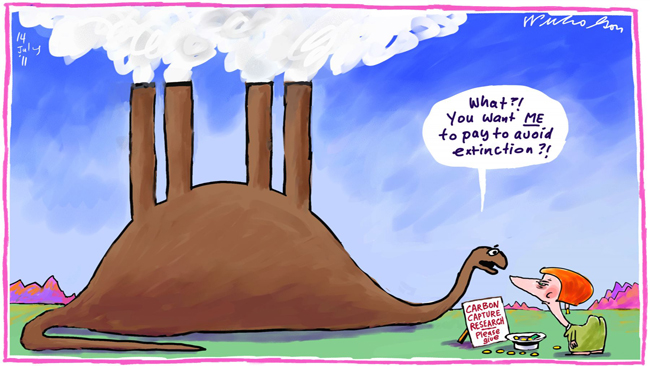
Australia’s huge reserves of fossil fuels mean that a carbon tax is just about the worst possible thing anyone could do to our economy. Congratulations Julia!

IF ever there were a single country in the entire world spectacularly unsuited to be the sole imposer of a vast, unprecedented carbon tax, which no other country in the world is remotely duplicating, it is Australia.

Isolated from our strategic friends, far distant from our biggest markets, a member of no natural trading bloc or customs union, we have just one serious, competitive advantage in the global economy.

That is the abundance of our fossil fuel endowments. If ever there were a nation well advised to move slowly and carefully on policies to cut greenhouse gas emissions, we are it.

As Productivity Commission head Gary Banks commented: “It will not be efficient from a global perspective [let alone a domestic one] for a carbon-intensive economy, such as ours, to abate as much as countries that are less reliant on cheap, high emission, energy sources . . . Modelling aside, it’s common sense that achieving any given level of abatement is likely to be costlier in a country with a comparative advantage in fossil fuels.”

Banks here did something extremely dangerous. He pitted common sense against economic modelling. Part of the economics profession has gone weak at the knees because the government has labelled its bizarre new amalgam of vast new taxes, huge new bureaucracies, massive expenditure churn, endless new regulation, huge government subsidies for preferred companies and wildly unrealistic targets, a “market-based mechanism”.

The government’s carbon tax does not pass the commonsense test at any point. To call $8 billion in new taxes in the first year, and new government expenditure so great that it exceeds even the new tax intake, a “market-based mechanism” and economic reform just illustrates George Orwell’s insight that if you control the language, you can convince people that black is white and up is down.

The whole enterprise is built on a falsehood, the supposition that nations around the world are taking comparable economy-distorting actions to that proposed by the Gillard government.

There is no really polite way of putting this but it is simply, utterly and comprehensively untrue. This is critically important. Even if you accept that all the science about climate change is true, that does not indicate what the best response for Australia is. If the science is true, then the problem can only be tackled by global action. If global action is impossible, then nations should do their best to cut greenhouse gas emissions in ways that don’t hurt their economy too much, prepare for adaptation when it’s needed and work to produce technological breakthroughs that allow lower emissions technologies to work and become affordable. This is broadly what other nations are doing. None is doing anything remotely like our carbon tax. (source)

And an economist dares speak the plain and simple truth (and we hope more will say the same):

AUSTRALIA could shut up shop and move all of its people to Antarctica and it would have little or no impact on climate change, says Griffith University economist Ross Guest.

“In terms of the world’s carbon emissions, Australia contributes 1.5 per cent,” Professor Guest said.

“So the carbon tax will have no effect on global warming.

“What Australia does makes almost no difference.” (source)