One religion speaks out about another religion


Anglican Archbishop of Melbourne, Dr Philip Freier, has weighed into the “climate change” debate urging synod members to cut their environmental footprint. He described the challenge of climate change as:

“potentially more grave than any other. ‘Climate change’ as a phrase has come to encapsulate the sickness of our planet, whether in the pollution of our rivers, oceans and atmosphere, or in the depletion of natural resources, global warming and drought, and the consequent impact on people whose lives are already balanced on the precarious margin of survival.”

To my knowledge even the alarmists haven’t tried to link the term “climate change” with pollution of our rivers, oceans or atmosphere (yes, atmosphere as well, as we all know CO2 is not a pollutant), or with depletion of natural resources. Maybe Dr Freier should read the AGW religion’s bible (An Inconvenient Truth) before making any more statements about climate change – it’s about as believable as the “other” bible, anyway…

Read it here.

Heartland – two articles


Two excellent articles from the Heartland Institute (thanks to Climate Change Fraud). The first discusses the growing apathy for climate change alarmism, and quotes our own Dr David Evans, formerly of the Australian Greenhouse Office, who wrote recently in The Australian about the lack of the expected “greenhouse signature” in the atmosphere.

As alarmists continue to push government policies to restrict energy use and the burning of fossil fuels in order to prevent “catastrophic” warming, the world continues to cool. That is leading to increasing suspicion that the call to sacrifice living standards in order to “save the planet” is just political spin designed to persuade the public to accept green taxes and regulations.

Read it here.

The second discusses James Hansen, a NASA “scientist” (although that term must be used in its loosest possible sense), who refuses to take part in debates about climate change or global warming, much like Al Gore, who refuses to debate the issues raised in An Inconvenient Truth. What other possible reason could there be for these refusals, other than a fear of losing those debates?

James Hansen, the National Aeronautics and Space Administration (NASA) staffer who has called for global warming skeptics to be tried for “crimes against humanity and nature,” has tersely declined an invitation to defend his extremist global warming views in a College of William and Mary debate.

Read it here.

Kangaroo-gate: scientists to breath-test sheep


More on the Kangaroo-gate saga, started by Ross Garnaut’s ill-informed suggestion that we should give up on beef and lamb and eat kangaroo instead, to cut down on methane emissions (or farts and belches as they are otherwise known). In order to counter this accusation, the Sheep Cooperative Research Centre is having to waste money (that would be better spent on something else) demonstrating that methane emissions from sheep are not significant enough to abandon sheep farming in Australia.

“It’s just a mask over the nostril-mouth area, as the animal breathes out. That air is then captured into a bladder, not too different from a football bladder.

“The animal is not in any distress … they don’t really object to it. [How can he be sure of that…? Ed]

It is very interesting to observe how an almost flippant comment has turned into a major story. Stay tuned for more Kangaroo-gate posts in the future!

Read it here.

ABC – climate is a threat to itself?


From the ABC – an interesting circular argument, maybe, or perhaps just a typo? Who knows?

Link here.

Sydney Morning Herald – truth or fiction in Hollywood


A couple of particularly amusing lines which caught my attention in a Herald article about Hollywood’s incorporation of environmental issues, particularly “climate change”, in its many films. The director of Happy Feet, George Miller, opines:

“It’s not too long a bow to draw that in Titanic, one of the many elements … was environmental. The ship was metaphorically the most powerful, most advanced, most privileged ship – a microcosm of the world with the rich and the poor who were all on this great ark – and, because of hubris, it was brought down. You don’t have to dig too deep to see the environmental analogy in the most successful film of all time.”

The planet exacts its revenge on the evils of humanity by carefully positioning an iceberg in the path of an oncoming ship. If nature were to attempt the same trick today, it may find it would have to look harder to find icebergs lying around, of course!

And my favourite:

Two years ago the Oscar-winning documentary An Inconvenient Truth became a rare film for literally changing the world by inspiring political and social change. But can a fictional movie have a similar impact?

Apart from the dubious claim that it “changed the world”, An Inconvenient Truth was fiction…

Read it here.

US legislation won't stop automobile emissions


The Herald Sun can barely conceal its glee at the fact the US Congress is introducing draft legislation to cut greenhouse emissions, thundering:

CLIMATE change sceptics would do well to choke on their own emissions now that a draft bill for a carbon trading scheme has emerged from the US House of Representatives.

The subsequent reduction of hot air will help American legislators get on with the job of framing a cap and trade program in the single most important economy capable of attempting to reverse global warming.

If the bill succeeds and the US shows leadership on climate change mitigation, China will follow.

Assuming that the bill is passed, and that is by no means certain given the US public’s concern with the economy and the cautiousness of their representatives in Congress, it will do little to curb emissions from cars and trucks, one of the largest sources of emissions in the US. As the Wall Street Journal says:

For drivers who’ve already seen gasoline prices double in the last two years, a 25-cent increase is a drop in the bucket and probably wouldn’t lead to many additional changes in the way people drive, the CBO [Congressional Budget Office] concludes. Even with pump prices (and crude oil) slipping a bit now, 25 cents remains a pretty tiny slice.

When gasoline spiked from about $2 a gallon to around $4 a gallon, demand for gasoline fell—but it didn’t collapse. In any event, the CBO says, new fuel-economy standards passed in late 2007 will do more to spur more fuel-efficient vehicles in coming decades than any carbon pricetag that comes out of Congress.

From Climate Change Fraud.

Cute fluffy creatures threatened by "climate change"


The alleged decline of the polar bear was the ultimate symbol of the evils that capitalism, and its unending lust for growth and development, are wreaking on the planet as a result of “global warming”. However, since polar bears seem to be doing OK, and reports of their demise a little premature, the AGW alarmists have had to find another icon to threaten with extinction as a result of climate change.

HALF to three-quarters of major Antarctic penguin colonies could be damaged or wiped out if global temperatures are allowed to climb by more than two degrees Celsius (3.6 degrees Fahrenheit), according to a report released today.

Conveniently leaving aside the fact that temperatures haven’t risen since 2001…

“Penguins are very well adapted to living in the cold and extreme conditions of Antarctica,” said the WWF’s Juan Casavelos, noting that warming has already contributed to a reduction in populations.

“If temperatures increase by another two degrees these icons of the Antarctic will be seriously threatened,” he said.

Read it here.

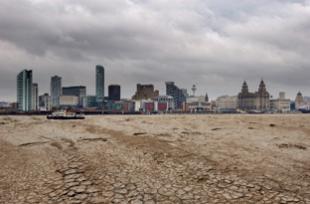
Ferry, 'cross the Mersey (no, let's walk instead…)


Don’t need the Mersey Tunnel anymore…

I know this isn’t Australian news, but I’m allowed a bit of licence when it comes to the most bizarre stories from my old homeland. That bastion of intelligent and considered reporting, the “Wirral Globe” (who they? Ed) have given us a vision of a post-climate change Britain, and their graphic design department have had a field day creating a photoshopped picture of the skyline of Liverpool, UK with a crusty, dried up River Mersey pasted into the foreground. Note the ferry stuck halfway across – I would have thought they may have managed to get into dock before it all evaporated, but hey, who knows? It could happen in days, hours, minutes!!

After all the scaremongering, Dr Neil MacDonald, lecturer in geography at the University of Liverpool said:

“The general rule is that there will be a reduction in river flows throughout the summer months but there is considerable uncertainty as to the actual amount. I certainly wouldn’t be worrying too much that we are going to wake up and find our river gone.”

So that’s OK then, phew.

Read it here.

Ban Ki-Moonbat – climate change is "defining challenge of our era"


More crazy alarmism from the UN, whose Secretary-General today reminded the world that whilst financial problems may come and go, “climate change” will be here for all eternity…

Global warming “remains the defining challenge of our era,” Mr. Ban told reporters at his monthly press conference at UN Headquarters. “The danger is that, as with the [Millennium Development Goals], the magnitude of the threat will be obscured by shorter-term problems, and in particular the deepening financial crisis.”

“Grave as it may be, today’s financial crisis is a passing storm from which we will recover,” he said. But he warned that “we cannot say that about the potential catastrophe of global warming.”

Tell that to the millions across the globe currently struggling to pay their mortgages…

Read it here.

Climate Change., Inc. – revenue hits $300bn


This is precisely the reason why it is now so difficult to put the brakes on the AGW bandwagon and get anyone in government or in the climate change industry to actually debate its causes in any rational way.

Companies providing goods and services that tackle climate change now form a bigger industry grouping than global software and biotechnology sectors combined, according to new research.

Global annual revenues from such businesses – which include renewable energy companies, nuclear power and energy management specialists – have surpassed $300bn for the first time, HSBC’s global banking and markets research team have found.

$300 BILLION! Let’s just pause and think about that for a moment – more than global software AND biotech sectors combined – that is a phenomenal statistic. If there had been no “global warming” scare over the past twenty years, most of these companies wouldn’t even exist!

There are now so many vested interests in maintaining the alarmist agenda (just think of our friend Al Gore) that when it finally comes off the rails, in other words when businesses and individuals wise up to the swindle that has been perpetrated on them, the decline in the climate change industry is likely to have a significant effect on the global economy.

Read it here.