UPDATED: The hypocrisy of Labor and the Labor-loving media


The media and Labor are all over Tony Abbott this morning after his “gaffe” on ABC’s 7.30 Report in which he rather too candidly admitted that politicians are susceptible to hyperbole in the heat of the moment. Well, knock me down with a feather. Tell me something I don’t know. But Labor are on to it, calling him Phoney Tony, trying to make cheap political capital out of it (always a sure sign of a government in deep trouble), and the media have all got collective “cat got the cream” expressions on their smug journalistic faces.

What short memories they have, and a truly impressive ability to forget instantly the lies, spin and deception of this bankrupt Labor government, which has executed more backflips than a gymnastics convention. Don’t know about Phoney Tony, but I sure know about Rudd the Dud.

Abbott simply told the truth about politics in the 21st century, and was rather too honest about it, but the hypocrisy it has received in response is nothing short of breathtaking.

UPDATE: Some of this simply has to be seen to be believed, as Labor ministers queue up to rubbish Abbott. Nicola Roxon (the worst health minister in living memory?) thinks Abbott is “cracking under pressure” and Penny Wong [who she? – Ed] thinks he “cannot be trusted” (see here). If those same standards were applied to the Government, there wouldn’t be a man or woman left standing. Andrew Robb calls the hypocrisy for what it is:

Those Government ministers who have been out all morning hyperventilating about Tony Abbott are hardly in a position to point a finger considering their appalling track record.

It is the pot calling the kettle black.

Kevin Rudd is the king of broken promises, back-flips and spin and when the going gets tough he goes into hiding, blames others and wheels out junior ministers to take the rap.

In stark contrast, Tony Abbott is a strong leader who is refreshingly authentic and who has the courage to get out there and take it on the chin.

Read it all.

New UN climate chief appointed


New UN climate chief

You can hardly blame Yvo de Boer for stepping down after the unmitigated disaster that was Copenhagen (see here). So the hospital pass has been handed to Costa Rican Christiana Figueres:

Figueres, 53, the choice of U.N. Secretary-General Ban Ki-moon, is the first leader of the U.N. climate change secretariat to come from a developing country. She will take over from Dutchman Yvo de Boer from July 1.

She beat fellow short-listed candidate Marthinus van Schalkwyk, a former South African environment minister, for a position meant to rally global accord on a successor to the Kyoto Protocol after a disappointing summit in Copenhagen last December.

Announcing the appointment, U.N. spokesman Martin Nesirky said Figueres “brings to this position a passion for the issue, deep knowledge of the stakeholders and valuable hands-on experience with the public sector, non-profit sector and private sector.”

The scale of Figueres’ task is underscored by a Copenhagen summit where 120 world leaders failed to reach a binding deal, pledging instead to mobilize $30 billion from 2010-2012 to help poor countries deal with droughts and floods, and to try to limit warming to less than 2 degrees Celsius.

In an interview with Reuters after her appointment, Figueres said the world can salvage a new deal to combat global warming but this was not a priority for 2010. Rich countries must first fulfill their pledges on climate aid, she said.

“Parties need to prove to themselves that issues already on the table, such as fast-tracking financing, that’s not just on paper but can also be delivered. That’s the focus of Cancun,” she said. (source)

New face, same old story.

Another alternative energy disaster


Spectacular failure

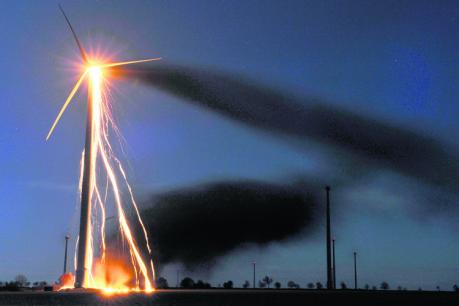
Anyone with even half a brain can see that alternative, “green” energy is currently expensive, inefficient and unreliable. It is delusional to believe that wind and solar power could possibly replace baseload fossil fuel electricity generation in the near future. But their failures can be quite spectacular, however (see pic), like the wave power generator in Port Kembla which now lies wrecked at the bottom of the sea, a sad playground for sea-life. It was visited in 2007 by Peter Garrett, who declared it “a terrific example of clean energy” and pledged the Rudd government to drive a “clean energy revolution”…

The landmark Oceanlinx wave energy system, the Mk3PC, sits underwater at the bottom of Port Kembla’s eastern break wall after heavy seas ripped the unit from its moorings.

The 170-tonne structure, which was located 150m offshore, broke free of its pylons on Friday afternoon.

Representatives from the Sydney-based company Oceanlinx immediately rushed to Port Kembla, but attempts to tow the structure to safety were hampered by heavy seas.

The barge-like structure was lodged tight against the eastern breakwater on Friday night with crews expected to make a second effort on Saturday, but by Saturday morning the structure had sunk.

Port Kembla Port Corporation CEO Dom Figliomeni said meetings with Oceanlinx representatives would be held today to discuss salvaging the unit.

“What we have been doing over the weekend is monitoring the unit to make sure it doesn’t enter shipping channels,” Mr Figliomeni said. “At the moment it is no danger to anyone.”

Certainly no danger to coal fired electricity production, anyway. Unfortunately, there isn’t such a thing as a clean energy revolution. Clean energy requires massive government subsidies to make it competitive, destroying jobs rather than creating them.

Read it here. (h/t Tim Blair)

"Expect global cooling for 2 – 3 decades": Easterbrook


Pacific Decadal Oscillation

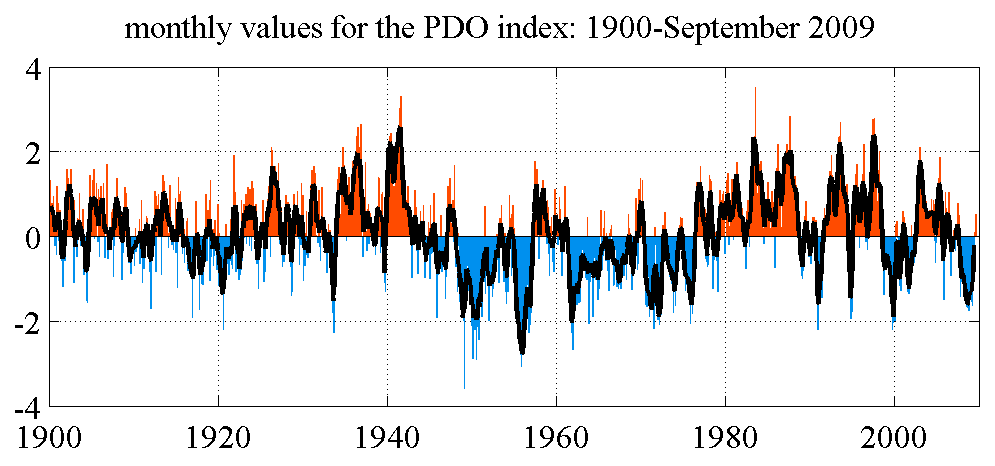
You certainly woudn’t know about it from the mainstream media, but there is currently an International Climate Change Conference taking place in Chicago. But because it is full of climate realists, and you’re unlikely to get any decent armageddon stories, the MSM don’t even bother to show up, except to hurl ad hominems about Big Oil, yawn. At the conference, Geologist Don Easterbrook presented a paper that has warned of global cooling for a considerable period, Climate Depot reports. Many, including Easterbrook, believe that climate changes are far more closely linked to changes in the Pacific Decadal Oscillation (PDO) than to microscopic increases in a harmless trace gas:

The Pacific Ocean has two modes, a warm mode and cool mode, and regularly switches back and forth between modes in a 25-30 year repeating cycle known as the Pacific Decadal Oscillation (PDO). When the PDO is in its warm mode, the climate warms and when it is in its cool mode the climate cools. Glacier fluctuations are driven by climatic changes, which are driven by ocean surface temperatures (PDO).

During the cool PDO mode, ocean surface temperatures in the eastern Pacific are cool. This was typical of the global cooling from 1945 to 1977. During the warm PDO, ocean surface temperatures in the eastern Pacific are warm. This was typical of the global warming from 1977 to 1998. The abrupt shift of the Pacific from the cool mode to the warm mode in a single year (1977) and the beginning of the last warm cycle has been termed the “Great Pacific Climate shift.” There is a direct correlation between PDO mode and global temperature

The ocean surface temperature in the eastern Pacific off the coast of North America was warm in 1997. In 1999, the PDO switched from its warm mode to its cool mode and has since remained cool as shown by satellite imagery. Adding the PDO record for the past decade to the PDO for the century provides an interesting pattern. The PDO 1915–1945 warm mode, the 1945-1977 cool mode, the 1977-1998 warn mode, and the switch from warm to cool mode in 1999 all match corresponding global climate changes and strongly suggest:

1. The PDO has a regular cyclic pattern with alternating warm and cool modes every 25-30 years

2. The PDO has accurately matched each global climate change over the past century and may be used as a predictive tool.

3. Since the switch of the PDO from warm to cool in 1999, global temperatures have not exceeded the 1998 high.

4. Each time the PDO has changed from one mode to another, it has stayed in that mode for 25-30 years; thus, since the switch of the PDO from warm to cool in 1999 has been entrenched, it will undoubtedly stay in its cool mode for another several decades.

5. With the PDO in cool mode for another several decades, we can expect another several decades of cooling. (source)

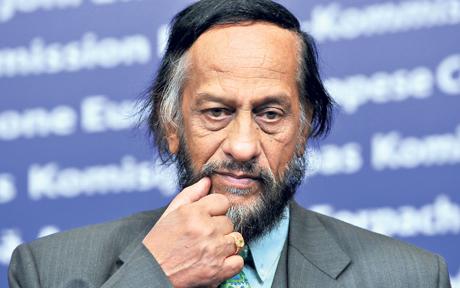
Even IPCC scientists acknowledge the effect of ocean oscillations on climate (when they’re not within hearing distance of Raj Pachauri, that is): see here.

Interestingly enough, this is also one of the points highlighted in Roy Spencer’s latest book, The Great Global Warming Blunder, in which he presents evidence for cloud cover responses to changes in the PDO, which result in warming and cooling of the climate. More on this in a future post.

IPCC bias exposed yet again


Anything goes if we say so

The UK Telegraph reports that Rajendra Pachauri has “defended the use of grey literature” in the IPCC’s reports. As long as it supports the IPCC’s pre-conceived conclusion of man-made warming, that is. Because whenever grey literature challenges the consensus, the knee-jerk response is “but it isn’t peer-reviewed!”. Hands up who can spot the hypocrisy there?

The head of the UN’s climate change panel has defended the use of unproven science to justify climate change by saying the “grey literature” cannot be ignored.

In a hearing at the InterAcademy Council, an organisation of the world’s science academies which is conducting an independent review of the processes and procedures of the IPCC, Dr Pachauri described the inclusion of the glacier claim as “human failure” which should not have happened. [No it wasn’t, it was deliberately put in to “pressure policymakers”, see here – Ed]

But the IPCC’s chairman said there was a need to use information which was not from peer-reviewed scientific journals, because in some places that was the only research that had been done.

He said the media and other sections of society had misunderstood the role of such information, labelling it grey literature, “as if it was some form of grey muddied water flowing down the drains”.

Dr Pachauri said academic work being done by bodies including the International Energy Agency, the World Bank, national governments and charities “cannot be ignored” [all backing the alarmist view, of course – Ed], but had to be closely examined [yeah, right – Ed] to make sure it was robust. (source)

And the IPCC was also very keen to use one particular journal that was unpublished at the time the report was finalised:

It was so impressed by one edition of the academic journal Climatic Change that it cited 16 of the 21 papers published that month. The journal editors should take a bow. When three-quarters of a single issue of your publication is relied on by a Nobel-winning report, you’re doing something right.

Except for one small problem. The issue in question – May 2007 – didn’t exist yet when the IPCC wrote its report. Moreover, none of the research papers eventually published in that issue had been finalized prior to the IPCC’s cutoff date. (source)

But hey, who cares? When an organisation and its chairman are so politically and financially motivated to come up with evidence to support a pre-conceived conclusion, anything goes. Yet it is on the advice of this organisation that governments around the world are basing their climate policies. Climate madness.

William Kininmonth: open letter to Tony Abbott


The fate of a sceptic in Kruddistan

You may recall the outrage earlier this week when Tony Abbott dared to suggest that school students should be “sceptical”. That will never do. Indoctrination with alarmist climate dogma is the only thing that will please the headbangers (see earlier story here). William Kininmonth, meteorologist, writes an open letter to Tony Abbott in defence of his comments:

The IPCC alarmist claim that Earth’s temperature has been steady for the last 10,000 years but this view is at odds with historical and archaeological evidence.

  1. Hannibal took his army and elephants across the Alps about 200BC in winter!
  2. Julius Caesar, about 50BC conquered Gaul and, after building a bridge across the Rhine River, waged war on the Germanic tribes; he and his army withdrew across the Rhine and dismantled the bridge. The Rhine River acted as a natural barrier for nearly 500 years but as the Roman Empire in Gaul was disintegrating the Vandals crossed the Rhine in the 5th century AD. The vandals did not build bridges but walked across the frozen Rhine River in winter.
  3. Greenland was settled by Vikings and by the 1100s there were more than 3,000 settlements. As the Little Ice Age advanced so the Greenland settlements were disbanded and the last was known to have perished about 1550AD, a century before the coldest of the Little Ice Age.
  4. For 300 years Earth has been recovering from the Little Ice Age. Mountain glaciers have retreated and high mountain passes of the Alps have opened. Archaeologists have identified artefacts from various eras corresponding with warming and cooling, and retreat and advance of mountain glaciers.

The arguments of the IPCC alarmists rely on an unchanging temperature record prior to industrialisation (that is, no Greco Roman warm period, no cold of the Dark Ages, no Medieval Warm Period and no Little Ice Age) to support their storyline of anthropogenic global warming. They claim that the warming of the past 100 years is unprecedented and therefore must be due to increasing concentrations of carbon dioxide.

Read it here.

Claims that New Zealand temperature record fudged


Warming exaggerated?

Surface temperature records are highly susceptible to adjustment. There are all kinds of valid reasons why the “raw” thermometer data may need adjustment, such as the relocation of a station, or urbanisation, but it’s curious, isn’t it, that in many of the data sets the corrections almost always increase any warming trend. This is highly suspect, given that urban warming, for example, is more likely to artificially increase temperatures, requiring a downward adjustment.

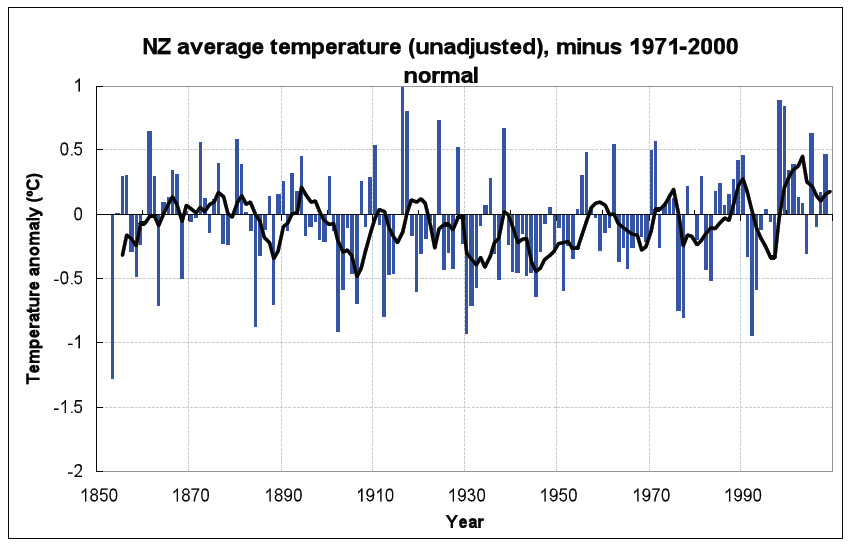
An article in Quadrant Online claims that whilst New Zealand’s National Institute of Water and Atmospheric Research (NIWA) has been plugging a 20th century temperature rise of 0.92˚C, the raw data shows nothing of the sort. ACM reported on this back in November of last year (see here) and here are the graphs of adjusted vs. raw data:

Raw temperature data

After adjustments

Barry Brill, chairman of the New Zealand Climate Science Coalition, takes up the story:

The official temperature record is wrong. The instrumental raw data correctly show that New Zealand average temperatures have remained remarkably steady at 12.6°C +/- 0.5°C for a century and a half. NIWA’s doctoring of that data is indefensible.

The NSS [NIWA Seven Station series] is the outcome of a subjective data series produced by a single Government scientist, whose work has never been peer-reviewed or subjected to proper quality checking. It was smuggled into the official archive without any formal process. It is undocumented and sans metadata, and it could not be defended in any court of law. Yet the full line-up of NIWA climate scientists has gone to extraordinary lengths to support this falsified warming and to fiercely attack its critics.

For nearly 15 years, the 20th-century warming trend of 0.92°C derived from the NSS has been at the centre of NIWA official advice to all tiers of New Zealand Government – Central, Regional and Local. It informs the NIWA climate model. It is used in sworn expert testimony in Environment Court hearings. Its dramatic graph graces the front page of NIWA’s printed brochures and its website.

Internationally, the NSS 0.92°C trend is a foundation stone for the Australia-New Zealand Chapter in the IPCC’s Third and Fourth Assessment Reports. In 1994, it was submitted to HadleyCRUT, so as to influence the vast expanses of the South Pacific in the calculation of globally-averaged temperatures.

Over the entire series, a total of 515 years were adjusted. Of these, no less than 467 years contributed to an upward-sloping trend line. So, by year, 90% of the NIWA corrections leaned in the same direction.The ratio of 9 out of 10 adjustments being ‘helpful to the hypothesis’ could surely not have occurred in the absence of bias.

This shouldn’t come as a surprise. NIWA has already made up its mind on climate change, and clearly, the debate is over in their view:

Already decided the answer?

The link then takes you to a page which parrots the IPCC line. But whenever this kind of news breaks, one has to wonder why, if the evidence for “global warming” is so strong, and the science so settled, why the need to exaggerate?

Read it here.

Idiotic Comment of the Day: Jessica Watson


Slips in global warming…

Celebrity not-quite-round-the-world-officially heroine Jessica Watson manages to slip in “global warming” [shurely “climate change”? – Ed] when speaking of her exploits on her blog last week (as reported by SBS):

“It’s a shame that my voyage won’t be recognised by a few organisations because I’m under 18, but it really doesn’t worry me,” Watson wrote on her blog last week.

I mean there’s millions, properly [sic] billions of people who still don’t believe in global warming, so I’m more than happy to settle for a few people going against the tide and declaring that mine hasn’t been an official circumnavigation.” (source)

See the original blog post here.

UPDATE: She did smack down Kevin Rudd’s patronising flannel, so she’s not all bad!

Academy dares question consensus – alarmists go ape


Stick to your guns

Another example of alarmists desperate to shut down debate on climate. The Australian Academy of Technological Sciences and Engineering (home page here) has circulated a draft two-page policy statement on climate change, the Canberra Times reports.

A copy obtained by the Canberra Times reveals the academy “does not accept that the science is settled” and notes many scientists believe “climate changes are nothing unusual, based on past geological records.”

Shock horror. It’s barely a sceptical view at all. More like a neutral view on the climate debate, and one on which even many pro-AGW scientists would have to agree. But it’s not a hysterical endorsement of the alarmist consensus, and the warmist headbangers can’t let that happen, so rent-an-alarmist Will Steffen gets in on the act:

Australian National University climate change institute director Professor Will Steffen said the draft was “a very poor, confused and sloppy document that obviously still needs a lot of work to improve its credibility.”

Translation: it has no credibility unless it peddles the alarmist nonsense of the IPCC. And the best bit of all, said without any hint of irony:

“It’s obvious someone involved in drafting this is showing their hand. This is not an objective document, and would appear to be politically motivated.

[Editor of ACM falls of chair in fit of hysterical laughing at the blatant hypocrisy of that statement.]

And because this is the Canberra Times and because it is written by Rosslyn Beeby, the article then wheels out a dozen alarmists to say the same thing in equally tedious fashion. Message to ATSE: do not be intimidated by this kind of playground bullying tactics. Stand your ground, and stand up for scientific integrity and impartiality, not the quasi-religious dogma of the warm-brigade.

(NB. This article is not available online [why not, I wonder? – Ed], and was sourced from Warwick Hughes, with thanks.)

"Non-Scientist" magazine's special report on "denial"


How "denial" is portrayed in Non Scientist

Note that they don’t devote a special report to investigating dodgy scientific practices in climate research, such as deleting emails, fudging data and skewing the peer-review process by intimidating journals. Oh no. That’s all fine and dandy. Instead, their special report sets up a long line of straw men about “denial” and then proceeds to blow them over:

From climate change to vaccines, evolution to flu, denialists are on the march. Why are so many people refusing to accept what the evidence is telling them? Over the next 10 pages we look at the phenomenon in depth. What is denial? What attracts people to it? How does it start, and how does it spread? And finally, how should we respond to it? (source)

And we don’t even have to look very far to see that this will be the usual tedious rant against climate realists:

A climate denier has a position staked out in advance, and sorts through the data employing “confirmation bias” – the tendency to look for and find confirmatory evidence for pre-existing beliefs and ignore or dismiss the rest. (source)

As if the consensus scientists are completely impartial and free-thinking, when their next funding cheque depends on alarmist research that grabs media attention? Or what about the fact that the IPCC’s sole purpose is to find evidence for a pre-conceived conclusion, that of man-made warming, and they will therefore ignore huge chunks of research because they are inconvenient? That sentence above describes the IPCC precisely. And, inevitably, the comparisons with tobacco follow:

In 1972, Tobacco Institute vice-president Fred Panzer outlined his industry’s “brilliantly executed” defence strategy. A key tactic was “creating doubt about the health charge without actually denying it” while “encouraging objective scientific research.”

“Objective scientific research”: those words would almost make you believe that Panzer was talking about objective science. But when doubt is your goal, the misuse of language is just another way to confuse the public.

Where tobacco led the way, coal and chemicals followed. And, of course, the fossil fuel industry has been working overtime – and with shocking success – creating doubt about climate change. (source)

The fact that governments and environmental groups have thrown billions of dollars at shonky science to “prove” man-made warming appears to have escaped the author of that little rant, who happens to be Richard Littlemore of DeSmogBlog, the warmists’ nirvana. Need I say more?

There is one article (out of six) that correctly claims that denial is a cheap slur:

The concept of denialism is itself inflexible, ideological and intrinsically anti-scientific. It is used to close down legitimate debate by insinuating moral deficiency in those expressing dissident views, or by drawing a parallel between popular pseudoscience movements and the racist extremists who dispute the Nazi genocide of Jews. (source)

But to be honest it’s lost in the noise… (h/t WUWT)