Climate Madness of the Year: tackle climate change to prevent alien attack


"This is a stick up. Give us all your petrol!"

I seriously had to check the calendar to make sure it wasn’t April Fools Day, such is the ludicrousness of this story.

In an ever more desperate attempt to justify action on climate change (which will achieve precisely nothing), “researchers”, and I use that term in its loosest possible sense, from NASA and Penn State conclude:

“Green” aliens might object to the environmental damage humans have caused on Earth and wipe us out to save the planet. “These scenarios give us reason to limit our growth and reduce our impact on global ecosystems. It would be particularly important for us to limit our emissions of greenhouse gases, since atmospheric composition can be observed from other planets.” (source)

And they accuse the sceptics of being mentally unhinged?

P.S. I assume those “researchers” got paid for this. Trough, pigs – again.

UPDATE: See here for a few more flights of fancy on this subject.

Daily Bayonet GW Hoax Weekly Roundup


Skewering the clueless

As always, a great read!

It's all the CWM's fault


Warning! CWMs ahead!

That would be “conservative white males”. Desperate as always to avoid engaging with sceptics’ arguments, the Sydney Morning Herald decides that it’s their background that is more important.

Helpfully illustrated with photos of Pell, Bolt, Jones and Monckton, the SMH claims that sceptics’ political and cultural views are causing their (obviously deranged) attitudes to climate alarmism, and not hiding data, fudging results, pal-review, Hockey Stick, and all the other highly dubious practices of climate science:

A US-based study has found that white men with politically conservative views are far more likely than the rest of the population to doubt the science of human-caused climate change.

And the “conservative white male effect” has been linked to Australia, with one prominent researcher citing the existence of a successful, politically engaged and outspoken coterie operating in high-profile positions that attract wide media coverage.

In the US researchers’ paper published in the journal Global Environmental Change, Dr Aaron McCright and Dr Riley Dunlap analysed data from 10 annual US opinion polls on environmental issues.

They found 58 per cent of conservative white males – or CWMs for short – thought recent global temperature rises were not caused mainly from human activities, such as burning fossil fuels. This compared with 31 per cent of other adults.

Some 29 per cent of CWMs thought the effects of global warming would “never happen” compared with only seven per cent of other adults.

Professor Joseph Reser, a Research Fellow with Griffith University’s Climate Change Response Program in Queensland, agreed broadly with the findings, but said his own research and other comparable studies from the US and Europe suggested the proportion of true climate change sceptics was much smaller. [See here for Reser’s earlier study – Ed]

“If you look at this group of conservative white males, less than 30% are characterised as denialists – they are not a majority even within this grouping,” Professer Reser said.

“But these CWMs tend to stand out and do well in many social, work, and political organisations; they align themselves with those sharing similar views; and they are also more likely to be outspoken in their views and politically engaged, and to work and operate in sectors where their views get aired more.”

He said the fact conservatives were unduly confident about their own views on climate change “also makes them less open to differing views or able to accept that they might be wrong”. (source)

There are a number of points here. Firstly, note the intentional confusion between “sceptics” and “denialists” – terms that Fairfax uses interchangeably, despite the fact that most climate “realists” are “sceptics” and very few indeed are outright “denialists”. Secondly, Reser is quick to condemn CWM’s for failing to accept the possibility of error, which is precisely the charge laid against most alarmist climate scientists, who play down uncertainty as a matter of course.

I have to suggest the obvious alternative, and highly politically incorrect, conclusion here, that maybe those CWMs, thanks to age, experience and education, have a greater capacity for critical thought, and are not taken in by government and media propaganda?

Who cares anyway – it’s just another generalisation that the alarmists use to label the sceptics and thereby avoid having to actually respond to their points in a rational way.

Professor William Happer on climate alarmism


Climate sense

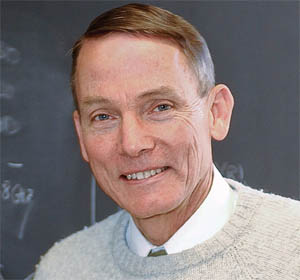
Professor Happer is the quaintly named Cyrus Fogg Brackett Professor of Physics at Princeton University – a serious academic, not easily dismissed as an extremist or crank. He has written a cogent summary of climate alarmism which is an essential read. It is overflowing with simple common sense:

A major problem has been the co-option of climate science by politics, ambition, greed, and what seems to be a hereditary human need for a righteous cause. What better cause than saving the planet, especially if one can get ample, secure funding at the same time? Huge amounts of money are available from governments and wealthy foundations for climate institutes and for climate-related research. Funding for climate studies is second only to funding for biological sciences. Large academic empires, prizes, elections to honorary societies, fellowships, consulting fees and other perquisites go to those researchers whose results may help “save the planet.” Every day we read about some real or contrived environmental or ecological effect “proved” to arise from global warming. The total of such claimed effects now runs in the hundreds, all the alleged result of an unexceptional century-long warming of less than one degree Celsius. Government subsidies, loan guarantees, and captive customers go to green companies. Carbon-tax revenues flow to governments. As the great Russian poet Pushkin said in his novella Dubrovsky, “If there happens to be a trough, there will be pigs.” Any doubt about apocalyptic climate scenarios could remove many troughs.

Download the PDF here.

New paper: climate models too sensitive


Climate sensitivity is the key to the AGW conundrum – how much will global temperatures respond to the extra forcing caused by anthropogenic carbon dioxide. If it’s nothing, or a few tenths of a degree, there really isn’t a problem. If it’s six degrees, there’s a problem.

Unsurprisingly, the majority of the consensus climate models indicate high sensitivity, meaning that in the IPCC’s view, it’s a problem that must be tackled.

However, Richard Lindzen and Yong-Sang Choi have prepared a new paper looking at real-world observations in an attempt to pin down climate sensitivity. The abstract contains the following:

We develop a method to distinguish noise in the outgoing radiation as well as radiation changes that are forcing SST [sea surface temperature] changes from those radiation changes that constitute feedbacks to changes in SST. We demonstrate that our new method does moderately well in distinguishing positive from negative feedbacks and in quantifying negative feedbacks. In contrast, we show that simple regression methods used by several existing papers generally exaggerate positive feedbacks and even show positive feedbacks when actual feedbacks are negative.  

And the conclusion states:

Our study also suggests that, in current coupled atmosphere-ocean models, the atmosphere and ocean are too weakly coupled since thermal coupling is inversely proportional to sensitivity (Lindzen and Giannitsis, 1998). It has been noted by Newman et al. (2009) that coupling is crucial to the simulation of phenomena like El Niño. Thus, corrections of the sensitivity of current climate models might well improve the behavior of coupled models, and should be encouraged. It should be noted that there have been independent tests that also suggest sensitivities less than predicted by current models.

Most claims of greater sensitivity are based on the models that we have just shown can be highly misleading on this matter. There have also been attempts to infer sensitivity from paleoclimate data (Hansen et al., 1993), but these are not really tests since the forcing is essentially unknown given major uncertainties in clouds, dust loading and other factors. Finally, we have shown that the attempts to obtain feedbacks from simple regressions of satellite measured outgoing radiation on SST are inappropriate. 

Sensitivity is one of the key areas of climate research. Whether you subscribe to Lindzen and Choi’s view, or the IPCC’s, one thing is certain. The science is most definitely not settled.

Download link here (PDF).

Settled science: no Arctic "tipping point"?


Clouded with doubt

The alarmist argument goes like this: if the ice disappears from the Arctic, the darker sea will absorb more sunlight than the more reflective ice, which will increase warming, which will reduce the ice even further, etc etc. The climate tips over the edge of the abyss and it’s goodnight.

But as always, there are other factors at work, and a new paper which looks at the forcing caused by the total loss of the Arctic ice sheet includes the following caveat:

The potential for changes in cloud cover as a result of the changes in sea ice makes the evaluation of the actual forcing that may be realized quite uncertain since such changes could overwhelm the forcing caused by the sea ice loss itself, if the cloudiness increases in the summertime.

In other words, the higher evaporation from the sea surface due to the lack of ice may actually increase the cloudiness during periods of low ice, therefore reducing the incoming solar radiation, and acting as a negative feedback to prevent the mythical tipping point being reached.

Again, without a thorough understanding of cloud feedbacks, predictions of Arctic tipping points (and the outputs from most climate models) are virtually worthless.

Abstract here. (h/t Hockey Schtick)

Labor: political survival above national interest


"Ha ha! F*** you, Australia!"

Ironic that this story breaks on the one year anniversary of “There will be no carbon tax under the government I lead.” A more obvious sign that Labor and Gillard are more interested in clinging on to power than doing what is in the best interests of the country is difficult to imagine – a damning indictment of any political leader.

Why else would she refuse to reconsider the carbon [dioxide] tax in the face of serious international financial concerns, and the possibility of a GFC Mark II? There couldn’t be a worse time to introduce yet another tax – especially a tax on everything like this one (ignore the 400/500 biggest polluters nonsense – it’s all spin. Everyone will pay more for just about anything you care to mention). Even in sound economic times it would be suicidal, but with the US faltering and European countries lining up to default, it is beyond madness.

So why is she pressing on? Because she knows if she backs away from the toxic tax, the Greens support will evaporate (don’t forget, Labor bribed the Greens with a cowardly promise of urgent action on climate), and there will be an election – which Labor will lose catastrophically. So political survival takes precedence of the interests of the nation and the people whom she is supposed to represent. Disgraceful.

THE Gillard government has vowed to forge ahead with its carbon tax amid growing financial uncertainty, saying the “manageable” economic reform” will deliver certainty to Australian businesses.

While the worsening economic outlook has the government edging away from its 2012-13 return-to-surplus deadline, Climate Change Minister Greg Combet said the carbon tax would go ahead regardless.

“Yes we have had a period unfortunately of great uncertainty in international markets driven by debt concerns in Europe in particular,” he told ABC radio, as protesters gathered for a new anti-carbon tax rally outside Parliament House.

“However this is a reform to our economy that is necessary in the long term, it is a manageable economic reform, what’s more it will deliver certainty.” (source)

Maybe Greg will front up at the carbon dioxide tax demonstration in Canberra today to explain… Ha, not a chance. This government has abandoned the country.

A bellyful of Greens


No more Greens…

That’s what I, and I guess a lot of you, have just about had. Environmentalism has become far too dominant, and it’s time it was taken down a peg or two.

I am sick to death of being told what to do, what to buy and how to behave, by governments and environmental activists, in order to “save the planet.” We have such short memories that we forget how many times in the past we have heard about the impending death of our planet, only for it still to be here, healthier, wealthier and stronger. And then the next scare comes along…

The planet has been here 4.5 billion years. It will be here for another 4.5 billion – long after we, and every other species, has disappeared. The conceit that the planet needs us to save it would be hilarious if it weren’t so tragic.

The latest lunacy, noted by Baldrick in the comments to an earlier post, is the plan for electricity companies to have the right to remotely switch off your appliances if demand gets too great. Just a reminder, in case you forget while reading the following extract, that this is Australia we’re talking about, not the former Soviet Union or an African dictatorship:

TVs, airconditioners and fridges could be switched off remotely by power companies during peak times under plans to rein in households’ demand for electricity.

The option is among measures being considered as part of a national review of the management of domestic power use.

The Ministerial Council on Energy has initiated the Australian Energy Market Commission review in response to the nation’s increasing demand for power.

The council is seeking ways to ease the demand for electricity during extremely cold nights and exceptionally hot days, to avoid the need for energy companies to build more power stations. (source)

The last sentence is the key. All of this is due to climate alarmism and the consequent imperative to cut emissions. If that alleged problem was not given the weight it is, the electricity companies would happily build more coal-fired power stations and supply us with as much electricity as we demand. But the nanny environmentalists won’t allow that. Oh no. Gaia’s representatives on earth require that we reduce our consumption of electricity, and personally, I’ve had enough of it.

I long for the good old days when if you wanted more electricity, all you had to do was pay for it. Which back then was easy since it was CHEAP. But not now – ridiculous, pointless and futile renewable energy targets and hopeless wind farms and solar power stations mean that electricity is frighteningly expensive, and, it appears, not under your control for much longer, if the above report is to be believed.

I am the first to agree that we must take care of our environment and use our resources wisely. But the key point is that there has to be a balance between environmental needs and the needs of humanity. And that balance is all wrong. At the moment, thanks to the green movement worldwide, and here in Australia, the Greens’ alliance with the Labor government, humanity is trailing a very, very distant second.

And the irony is that the inevitable result of this badgering and hectoring from the Green movement will be the opposite of what they want. Most people, like myself, who wish to do their bit for the environment, are increasingly irritated by the incessant demands of “the planet” curtailing how much petrol I use, or how much electricity I use, or dictating what kind of light bulbs I must use, or any number of equally intrusive and controlling requirements thrust upon us by governments in thrall to the green movement. The corollary of this will be a rejection of environmentalism to make up for decades of enslavement to the Green gods.

I won’t be sorry to see that happen. Environmentalism is out of control and needs a swift reality check. The activists and the governments need to realise that people who are tied up in green regulations will develop deep resentments towards environmental goals, rather than working towards them.

As Andrew McIntyre pointed out in his book “The Greens” (reviewed here), environmentally-friendly behaviour requires a high GDP and a high standard of living. The poorest countries have the worst environmental records.

Give people the ability to enjoy high standards of living, and they will voluntarily help the environment. Witness the emergence of the urban Greens. Start telling them how they must live, and punish them, on the other hand, and they will rebel. The Convoy of No Confidence is the first of many signs of this reaction.

Rant over. Final comment: I’ve had enough greens, thanks. Time for the next course.

Figures fudged to justify carbon price


China's carbon price is lower, Greg

This is what happens when ideology and a tawdry deal with the Greens takes precedence over the best interests of the nation.

THE Gillard government’s claims that Australia lags behind China in the effective price on carbon have been discredited by its Climate Change Department.

The revelations, in documents obtained through a Freedom of Information application, show that rather than trailing China’s implicit carbon price by more than $12 per tonne, Australia’s effective price could already be higher.

This undermines the government’s argument for Australia to introduce a carbon tax now at an additional cost of $23 per tonne.

The documents, obtained by the Institute of Public Affairs, show the Department of Climate Change and Energy Efficiency warned that a crucial draft report on comparative implicit carbon prices overestimated China’s figure more than sixfold.

Despite that warning, the higher figure remained in the report and has been quoted by Climate Change Minister Greg Combet.

The report the minister referred to was not as independent as it sounds — it was funded by government through a $70,000 payment that went via the “non-partisan” Climate Institute.  (source)

The Climate Institute? Non-partisan? Oh, please.

Read Tim Wilson’s article in The Australian here.

Sea change in America?


Sceptic's choice

The American people have discovered, rather late in the day, that Barack Obama did not possess the wisdom of King Cnut. The story of Cnut is often retold wrongly – that he was attempting to control the tides, and failed. In fact, he was demonstrating to his excessively worshipful people that he did not have the power of  a God to control natural phenomena like the tides.

Obama wasn’t so modest, and had no qualms about excessive worship. The Wall Street Journal asks “What happened to Obama?”:

In short, the spell that Mr. Obama once cast—a spell so powerful that instead of ridiculing him when he boasted that he would cause “the oceans to stop rising and the planet to heal,” all of liberaldom fell into a delirious swoon—has now been broken by its traumatic realization that he is neither the “god” Newsweek in all seriousness declared him to be nor even a messianic deliverer.

Humility isn’t usually a strong point with people suffering from a Messiah complex. And WSJ’s answer:

He is still the same anti-American leftist he was before becoming our president, and it is this rather than inexperience or incompetence or weakness or stupidity that accounts for the richly deserved failure both at home and abroad of the policies stemming from that reprehensible cast of mind. (source)

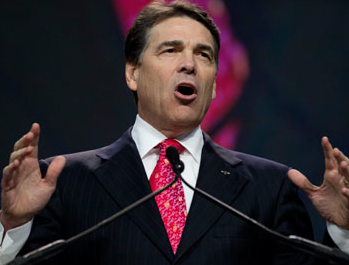
Now Rick Perry has entered the race for Republican nomination, and unlike Obama, he won’t be making any attempt to control the weather:

Perry calls global warming “all one contrived phony mess that is falling apart under its own weight.” Unlike many of the other GOP presidential candidates, he hasn’t expressed concern about climate change in the past, so he won’t have to do any back-pedaling. Notorious climate denier realist [apologies, this is the Guardian, after all – Ed] Marc Morano is a big fan: “Based on climate views alone, anyone who is holding their nose voting for Mitt Romney because there’s no other viable candidate will now rejoice to have an option with Rick Perry.”

The Texas governor will announce his intentions in the early primary state of South Carolina on Saturday, then head to New Hampshire andIowa to rub elbows with all of the other aspiring commanders-in-chief. As a social and fiscal conservative, governor of a state that’s been adding jobs (even if they’re low-wage), and owner of a full head of lustrous hair, Perry is expected to swagger to the front of the pack in the contest for the Republican nomination.

Perry served as Al Gore’s Texas campaign chair in the 1988 presidential race, just before switching his party allegiance from Democrat to Republican, but conservatives don’t have to worry that Perry holds any residual affection for the former veep. “I’ve heard Al Gore talk about man-made global warming so much that I’m starting to think that his mouth is the leading source of all that supposedly deadly carbon dioxide,” Perry said in 2007. (source)

At least the American people will have the choice of a genuinely sceptical candidate in 2012. Hopefully, Australia will have the same in 2013 (or before).