Aussie carbon tax "a trip to the moral high ground" – Guardian


Totally screwed. Thanks, Labor.

When even the Guardian thinks that you’ve screwed up, you know you’ve REALLY screwed up. Julia, Greg, Kevin, Penny and all you other Labor no-hopers and no-brainers, read this editorial, bemoaning the fact that Durban achieved essentially nothing:

Bold unilateral moves like the Australian carbon tax, due to take effect from July next year, now look like a trip to the moral high ground at the expense of international competitiveness. 

Gee, who’d a thunk it? Answer: anyone on planet Earth with a couple of functioning brain cells (which excludes most of the ALP). Even bivalve molluscs washing up on Bondi beach have more intelligence than the average Labor MP and could have worked this out.

Let us all take a moment to despair at the depths to which our great country has sunk. Time to get angry.

Read it here (and weep).

TONIGHT: 7 News to run exclusive on Gillard's climate policy


UPDATE: Brian Wilshire on 2GB last night said:

“I’m told that Channel 7 at 6.00 tomorrow night in their news will have an exposé of what the government… has done and shouldn’t have done regarding the illusion of global warming, what they sometimes like to call climate change. They are letting the cat out of the bag tomorrow night, so I am told. I don’t have the details but I will be watching in anticipation.”

[Download the podcast for iTunes here, and skip to 1 hr 5 min 30 secs.]

7 News have just confirmed that they will be running an exclusive on Julia Gillard’s climate policy:

Fingers crossed…

Be sure to tune in!

Gillard and Co to waste $100 million on CO2 tax advertising


Your taxpayer dollars

[Jaw hits floor in disbelief at the arrogance and shamelessness of this government]. That’s ONE HUNDRED MILLION DOLLARS – in other words, an awful lot of nurses, police and teachers:

A $100 million taxpayer funded advertising and information blitz will be waged to sell the government’s carbon tax, despite promises to slash waste in Tuesday’s mini-budget.

The money will go to creating what the opposition has described as a new propaganda unit in the Department of Climate Change and Energy and to fund lobby groups to help sell the tax to consumers.

The figures, contained in Tuesday’s crisis mini-budget, come on top of the $24 million spent this year by the government on advertising the merits of the tax, and following promises to cut back on government ad spending to help bring the budget back to surplus. (source)

Utterly disgusting.

EU carbon price tumbles to new low


The only way is down…

As if the European financial crisis wasn’t bad enough. Not only is GFC Mark II just around the corner, courtesy of a US debt of over $15 trillion, the sound financial management of Greece, Italy, Ireland, Spain, Portugal, etc etc, but also, thanks to Julia Gillard’s pointless carbon tax (AU$23 per tonne, rising each year thereafter), Australia’s competitiveness at a very difficult time will be severely compromised in the global economy, as European carbon prices enter free fall:

European Union carbon permits and U.N.-backed credits collapsed to record lows on Thursday, extending this week’s sharp price slide as fears of a slowing economy sapped demand in the markets that are heavily supplied with emissions units.

It was also a signal that market participants are losing confidence in the flagging EU carbon market, the world’s biggest cap-trade scheme, traders and analysts said.

This latest crash could not have come at a worse time. In just a few days a U.N. climate summit in South Africa will resume work on a new globally binding pact to cut emissions.

Investors are already nervous about the future of carbon markets, given the uncertainty around when a new climate pact will emerge and what trading mechanisms will operate under it.

“Confidence is at an absolute minimum. It’s the macro-economic picture and the whole sentiment is not too good,” said a carbon trader at a financial institution.

Front-year carbon permits called EU Allowances (EUAs) closed 6.6 percent lower at 7.91 euros ($10.54) a tonne, after touching an all-time low of 7.80 euros earlier.

“There’s room to go down to 7 euros,” said Matteo Mazzoni, carbon analyst at Nomisma Energia in Italy, adding that 7.70 euros could be the next support level.

Some 11,000 power generators and industrial plants from 30 European countries take part in the region’s emissions trading scheme. It covers around half of the bloc’s carbon emissions.

Benchmark U.N.-issued carbon credits, which come from accredited emission reduction projects in developing countries, closed down almost 8 percent at 5.43 euros, after hitting a new record low of 5.30 euros.

FREEFALL

Carbon prices have shed more than half their value since June, as the euro zone’s worsening debt crisis choked demand for emissions permits.

The EU carbon market is also oversupplied with hundreds of millions of permits, and some analysts don’t expect demand to outpace supply until 2020.

“The oversupply seems to be overwhelming,” the trader said. (source)

Demand won’t outpace supply until 2020 – meaning that if the carbon tax survives that long (highly unlikely), Australians will suffer at least three years of a fixed carbon price far greater than that in the EU, and then a market-based trading scheme which will have a price floor of $15 from day one.

Hello? Julia and Greg? Are you receiving any of this? This Labor government sure know how to screw a country. Their own.

Rich nations "give up" on climate deal as GHGs reach record levels


The ABC thinks particulates and toxins are GHGs…

Greenhouse gases are continuing their steady rise, and the climate is stubbornly refusing to play the game:

The amount of global warming-causing greenhouse gases in the atmosphere rose to a new high in 2010 and the rate of increase has accelerated, the UN weather agency said on Monday.

Levels of carbon dioxide – a greenhouse gas and major contributor to climate change – rose by 2.3 parts per million between 2009 and 2010, higher than the average for the past decade of 2.0 parts per million, a new report by the World Meteorological Organisation found.

“The atmospheric burden of greenhouse gases due to human activities has yet again reached record levels since pre-industrial time,” said WMO secretary-general Michel Jarraud. (source)

No emotive language there. Despite the fact that emissions have risen significantly over the last decade or so, the increase in global temperature has slowed significantly. This alone is sufficient to demonstrate that the hypothesis of “dangerous global warming” is false. As Bob Carter explained in a recent email exchange:

The greenhouse hypothesis, which is almost never formulated correctly in the public discussion, but is “That human carbon dioxide emissions are causing dangerous global warming”. 

Given that the mixing time of the atmosphere is ~1 yr, and that physical radiative effects are instantaneous, a 10 year period is plenty of time to test that hypothesis. And the data that I cited invalidate it.

Note that that DOESN’T mean that humans have no effect on global temperature, because we know they do. What is indicated is that that effect is small, and for the time being lost in the noise of natural variation of the climate system.

So it is fortunate, then, that there is no chance of any global agreement on reducing emissions in the near future, because it would be a complete and utter waste of time and money. Headline of the day, in The Guardian, is not exactly what their moonbattish environmental staff would like to be writing a few days before Durban:

“Rich nations give up on climate treaty until 2020”

Governments of the world’s richest countries have given up on forging a new treaty on climate change to take effect this decade, with potentially disastrous consequences for the environment through global warming.

Ahead of critical talks starting next week, most of the world’s leading economies now privately admit that no new global climate agreement will be reached before 2016 at the earliest, and that even if it were negotiated by then, they would stipulate it could not come into force until 2020.

The eight-year delay is the worst contemplated by world governments during 20 years of tortuous negotiations on greenhouse gas emissions, and comes despite intensifying warnings from scientists and economists about the rapidly increasing dangers of putting off prompt action.

After the Copenhagen climate talks in 2009 ended amid scenes of chaos, governments pledged to try to sign a new treaty in 2012. The date is critical, because next year marks the expiry of the current provisions of the Kyoto protocol, the only legally binding international agreement to limit emissions.

The UK, European Union, Japan, US and other rich nations are all now united in opting to put off an agreement and the United Nations also appears to accept this. (source)

Hang on a minute, didn’t Julia Gillard sell her carbon tax on the premise that Australia was lagging behind the rest of the world? Ah, that was a lie, wasn’t it? In fact, we are at the bleeding edge of climate madness, with our economy set to haemorrhage billions of dollars over the next forty years thanks to a pointless carbon tax which morphs into an ETS, neither of which will do anything for the climate. What it will do, however, is send thousands of jobs overseas, and funnel your hard-earned taxes to developing countries. Great move.

Barely a month after the carbon tax was passed into law, the chance of any global deal, on which all the highly favourable treasury modelling was based, has evaporated. What was that about the rest of the world following Australia’s lead? Greg? Hello?

The reality is that there is no chance of a “global deal” on anything. With 190-odd countries’ competing interests battling it out, the possibility of reaching an agreement about something as simple as what colour the sky is today is all but impossible.

At least this gives us all some breathing space. The Coalition will repeal the carbon tax in 2013, and a few cold winters in Europe and the US, combined with ever increasing fuel poverty, will finally force their governments to think twice about setting nonsensical renewable energy targets. Politicians will begin to realise that adaptation might be a better way of allocating valuable and scarce resources, rather than mitigation which simply won’t work.

By the way, if you would like to relive some of the dramas of Copenhagen, go here.

So that's that, then


The carbon tax we would never have will today pass the Senate, finally legislating the tax that Julia Gillard promised there wouldn’t be, back in August 2010. “Australian climate madness” finally comes true.

Let’s remind ourselves. This is a tax that:

  • will do nothing for the climate – nothing at all
  • is based on corrupted and partial science, influenced by environmental activist groups
  • will disadvantage our economy when most other nations are backing away from climate action
  • is a breach of an express pre-election promise
  • is nothing more than a bribe to buy the support of the Greens, who are today crowing at their “success”
  • commits economic suicide when GFC Mk II is just around the corner
  • the majority of the population opposes.
There isn’t much more to be said. We just have to sit and wait until the next election, and pray that the people of Australia have long memories.

Carbon tax will bury Labor


Out - In

A big public kissy-kissy party in the House of Reps after the vote, to rub the electorate’s collective noses in it, probably didn’t do much to help either:

TONY Abbott would be handed an overwhelming mandate to abolish the carbon tax if the coalition won the next election and he became the prime minister.

A clear majority of voters, 60 per cent, believe the Opposition Leader would have the electoral and moral authority to repeal the tax.

With the government’s asylum seeker policy also in disarray, the Coalition’s primary vote has now soared to a crushing 51 per cent, according to a Galaxy poll commissioned by The Daily Telegraph.

It is the largest primary vote the coalition has enjoyed in any poll since 1996 – when John Howard defeated Paul Keating – with Labor now stuck at a morale-sapping 29 per cent.

Meanwhile, a Nielsen poll, in Fairfax newspapers, shows the government would be swept away by a two-party preferred 57-43 per cent landslide.

Read it here.

Joint Select Committee: dissenting submissions excluded because they were not "relevant"


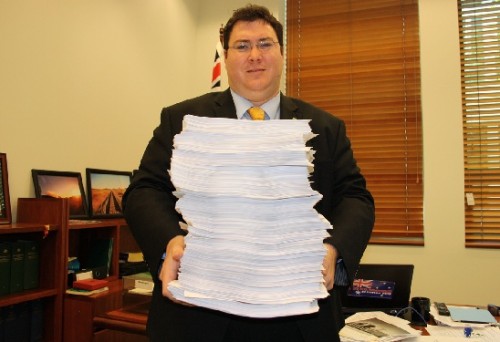
Submissions ignored (image from Andrew Bolt)

The Dissenting Report of the Joint Select Committee into the Clean Energy Bills makes very interesting reading, and shows evidence of a concerted attempt to suppress or exclude dissent from the debate, based on a subjective test of “relevance”.

It appears that many submissions were intentionally classified as “mere correspondence” in order to avoid their publication, and obviate the need for the Committee to have regard to their content.

In this report of Coalition Members and Senators we have included the comments of hundreds of Australians – not just those few who appeared before the committee in its select few days of hearings in south-eastern Australia, or those professional organisations who made detailed submissions, but also many comments from the more than 4,500 people who made submissions to this inquiry, which the Labor-Greens-Independent majority refused to have published.

To the thousands of people who feel like Noel Bowman, who stated in his submission that ‘I suppose no one will ever read this submission and in consequence I am wasting my time’, the Coalition members say we have tried to give you a voice. We could not quote or reference everybody, but in contrast to Labor’s determination to shut people out of this process we were even more determined to ensure that as many voices as possible from across Australia were heard. (page 129)

This Joint Select Committee – dominated by the Labor and Greens proponents of the legislation into which it is inquiring – allowed just a week for the committee to receive submissions, determining at its first meeting on Thursday 15 September that it would advertise for the first time on Saturday 17 September 2011 but with a closing date for submissions of Thursday 22 September 2011.

Hearings for this inquiry were scheduled in the week following the closing date of submissions, which did not allow the committee to properly consider the more than 4,500 submissions it received. In fact, the Labor-Greens dominated committee opted not to accept the vast majority of submissions and merely received them as ‘correspondence’, despite unsuccessful Coalition attempts to extend both the deadline for making submissions and the time allowed for the committee to report.

This volume of correspondence demonstrates the level of engagement and the depth of feeling Australians have in relation to the Government’s policy approach on this issue, but which Labor and the Greens have effectively sought to silence as far as this inquiry is concerned. (page 253)

On what grounds, therefore, did the committee exclude such a vast amount of correspondence? Let’s look at the requirements for submissions, from the Committees web site:

  • There is no prescribed form for a submission to a parliamentary committee. Submissions may be in the form of a letter, a short document or a substantial paper. They may include appendices and other supporting documents.
  • Submissions should be prepared solely for the inquiry and should be relevant to the terms of reference. They may address all or a selection of the points outlined in the terms of reference. Submissions may contain facts, opinions, arguments and recommendations for action.
  • It is helpful if submissions are prefaced by a brief summary of the main points.
  • Supplementary submissions may be lodged during the course of an inquiry to provide additional information or comments on other evidence.

Nothing particularly challenging there. The Clean Energy Committee had no specific terms of reference (see here), so that removes one hurdle. Let’s have a look at the checklist:

Before lodging your submission you may find it helpful to consider the following checklist:

  •  Have I commented on some or all of the terms of reference? [There were none for this inquiry – Ed]
  • Have I provided a summary of the submission at the front (for lengthy submissions)?
  • Have I provided my return address and contact details with the submission?
  • If the submission contains confidential information, have I made this clear at the front?
  • Have I provided an electronic version of the submission (if possible)?

There is nothing there which would permit the Committee to exclude 4,500 submissions as mere correspondence. An email with a return address should be sufficient for it to be accepted as a submission.

But here is the Committee’s explanation – and it is based on the wholly subjective test of “relevance”:

A large amount of correspondence was received by the committee. These items were not received as submissions to the inquiry because they did not address the actual legislation being considered. The correspondence was read and noted. The majority of the correspondence questioned the following issues:

  • The legitimacy of the science behind climate change and whether it is due to human action;
  • The legitimacy of the government to introduce the legislation;
  • The impact of the carbon ‘tax’ on individuals and the economy; and
  • Why should Australia go it alone on introducing measures to reduce carbon pollution putting us at a claimed competitive disadvantage? (Introduction, p12, here – PDF)

The next paragraph quotes the Chief Scientist, Ian Chubb, at the Inquiry hearings (see here for more of Chubb’s nonsense at that hearing) as if this somehow justifies their relevance test:

The latest information I have seen shows that the CO2 levels are high and that the rate of accumulation is accelerating. The scientists who study this would argue that it is getting to the point where something has to be done quickly in order to cap them at least and start to have them decrease over a sensible period of time. You could easily argue that it is urgent and that something needs to be done because of the high level presently and the accelerating accumulation presently (sic). We do need to do something.

Well that clinches it for me…!

It is almost beyond comprehension that the Committee felt that those four issues “did not address the actual legislation being considered.” They may not be relevant for considering individual sections of the Bills, but those four key issues go straight to the heart of whether the legislation is prudent, or even necessary at all! Is the Committee expecting us to believe that questions of prudence or necessity are outside its scope? Laughable.

Remember, there were NO terms of reference for this Inquiry, so the Committee should not have been able to exclude correspondence on the grounds of relevance. Even if there were terms of reference, issues raised in correspondence are clearly relevant to the matter being considered.

I have to keep reminding myself that this is Australia and not the former Soviet Union. Is this where we are at, in 2011, where the genuine concerns of the public, in a formal parliamentary committee, are simply ignored?

The Dissenting Report is here (PDF).

Quote of the Day: Tony Abbott


Australia's only hope

Something to make you smile. Go TA!

“We will repeal this tax, we will dismantle the bureaucracy associated with it.

“I am giving you the most definite commitment any politician can give that this tax will go. This is a pledge in blood this tax will go.

“If the bills pass today this will be an act of betrayal on the Australian public. We will repeal the tax, we can repeal the tax, we must repeal the tax.” (source)

Labor's great betrayal


So the carbon tax bills are expected to pass through the Lower House today [UPDATE: The Bills passed the lower house at around 9.30am AEST]. In a strange kind of way, I am glad, because it demonstrates to the electorate clearly what principles Labor stands for. None – apart from its own survival.

If any Labor MPs had shown even a trace of any backbone and stood up for the democratic rights of the Australian people by voting against the Bills, it may have lifted Labor’s support in the polls, and made people reconsider Labor’s principles and values. As it is, however, they act true to form, like a bunch of gutless lemmings, more concerned with keeping their own jobs than respecting the wishes of the electorate.

Julia Gillard’s pre-election promise not to introduce a carbon tax was swiftly forgotten when it became clear that the Greens’ support would have to be bought with a commitment to rapid action on climate change. And clearly, in the minds of Labor, buying support was more important than an explicit pre-election promise. Over the next few months, there was much talk of “consultation” with the public about the carbon tax, but in reality it was all a sham. All the inquiries and meetings were simply a pretence, because if they had genuinely listened to public opinion, they would have abandoned the tax.

And Labor have deluded themselves by believing that global action is just around the corner. Only blind Freddy (and Labor) think that – the evidence is clear that the chance of any global deal is retreating faster than an IPCC-fudged Himalayan glacier.

But nothing was going to stop Labor passing these bills and therefore, with the Green’s continuing support, staying in power.

Because that is all that matters to Labor – power. Forget the wishes of the Australian people or the “national interest” (funny isn’t it how Labor uses this term so frequently), what drives Labor is staying in power.

And as a final insult, demonstrating Labor’s contempt for the people it is supposed to represent, they hope that the electorate are stupid enough to “forget” this betrayal, and “get used” to the pointless carbon tax.

Well this voter will neither forget the betrayal, nor get used to the tax. It will be at the front of my mind when I enter the polling booth at the next election, and I hope it will be in yours as well.